Etiket: #Rosa damascena
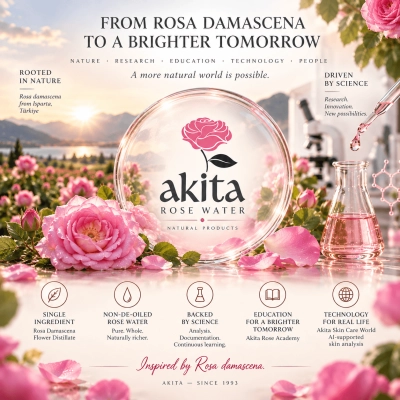
From Rosa damascena to the Future: Akita’s 2025–2026 Journey and Our Vision for 2027
From Non-De-Oiled Rose Water to scientific research, education and Akita Skin Care World: a new chapter in Akita’s journey
Some years represent more than growth for a company. They become periods of reflection—moments when a company looks beyond what it produces and asks deeper questions about what makes it different, what it has learned, and where it wants to go next.
For Akita, 2025 and 2026 have been such years.
Our journey began in 1993 and has been shaped by more than three decades of experience with natural products, botanical ingredients and skin care. At the heart of that journey has remained one remarkable flower:
Rosa damascena.
Over the years, our relationship with this flower has evolved from production into a much broader pursuit of knowledge. We have explored how it is cultivated and harvested, how distillation influences the resulting botanical distillate, how its composition can be studied, and how this knowledge can contribute to the development of natural skin care.
During 2025 and 2026, another dimension was added to this journey:
researching, measuring, documenting, educ...
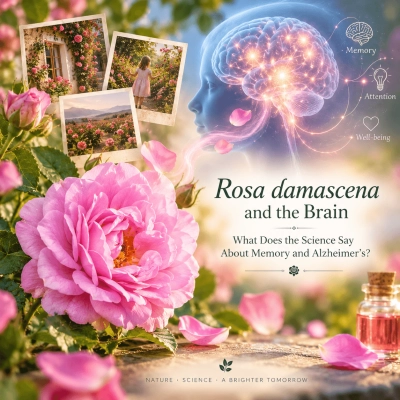
Alzheimer’s disease is usually associated with memory loss, but the scientific picture is much broader. Attention, language, mood, behaviour, orientation, decision-making and the ability to manage everyday activities can also be affected as cognitive decline progresses. This is why researchers studying plants such as Rosa damascena are interested in more than a single question about memory.
Damask rose has now been investigated from several scientific directions. A small controlled human study examined Rosa damascena extract in people with dementia. Experimental Alzheimer-related studies have investigated learning and long-term memory. More recent research has examined Rosa damascena essential oil in relation to the cholinergic system and BDNF—two areas of considerable interest in neuroscience.
Taken together, these studies raise an intriguing question:
Why does Rosa damascena continue to appear in research on cognitive decline, and what have scientists actually found?
This article looks specifically at Alzheimer’s disease, dementia and cognitive research. For the broader science of rose scent, memory, gray matter and olfactory research,...
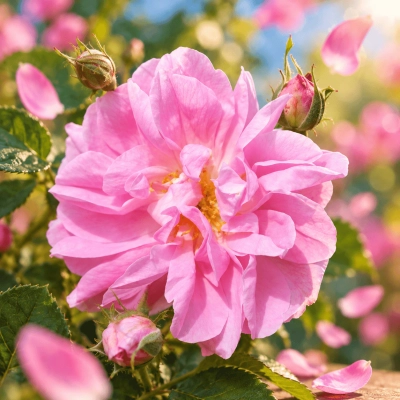
The value of a rose cannot be explained by its beauty or fragrance alone.
Every year, when the rose harvest begins in Isparta, Türkiye, work in the fields starts before the sun has fully risen. Pink blossoms are picked by hand and transported for processing as soon as possible.
The scientific name of this flower is Rosa damascena.
What makes this rose important is not simply its distinctive fragrance. Its growing environment, harvest timing, aromatic composition, suitability for distillation and long history of use in perfumery, cosmetics and traditional practices have made Rosa damascena one of the world's most important aromatic roses.
But what exactly is Rosa damascena? Is it the same as the Isparta rose? How is it different from other roses? Why are the flowers traditionally harvested early in the morning? And why is this particular rose so highly valued for rose oil and rose water production?
To understand the answers, we need to follow the Isparta rose from the field to the distillation process.
What Is Rosa damascena?
Rosa damascena is an aromatic rose belonging to the genus Rosa in the Rosaceae family. In English, it is commonly known as the Damask rose.
While man...
Search online for Rosa damascena essential oil, and it will not take long before you encounter statements such as:
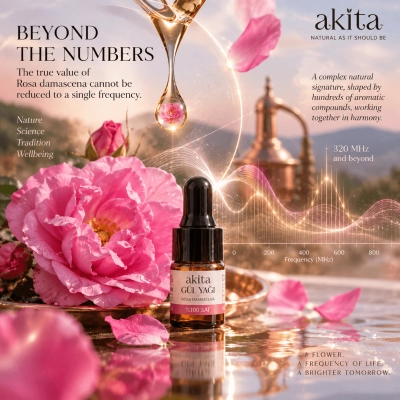
“Rose oil has the highest frequency of any essential oil.” “Rose oil vibrates at 320 MHz.” “It is one of the highest-vibrational natural substances.”
320 MHz.
It sounds remarkably precise.
But from a scientific perspective, that precision raises an important question:
How exactly is the frequency of a bottle of rose oil measured?
With what instrument?
What physical signal is being measured?
Under what conditions?
And why should the result be exactly 320 MHz?
Once we begin asking these questions, the story of rose oil becomes much more interesting.
Because we do not need an unverified number to explain why Rosa damascena is extraordinary.
First, What Does “Frequency” Actually Mean?
In physics, frequency describes how often a repeating event occurs within a given period of time. It is expressed in Hertz (Hz).
Sound waves have frequencies.
Electromagnetic signals have frequencies.
Radio transmissions have frequencies.
Light has electromagnetic frequencies.
But there is an important distinction:
Whenever scientists measure frequency, the...
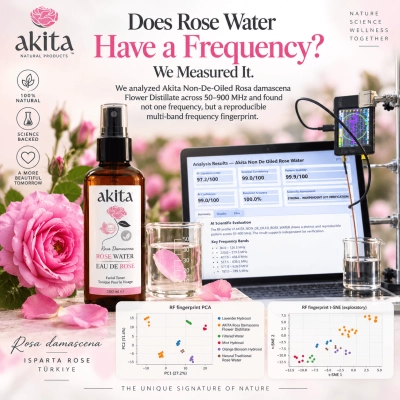
Have you ever wondered, “What is the frequency of rose water?”
If you search online for rose oil and frequency, you will often come across the number 320 MHz. There is, however, an important distinction: this widely circulated claim has been associated with Rosa damascena flower oil, not rose water.
That raised another question for us.
What happens when the naturally carried oil fraction is not separated from the rose distillate? Does Akita Non-De-Oiled Rose Water show one particular frequency when measured?
We decided to investigate.
The result was more interesting than a single number:
We did not find one frequency. We found a reproducible frequency fingerprint.
In Akita's study, Non-De-Oiled Rosa damascena Flower Distillate was examined across 50–900 MHz. The study did not find one isolated characteristic peak at 320 MHz. Instead, discriminative information appeared across multiple frequency regions, producing a reproducible multi-band measurement profile that separated from the other liquids tested in the dataset.
First, an Important Difference: Rose Oil and Rose Water Are Not the Same
When rose flowers are distilled, volatile compounds are carried with the stea...
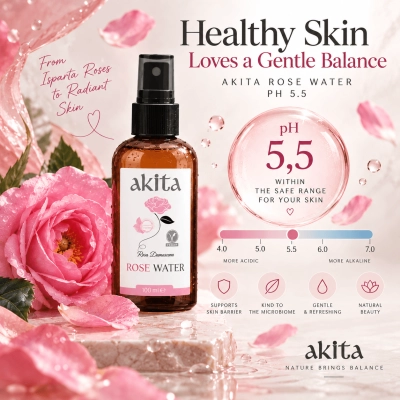
Why Does Your Skin’s pH Matter? Is 5.5 Really the Magic Number?
Your skin naturally has a slightly acidic surface. But what does that mean for your skin barrier, microbiome, and the products you use every day? Science shows that skin pH is much more interesting than a single number.
You may have seen the words “pH-balanced” on a facial cleanser, toner, or moisturizer. You may also have heard that the ideal pH for skin is 5.5.
But why 5.5?
And is everyone’s skin really pH 5.5 all the time?
The answer is more interesting than you might expect.
Your skin has a naturally slightly acidic environment at its surface. Scientists have studied this environment for decades because skin pH is closely connected with the skin barrier, the microorganisms that live on our skin, and some of the biological processes that help the skin function normally.
First, What Is pH?
pH is a way of describing how acidic or alkaline something is.
The scale generally runs from 0 to 14:
7 is neutral
Below 7 is acidic
Above 7 is alkaline
Pure water is close to neutral.
Healthy skin, however, is generally not neutral.
Its surface is naturally slightly acidic.
And that is where things become...
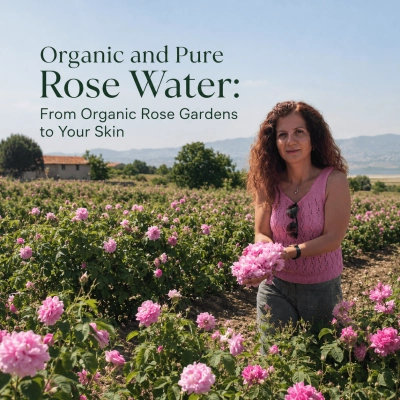
Organic and Pure Rose Water: From Akita’s Organic Rose Gardens to Your Skin
What makes rose water truly organic and pure?
“Organic rose water” and “pure rose water” are often used as if they mean the same thing. In fact, they describe two different qualities.
Organic refers mainly to how the roses are grown and how the agricultural process is managed.
Pure refers to what is inside the finished bottle.
A rose water may be produced from organically grown roses but still contain added fragrance, preservatives or other ingredients. Conversely, a product may contain only rose distillate without holding an organic certification.
This is why Canadian consumers should look beyond the words printed on the front of the bottle. The rose species, growing conditions, production method, ingredient list and supporting documents all matter.
Akita Non-De-Oiled Rose Water brings these elements together: Rosa damascena flowers grown in Akita’s organic rose gardens are distilled without separating the naturally occurring rose oil from the water. The finished product contains a single cosmetic ingredient:
INCI: Rosa Damascena Flower Distillate
What does “organic rose water” mean?
Or...
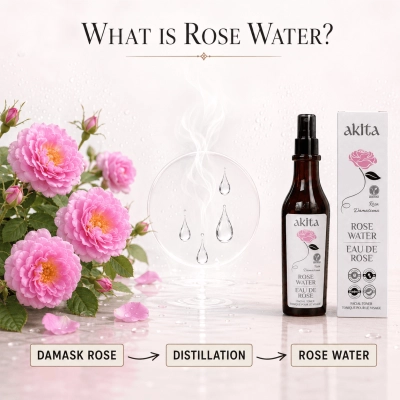
A complete guide to real rose water, rose hydrosol and Rosa damascena flower distillate
Rose water is often described simply as water that smells like roses. That description, however, leaves out what makes traditionally distilled rose water so distinctive.
Authentic rose water is an aromatic distillate produced from rose flowers—most commonly the Damask rose, Rosa damascena. During distillation, heat releases volatile and water-soluble compounds from the petals. These compounds travel with the steam, which is then cooled and collected as a clear, fragrant liquid.
The result is more than rose-scented water. It is a plant distillate whose aroma, composition and quality depend on the rose variety, growing region, harvest conditions, distillation method and whether the rose oil is separated afterward.
This distinction matters because products sold as “rose water” in Canada can be very different from one another.
What exactly is rose water?
In its traditional sense, rose water is the water-based aromatic portion collected during the distillation of fresh rose flowers.
A scientific description would be:
Rose water is a liquid distillate containing wa...
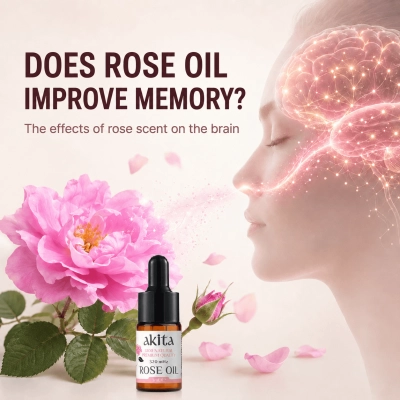
What does science tell us about Rosa damascena, rose essential oil, memory, gray matter, and the brain?
Could something as simple as the scent of a rose be associated with measurable changes in the brain?
It sounds surprising, but scientists have begun asking exactly this kind of question.
In recent years, researchers have studied Rosa damascena—the Damask rose famously cultivated in Isparta, Türkiye—and rose essential oil to better understand their possible relationship with the brain, learning, and memory.
One recent human study produced a particularly interesting finding: after one month of continuous exposure to a designated rose scent, researchers detected changes in gray matter volume using MRI brain scans.
Other studies involving Rosa damascena extract and rose essential oil have explored memory, BDNF, neurogenesis, and the systems nerve cells use to communicate.
So, does this mean smelling roses improves your memory?
Not yet.
The science is promising, but there is an important difference between discovering a change in the brain and proving that something improves memory. Here is what researchers have actually found.
🌹 One Month of...
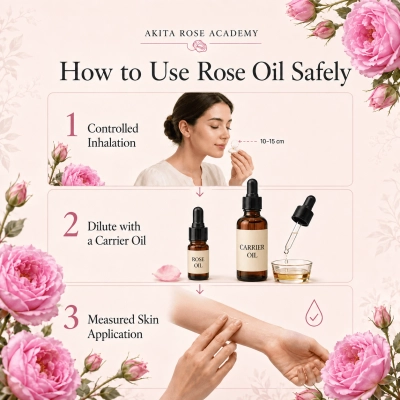
Safe inhalation and skincare methods for Rosa damascena essential oil
If you are wondering how rose oil is used, controlled inhalation is one of the most common methods reported in scientific studies. Researchers have typically placed a small amount of rose oil on cotton or cloth and asked participants to inhale its aroma for a specified period without applying the oil inside the nose. In topical studies, rose oil has generally been diluted in a carrier oil before being applied to the skin.
For everyday use, pure rose essential oil should not be applied directly to the skin, around the eyes, or inside the mouth. For inhalation, you may place one drop on a cotton pad or aroma inhaler and smell it briefly from a distance. For topical use, it should be diluted to a low concentration in a suitable carrier oil.
When choosing rose oil, look for products that clearly state their ingredients and intended use. You can review Akita Golden Rose Oil 1 mL for product information. You may also explore Akita’s carrier oil options.
How has rose oil been used in scientific studies?
In human studies involving rose oil, the method of application has varied according to the purpose of the resea...