Etiket: #Frequency Fingerprint
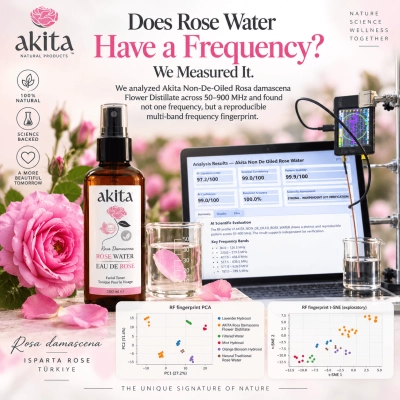
Have you ever wondered, “What is the frequency of rose water?”
If you search online for rose oil and frequency, you will often come across the number 320 MHz. There is, however, an important distinction: this widely circulated claim has been associated with Rosa damascena flower oil, not rose water.
That raised another question for us.
What happens when the naturally carried oil fraction is not separated from the rose distillate? Does Akita Non-De-Oiled Rose Water show one particular frequency when measured?
We decided to investigate.
The result was more interesting than a single number:
We did not find one frequency. We found a reproducible frequency fingerprint.
In Akita's study, Non-De-Oiled Rosa damascena Flower Distillate was examined across 50–900 MHz. The study did not find one isolated characteristic peak at 320 MHz. Instead, discriminative information appeared across multiple frequency regions, producing a reproducible multi-band measurement profile that separated from the other liquids tested in the dataset.
First, an Important Difference: Rose Oil and Rose Water Are Not the Same
When rose flowers are distilled, volatile compounds are carried with the stea...
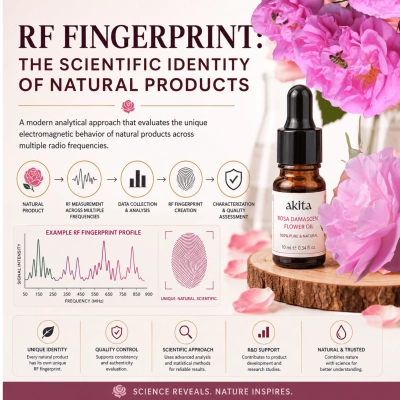
What Is RF Fingerprint?
Understanding the Scientific Identity of Natural Products Through Multi-Frequency Analysis
Could Natural Products Have Their Own Fingerprints?
Imagine arriving at an airport.
Instead of showing your passport, you simply place your finger on a scanner. Within seconds, the system recognizes you—not because of your name, your photograph, or your nationality, but because your fingerprint is unlike anyone else's.
A fingerprint is more than just a pattern. It is a unique identifier.
Now imagine applying the same idea to nature.
Could a bottle of Rosa damascena flower oil, a lavender essential oil, or a botanical distillate also possess a unique identity?
Not a fingerprint made of ridges and lines, of course, but a distinctive scientific profile that reflects how the material behaves under carefully controlled laboratory conditions.
This question has become increasingly relevant as analytical technologies continue to evolve.
For decades, researchers have relied on chemical analysis to understand natural products. Techniques such as Gas Chromatography–Mass Spectrometry (GC-MS) have made it possible to identify hundreds...