Etiket: #320MHz
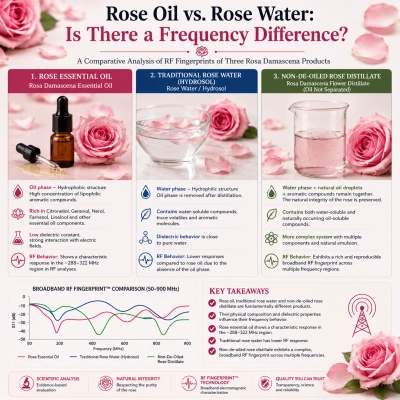
Rose Oil vs. Rose Water: Is There a Frequency Difference?
Why AKITA's Non-De-Oiled Rosa Damascena Flower Distillate May Exhibit a Richer RF Fingerprint Than Rose Essential Oil
Key Takeaway
For decades, the discussion has focused on the reported 320 MHz frequency of Rosa damascena essential oil. Almost nobody asked whether rose water itself has a measurable RF fingerprint. Our research began with that simple question—and the answer surprised even us.
Introduction
If you search online for the phrase "rose oil frequency," you will quickly encounter one familiar number:
320 MHz.
Whether this value is interpreted literally or symbolically, it has long been associated with Rosa damascena essential oil.
However, this raises an interesting question.
If rose essential oil has been discussed for decades from a frequency perspective, what about rose water?
Surprisingly, almost no one has explored this question scientifically.
Even more intriguing is another possibility:
What happens when the natural rose oil is never removed from the distillate?
Until we began our RF Fingerprint™ research,...

What Is RF Fingerprint?
Understanding the Scientific Identity of Natural Products Through Multi-Frequency Analysis
Could Natural Products Have Their Own Fingerprints?
Imagine arriving at an airport.
Instead of showing your passport, you simply place your finger on a scanner. Within seconds, the system recognizes you—not because of your name, your photograph, or your nationality, but because your fingerprint is unlike anyone else's.
A fingerprint is more than just a pattern. It is a unique identifier.
Now imagine applying the same idea to nature.
Could a bottle of Rosa damascena flower oil, a lavender essential oil, or a botanical distillate also possess a unique identity?
Not a fingerprint made of ridges and lines, of course, but a distinctive scientific profile that reflects how the material behaves under carefully controlled laboratory conditions.
This question has become increasingly relevant as analytical technologies continue to evolve.
For decades, researchers have relied on chemical analysis to understand natural products. Techniques such as Gas Chromatography–Mass Spectrometry (GC-MS) have made it possible to identify hundreds...
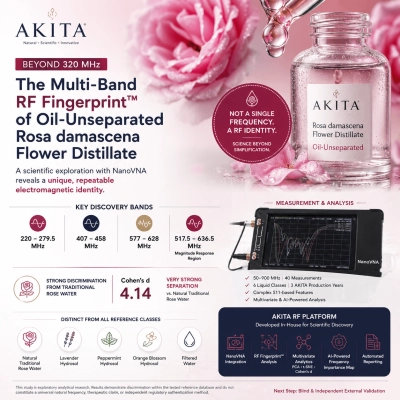
From the 320 MHz Hypothesis to a Multi-Band RF Fingerprint: New Findings from the AKITA Rosa Damascena Flower Oil Study
Broadband S11 analysis reveals that AKITA Rosa Damascena Flower Oil exhibits a reproducible multi-band RF fingerprint spanning 288–322 MHz, providing a broader scientific perspective beyond the traditionally referenced 320 MHz frequency.
Scientific knowledge advances through observation, measurement, and refinement. As new data become available, existing hypotheses are revisited, expanded, and strengthened.
Our latest broadband RF (Radio Frequency) investigation of AKITA Rosa Damascena Flower Oil follows this scientific principle. Rather than focusing on a single frequency, the study explores the product's electromagnetic behavior across a wide frequency spectrum using standardized S11 measurements.
The findings suggest that the electromagnetic identity of AKITA Rosa Damascena Flower Oil is better represented by a multi-band RF fingerprint than by a single natural frequency.
Why Revisit the 320 MHz Hypothesis?
For many years, 320 MHz has frequently been associated with Rosa Damascena essential oil in various publications and discussions.
While this refere...