Beyond 320 MHz: The Multi-Band RF Fingerprint of AKITA Rosa Damascena Flower Oil
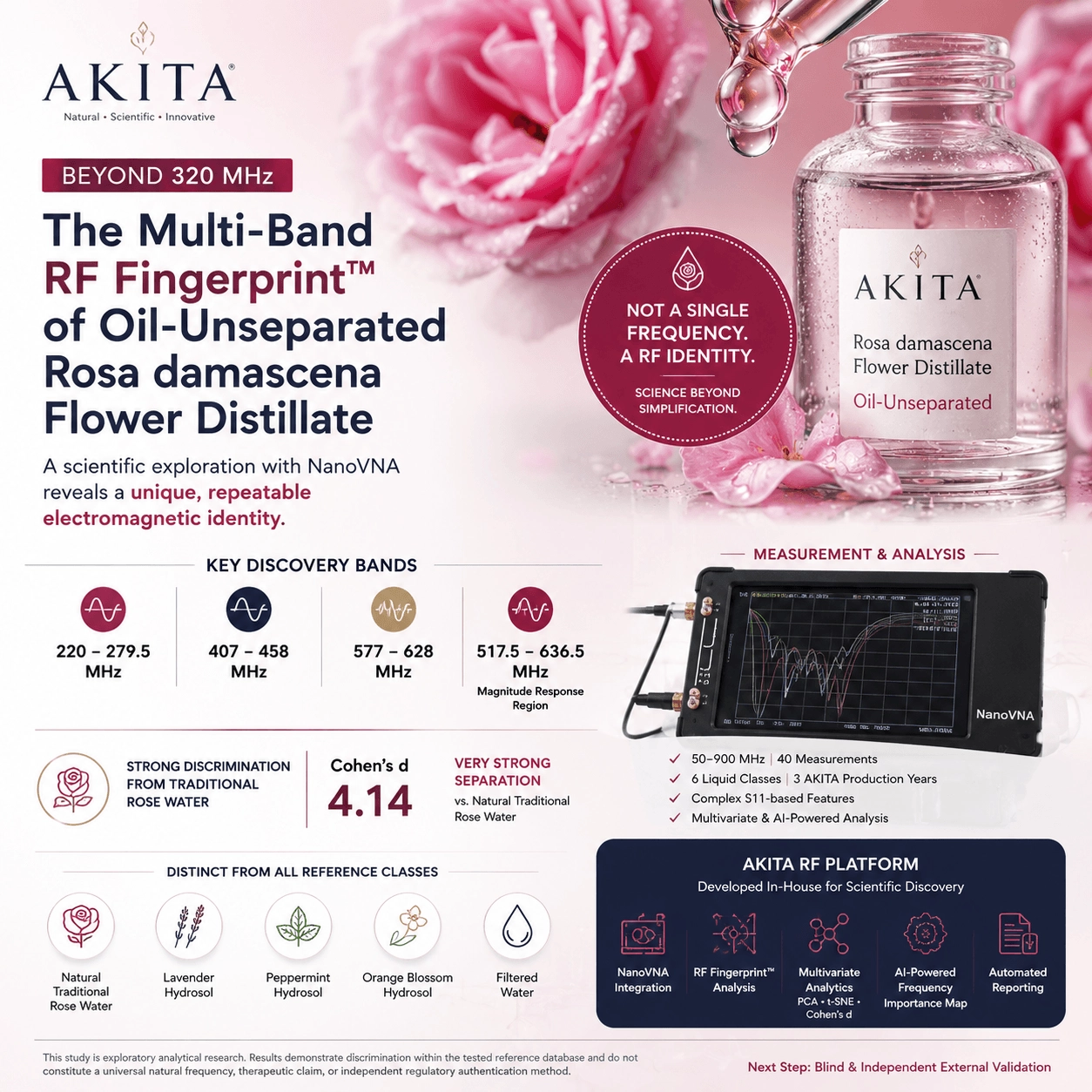
From the 320 MHz Hypothesis to a Multi-Band RF Fingerprint: New Findings from the AKITA Rosa Damascena Flower Oil Study
Broadband S11 analysis reveals that AKITA Rosa Damascena Flower Oil exhibits a reproducible multi-band RF fingerprint spanning 288–322 MHz, providing a broader scientific perspective beyond the traditionally referenced 320 MHz frequency.
Scientific knowledge advances through observation, measurement, and refinement. As new data become available, existing hypotheses are revisited, expanded, and strengthened.
Our latest broadband RF (Radio Frequency) investigation of AKITA Rosa Damascena Flower Oil follows this scientific principle. Rather than focusing on a single frequency, the study explores the product's electromagnetic behavior across a wide frequency spectrum using standardized S11 measurements.
The findings suggest that the electromagnetic identity of AKITA Rosa Damascena Flower Oil is better represented by a multi-band RF fingerprint than by a single natural frequency.
Why Revisit the 320 MHz Hypothesis?
For many years, 320 MHz has frequently been associated with Rosa Damascena essential oil in various publications and discussions.
While this reference has attracted considerable interest, modern broadband RF analysis allows a much more comprehensive evaluation than focusing on a single frequency.
Instead of asking whether one specific frequency exists, the present study investigates whether the oil demonstrates a reproducible electromagnetic signature across a broader RF region.
The results indicate that it does.
📦 Key Finding
Broadband S11 measurements identified a reproducible discriminatory RF region approximately between:
288–322 MHz
Importantly,
the historically referenced 320 MHz point lies within this characteristic RF region.
Therefore, the study does not reject the traditional 320 MHz hypothesis.
Instead, it demonstrates that:
320 MHz is one important point within a broader electromagnetic fingerprint rather than the complete RF identity of the material.
Research Design
Reliable scientific conclusions require more than a single measurement.
To improve reproducibility and statistical confidence, the study included:
✅ Approximately four independent production batches
✅ Twenty targeted RF measurements
✅ Broadband S11 characterization
✅ Multivariate statistical analysis
AKITA Rosa Damascena Flower Oil was compared with several botanical oils, including:
- Lavender Oil
- Peppermint Oil
- Jojoba Oil
- Olive Oil
- Rosemary Oil
- Tea Tree Oil
- Violet Oil
This comparative approach enabled evaluation of whether the observed RF behavior was unique to the rose oil.
📦 Statistical Evidence
Within the primary RF signature region, the calculated effect sizes (Cohen's d) demonstrated strong separation between AKITA Rosa Damascena Flower Oil and the comparison oils.
| Comparison Oil | Cohen's d |
|---|---|
| Lavender Oil | 6.74 |
| Peppermint Oil | 4.96 |
| Jojoba Oil | 4.05 |
| Violet Oil | 3.78 |
| Rosemary Oil | 3.28 |
| Tea Tree Oil | 3.00 |
| Olive Oil | 1.54 |
These values indicate strong to extremely strong statistical discrimination within the analyzed RF region.
Even olive oil, which exhibited the smallest effect size, remained clearly distinguishable.
📦 RF Fingerprint Stability
Reproducibility is essential for any physical characterization method.
The calculated RF fingerprint stability reached:
99.9 / 100
This exceptionally high value indicates that the observed RF signature remained highly consistent across repeated measurements and different production batches.
What Is an RF Fingerprint?
Just as every individual has a unique fingerprint, physical materials may exhibit characteristic electromagnetic responses when measured across a range of frequencies.
These responses are rarely defined by a single frequency.
Instead, they are more accurately represented by a combination of reproducible spectral features.
This collection of characteristic responses is referred to as an RF fingerprint.
The present study indicates that AKITA Rosa Damascena Flower Oil possesses such a reproducible electromagnetic fingerprint.
📦 What Does This Mean for the 320 MHz Hypothesis?
One of the most significant outcomes of the study is that the original hypothesis has been refined rather than dismissed.
The data demonstrate that:
- 320 MHz remains an important point within the characteristic RF region.
- However, it should no longer be interpreted as the product's sole defining frequency.
- The electromagnetic identity is more accurately described as a multi-band RF fingerprint spanning approximately 288–322 MHz.
This represents a more comprehensive scientific model for describing the RF characteristics of this natural botanical product.
Science Evolves Through Better Evidence
Scientific progress is built on continuously improving models rather than defending fixed assumptions.
As measurement techniques become more advanced and datasets become larger, researchers gain a deeper understanding of natural materials.
This study represents one step toward a more comprehensive physical characterization of botanical products using broadband RF analysis.
📦 Why Does This Matter?
Understanding the reproducible physical characteristics of natural materials may contribute to future research in:
- Electromagnetic material characterization
- Natural product authentication
- Quality assessment
- Comparative botanical analysis
- Non-destructive analytical methods
While additional research is needed, reproducible RF fingerprinting may become an important complementary analytical tool in the study of complex natural products.
Conclusion
Based on the current evidence, the most accurate conclusion is:
320 MHz is one important location within the electromagnetic fingerprint of AKITA Rosa Damascena Flower Oil, but it does not represent the complete fingerprint. The product is more appropriately characterized by a reproducible multi-band RF signature spanning approximately 288–322 MHz.
The study demonstrates how broader frequency analysis can provide a more complete understanding of the physical electromagnetic behavior of natural botanical materials.
As research continues, multi-band RF fingerprinting may offer new opportunities for characterizing complex natural products with greater precision.
Frequently Asked Questions (FAQ)
Is the 320 MHz hypothesis incorrect?
No. The study confirms that 320 MHz lies within a characteristic RF region but shows that the complete electromagnetic identity extends across a broader frequency range.
What is an RF fingerprint?
An RF fingerprint is a reproducible electromagnetic response pattern measured across multiple frequencies, rather than a single frequency value.
How many samples were analyzed?
The study included approximately four independent production batches and twenty targeted RF measurements.
Which oils were used for comparison?
AKITA Rosa Damascena Flower Oil was compared with lavender, peppermint, jojoba, olive, rosemary, tea tree, and violet oils.
Does this study demonstrate biological or health effects?
No. This research investigates only the physical electromagnetic (RF) characteristics of the material. It does not establish biological activity, therapeutic effects, or health benefits.
🌹 Final Thoughts
At AKITA, we believe that natural products deserve to be explored using rigorous, reproducible scientific methods.
Every new measurement helps us better understand the remarkable complexity of nature. As analytical technologies evolve, so does our understanding of the physical characteristics of botanical materials, and this study represents another step in that ongoing scientific journey.
Comment