Is Rose Oil Really 320 MHz? What New Scientific Research Reveals
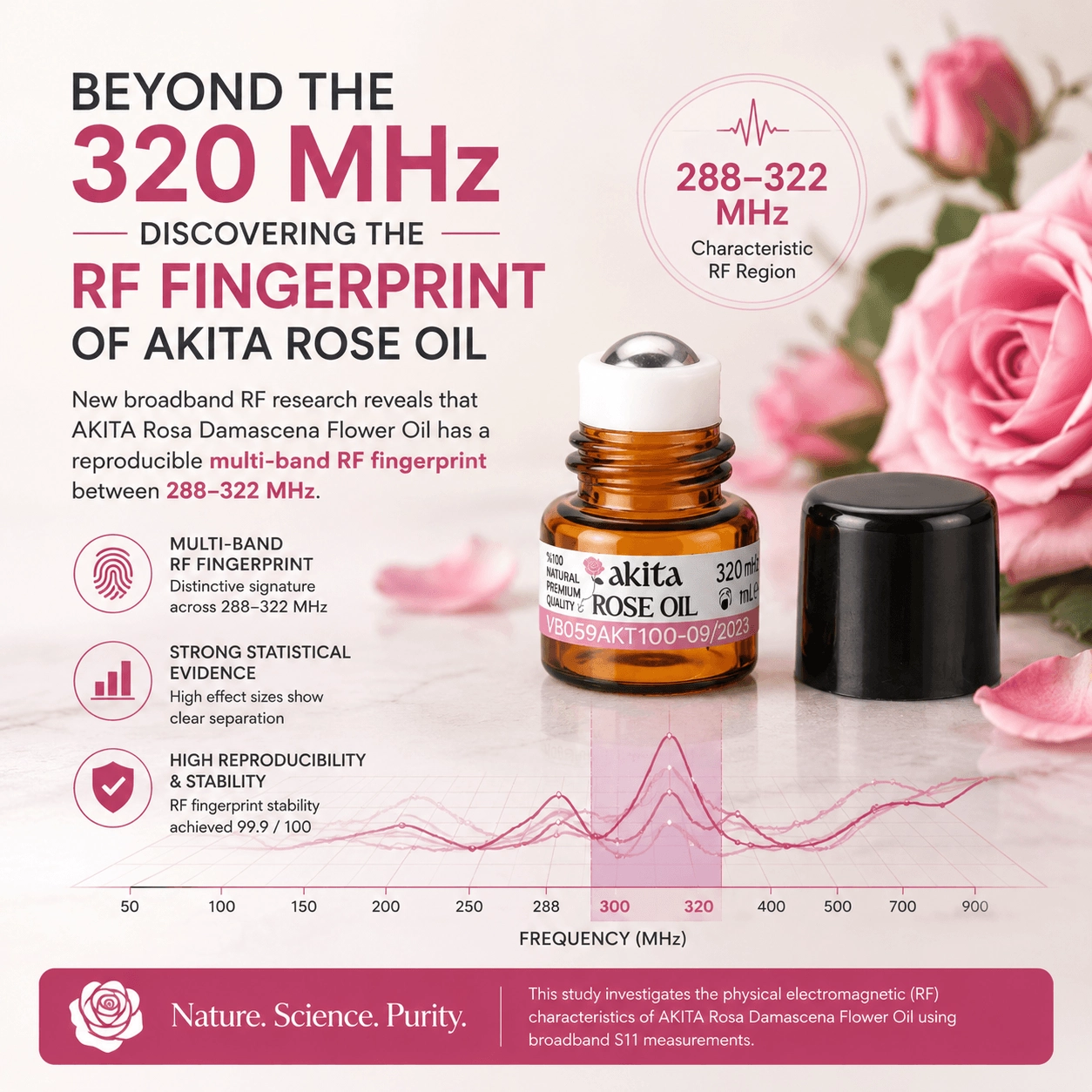
Is Rose Oil Really 320 MHz? What New Scientific Research Reveals
Beyond the 320 MHz Claim: A New Perspective on the RF Fingerprint of Rosa damascena Flower Distillate
For many years, one statement has been widely shared across aromatherapy and natural wellness communities:
"Rose vibrates at 320 MHz."
This claim has become one of the most frequently repeated facts about Rosa damascena, often presented as evidence of the flower's unique energetic properties.
But where did this number come from? Does it apply to all rose-based products, including rose water? And what happens when modern radio-frequency (RF) analysis is used to investigate this long-standing claim?
A recent exploratory study offers a different perspective. Rather than identifying a single dominant frequency, researchers observed that a non-de-oiled Rosa damascena flower distillate exhibited a reproducible multi-band RF fingerprint across a broad frequency range.
Where Did the 320 MHz Claim Originate?
An important distinction is often overlooked.
Historically, the widely quoted 320 MHz value has generally been associated with Rosa Damascena Flower Oil, the essential oil obtained during steam distillation.
It was not originally proposed for conventional rose water.
Traditional rose water is produced after the essential oil has been physically separated from the distilled liquid, leaving primarily the aqueous phase known as a hydrosol.
Understanding this distinction is essential when evaluating claims about the electromagnetic properties of rose-derived products.
What Happens When the Rose Oil Is Not Removed?
During steam distillation, aromatic compounds naturally distribute between the oil phase and the water phase.
AKITA developed a different production approach called Non-De-Oiled Rosa damascena Flower Distillate, in which the naturally carried rose-oil fraction remains within the distillate instead of being separated.
This raises an interesting scientific question:
Does a non-de-oiled rose distillate behave as a single-frequency material near 320 MHz, or does it exhibit a broader electromagnetic signature?
How Was the Study Conducted?
To explore this question, researchers performed a comprehensive radio-frequency analysis.
The experimental design included:
- RF scanning from 50 to 900 MHz
- 40 individual measurements
- Six different liquid classes
- Samples from three AKITA production years
- Standardized sample containers and probe geometry
- Analysis of complex S11-derived RF variables
- Statistical evaluation using PCA, t-SNE, effect-size analysis, and machine-learning exploration
Rather than searching for one specific frequency, the study evaluated the complete electromagnetic behavior of each sample across hundreds of frequencies.
The Result: No Single Frequency Was Found
One of the study's most interesting findings was that researchers did not observe one isolated peak at 320 MHz.
Instead, several reproducible frequency regions contributed to the material's RF behavior.
Some of the strongest exploratory regions included:
| RF Feature | Frequency Range |
|---|---|
| gamma_imag | 220–279.5 MHz |
| gamma_real | 407–458 MHz |
| gamma_imag | 577–628 MHz |
| Magnitude Response | 517.5–636.5 MHz |
These findings suggest that the electromagnetic behavior of the tested distillate is better described by multiple characteristic frequency regions rather than a single numerical value.
What Is an RF Fingerprint?
The researchers describe this concept as an RF Fingerprint.
Think of it like a human fingerprint.
A fingerprint is not defined by one single line.
Instead, it is created by hundreds of unique patterns that together identify an individual.
Similarly, a material's electromagnetic behavior may not be represented by one frequency alone.
Instead, multiple frequency-dependent characteristics combine to create a distinctive RF identity.
This represents one of the central concepts emerging from the study.
Could It Be Distinguished from Traditional Rose Water?
Within the reference dataset, the tested AKITA Rosa damascena Flower Distillate was distinguishable from:
- Traditional Natural Rose Water
- Lavender Hydrosol
- Mint Hydrosol
- Orange Blossom Hydrosol
- Filtered Water
The primary-band comparison with Traditional Natural Rose Water produced a Cohen's d value of 4.14, indicating a very strong statistical separation within the current dataset.
These findings apply specifically to the samples included in this exploratory study and will require additional independent validation.
What Does This Research Not Claim?
Scientific findings are best understood within their proper limits.
This study does not:
- prove that roses possess one universal "natural frequency,"
- assign specific frequency bands to individual molecules,
- demonstrate therapeutic or biological effects,
- replace established regulatory or analytical testing.
Instead, the study demonstrates that the tested non-de-oiled rose distillate exhibited a reproducible RF profile that differed from the comparison liquids under the experimental conditions.
Why Could This Matter in the Future?
If future independent studies confirm these observations, RF fingerprinting may eventually contribute to:
- product characterization,
- production consistency monitoring,
- batch-to-batch comparison,
- production-year analysis,
- aging and maturation studies,
- authenticity screening of botanical distillates.
At present, these applications remain promising research directions rather than established industrial standards.
Conclusion
For decades, discussions about Rosa damascena have often centered around a single number: 320 MHz.
This new exploratory research suggests a broader perspective.
Rather than behaving as a material defined by one isolated frequency, Non-De-Oiled Rosa damascena Flower Distillate may exhibit a reproducible multi-band RF fingerprint, a unique electromagnetic identity formed by multiple frequency regions working together.
Perhaps the future of botanical characterization will rely less on one number and more on understanding the complete electromagnetic profile of natural materials.
Frequently Asked Questions (FAQ)
Is 320 MHz scientifically proven for rose oil?
The 320 MHz claim has historically been associated with Rosa damascena essential oil rather than conventional rose water. Current exploratory RF research suggests a more complex electromagnetic behavior than a single dominant frequency.
What is an RF Fingerprint?
An RF Fingerprint is the unique combination of electromagnetic characteristics observed across multiple frequency bands, rather than one isolated frequency.
Did this study identify one natural frequency?
No. The study found reproducible patterns across several frequency regions instead of one dominant frequency.
Does this research prove health benefits?
No. The study focuses on RF characterization only. It does not evaluate therapeutic, medical, or biological effects.
Could RF fingerprinting become a quality-control tool?
Potentially. Future research may determine whether RF fingerprinting can support authenticity testing, batch comparison, production monitoring, and botanical product characterization.
Learn More
This article summarizes key concepts from the exploratory research:
"Beyond 320 MHz: From the Rose Oil Claim to the Multi-Band RF Fingerprint of Non-De-Oiled Rosa damascena Flower Distillate."
For readers interested in the experimental methods, RF measurement techniques, statistical analyses, and the complete scientific discussion, the full research article provides a detailed overview of the study and its findings.
Comment (1)
While preparing this article, our goal was not to confirm or reject a long-standing claim, but to re-examine it using modern analytical methods. Our initial findings suggest that Non-De-Oiled Rosa damascena Flower Distillate may exhibit a reproducible multi-band RF behavior rather than a single dominant frequency. As an exploratory study, these observations require validation through larger datasets and independent research. One of the most exciting aspects of science is its ability to challenge assumptions and encourage better questions. I hope this work contributes to future research on the analytical characterization of botanical distillates. Ayse Kilic