Rosa damascena, Alzheimer’s and Dementia: What Have Scientists Found?
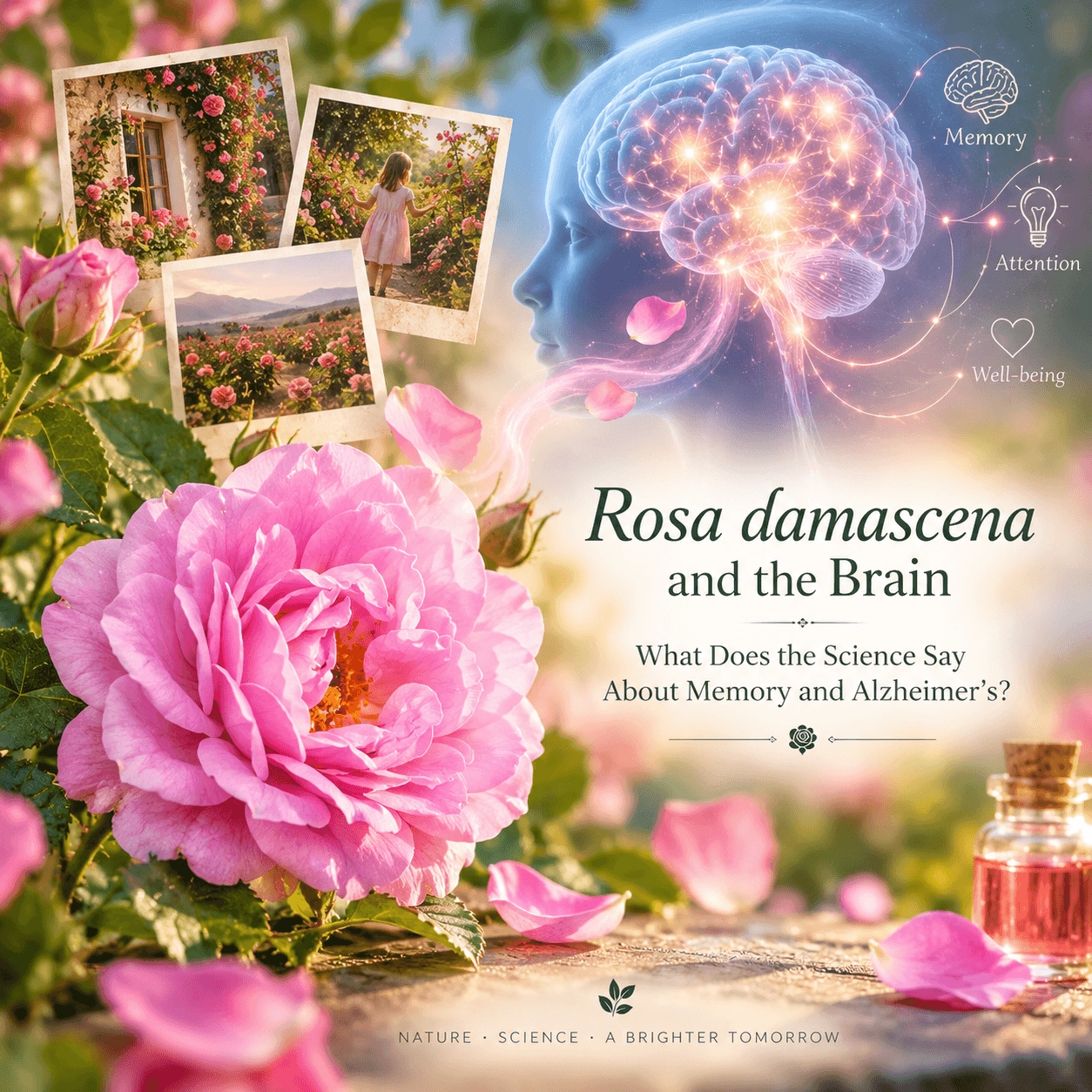
Alzheimer’s disease is usually associated with memory loss, but the scientific picture is much broader. Attention, language, mood, behaviour, orientation, decision-making and the ability to manage everyday activities can also be affected as cognitive decline progresses. This is why researchers studying plants such as Rosa damascena are interested in more than a single question about memory.
Damask rose has now been investigated from several scientific directions. A small controlled human study examined Rosa damascena extract in people with dementia. Experimental Alzheimer-related studies have investigated learning and long-term memory. More recent research has examined Rosa damascena essential oil in relation to the cholinergic system and BDNF—two areas of considerable interest in neuroscience.
Taken together, these studies raise an intriguing question:
Why does Rosa damascena continue to appear in research on cognitive decline, and what have scientists actually found?
This article looks specifically at Alzheimer’s disease, dementia and cognitive research. For the broader science of rose scent, memory, gray matter and olfactory research, see our separate article, Rose Oil and Memory: How Rose Scent May Affect the Brain.
First, What Is the Difference Between Dementia and Alzheimer’s Disease?
The words Alzheimer’s and dementia are often used as though they mean exactly the same thing, but they do not.
Dementia is an umbrella term describing a decline in cognitive abilities significant enough to interfere with everyday functioning.
Alzheimer’s disease is a specific neurodegenerative disease and one of the major causes of dementia.
This distinction becomes particularly important when reading Rosa damascena research.
One human clinical study involved people with dementia, while other studies used experimental models designed to reproduce particular aspects associated with Alzheimer’s disease or memory impairment.
These different studies should not be treated as if they were one experiment. Instead, each provides a different piece of the scientific picture.
🌹 Has Rosa damascena Actually Been Studied in People with Dementia?
Yes.
One of the most interesting studies was published in the International Journal of Preventive Medicine in 2018.
It was a randomized, double-blind, placebo-controlled clinical trial involving 40 people over the age of 55 with dementia.
Both groups received donepezil.
The intervention group received:
donepezil + Rosa damascena extract capsules
while the control group received:
donepezil + placebo capsules.
Participants were evaluated at the beginning of the study, after one month and after three months.
This design makes the study particularly interesting because researchers were not simply asking participants whether they felt better.
They used established cognitive and behavioural assessments.
🧠 What Did Researchers Measure?
The study used several assessment tools.
The Mini-Mental State Examination (MMSE) was used to assess overall cognitive function.
Researchers also used the Addenbrooke’s Cognitive Examination-Revised (ACE-R), which evaluates several cognitive domains, including:
- attention and orientation,
- memory,
- verbal fluency,
- language,
- visuospatial abilities.
Depressive symptoms, behavioural problems and daily activities were also evaluated.
This matters because dementia is not simply a disorder of memory.
For patients and families, the ability to pay attention, communicate, manage daily activities and maintain emotional well-being can be just as meaningful.
What Did the Human Study Find?
After three months, researchers reported significant differences between the Rosa damascena and placebo groups in several outcomes.
For overall cognitive impairment measured by MMSE, the reported result was:
p = 0.002
For the total ACE-R cognitive assessment:
p = 0.001
Researchers also reported significant findings for:
depressive symptoms: p = 0.012
behavioural problems: p < 0.001
daily activity: p < 0.001
These results make this study particularly valuable in the Rosa damascena literature.
It demonstrates that the relationship between Damask rose and cognition has moved beyond laboratory investigation and has also been explored in a controlled human clinical setting.
🎯 Why Is the Attention Finding Particularly Interesting?
When the individual components of cognitive function were examined, attention produced an especially interesting result.
Participants receiving Rosa damascena showed significant change in attention over time, while the control group did not show the same pattern.
The between-group effect for attention was reported as:
p = 0.030
Attention deserves more consideration than it often receives in discussions about ageing and cognition.
Before we can remember information, we generally need to notice it, process it and maintain enough attention to encode it.
Attention therefore sits near the beginning of the chain:
Attention → information processing → learning → memory
This makes the attention result one of the most interesting reasons for larger studies of Rosa damascena in older adults.
🧠 And What Happened to Memory?
Memory was also evaluated separately.
The Rosa damascena group showed significant change in memory scores over time, while the placebo group did not show the same pattern.
In the direct comparison between groups, the reported result was:
p = 0.06
This sits just above the commonly used statistical significance threshold of p<0.05.
Rather than making the result uninteresting, it creates an important research question.
A trial involving only 40 participants produced a signal close to the conventional significance threshold. A larger study specifically designed around memory could provide much more information.
That is precisely how scientific research develops: an interesting signal in a small study can become the basis for a better and larger experiment.
🌿 Behaviour and Everyday Life Matter Too
Perhaps one of the most overlooked aspects of the 2018 study is that researchers did not concentrate exclusively on memory scores.
They also reported significant differences involving behavioural problems and daily activities.
This is important when thinking about dementia.
For families living with cognitive decline, meaningful outcomes can include questions such as:
Can the person participate more comfortably in everyday routines?
Can they remain engaged with their surroundings?
How is their mood?
How are their behavioural symptoms?
How independently can they manage daily activities?
This broader perspective helps explain why future Rosa damascena research should examine cognitive function and quality of daily life together, rather than focusing on memory alone.
Why Is Donepezil Important to This Story?
There is another fascinating scientific detail in this study.
Both groups were taking donepezil.
Donepezil belongs to a class of medicines known as acetylcholinesterase inhibitors.
To understand why this becomes interesting later in the Rosa damascena research story, we need to meet one important brain chemical:
Acetylcholine.
Acetylcholine is a neurotransmitter—a chemical messenger used by nerve cells.
It is involved in cognitive processes including:
attention, learning and memory.
An enzyme called acetylcholinesterase (AChE) breaks down acetylcholine.
Donepezil inhibits this enzyme, thereby increasing the availability of acetylcholine in the brain.
Keep this mechanism in mind, because several years after the human dementia study, researchers studying Damask rose essential oil itself reported an intriguing finding involving the same cholinergic system.
🌹 Scientists Then Studied Rosa damascena Essential Oil
In 2024, researchers published a detailed study of Rosa damascena essential oil in Brain and Behavior.
This time the research used rats with scopolamine-induced amnesia.
The researchers examined:
- learning,
- memory,
- acetylcholinesterase activity,
- M1 muscarinic acetylcholine receptors,
- BDNF levels.
The Rosa damascena essential oil was administered orally at 100 μL/kg in the experimental model.
The behavioural findings were encouraging.
Researchers reported that the essential oil mitigated scopolamine-induced impairments in learning and memory.
But what makes the study especially interesting is what they found when they examined brain tissue.
🧠 An Interesting Connection: Rose Essential Oil and the Cholinergic System
Researchers reported that the positive behavioural findings were associated with:
decreased acetylcholinesterase activity
and
increased M1 muscarinic acetylcholine receptor levels.
This creates an intriguing scientific connection.
Remember the human dementia study?
The participants were taking donepezil, which acts on acetylcholinesterase.
Years later, a separate experimental study found that Rosa damascena essential oil itself was associated with changes involving AChE and the cholinergic system in an animal model.
These are not equivalent findings, and an animal experiment cannot tell us that rose essential oil acts like donepezil in people.
But scientifically, the convergence is fascinating.
It gives researchers a specific biological pathway to investigate further.
🌱 Researchers Also Found a Change in BDNF
The same study reported increased levels of BDNF—Brain-Derived Neurotrophic Factor in the brains of animals receiving Rosa damascena essential oil.
BDNF is associated with neuronal health, synaptic plasticity, learning and memory.
This provides another piece of the puzzle.
Scientists are no longer looking only at whether animals perform better on memory tests.
They can also ask:
What is changing biologically at the same time?
In this experiment, behavioural improvement occurred alongside changes in AChE, M1 muscarinic receptors and BDNF.
That makes Damask rose essential oil an interesting candidate for further neuroscience research.
🌹 What About the Natural Components of Damask Rose Oil?
The 2024 study went one step further.
Researchers used computer modelling to examine interactions between major constituents of Rosa damascena essential oil and the human M1 muscarinic acetylcholine receptor.
Three familiar Damask rose oil constituents attracted particular attention:
citronellol, geraniol and nerol.
The modelling suggested that these molecules could be accommodated within an allosteric binding pocket of the active-state human M1 receptor.
Computer modelling is not the same as demonstrating an effect in a human brain.
But it gives scientists something extremely useful:
a plausible molecular hypothesis that can be tested experimentally.
This is how a botanical observation can gradually develop into mechanistic research.
🧪 What Did an Amyloid-Beta Alzheimer Model Find?
Another important line of investigation involves amyloid-beta.
Amyloid-beta accumulation is closely associated with Alzheimer’s disease, and researchers sometimes use amyloid-beta in experimental animals to reproduce selected aspects of Alzheimer-related brain dysfunction.
A 2015 study injected amyloid-beta into the CA1 region of the hippocampus in rats.
The hippocampus is particularly important for learning and memory.
Researchers then administered a methanolic Rosa damascena extract and assessed the animals using the Morris water maze and passive avoidance tests.
The results showed that the extract significantly improved spatial and long-term memory in a dose-dependent manner, particularly at the middle and higher doses.
This gives us another independent line of investigation connecting Rosa damascena with cognitive research.
🌹 Extract and Essential Oil Are Different—But Both Are Scientifically Interesting
One of the most important lessons from these studies is that Rosa damascena should not be reduced to a single preparation.
A rose extract and Damask rose essential oil are chemically different.
Depending on how it is produced, an extract may contain flavonoids, phenolic compounds and other constituents that are not represented in the essential oil in the same way.
The essential oil, by contrast, is a concentrated mixture of volatile compounds.
Yet scientists have reported interesting cognitive findings with both types of preparation.
That does not make them interchangeable.
It makes Rosa damascena more scientifically interesting.
Instead of asking:
“Which one is the real active rose product?”
a better research question may be:
Which components of Rosa damascena interact with which biological pathways—and through which routes of exposure?
🌹 Where Does Rose Aroma Fit into Alzheimer’s and Dementia Research?
This opens another important direction.
Damask rose essential oil is intensely aromatic.
When an aroma is inhaled, it is experienced through the olfactory system—a sensory system closely connected with brain networks involved in emotion and memory.
This means smelling Rosa damascena essential oil represents a fundamentally different exposure route from swallowing a botanical extract.
Human studies have already investigated rose aroma in areas such as memory, learning, anxiety and measurable brain changes. We examine that research separately in our article “Rose Oil and Memory: How Rose Scent May Affect the Brain.”
For Alzheimer’s and dementia research, this creates a compelling future question:
🌹🧠 Could Rosa damascena aroma be studied as a simple sensory intervention alongside measures of attention, memory, anxiety, sleep, behaviour and quality of life in older adults?
That is a testable scientific question.
And it may be particularly interesting because aroma can be incorporated into a familiar daily environment without requiring a complicated activity from the participant.
🌹 Why Pleasant Sensory Experiences Matter
When discussing dementia, scientific attention naturally focuses on disease pathology and cognitive decline.
But the person's everyday experience matters too.
Familiar music, voices, photographs, textures and scents can all become part of a person's sensory environment.
Rose aroma offers an interesting possibility within this broader perspective because fragrance can be associated with:
people, gardens, places, seasons, traditions and personal memories.
For someone who enjoys roses, experiencing a familiar natural rose aroma can therefore be meaningful even before we ask whether it changes a cognitive test score.
This gives researchers another interesting area to explore:
cognition + emotion + sensory memory + quality of life.
💧 And Where Does Rose Water Fit?
Rose water deserves its own place in this discussion.
A genuine Rosa damascena distillate is not simply water to which a rose fragrance has been added.
During distillation, volatile and water-compatible compounds from the rose flower are carried into the aqueous distillate.
Rose essential oil and rose water therefore originate from the same distillation process but represent different chemical phases with different profiles.
This creates an important research opportunity.
Most cognitive research has concentrated on extracts, essential oils or aroma exposure.
Rose distillates have received far less attention in human cognitive research.
Rather than assuming that rose water behaves exactly like either an extract or essential oil, scientists can study the distillate on its own terms.
For Akita, this question is particularly relevant because our research focuses on Non-De-Oiled Rose Water—a whole Rosa damascena distillate produced without separating the rose oil from the aromatic water.
Its distinctive chemical profile creates an additional question for future research:
💧🌹 Could different Rosa damascena distillates produce different sensory or biological responses depending on how they are produced and which aromatic compounds remain in the water?
That is not yet an answered question.
It is a research opportunity.
🧠 What Should Scientists Study Next?
The existing research gives us enough information to design much more focused human studies.
One particularly interesting approach would involve older adults with healthy ageing or mild cognitive impairment.
Researchers could compare:
authentic Rosa damascena essential oil aroma,
a different pleasant aroma,
and
an unscented control.
They could then measure attention, delayed recall, working memory, anxiety, sleep quality and everyday functioning over several weeks or months.
A separate study could compare different Rosa damascena distillates, including conventional rose water and whole non-de-oiled distillates.
This would allow researchers to distinguish several questions that are currently often mixed together:
Is there an effect of fragrance in general?
Is there something distinctive about Damask rose aroma?
Does the chemical composition of the distillate matter?
Does repeated exposure create a useful sensory or memory context?
And do any of these effects remain measurable over time?
These are realistic questions that modern cognitive research can answer.
🌹 A Different Way to Think About Rose and Cognitive Ageing
Perhaps the most interesting lesson from the existing research is that Rosa damascena does not need to fit into a single scientific category.
It can be investigated as:
a botanical extract,
an essential oil,
an olfactory stimulus,
a distillate,
and
a complex source of naturally occurring molecules.
Each approach asks a different question.
The human dementia study provides an early clinical signal involving cognition, attention, mood, behaviour and daily activities.
The amyloid-beta animal research adds evidence involving spatial and long-term memory.
The 2024 essential-oil study adds another layer involving learning, memory, acetylcholinesterase, M1 receptors and BDNF.
Together, these studies show why Rosa damascena has become an intriguing subject for cognitive and neuroscience research.
🌿 Akita Rose Academy Science Box
Has Rosa damascena been studied in people with dementia?
Yes. A randomized double-blind placebo-controlled study involving 40 participants examined Rosa damascena extract added to donepezil and reported significant findings in overall cognitive measures, depression, behavioural problems and daily activity.
Was attention measured?
Yes. Attention produced a statistically significant between-group effect (p=0.030).
What happened with memory?
Memory scores changed significantly over time within the Rosa damascena group. The direct between-group comparison was p=0.06, making it an interesting signal for larger studies.
Has Rosa damascena essential oil been studied in Alzheimer-related research?
Yes. A 2024 animal study found improvements in learning and memory in a scopolamine-induced amnesia model, alongside decreased AChE activity and increased M1 receptor and BDNF levels.
Has amyloid-beta research been conducted?
Yes. A 2015 rat study using amyloid-beta reported dose-dependent improvements in spatial and long-term memory following Rosa damascena extract administration.
Where does rose scent fit?
Rose aroma is a separate and growing area of human research involving olfaction, memory and the brain. We explore that evidence in our dedicated article on rose oil and memory.
What about rose water?
Rose distillates are chemically different from both botanical extracts and isolated essential oil. Their potential relationship with cognitive or sensory outcomes remains an interesting area for future research.
🌹 What Does the Scientific Picture Tell Us Today?
There is something particularly interesting about the Rosa damascena research story.
Scientists did not begin with one experiment and repeatedly reproduce the same question.
Instead, different research groups have approached the Damask rose from different directions.
One investigated people living with dementia.
Another examined an amyloid-beta model related to Alzheimer’s disease.
Another studied Damask rose essential oil, learning, memory and the cholinergic system.
Researchers have also investigated rose aroma and the human brain through separate olfactory studies.
The result is not one simple answer.
It is something scientifically more valuable:
a growing research map.
That map connects Rosa damascena with questions involving cognition, attention, memory, acetylcholine, BDNF, emotion, sensory experience and everyday functioning.
And it points toward a fascinating next stage of research:
What happens when authentic Rosa damascena essential oil and whole rose distillates are studied directly in older adults using modern cognitive, sensory and quality-of-life measurements?
That question remains open.
But there are now enough scientific clues to make it a question worth asking.
Scientific Note
This article discusses scientific research for educational purposes and should not be interpreted as medical advice. Alzheimer’s disease and other forms of dementia require professional medical assessment and care. Rosa damascena, rose essential oil, rose aroma and rose water should not be presented as substitutes for prescribed medical treatment.
Sensory use of rose aroma may be considered as part of a pleasant everyday environment when appropriate for the individual. Fragrance sensitivity, allergies, asthma, migraine and other individual considerations should be taken into account.
Scientific References
Esfandiary E, Abdolali Z, Omranifard V, et al.Novel Effects of Rosa damascena Extract on Patients with Neurocognitive Disorder and Depression: A Clinical Trial Study. International Journal of Preventive Medicine. 2018;9:57. PMID: 30050668.
Esfandiary E, Karimipour M, Mardani M, et al.Neuroprotective effects of Rosa damascena extract on learning and memory in a rat model of amyloid-β-induced Alzheimer’s disease. Advanced Biomedical Research. 2015;4:131. PMID: 26322279.
Teralı K, Ozbeyli D, Yiğit-Hanoğlu D, et al.A comprehensive assessment of the cholinergic-supporting and cognitive-enhancing effects of Rosa damascena Mill. essential oil on scopolamine-induced amnestic rats. Brain and Behavior. 2024;14(5):e3507. PMID: 38688895.
Further reading:Rose Oil and Memory: How Rose Scent May Affect the Brain — Akita Rosewater. This companion article examines rose scent, gray matter, BDNF, neurogenesis and the broader relationship between olfaction and memory.
Innovation in Skincare Starts with Ingredients In today’s skincare industry, innovation is no longer defined only by packaging or marketing claims. T...
Akita Rose Water is a product that goes beyond conventional definitions of hydrosols or aromatic rose waters. Due to its unique production methodo...
A Simple, Natural Skincare Ritual for 35+ Skin As skin matures, it needs gentler, more intentional care. The Akita 35+ Natural Anti‑Aging Face Cream i...
Burhan Kilic Founder, Inventor, Cosmetic Innovation Leader & Creator of Non-Deoiled Rose Water Burhan Kilic is a Canadian entrepreneur, inventor, an...
For centuries, roses have been recognized as symbols of beauty, elegance, and natural skincare. Among them, Rosa Damascena (Damask Rose) has earned a ...
Most products on the market are called "rose water." But Akita Rose Water is not the same. Akita Organic Unseparated Rose Water goes beyond the t...
Can You Drink Rose Water? Pure and authentic rose water has been used for centuries in different cultures for both skincare and various traditional a...
Akita Non-Deoiled Rose Water: Why Our Rose Distillate Is Different A New Perspective on Rose Water For centuries, rose water has been one of nature'...
What Is Rose Water Good For? 10 Reasons Rosa Damascena Rose Water Remains a Skincare Essential in 2026 In an age of complex skincare routines and ing...
Can Rose Water Support a Healthy Skin Barrier? Why More Canadians Are Turning to Simpler Skincare Understanding the Skin Barrier Over the last few y...
Why Rose Water Is the Ultimate Skinimalism Product Less Products. Better Skin. A Simpler Routine. For years, the beauty industry encouraged people t...
Can the Value of Rose Oil and the Elegance of Rose Water Exist Together? Rose water has been one of the world's most trusted natural skincare ingredi...
The Most Important Ingredient in Your Formula Is Often the One Nobody Talks About When formulators develop a cream, serum, lotion, toner, or mask, mo...
Akita's Philosophy of Real Rose Water Every year, millions of liters of rose water are produced around the world. But have you ever wondered why the...
Understanding the natural components of Rosa damascena is essential to understanding what real rose water truly is. Many people believe that the most...
For centuries, people have cherished the fragrance of roses not only for their beauty but also for the sense of calm and well-being they inspire. Acro...
If you've searched for Rosa Damascena essential oil online, you've probably come across claims such as: "Rose oil has the highest vibration of any ...
Pure Rosa Damascena rose essential oil is one of the most precious botanical oils in the world. It takes thousands of fresh rose petals to produce eve...
Comment