What Is RF Fingerprint? How Is the Scientific Fingerprint of Natural Products Measured?
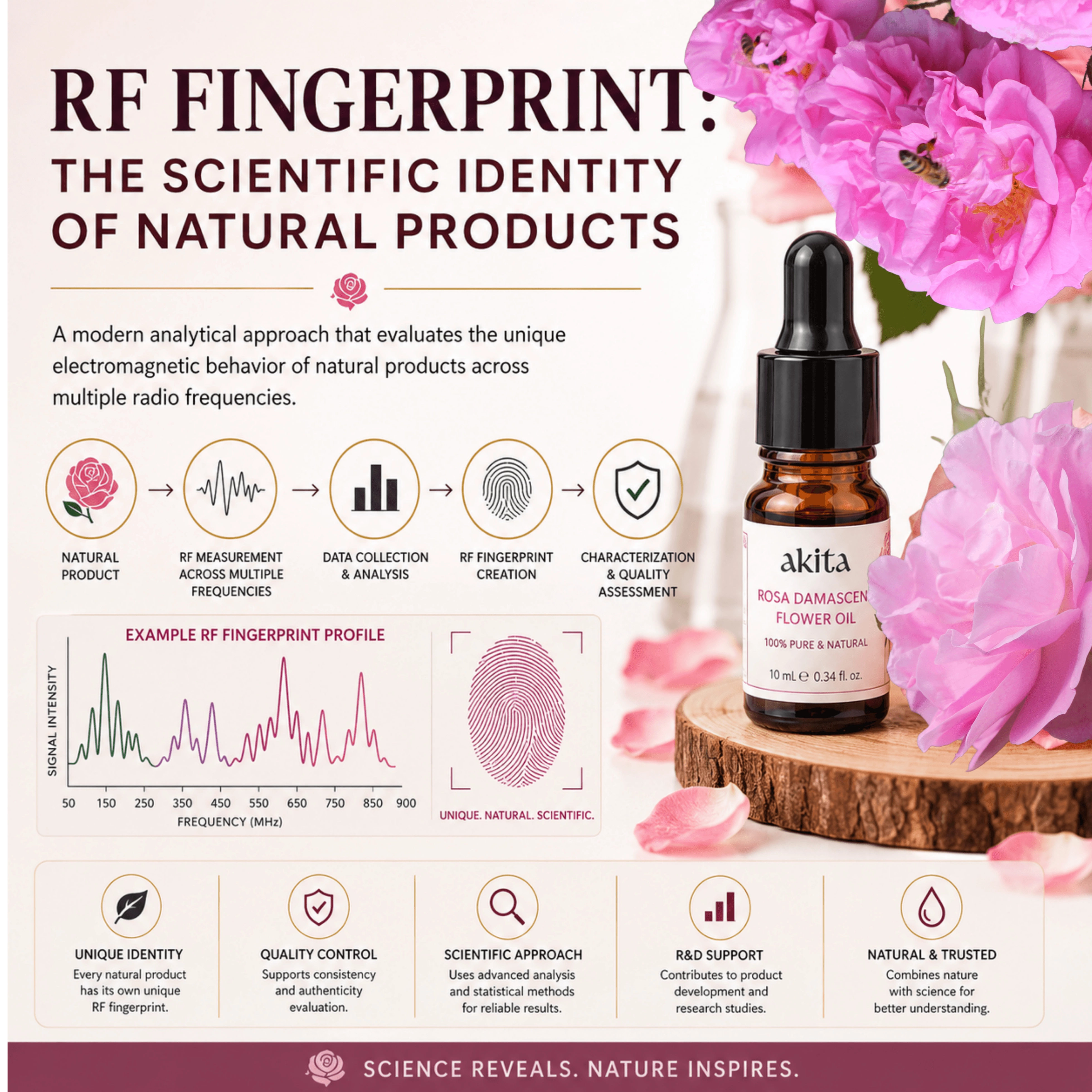
What Is RF Fingerprint?
Understanding the Scientific Identity of Natural Products Through Multi-Frequency Analysis
Could Natural Products Have Their Own Fingerprints?
Imagine arriving at an airport.
Instead of showing your passport, you simply place your finger on a scanner. Within seconds, the system recognizes you—not because of your name, your photograph, or your nationality, but because your fingerprint is unlike anyone else's.
A fingerprint is more than just a pattern. It is a unique identifier.
Now imagine applying the same idea to nature.
Could a bottle of Rosa damascena flower oil, a lavender essential oil, or a botanical distillate also possess a unique identity?
Not a fingerprint made of ridges and lines, of course, but a distinctive scientific profile that reflects how the material behaves under carefully controlled laboratory conditions.
This question has become increasingly relevant as analytical technologies continue to evolve.
For decades, researchers have relied on chemical analysis to understand natural products. Techniques such as Gas Chromatography–Mass Spectrometry (GC-MS) have made it possible to identify hundreds of naturally occurring compounds and quantify their concentrations with remarkable precision.
These methods remain essential and continue to serve as the foundation of modern natural product research.
However, chemistry tells only part of the story.
As instrumentation has advanced, scientists have begun exploring additional ways to characterize natural materials—not by replacing chemical analysis, but by complementing it with new perspectives.
One of these emerging approaches is known as RF Fingerprint (Radio Frequency Fingerprint).
Rather than asking a simple question such as:
"What is the frequency of this product?"
RF Fingerprint explores a much broader and more meaningful question:
"How does this natural product behave across an entire range of radio frequencies?"
The difference may seem subtle, but scientifically it represents a completely different way of looking at complex natural materials.
Did You Know?
The term "fingerprint" is widely used in science—not only for humans.
Researchers also refer to:
- Chemical fingerprints
- DNA fingerprints
- Protein fingerprints
- Spectral fingerprints
- Metabolic fingerprints
In each case, the word fingerprint describes a unique and reproducible pattern that helps distinguish one sample from another under defined analytical conditions.
RF Fingerprint follows the same principle.
Why Is This Topic Becoming More Important?
Natural products are among the most chemically complex materials found in nature.
Unlike synthetic compounds, they are not made from a single molecule.
A bottle of pure essential oil may contain hundreds of naturally occurring compounds, each interacting with the others in ways that are still being investigated.
Even products obtained from the same plant species can vary depending on factors such as:
- Geographic origin
- Climate
- Soil composition
- Harvest timing
- Distillation process
- Storage conditions
- Natural seasonal variation
Because of this complexity, scientists often use several complementary analytical techniques to better understand and characterize botanical materials.
Each method provides a different perspective.
Chemical analysis reveals composition.
Microbiological testing evaluates purity and safety.
Physical measurements describe measurable properties.
RF Fingerprint introduces another perspective by examining how a material responds across multiple radio frequency bands under standardized laboratory conditions.
Scientific Note
RF Fingerprint does not measure the "energy" or "vibration" of a product in the popular or metaphysical sense.
Instead, it is an analytical approach that investigates how a sample behaves when measured across multiple radio frequencies using specialized laboratory instrumentation.
Its purpose is to generate a characteristic measurement profile that may contribute to product characterization and comparative research.
Looking Beyond a Single Frequency
If you have searched online for information about natural products, you have probably encountered claims suggesting that certain plants or essential oils possess a specific frequency expressed as a single number.
These claims have become especially popular in discussions surrounding rose oil.
While such statements are widely repeated, modern analytical science increasingly recognizes that complex natural materials cannot usually be described by a single numerical value alone.
Imagine trying to describe an entire symphony by listening to only one musical note.
Although that single note exists, it does not represent the richness, complexity, or structure of the complete composition.
Natural products are remarkably similar.
Their analytical behavior often extends across many frequencies rather than being confined to one isolated point.
This broader perspective is one of the ideas that makes RF Fingerprint particularly interesting for scientific exploration.
Why Read This Guide?
This article explains RF Fingerprint in clear, accessible language while remaining scientifically grounded.
Throughout this guide, you will discover:
- What an RF Fingerprint actually is.
- Why scientists are exploring this analytical approach.
- How RF Fingerprint differs from traditional chemical analysis.
- Why a single frequency rarely tells the whole story.
- How RF Fingerprint may contribute to natural product characterization and quality assessment.
- How modern statistical methods help interpret complex RF data.
- How AKITA's exploratory RF Fingerprint™ research applies these concepts to Rosa damascena.
Whether you are a researcher, a skincare professional, a natural product enthusiast, or simply curious about how science continues to evolve, understanding RF Fingerprint offers a fascinating glimpse into the future of botanical analysis.
What Is an RF Fingerprint?
When most people hear the word "fingerprint," they immediately think of human identification.
A fingerprint allows us to distinguish one individual from another because its pattern is unique and remarkably consistent throughout a person's lifetime.
Science uses the same concept in many different fields.
Researchers speak of chemical fingerprints, DNA fingerprints, protein fingerprints, and spectral fingerprints because each describes a characteristic pattern that helps identify or differentiate one sample from another.
An RF Fingerprint (Radio Frequency Fingerprint) follows exactly the same principle.
Rather than examining ridges on a fingertip, it evaluates how a material responds across multiple radio frequency bands under standardized laboratory conditions.
The result is not a single measurement but a characteristic electromagnetic profile that can be compared with other samples.
This profile is what researchers call an RF Fingerprint.
Did You Know?
The word "fingerprint" does not imply that a natural product is permanently unique in every possible situation.
Instead, it refers to a repeatable analytical pattern obtained under defined laboratory conditions that may help distinguish one material from another.
More Than a Single Number
One of the biggest misconceptions surrounding RF analysis is the idea that every natural product can be represented by one frequency.
In reality, nature is rarely that simple.
Imagine listening to an orchestra.
If someone asked you to describe the entire performance using only one musical note, it would be impossible.
That single note exists, but it tells you almost nothing about the symphony itself.
Natural products behave in a similar way.
Essential oils, botanical extracts, and plant distillates contain numerous naturally occurring compounds that interact with one another.
When these materials are measured using RF instrumentation, their responses may vary across different frequency regions.
For this reason, scientists often examine the entire response pattern rather than focusing on one isolated frequency.
That broader analytical profile is what gives RF Fingerprint its value.
Scientific Note
An RF Fingerprint is not intended to identify a mysterious "natural frequency" hidden inside a plant.
Instead, it represents a collection of measurements obtained across multiple frequencies that together describe the sample's electromagnetic behavior under specific testing conditions.
How Is an RF Fingerprint Created?
Although the concept sounds sophisticated, the overall process follows a logical sequence.
First, a sample is prepared using standardized laboratory procedures.
Maintaining consistent measurement conditions is essential because even small variations can influence analytical results.
The sample is then measured across a predefined radio frequency range.
Instead of recording only one point, the instrument collects a large number of data points.
Each measurement contributes additional information about how the sample behaves throughout the frequency spectrum.
Once the measurements are completed, the raw data are processed using statistical analysis.
Researchers may also apply machine learning or artificial intelligence tools to identify recurring patterns and compare samples objectively.
Finally, these combined measurements form the product's characteristic RF profile.
This profile—not any individual frequency—is what researchers refer to as the RF Fingerprint.
How an RF Fingerprint Is Built
Natural Product Sample
↓
Standardized Laboratory Preparation
↓
Broadband RF Measurements
↓
Collection of Hundreds of Data Points
↓
Statistical Analysis
↓
Pattern Recognition
↓
RF Fingerprint Profile
Why Repeatability Matters
A fingerprint is useful only if it can be reproduced consistently.
The same principle applies in analytical science.
If a measurement changes dramatically every time it is repeated, it has little scientific value.
For this reason, RF Fingerprint studies emphasize repeatability.
Researchers typically perform multiple measurements under identical conditions to determine whether the observed RF profile remains stable.
A reproducible fingerprint provides greater confidence that the measured pattern reflects characteristics of the sample rather than random variation or measurement noise.
Why It Matters
Scientific measurements should be:
✔ Repeatable
✔ Objective
✔ Reproducible
✔ Statistically supported
These principles are fundamental to analytical research, regardless of whether the technique involves chemistry, spectroscopy, microscopy, or RF analysis.
Is RF Fingerprint the Same as Chemical Analysis?
No.
Although both approaches investigate the same sample, they answer different scientific questions.
Chemical analysis focuses on what the material contains.
Techniques such as GC-MS identify individual compounds and estimate their relative abundance.
RF Fingerprint, on the other hand, focuses on how the material behaves across multiple radio frequencies under controlled laboratory conditions.
Neither method replaces the other.
Instead, they provide complementary perspectives that can contribute to a broader understanding of complex natural products.
RF Fingerprint vs. GC-MS
| GC-MS | RF Fingerprint |
|---|---|
| Identifies chemical compounds | Evaluates RF response patterns |
| Measures composition | Measures electromagnetic behavior |
| Produces chemical profiles | Produces RF profiles |
| Well-established analytical technique | Emerging complementary analytical approach |
| Answers "What is present?" | Explores "How does the sample respond?" |
Together, these methods can provide a more comprehensive picture of a natural product than either technique alone.
Quick Summary
Before moving to the next section, here are the key ideas:
✔ RF Fingerprint is not a single frequency.
✔ It is a multi-frequency analytical profile.
✔ It is created from numerous RF measurements collected under standardized laboratory conditions.
✔ Repeatability is essential for scientific reliability.
✔ RF Fingerprint complements chemical analysis rather than replacing it.
✔ The goal is to characterize complex natural materials from an additional analytical perspective.
Coming Up Next
In the next section, we'll explore why RF Fingerprint has become increasingly relevant in natural product research, how modern statistical tools such as PCA and t-SNE help scientists interpret complex RF datasets, and why researchers are moving beyond the idea of describing botanical materials with a single frequency value.
Why Are Scientists Looking Beyond a Single Frequency?
Science rarely stands still.
As analytical technologies improve, researchers continuously look for new ways to better understand complex natural materials.
For many years, chemical analysis has been the gold standard for studying botanical products. Techniques such as GC-MS have allowed scientists to identify hundreds of naturally occurring compounds with remarkable accuracy.
These methods remain indispensable.
However, scientists have also recognized an important reality:
Natural products are more complex than a list of chemical compounds.
Two samples may appear chemically similar while still exhibiting subtle differences that are difficult to detect using a single analytical technique alone.
This does not mean chemical analysis is insufficient.
Rather, it highlights why modern research often combines multiple analytical approaches to build a more comprehensive understanding of natural materials.
RF Fingerprint represents one of these complementary approaches.
Think of It Like a Symphony
Imagine attending a live orchestra performance.
If someone asked you to describe the entire concert after hearing only one violin note, your answer would be incomplete.
The orchestra is not defined by a single sound.
It is the combination of hundreds of instruments playing together that creates its unique identity.
Natural products behave in much the same way.
Essential oils, botanical extracts and plant distillates are complex mixtures of naturally occurring compounds that interact with one another.
Their overall analytical behavior cannot always be summarized by a single measurement.
Instead, scientists increasingly examine the complete pattern generated across many measurements.
That pattern is often far more informative than any individual data point.
Did You Know?
Modern analytical science increasingly relies on multidimensional data rather than single measurements.
The same trend can be found in:
- Medical imaging
- DNA sequencing
- Artificial intelligence
- Food authentication
- Pharmaceutical research
- Botanical analysis
Instead of relying on one number, researchers evaluate entire datasets to better understand complex systems.
From Single Measurements to Data Patterns
Traditional laboratory analysis often focuses on individual values.
Modern analytical science, however, increasingly focuses on patterns.
Imagine looking at a city from an airplane.
At street level, you only see individual buildings.
From above, you suddenly recognize neighborhoods, roads, parks and the overall structure of the city.
Nothing has changed.
Only your perspective has.
The same principle applies to RF analysis.
Rather than examining one frequency at a time, researchers observe how measurements relate to one another across the entire frequency range.
These relationships form characteristic patterns that may help distinguish one sample from another.
Scientific Note
An RF Fingerprint is not created by selecting one "important" frequency.
It is generated by analyzing how measurements behave collectively across a predefined frequency range using statistical methods.
Why Do Scientists Use Statistics?
Collecting hundreds of measurements is only the beginning.
The real challenge is understanding what those measurements mean.
Imagine receiving a spreadsheet containing thousands of numbers.
Reading each value individually would reveal very little.
Instead, scientists use statistical tools that help identify meaningful patterns hidden within large datasets.
These methods do not change the data.
They simply help researchers visualize and interpret it more effectively.
PCA: Seeing the Bigger Picture
One of the most widely used statistical techniques is Principal Component Analysis (PCA).
PCA simplifies complex datasets by identifying the directions in which samples differ the most.
Instead of comparing hundreds of variables separately, PCA summarizes the overall variation into a few principal components that can be visualized on a graph.
When similar samples naturally cluster together while different materials separate into distinct groups, researchers gain valuable insight into how those samples relate to one another.
Imagine Sorting Colored Marbles
Suppose you have one thousand marbles.
Some are blue.
Some are red.
Some are green.
If you scatter them randomly across a table, they appear completely disorganized.
But if you group them according to their characteristics, clear clusters begin to appear.
PCA works in a similar way.
It organizes complex analytical data so that similarities and differences become easier to recognize.
t-SNE: Revealing Hidden Relationships
Another visualization technique frequently used in data science is t-distributed Stochastic Neighbor Embedding (t-SNE).
While PCA focuses on preserving the overall structure of the data, t-SNE is particularly useful for revealing local relationships between samples.
It can help researchers identify clusters that may not be immediately obvious using conventional visualization methods.
For this reason, PCA and t-SNE are often used together.
If both methods independently reveal similar groupings, confidence in the observed patterns generally increases.
Why Use More Than One Method?
Scientists rarely rely on a single analytical tool.
Instead, they seek agreement between multiple independent methods.
For example, a natural product study may combine:
- GC-MS for chemical composition
- RF Fingerprint measurements
- PCA visualization
- t-SNE visualization
- Statistical validation
- Machine learning classification
When several independent approaches point toward similar conclusions, the overall interpretation becomes more robust.
Beyond Human Observation
As datasets continue to grow, they often become too large for visual interpretation alone.
This is where artificial intelligence and machine learning become valuable.
Rather than replacing scientific judgment, AI can assist researchers by recognizing subtle relationships within complex datasets that might otherwise go unnoticed.
It can compare hundreds or even thousands of measurements simultaneously and identify recurring patterns objectively.
This makes AI a powerful tool for exploratory research involving multidimensional analytical data.
Why It Matters
The goal of modern analytical science is no longer simply to collect more measurements.
It is to extract meaningful knowledge from those measurements.
RF Fingerprint becomes significantly more informative when combined with statistical analysis and modern data science techniques.
Together, they allow researchers to move beyond isolated measurements and explore the overall analytical identity of complex natural products.
Quick Summary
✔ Modern natural products generate complex analytical datasets.
✔ Scientists increasingly study patterns, not isolated values.
✔ PCA helps visualize overall similarities and differences.
✔ t-SNE reveals hidden relationships between samples.
✔ Artificial intelligence assists in recognizing reproducible analytical patterns.
✔ RF Fingerprint gains strength when interpreted using multiple complementary analytical methods rather than relying on a single measurement.
Coming Up Next
In the next section, we'll examine how these analytical principles were applied in the AKITA RF Fingerprint™ exploratory study, why broadband RF measurements were chosen over single-frequency analysis, and what researchers observed when comparing Rosa damascena flower oil with other botanical oils.
AKITA RF Fingerprint™
Exploring the Radio Frequency Characteristics of Rosa damascena Flower Oil
After understanding what an RF Fingerprint is and why modern analytical science increasingly relies on multidimensional data, an important question naturally follows:
Can these principles be applied to real botanical products?
To explore this question, AKITA conducted an independent exploratory research project focusing on one of the world's most valuable natural ingredients:
Rosa damascena flower oil.
Rather than attempting to confirm a single "natural frequency," the objective was fundamentally different.
The study aimed to investigate whether broadband radio frequency measurements could produce a consistent and reproducible RF Fingerprint capable of distinguishing rose oil from other botanical oils under standardized laboratory conditions.
This represents a shift in perspective—from searching for one frequency to examining an entire analytical profile.
Research Objective
The primary objective of the study was not to prove extraordinary biological effects or assign a unique numerical frequency to rose oil.
Instead, the research asked a more measurable scientific question:
Can Rosa damascena flower oil generate a reproducible RF response pattern that differs from other botanical oils when analyzed under identical laboratory conditions?
This question can be tested experimentally, statistically analyzed, and independently reproduced.
That makes it appropriate for exploratory analytical research.
Why Rose Oil?
Among natural aromatic materials, Rosa damascena flower oil occupies a unique position.
It is one of the most precious essential oils in the world.
Producing only one kilogram of authentic rose oil may require approximately three to four metric tons of freshly harvested rose petals, all collected within a short seasonal window.
Its chemical composition has been studied extensively for decades, with compounds such as citronellol, geraniol, nerol, and phenethyl alcohol contributing to its characteristic aroma.
Because of its complexity, rarity, and well-documented chemistry, rose oil provides an excellent model for investigating whether RF Fingerprint analysis can reveal additional analytical characteristics beyond conventional chemical profiling.
Study Design
To improve reliability, the study was designed around repeatability rather than isolated observations.
Multiple production batches of AKITA Rosa damascena flower oil were analyzed under standardized laboratory conditions.
For comparison, several commercially available botanical oils with different chemical compositions were also included.
The comparison group included oils such as:
- Lavender
- Rosemary
- Tea Tree
- Peppermint
- Jojoba
- Violet
- Olive Oil
Each sample was measured repeatedly using the same RF measurement system across a broadband frequency range.
Maintaining identical measurement conditions helped minimize experimental variability and allowed meaningful comparisons between samples.
Scientific Note
Analytical studies require controlled experimental conditions.
Factors such as sample volume, measurement vessel, probe positioning, environmental conditions, and instrument calibration should remain as consistent as possible to ensure that observed differences are more likely to reflect characteristics of the samples rather than variations in the measurement procedure.
Measuring Across Hundreds of Frequencies
Unlike approaches that focus on a single numerical value, the AKITA RF Fingerprint™ study evaluated how each sample responded across a broad frequency spectrum.
Every measurement generated numerous data points rather than one isolated result.
Together, these measurements formed a multidimensional dataset suitable for statistical analysis.
This broader dataset made it possible to examine overall response patterns instead of relying on individual frequencies.
From Raw Data to RF Fingerprint
The analytical workflow followed a structured process:
Sample Preparation
↓
Broadband RF Measurement
↓
Collection of Multiple Frequency Responses
↓
Data Processing
↓
Statistical Analysis
↓
Pattern Recognition
↓
RF Fingerprint Generation
Rather than searching for one "special" frequency, the study focused on whether the complete response profile remained consistent across repeated measurements.
Statistical Evaluation
Large datasets become meaningful only after careful statistical interpretation.
To evaluate the RF measurements, several complementary analytical approaches were applied.
These included:
- Principal Component Analysis (PCA) to visualize similarities and differences among samples.
- t-distributed Stochastic Neighbor Embedding (t-SNE) to explore local clustering patterns.
- Effect size analysis to quantify the strength of separation between sample groups.
- Additional statistical evaluations to assess reproducibility and consistency.
Using multiple analytical methods provides greater confidence than relying on a single statistical technique alone.
Why Use Multiple Statistical Methods?
Each statistical tool answers a different question.
PCA highlights the dominant sources of variation.
t-SNE reveals relationships that may not be immediately visible in linear analyses.
Effect size estimates the practical significance of observed differences rather than focusing solely on statistical significance.
When several independent methods point toward similar conclusions, the interpretation becomes considerably more robust.
What Did the Study Observe?
The exploratory analysis indicated that repeated measurements of AKITA Rosa damascena flower oil produced consistent RF response patterns under standardized laboratory conditions.
When compared with other botanical oils included in the study, rose oil demonstrated distinguishable clustering within the analyzed datasets.
Importantly, these observations were not based on a single measurement point.
Instead, they emerged from evaluating the overall RF Fingerprint generated across multiple frequencies.
This finding supports the concept that complex natural products may be more effectively characterized through multidimensional analytical profiles than by relying on individual frequency values alone.
Why This Matters
RF Fingerprint analysis does not replace GC-MS, chromatography, or established analytical methods.
Instead, it introduces an additional layer of information that may contribute to:
- Product characterization
- Comparative botanical research
- Exploratory quality assessment
- Batch-to-batch consistency studies
- Future authentication research
As analytical science continues to evolve, integrating multiple complementary techniques may provide a richer understanding of complex natural materials.
Quick Summary
✔ AKITA RF Fingerprint™ is an exploratory analytical research project.
✔ The study investigated broadband RF response patterns, not a single frequency.
✔ Multiple botanical oils were analyzed under standardized laboratory conditions.
✔ Statistical tools including PCA, t-SNE, and effect size analysis were used to interpret the data.
✔ Repeated measurements produced reproducible RF profiles for Rosa damascena flower oil.
✔ The results support the concept that RF Fingerprint represents a multidimensional analytical profile rather than an isolated numerical frequency.
Coming Up Next
In the final section, we'll explore the broader implications of RF Fingerprint for the future of natural product research, discuss its potential applications in quality assessment and authentication, address common misconceptions about "frequency" claims, and conclude with key takeaways, FAQs, and references.
The Future of RF Fingerprinting
A New Perspective on Natural Product Characterization
Natural products have fascinated scientists for centuries.
As analytical technology continues to evolve, researchers are no longer limited to identifying individual chemical compounds. Instead, they are increasingly exploring how multiple analytical techniques can work together to provide a more comprehensive understanding of botanical materials.
RF Fingerprint is part of this broader scientific evolution.
Rather than replacing established laboratory methods, it introduces another layer of analytical information that may help researchers better characterize complex natural products.
This multidimensional approach reflects a growing trend across modern science: moving beyond isolated measurements and toward integrated data analysis.
From Chemistry to Multidimensional Analysis
For decades, chemical composition has been the primary way to evaluate natural products.
Techniques such as GC-MS remain essential because they identify the compounds present within a sample.
However, scientific research increasingly recognizes that understanding a natural material often requires more than one analytical perspective.
Today, researchers routinely combine multiple complementary techniques, including:
- Chemical profiling
- Spectroscopic analysis
- Microscopy
- Microbiological testing
- Statistical modeling
- Artificial intelligence
- RF-based analytical measurements
Each method contributes different information.
Together, they provide a richer understanding than any single technique alone.
Potential Applications of RF Fingerprint
Although RF Fingerprint is still an emerging analytical approach, it may contribute to several areas of future research.
Potential applications include:
Botanical Product Characterization
Different plant species and botanical materials may exhibit distinguishable RF response profiles when measured under standardized conditions.
This could provide an additional tool for comparative botanical research.
Batch-to-Batch Consistency
Manufacturers continually work to produce products with consistent quality.
RF Fingerprint may offer an additional analytical method for comparing production batches alongside conventional laboratory testing.
Authentication Research
One of the greatest challenges in the essential oil industry is authenticity.
Future research may investigate whether RF Fingerprint can contribute to distinguishing authentic botanical materials from altered or adulterated products when used together with established analytical techniques.
Such applications would require extensive validation through independent scientific studies.
Research and Innovation
Perhaps the greatest value of RF Fingerprint lies in scientific exploration itself.
Each new analytical method expands our ability to observe natural products from a different perspective.
As more datasets become available, future studies may reveal relationships that are not yet fully understood.
Scientific Note
RF Fingerprint should be viewed as an analytical characterization technique, not as a method for diagnosing health conditions or predicting biological activity.
Its role is to describe measurable laboratory responses under defined experimental conditions.
Moving Beyond the "Single Frequency" Narrative
One of the most common misconceptions surrounding natural products is the idea that they can be fully described by a single frequency value.
This simplified narrative has circulated widely in popular discussions, particularly in relation to certain essential oils.
While such claims are easy to remember, they do not reflect the complexity typically encountered in analytical science.
Modern research increasingly focuses on patterns rather than isolated numbers.
Just as a person's identity cannot be reduced to a single fingerprint ridge, the analytical identity of a botanical material is unlikely to be represented by one frequency alone.
Instead, RF Fingerprint emphasizes the importance of examining the complete response profile generated across multiple frequencies.
This broader perspective provides a more nuanced framework for studying complex natural products.
Why This Matters
Science advances by asking better questions.
Instead of asking,
"What is the frequency of this product?"
researchers may increasingly ask,
"What does the complete RF response pattern reveal about this material?"
Although the difference appears subtle, it represents a significant shift in analytical thinking.
Looking Ahead
RF Fingerprint remains an emerging field of research.
As additional studies are published and independent laboratories continue to investigate broadband RF measurements, our understanding of natural products may continue to expand.
Future developments could include:
- Improved analytical instrumentation
- Larger comparative datasets
- AI-assisted classification models
- Standardized RF measurement protocols
- Multi-laboratory validation studies
- Integration with established analytical techniques
Like many scientific innovations, progress will depend on reproducibility, transparency, peer review, and independent verification.
Conclusion
Nature is remarkably complex.
For generations, scientists have relied on chemical analysis to understand botanical materials, and those methods remain indispensable today.
RF Fingerprint does not seek to replace these established techniques.
Instead, it offers a complementary analytical perspective by examining how natural products respond across multiple radio frequencies under standardized laboratory conditions.
Rather than reducing complex materials to a single numerical value, RF Fingerprint encourages researchers to study complete response patterns.
This multidimensional approach aligns with a broader trend in modern analytical science, where large datasets, statistical modeling, and artificial intelligence increasingly support scientific discovery.
As research in this field continues to grow, RF Fingerprint may become another valuable tool for product characterization, comparative botanical studies, quality assessment, and future authentication research.
The journey has only begun.
What makes this field exciting is not that every question has been answered, but that entirely new questions can now be explored.
That is how science moves forward.
Key Takeaways
✔ RF Fingerprint is a multi-frequency analytical profile, not a single frequency.
✔ It complements, rather than replaces, traditional analytical methods such as GC-MS.
✔ Statistical tools like PCA and t-SNE help researchers interpret complex RF datasets.
✔ Artificial intelligence can support the recognition of reproducible analytical patterns.
✔ RF Fingerprint has potential applications in botanical characterization, quality assessment, and authentication research.
✔ Ongoing research and independent validation will continue to shape the future of this emerging analytical approach.
Frequently Asked Questions (FAQ)
1. What is an RF Fingerprint?
An RF Fingerprint (Radio Frequency Fingerprint) is a characteristic measurement profile obtained by analyzing how a material responds across multiple radio frequency bands under standardized laboratory conditions. Rather than relying on a single frequency, it evaluates the overall response pattern of a sample.
2. Is an RF Fingerprint the same as a single frequency?
No.
A single frequency represents only one measurement point. An RF Fingerprint is created from numerous measurements collected across a wide frequency range, providing a multidimensional analytical profile instead of one numerical value.
3. Does every natural product have an RF Fingerprint?
Any material measured under controlled RF conditions may generate a characteristic response profile. Whether that profile is sufficiently reproducible and useful for identification depends on the sample, the measurement protocol, and scientific validation.
4. How is an RF Fingerprint measured?
A sample is analyzed using specialized laboratory equipment across a defined radio frequency range. The resulting data are processed using statistical methods to generate a characteristic RF response profile.
5. Is RF Fingerprint a replacement for GC-MS?
No.
GC-MS and RF Fingerprint provide different types of information.
GC-MS identifies the chemical compounds present in a sample, while RF Fingerprint evaluates its radio frequency response pattern. These methods are complementary rather than competitive.
6. Why do scientists analyze multiple frequencies instead of just one?
Natural products are highly complex mixtures of many naturally occurring compounds.
Analyzing multiple frequencies provides a more comprehensive picture of a material's analytical behavior than relying on a single measurement point.
7. What statistical methods are commonly used in RF Fingerprint studies?
Researchers often use techniques such as:
- Principal Component Analysis (PCA)
- t-distributed Stochastic Neighbor Embedding (t-SNE)
- Effect Size Analysis
- Cluster Analysis
- Machine Learning algorithms
These methods help identify reproducible patterns within complex datasets.
8. Can RF Fingerprint identify counterfeit or adulterated products?
Potentially, but further scientific validation is required.
Researchers are exploring whether RF Fingerprint could contribute to authenticity studies when used alongside established analytical techniques such as GC-MS and chromatography.
9. Does RF Fingerprint measure the "energy" of a natural product?
Not in the popular or metaphysical sense.
RF Fingerprint measures how a sample responds to radio frequency measurements under standardized laboratory conditions. It is an analytical characterization technique rather than a measurement of biological or spiritual energy.
10. Why is repeatability important in RF Fingerprint research?
Scientific measurements must produce consistent results when repeated under the same conditions.
A reproducible RF response profile provides greater confidence that the observed pattern reflects characteristics of the sample rather than random measurement variation.
11. Can two samples from the same plant produce different RF Fingerprints?
Yes.
Natural variation may occur due to factors such as:
- Geographic origin
- Climate
- Soil conditions
- Harvest time
- Distillation process
- Storage conditions
- Plant genetics
These variables can influence many analytical measurements, including RF response patterns.
12. What is the purpose of the AKITA RF Fingerprint™ study?
The AKITA RF Fingerprint™ exploratory study investigated whether Rosa damascena flower oil could generate a reproducible broadband RF response profile under standardized laboratory conditions and whether that profile could be distinguished from those of other botanical oils using statistical analysis.
13. Is RF Fingerprint scientifically accepted?
RF-based analytical measurements are used in many areas of science and engineering.
The application of broadband RF Fingerprint analysis to natural products is an emerging area of research that continues to evolve. As with any developing analytical approach, broader validation through independent studies and peer-reviewed research will further clarify its potential applications.
14. Why is RF Fingerprint becoming increasingly interesting for natural product research?
Modern analytical science is moving toward multidimensional data analysis.
Instead of relying on a single measurement, researchers increasingly combine chemical analysis, spectroscopy, statistical modeling, and RF response analysis to build a more complete understanding of complex botanical materials.
15. What is the main advantage of RF Fingerprint?
Its greatest strength lies in evaluating the complete analytical response profile of a material rather than focusing on a single numerical value. This multidimensional approach may provide additional insights into product characterization, comparative research, and quality assessment when used alongside established analytical techniques.
One of the biggest challenges with natural products sold in markets is their short shelf life. If a product is truly 100% natural, it means that no p...
When it comes to natural skin care, the ingredients inside your cream determine how effective your daily routine will be. Akita creams stand out thank...
It’s easy to find both in Canada and Turkey — whether you prefer shopping online or in-store. In Canada Store Locator: Visit www.akitarosewat...
🌹 How to Meditate with Rose Oil? In today’s fast-paced world, finding inner peace and calming the mind has become essential. Meditation is one of the...
The Rosa damascena is one of Turkey’s most precious natural treasures. Known worldwide for its captivating fragrance, this unique rose has also drawn ...
What Is Rosa Damascena Flower Distillate? The Scientific Identity Behind Akita Non-De-Oiled Rose Water Rose water may sound like one of the simplest...
Akita Organic Non-Oil-Separated Rose Water is a premium, award-winning skincare ingredient produced from fresh organic Isparta roses (Rosa Damascena),...
The Importance of Eye-Safe Skincare In recent years, Canadian consumers have become more conscious about the ingredients used in their skincare produ...
Innovation in Skincare Starts with Ingredients In today’s skincare industry, innovation is no longer defined only by packaging or marketing claims. T...
Akita Rose Water is a product that goes beyond conventional definitions of hydrosols or aromatic rose waters. Due to its unique production methodo...
A Simple, Natural Skincare Ritual for 35+ Skin As skin matures, it needs gentler, more intentional care. The Akita 35+ Natural Anti‑Aging Face Cream i...
Burhan Kilic Founder, Inventor, Cosmetic Innovation Leader & Creator of Non-Deoiled Rose Water Burhan Kilic is a Canadian entrepreneur, inventor, an...
For centuries, roses have been recognized as symbols of beauty, elegance, and natural skincare. Among them, Rosa Damascena (Damask Rose) has earned a ...
Most products on the market are called "rose water." But Akita Rose Water is not the same. Akita Organic Unseparated Rose Water goes beyond the t...
Can You Drink Rose Water? Pure and authentic rose water has been used for centuries in different cultures for both skincare and various traditional a...
Akita Non-Deoiled Rose Water: Why Our Rose Distillate Is Different A New Perspective on Rose Water For centuries, rose water has been one of nature'...
What Is Rose Water Good For? 10 Reasons Rosa Damascena Rose Water Remains a Skincare Essential in 2026 In an age of complex skincare routines and ing...
Can Rose Water Support a Healthy Skin Barrier? Why More Canadians Are Turning to Simpler Skincare Understanding the Skin Barrier Over the last few y...
Comment