Etiket: #rose oil
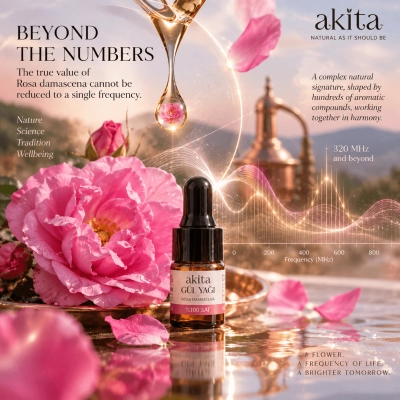
Search online for Rosa damascena essential oil, and it will not take long before you encounter statements such as:
“Rose oil has the highest frequency of any essential oil.” “Rose oil vibrates at 320 MHz.” “It is one of the highest-vibrational natural substances.”
320 MHz.
It sounds remarkably precise.
But from a scientific perspective, that precision raises an important question:
How exactly is the frequency of a bottle of rose oil measured?
With what instrument?
What physical signal is being measured?
Under what conditions?
And why should the result be exactly 320 MHz?
Once we begin asking these questions, the story of rose oil becomes much more interesting.
Because we do not need an unverified number to explain why Rosa damascena is extraordinary.
First, What Does “Frequency” Actually Mean?
In physics, frequency describes how often a repeating event occurs within a given period of time. It is expressed in Hertz (Hz).
Sound waves have frequencies.
Electromagnetic signals have frequencies.
Radio transmissions have frequencies.
Light has electromagnetic frequencies.
But there is an important distinction:
Whenever scientists measure frequency, the...
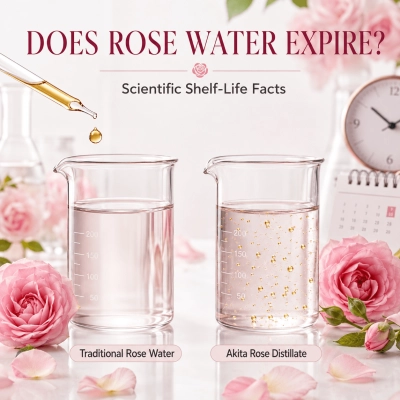
Scientific data on the shelf life of de-oiled rose water produced during rose oil production—and the difference of Akita Unde-oiled Rose Distillate
Rose water is often considered a natural product that can remain stable for many years. However, scientific research shows that not all rose waters have the same composition, production method, or storage stability.
To understand the shelf life of a rose water product, we should first ask an important question:
Is it the aromatic water remaining after rose oil has been separated, or was the rose distillate produced as the primary product without removing its naturally occurring rose oil?
This distinction matters because the production method may influence the product’s chemical composition and behavior during storage.
How Is Rose Water Produced During Rose Oil Production?
When Rosa damascena flowers are distilled with water and steam, volatile compounds from the flowers travel with the steam. After cooling, the vapor condenses back into a liquid.
The resulting distillate may contain two phases:
An aqueous phase
A volatile rose oil phase
In traditional rose oil production, the primary objective is to obtain rose oil....
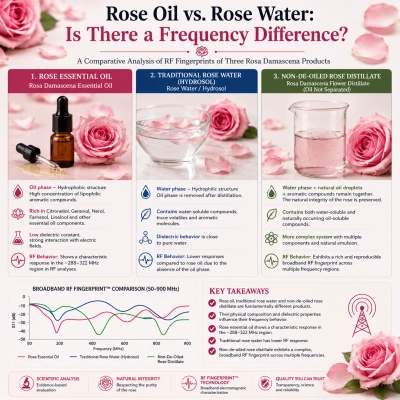
Rose Oil vs. Rose Water: Is There a Frequency Difference?
Why AKITA's Non-De-Oiled Rosa Damascena Flower Distillate May Exhibit a Richer RF Fingerprint Than Rose Essential Oil
Key Takeaway
For decades, the discussion has focused on the reported 320 MHz frequency of Rosa damascena essential oil. Almost nobody asked whether rose water itself has a measurable RF fingerprint. Our research began with that simple question—and the answer surprised even us.
Introduction
If you search online for the phrase "rose oil frequency," you will quickly encounter one familiar number:
320 MHz.
Whether this value is interpreted literally or symbolically, it has long been associated with Rosa damascena essential oil.
However, this raises an interesting question.
If rose essential oil has been discussed for decades from a frequency perspective, what about rose water?
Surprisingly, almost no one has explored this question scientifically.
Even more intriguing is another possibility:
What happens when the natural rose oil is never removed from the distillate?
Until we began our RF Fingerprint™ research,...

What Is RF Fingerprint?
Understanding the Scientific Identity of Natural Products Through Multi-Frequency Analysis
Could Natural Products Have Their Own Fingerprints?
Imagine arriving at an airport.
Instead of showing your passport, you simply place your finger on a scanner. Within seconds, the system recognizes you—not because of your name, your photograph, or your nationality, but because your fingerprint is unlike anyone else's.
A fingerprint is more than just a pattern. It is a unique identifier.
Now imagine applying the same idea to nature.
Could a bottle of Rosa damascena flower oil, a lavender essential oil, or a botanical distillate also possess a unique identity?
Not a fingerprint made of ridges and lines, of course, but a distinctive scientific profile that reflects how the material behaves under carefully controlled laboratory conditions.
This question has become increasingly relevant as analytical technologies continue to evolve.
For decades, researchers have relied on chemical analysis to understand natural products. Techniques such as Gas Chromatography–Mass Spectrometry (GC-MS) have made it possible to identify hundreds...
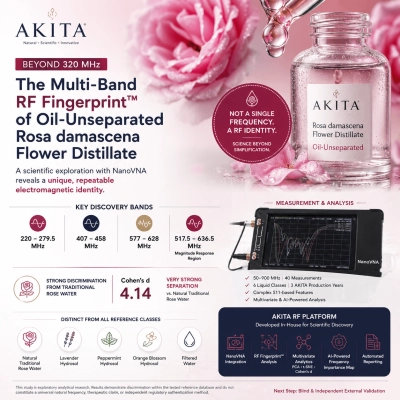
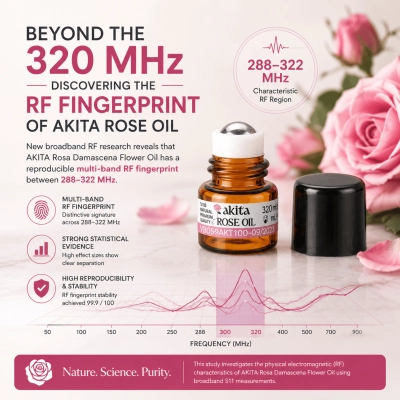
From the 320 MHz Hypothesis to a Multi-Band RF Fingerprint: New Findings from the AKITA Rosa Damascena Flower Oil Study
Broadband S11 analysis reveals that AKITA Rosa Damascena Flower Oil exhibits a reproducible multi-band RF fingerprint spanning 288–322 MHz, providing a broader scientific perspective beyond the traditionally referenced 320 MHz frequency.
Scientific knowledge advances through observation, measurement, and refinement. As new data become available, existing hypotheses are revisited, expanded, and strengthened.
Our latest broadband RF (Radio Frequency) investigation of AKITA Rosa Damascena Flower Oil follows this scientific principle. Rather than focusing on a single frequency, the study explores the product's electromagnetic behavior across a wide frequency spectrum using standardized S11 measurements.
The findings suggest that the electromagnetic identity of AKITA Rosa Damascena Flower Oil is better represented by a multi-band RF fingerprint than by a single natural frequency.
Why Revisit the 320 MHz Hypothesis?
For many years, 320 MHz has frequently been associated with Rosa Damascena essential oil in various publications and discussions.
While this refere...
Is Rose Oil Really 320 MHz? What New Scientific Research Reveals
Beyond the 320 MHz Claim: A New Perspective on the RF Fingerprint of Rosa damascena Flower Distillate
For many years, one statement has been widely shared across aromatherapy and natural wellness communities:
"Rose vibrates at 320 MHz."
This claim has become one of the most frequently repeated facts about Rosa damascena, often presented as evidence of the flower's unique energetic properties.
But where did this number come from? Does it apply to all rose-based products, including rose water? And what happens when modern radio-frequency (RF) analysis is used to investigate this long-standing claim?
A recent exploratory study offers a different perspective. Rather than identifying a single dominant frequency, researchers observed that a non-de-oiled Rosa damascena flower distillate exhibited a reproducible multi-band RF fingerprint across a broad frequency range.
Where Did the 320 MHz Claim Originate?
An important distinction is often overlooked.
Historically, the widely quoted 320 MHz value has generally been associated with Rosa Damascena Flower Oil, the essential oil obtained during steam distillatio...

Can the Value of Rose Oil and the Elegance of Rose Water Exist Together?
Rose water has been one of the world's most trusted natural skincare ingredients for centuries. Used across cultures for beauty, wellness, and personal care, it remains a staple in modern skincare routines.
Today, however, consumers are asking new questions:
What is Non-Deoiled Rose Water?
Can the valuable aromatic compounds associated with rose oil also be present within a rose distillate?
Why is Akita's Non-Deoiled Rose Water different from traditional rose water?
The answers begin with understanding the science of rose distillation.
Why Is Rose Oil So Valuable?
Rosa Damascena, often known as the Damask Rose, is one of the most prized aromatic plants in the world.
Scientific research has identified several key aromatic compounds that contribute to the characteristic profile of rose oil, including:
Citronellol
Geraniol
Nerol
Farnesol
Linalool
Phenethyl Alcohol
These naturally occurring aromatic molecules help create the distinctive scent and identity of the rose.
For centuries, rose oil has been valued by the fragrance, cosmetic, and wellness industries because o...

🌹 How to Meditate with Rose Oil?
In today’s fast-paced world, finding inner peace and calming the mind has become essential. Meditation is one of the most powerful tools for this and did you know you can make your practice even more effective with rose oil?
The Role of Rose Oil in Meditation
Emotional Balance: Opens the heart chakra, cultivating love, compassion, and serenity.
Mental Clarity: Research shows inhaling rose oil helps reduce stress, ease anxiety, and improve focus.
Spiritual Depth: Supports mindfulness and deepens the connection to the present moment.
Step-by-Step Meditation with Rose Oil
1. Prepare the Space
Choose a quiet, peaceful spot. Light a candle, dim the lights, or play soft instrumental music if you wish.
2. Relax the Body
Sit comfortably, close your eyes, and observe your breath in its natural rhythm.
3. Different Ways to Apply Rose Oil
🌸 Inhalation in the Palms
Place 1 drop of rose oil in your palms.
Rub them gently and bring your hands close to your nose.
Inhale deeply and allow the calming aroma to ground you.
🌸 Fingertip Application
Put a tiny amount on your fingertips.
Gently massage into yo...
Discover the Pure Power of Akita Rose Oil
Crafted with Care, Drop by Drop
At Akita, we produce our rose oil the traditional way drop by drop, using old-fashioned copper distillers. Our process is simple yet sacred: we add only fresh Damask roses and pure water, then gently boil the mixture. We don't extract large quantities of oil because we focus on producing rose water without removing the oil from it, preserving the full natural power of the rose in every drop.
Would you like to try Akita’s pure rose oil and unlock naturally radiant skin?
Why Choose Akita Rose Oil?
Our rose oil is more than a beauty product, it's a timeless ritual of care for your skin and soul.
🌹 Fights Spots & Blemishes: Helps reduce the appearance of dark spots and uneven tone.
✨ Naturally Anti-Wrinkle & Anti-Aging: Rich in antioxidants, it visibly improves skin texture and elasticity.
🔥 Anti-Inflammatory & Soothing: Calms irritation and supports skin healing, even on sensitive or allergic skin.
💧 Deeply Nourishing: Just a few drops go a long way. This dense oil offers a month-long skin therapy with only 1ml.
How to Use Akita Rose Oil...
A Calming, Skin-Softening Ritual from Nature
1. 🌸 What Makes Damask Rose Oil Special?
Rosa damascena, also known as the Damask rose, is far more than a beautiful bloom. It’s a sacred botanical treasure that has been cultivated for centuries in Isparta (Turkey), Bulgaria, and Iran for its precious essential oil.
This oil is one of the most valuable in the world—not just for its exquisite scent, but for its unique composition of bioactive compounds that support both skin health and emotional balance.
🌿 Key Components of Rosa Damascena Oil:
Citronellol – Soothes the skin and has natural antibacterial properties
Geraniol – Rich in antioxidants, helps protect skin from oxidative stress
Nerol – Supports mood stability and relieves emotional tension
Phenyl Ethyl Alcohol – Adds that classic rose aroma while purifying the skin
Flavonoids & Phenolic acids – Reduce inflammation and slow signs of aging
2. 💆♀️ 5 Ways Rosa Damascena Oil Transforms Your Skin
If you have dry, sensitive, or mature skin, Rosa damascena oil is your new best friend. It’s gentle, nourishing, and works wonders in your daily skincare routine.
💧 Skin Benefits:
De...