Is the Frequency of Rose Oil Really 320 MHz?
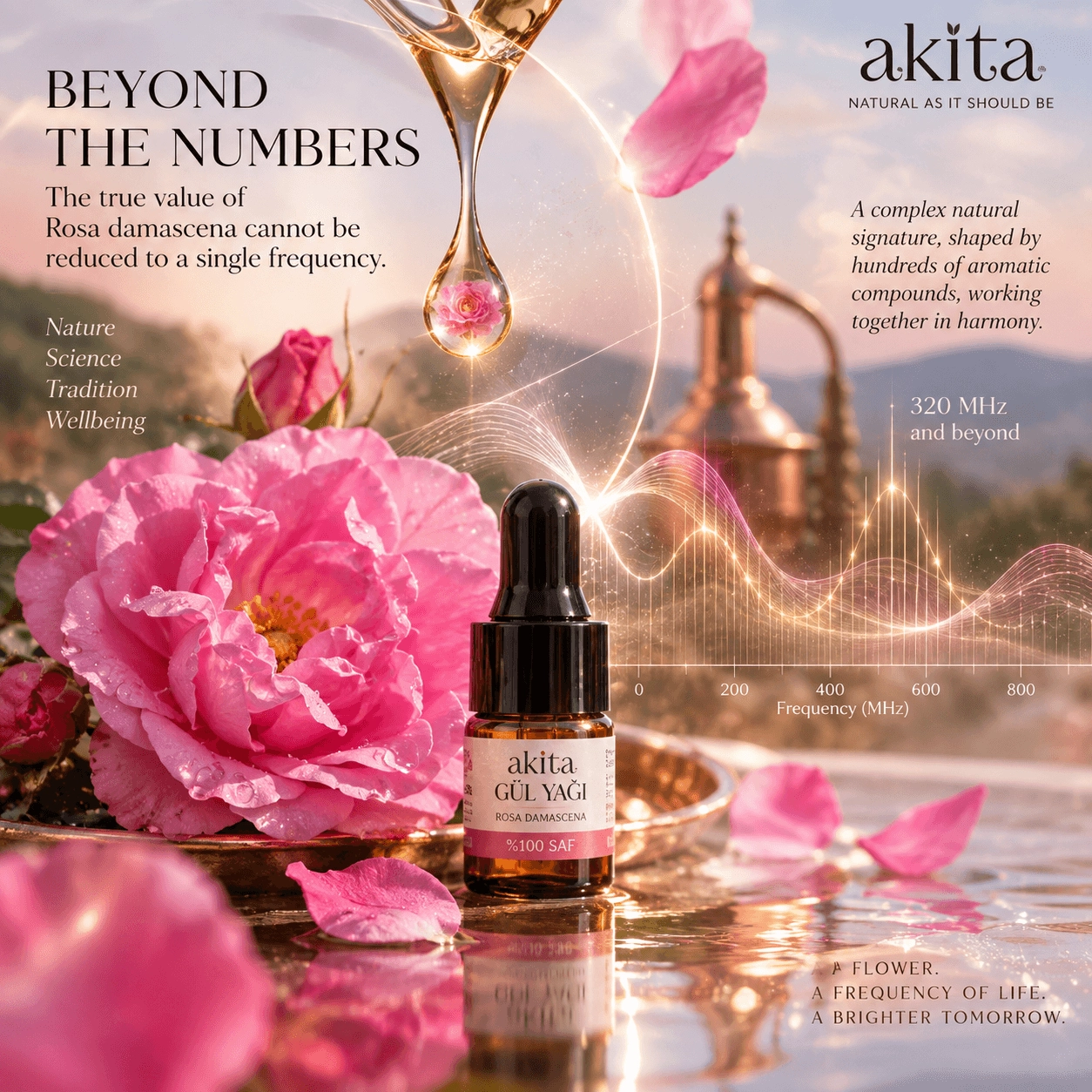
Search online for Rosa damascena essential oil, and it will not take long before you encounter statements such as:
“Rose oil has the highest frequency of any essential oil.”
“Rose oil vibrates at 320 MHz.”
“It is one of the highest-vibrational natural substances.”
320 MHz.
It sounds remarkably precise.
But from a scientific perspective, that precision raises an important question:
How exactly is the frequency of a bottle of rose oil measured?
With what instrument?
What physical signal is being measured?
Under what conditions?
And why should the result be exactly 320 MHz?
Once we begin asking these questions, the story of rose oil becomes much more interesting.
Because we do not need an unverified number to explain why Rosa damascena is extraordinary.
First, What Does “Frequency” Actually Mean?
In physics, frequency describes how often a repeating event occurs within a given period of time. It is expressed in Hertz (Hz).
Sound waves have frequencies.
Electromagnetic signals have frequencies.
Radio transmissions have frequencies.
Light has electromagnetic frequencies.
But there is an important distinction:
Whenever scientists measure frequency, they are measuring a defined physical phenomenon or signal.
So before asking, “What is the frequency of rose oil?” we first need to ask:
What physical property of the oil are we measuring?
That distinction changes everything.
📌 SCIENCE BOX
Does a plant have one single frequency?
No.
A rose flower cannot simply be treated like a radio transmitter broadcasting at one fixed frequency.
A living Rosa damascena flower contains many things simultaneously:
- numerous chemical compounds,
- volatile aromatic molecules,
- water,
- pigments,
- cellular electrical activity,
- molecular vibrations,
- interactions with light,
- mechanical movements.
Some of these phenomena can certainly be studied using different scientific instruments and analytical techniques.
But the ability to measure particular physical phenomena does not automatically mean that an entire plant—or the essential oil produced from it—can be assigned one universal frequency value.
For this reason, there is currently insufficient scientific evidence to state:
“The scientifically established frequency of Rosa damascena essential oil is 320 MHz.”
The widely circulated 320 MHz figure has not been established as a universal physical property of Rosa damascena essential oil through an accepted standardized measurement method supported by adequate peer-reviewed evidence.
So Why Does Rose Feel So Different?
This is where the story becomes much more compelling.
We do not necessarily need to search for a mysterious frequency to understand why smelling a rose can produce such a powerful sensory experience.
Our own biology already provides a fascinating explanation.
And that explanation takes us from chemistry to neuroscience.
Rose Oil Has More Than a Number — It Has Complex Chemistry
Authentic Rosa damascena essential oil is a complex natural mixture containing numerous volatile compounds.
Depending on the rose material and the method of production, important aromatic constituents can include compounds such as:
- citronellol,
- geraniol,
- nerol,
- linalool,
- farnesol,
- and many other naturally occurring constituents.
But the important question is not simply:
“Which molecule is present?”
We also need to ask:
How much of each molecule is present?
How do they exist together?
Where were the roses grown?
When were they harvested?
How were they distilled?
All of these factors can influence the final aromatic and chemical profile.
🌹 The identity of a rose is not contained in one molecule. It emerges from the complexity of the whole.
What Happens in Your Brain When You Smell a Rose?
Imagine opening a bottle of genuine rose oil.
You remove the cap.
You have not even applied the oil to your skin yet.
But the moment you smell it, something begins to happen.
Volatile aromatic molecules interact with olfactory receptors in the nose. Signals generated through this process are then transmitted into the brain's olfactory pathways.
The olfactory system has particularly close connections with brain regions involved in emotion and memory.
This helps explain why a fragrance can suddenly bring back a memory from decades ago.
Another scent may feel comforting.
Another may remind us of a person, a place, or a particular moment in our lives.
This relationship between scent, emotion and physiology is one reason researchers have become interested in Rosa damascena.
🧠 RESEARCH BOX
Is Rosa damascena studied only because it smells beautiful?
No.
Different Rosa damascena preparations have been investigated scientifically in a range of areas.
Depending on the study and preparation used, research has explored topics including:
stress and anxiety, relaxation, sleep, pain perception, cognitive processes, antioxidant activity, antimicrobial activity and mechanisms associated with inflammation.
There is, however, an important distinction.
A result observed in a laboratory experiment is not equivalent to evidence from a well-controlled human clinical trial.
So saying that something “has been studied” is very different from saying that it “has been proven to treat” a particular condition.
That distinction matters.
Is Rose Oil's Effect Caused by Frequency or Fragrance?
Perhaps we should change the question.
Instead of asking:
“What is the frequency of rose?”
we might ask:
“Through which biological and physical pathways does rose interact with us?”
That is a question science can investigate.
We can analyze the chemical composition of rose oil.
We can identify its volatile compounds.
We can study the olfactory system.
We can investigate physiological and psychological responses after exposure to rose aroma.
We can examine interactions with the skin using appropriate experimental methods.
And we can compare rose-derived products under controlled conditions.
Suddenly, the subject becomes much larger—and scientifically much more interesting—than a single 320 MHz number.
⚠️ Not Everything Labelled “Natural Rose” Is the Same
Two bottles may both say Rosa damascena on their labels, yet the products inside may not necessarily be equivalent.
The final product can be influenced by factors such as:
the geographical origin of the plant,
harvest timing,
how long flowers are stored before processing,
distillation technique,
distillation conditions,
storage,
and further processing after distillation.
That is why evaluating a quality rose product requires more than reading the front label.
You also need to understand the production story behind the bottle.
Why Is Pure Rosa damascena Oil So Valuable?
Here we reach another remarkable part of the story.
Producing genuine Rosa damascena essential oil is extraordinarily demanding.
Large quantities of freshly harvested rose blossoms are required to obtain a relatively small quantity of essential oil.
And the roses cannot be harvested throughout the entire year.
In Isparta, the rose harvest takes place during a relatively short season. Flowers are traditionally collected in the early hours of the morning and transported for distillation.
Think about what that means:
Thousands of kilograms of roses.
A short harvest season.
Intensive manual work.
Careful distillation.
And ultimately, only a small amount of precious essential oil.
Rose oil does not need a mysterious number to make it valuable. Its production story is already extraordinary.
Is Synthetic Rose Fragrance the Same as Genuine Rose Oil?
No.
A fragrance formulation may reproduce the familiar smell of roses very convincingly.
But genuine Rosa damascena essential oil is a naturally derived, multi-component aromatic mixture.
That means:
“Smelling like a rose” and “being obtained from a rose” are not the same thing.
For consumers, this leads to a much more useful question:
Am I buying something that simply smells like roses, or am I buying a product genuinely derived from Rosa damascena?
🔬 THE AKITA PERSPECTIVE
At Akita, we believe the value of Rosa damascena cannot be reduced to a single number.
What matters to us is the complete picture:
✓ quality of the rose material
✓ origin of the raw material
✓ harvest conditions
✓ distillation method
✓ preservation of the natural composition
✓ analytical evaluation
✓ product quality and safety research
Because genuine quality does not emerge from one number.
It comes from the entire production process.
This philosophy also guides Akita's approach to Rosa Damascena Flower Distillate.
Rather than viewing rose water simply as pleasantly scented water, we approach it as a whole distillate produced through the distillation of Rosa damascena.
Does This Mean Frequency Research Is Meaningless?
Not at all.
This is an important distinction.
Saying that “320 MHz has not been established as the universal frequency of rose oil” does not mean that plant-derived products cannot be investigated using physical or electromagnetic measurement techniques.
They can.
Electromagnetic behaviour, spectroscopic characteristics, molecular vibrations and signal responses can all potentially be investigated using appropriate experimental systems.
But a meaningful scientific investigation needs to explain:
What exactly was measured?
Which instrument was used?
What frequency range was investigated?
What was the control sample?
Can the result be reproduced?
Does the same pattern appear in independently prepared samples?
This is where scientific exploration becomes particularly interesting.
🔬 Perhaps the most useful question is not “What is the frequency of rose?” but “What physical signal are we measuring, with what method, and under what conditions?”
That distinction opens a much more credible and exciting path for future research into Rosa damascena and its distillates.
🌹 Perhaps the Real Secret of Rose Is Not 320 MHz
Humans have lived with roses for centuries.
We smell them.
We distill them.
We make rose water.
We produce rose oil.
We grow them in our gardens.
We give them to people we love.
And today, modern science continues to explore the chemistry and biological interactions of this remarkable plant.
Perhaps reducing Rosa damascena to a single “high-frequency” number does not make its story more extraordinary.
Perhaps it actually makes the story smaller.
Because the real story includes:
chemistry,
botany,
olfactory science,
neuroscience,
distillation technology,
centuries of cultural history,
and many scientific questions that have yet to be answered.
Perhaps the true value of Rosa damascena is not hidden in one mysterious number, but in the meeting point between nature, chemistry, human perception and the art of distillation.
Frequently Asked Questions
Is the frequency of Rosa damascena oil really 320 MHz?
The figure 320 MHz is frequently repeated online, but there is currently insufficient scientific evidence to establish it as the universal physical frequency of Rosa damascena essential oil. An accepted standardized measurement method supported by adequate peer-reviewed research has not established 320 MHz as an inherent property of rose oil.
Can the frequency of a plant be measured?
Specific physical phenomena associated with plants and plant-derived materials can be measured, including certain electrical, electromagnetic, spectroscopic and molecular behaviours. However, researchers must define exactly what is being measured, which instrument is used and under what experimental conditions. This is different from assigning an entire plant one universal “frequency.”
Why can the smell of rose have such a powerful effect on people?
The olfactory system has close connections with brain regions involved in emotion and memory. This is one reason scents can trigger strong memories and emotional responses. The potential physiological and psychological effects associated with Rosa damascena aroma have also been investigated scientifically.
Has Rosa damascena been scientifically studied?
Yes. Different Rosa damascena preparations have been investigated in relation to areas such as stress, anxiety, relaxation, sleep, pain, cognitive processes and several biological activities. The strength of the evidence varies according to the preparation, dose, study design and whether the research was conducted in vitro, in animals or in humans.
Does rose oil work only because of its fragrance?
Its characteristics cannot be explained simply by saying that it “smells pleasant.” Its chemical composition, relative concentrations of volatile constituents, production method and route of use are also relevant. Effects associated with inhalation should also be distinguished from those related to topical application.
Is genuine Rosa damascena oil the same as synthetic rose fragrance?
No. Synthetic fragrance can reproduce aspects of the smell of rose, whereas genuine Rosa damascena essential oil is a naturally derived mixture containing numerous volatile constituents. Similar fragrance does not mean identical chemical composition.
Why is Rosa damascena essential oil so expensive?
A large quantity of freshly harvested rose flowers is required to produce a relatively small amount of essential oil. The short harvest period, manual collection and demanding distillation process also contribute to its value.
Why does Akita focus on preserving the natural character of Rosa damascena?
Akita's approach is to evaluate Rosa damascena through the quality of its raw material, production method, natural composition, analytical testing, safety and overall product quality rather than relying on a single popular frequency claim.
🌹 Experience the Real Value of Rosa damascena
The value of rose cannot be explained by a single number.
What makes it remarkable is the combination of its natural composition, geographical origin, harvest, distillation process and distinctive aromatic character.
At Akita, our focus is on preserving this natural richness of Rosa damascena.
Discover Akita Non-De-Oiled Rosa Damascena Flower Distillate as part of your daily skincare ritual, or experience the precious aromatic character of Isparta rose with Akita 100% Pure Rosa Damascena Essential Oil.
Don't judge a rose only by its fragrance. Discover the quality behind it.
Explore the Akita Rosa Damascena collection.
Comment