Articles & Blog
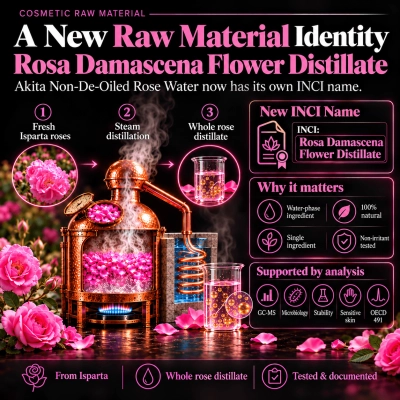
Rosa Damascena Flower Distillate: Rethinking the Water Phase in Modern Cosmetic Formulation
A new botanical raw material identity for formulators looking beyond conventional purified water
In cosmetic formulation, water is often the largest ingredient in the formula.
Yet it is also one of the ingredients that receives the least attention.
For decades, formulators have invested heavily in active ingredients, botanical extracts, peptides, oils and delivery systems while the aqueous phase has largely remained functional and invisible.
But the direction of modern formulation is changing.
Brands are increasingly looking for multifunctional raw materials, shorter ingredient lists, botanical storytelling, traceable sourcing and ingredients supported by analytical documentation.
This raises an interesting formulation question:
What if the water phase itself could contribute to the identity of the finished product?
Akita Non-De-Oiled Rose Water introduces one possible answer.
The ingredient now has a distinct INCI identity:
Rosa Damascena Flower Distillate
INCI Application No. 2025-14613
Produced from Rosa damascena flowers through Akita's non-de-oiled distillation approach...
Rethink Your Expectations of Rose Water
Not all rose waters begin with the same intention. Discover what separates conventional rose hydrosols from Akita’s Non-De-Oiled Rosa damascena Distillate, and why production methods, ingredient transparency, and scientific testing matter.
What should you expect from a bottle of rose water?
A beautiful floral fragrance? A refreshing facial mist? A natural product made from rose petals?
Perhaps all three.
But here is a question most of us rarely ask:
What happened to the rose before its distillate reached the bottle?
Two products may both carry the words rose water. They may look equally clear, contain naturally occurring aromatic compounds, and come from the same botanical species.
Yet their production histories can be different.
One may be an aromatic water collected after rose essential oil has been separated. Another may be produced specifically to retain the naturally occurring oil fraction alongside the water-based distillate.
Both can be genuine rose-derived cosmetic ingredients.
The important question is not simply which bottle sounds more natural.
It is what the manufacturer intended to produce, how the botanical material...
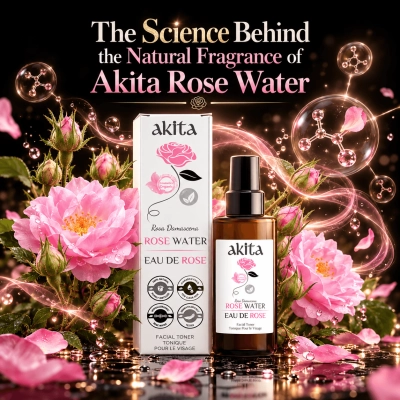
The Science Behind the Natural Fragrance of Akita Rose Water
Why does a natural Rosa damascena distillate smell different from a rose perfume? Discover the aromatic molecules, GC-MS findings, and science behind Akita's distinctive botanical fragrance.
A laboratory instrument cannot smell a rose.
But it can help us understand what makes a rose smell the way it does.
When we experience the fragrance of Rosa damascena, we are not detecting a single substance. Our sense of smell responds to a mixture of volatile molecules, each with its own chemical characteristics and potential contribution to the overall aroma.
Some create familiar floral impressions. Others may introduce fresh, green, or subtly sharp nuances.
This is especially interesting when we examine rose water.
Many people imagine that authentic rose water should smell exactly like a freshly opened rose or a sweet floral perfume.
Yet the chemistry of a botanical distillate tells a more complex story.
At Akita, we have explored this question through laboratory analysis of our Non-De-Oiled Rose Water.
What exactly creates its natural fragrance, and what can science tell us about the scent we experience?
🌹 THE E...
The Science Behind a Single Drop: So Much More Than Rose Water
Explore Akita's Non-De-Oiled Rose Distillate through the lens of science, from its natural chemical compounds and skincare research to stability testing and radio-frequency (RF) measurements.
What do you see when you look at a drop of rose water?
A clear liquid. Perhaps a delicate rose fragrance. Or a traditional botanical product that has been used in beauty and personal care for centuries.
But what happens when we examine that same drop in a laboratory?
Suddenly, an entirely different set of questions emerges.
Which natural molecules does it contain? How can these compounds be identified? How is the product's compatibility with the skin evaluated? How is its stability over time investigated? And beyond chemical analysis, can its physical properties also be measured?
Akita's research into Rosa damascena highlights the importance of looking beyond rose water as a traditional cosmetic product and exploring it as a botanical distillate that can be examined through scientific methods.
🌹 SO MUCH MORE THAN ROSE WATER
For Akita, the value of the rose extends beyond its fragrance. Its botanical identity, na...
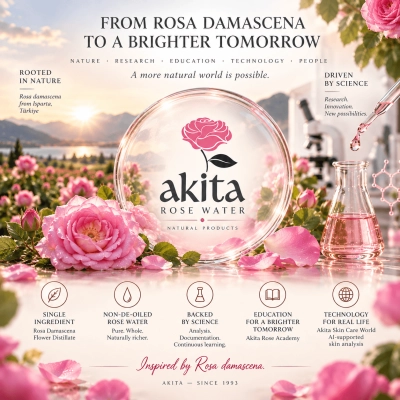
From Rosa damascena to the Future: Akita’s 2025–2026 Journey and Our Vision for 2027
From Non-De-Oiled Rose Water to scientific research, education and Akita Skin Care World: a new chapter in Akita’s journey
Some years represent more than growth for a company. They become periods of reflection—moments when a company looks beyond what it produces and asks deeper questions about what makes it different, what it has learned, and where it wants to go next.
For Akita, 2025 and 2026 have been such years.
Our journey began in 1993 and has been shaped by more than three decades of experience with natural products, botanical ingredients and skin care. At the heart of that journey has remained one remarkable flower:
Rosa damascena.
Over the years, our relationship with this flower has evolved from production into a much broader pursuit of knowledge. We have explored how it is cultivated and harvested, how distillation influences the resulting botanical distillate, how its composition can be studied, and how this knowledge can contribute to the development of natural skin care.
During 2025 and 2026, another dimension was added to this journey:
researching, measuring, documenting, educ...
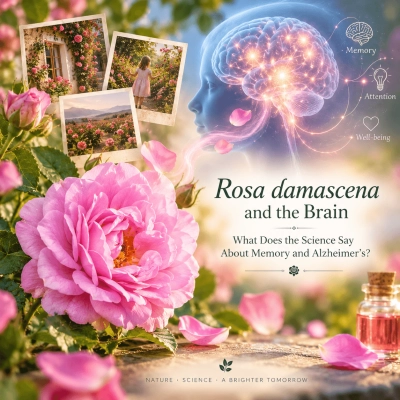
Alzheimer’s disease is usually associated with memory loss, but the scientific picture is much broader. Attention, language, mood, behaviour, orientation, decision-making and the ability to manage everyday activities can also be affected as cognitive decline progresses. This is why researchers studying plants such as Rosa damascena are interested in more than a single question about memory.
Damask rose has now been investigated from several scientific directions. A small controlled human study examined Rosa damascena extract in people with dementia. Experimental Alzheimer-related studies have investigated learning and long-term memory. More recent research has examined Rosa damascena essential oil in relation to the cholinergic system and BDNF—two areas of considerable interest in neuroscience.
Taken together, these studies raise an intriguing question:
Why does Rosa damascena continue to appear in research on cognitive decline, and what have scientists actually found?
This article looks specifically at Alzheimer’s disease, dementia and cognitive research. For the broader science of rose scent, memory, gray matter and olfactory research,...
The value of a rose cannot be explained by its beauty or fragrance alone.
Every year, when the rose harvest begins in Isparta, Türkiye, work in the fields starts before the sun has fully risen. Pink blossoms are picked by hand and transported for processing as soon as possible.
The scientific name of this flower is Rosa damascena.
What makes this rose important is not simply its distinctive fragrance. Its growing environment, harvest timing, aromatic composition, suitability for distillation and long history of use in perfumery, cosmetics and traditional practices have made Rosa damascena one of the world's most important aromatic roses.
But what exactly is Rosa damascena? Is it the same as the Isparta rose? How is it different from other roses? Why are the flowers traditionally harvested early in the morning? And why is this particular rose so highly valued for rose oil and rose water production?
To understand the answers, we need to follow the Isparta rose from the field to the distillation process.
What Is Rosa damascena?
Rosa damascena is an aromatic rose belonging to the genus Rosa in the Rosaceae family. In English, it is commonly known as the Damask rose.
While man...
A rose does not attract scientific attention simply because it smells beautiful.
When researchers study a plant, they ask very different questions:
What compounds does it contain? Can those compounds be identified and measured? What happens when they interact with cells or microorganisms? Are similar effects observed in humans? Does the production method change the final product and its properties?
Rosa damascena—the Damask rose, particularly associated with Isparta, Türkiye—is an intriguing plant because it raises many of these questions at the same time.
Scientific research is not limited to rose essential oil. Rose water, hydrosols, flower extracts, and preparations obtained from different parts of the plant have also been investigated.
🌹 IN SHORT
Rosa damascena is scientifically interesting because of its long history of use, complex chemical composition, the variety of products that can be obtained from it, and the measurable biological activities reported for some of these preparations.
However, the fact that something has been studied does not mean that every claimed benefit has been conclusively proven in humans.
1. It All Begins with the Chemistry of...
Search online for Rosa damascena essential oil, and it will not take long before you encounter statements such as:
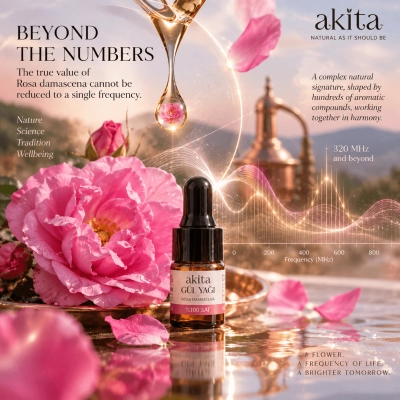
“Rose oil has the highest frequency of any essential oil.” “Rose oil vibrates at 320 MHz.” “It is one of the highest-vibrational natural substances.”
320 MHz.
It sounds remarkably precise.
But from a scientific perspective, that precision raises an important question:
How exactly is the frequency of a bottle of rose oil measured?
With what instrument?
What physical signal is being measured?
Under what conditions?
And why should the result be exactly 320 MHz?
Once we begin asking these questions, the story of rose oil becomes much more interesting.
Because we do not need an unverified number to explain why Rosa damascena is extraordinary.
First, What Does “Frequency” Actually Mean?
In physics, frequency describes how often a repeating event occurs within a given period of time. It is expressed in Hertz (Hz).
Sound waves have frequencies.
Electromagnetic signals have frequencies.
Radio transmissions have frequencies.
Light has electromagnetic frequencies.
But there is an important distinction:
Whenever scientists measure frequency, the...
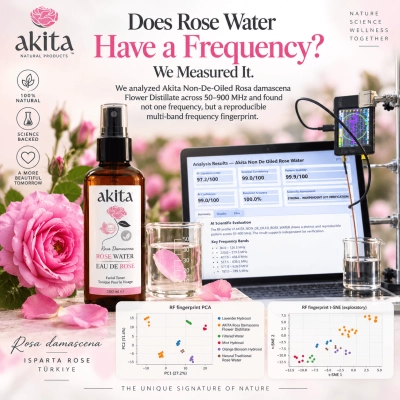
Have you ever wondered, “What is the frequency of rose water?”
If you search online for rose oil and frequency, you will often come across the number 320 MHz. There is, however, an important distinction: this widely circulated claim has been associated with Rosa damascena flower oil, not rose water.
That raised another question for us.
What happens when the naturally carried oil fraction is not separated from the rose distillate? Does Akita Non-De-Oiled Rose Water show one particular frequency when measured?
We decided to investigate.
The result was more interesting than a single number:
We did not find one frequency. We found a reproducible frequency fingerprint.
In Akita's study, Non-De-Oiled Rosa damascena Flower Distillate was examined across 50–900 MHz. The study did not find one isolated characteristic peak at 320 MHz. Instead, discriminative information appeared across multiple frequency regions, producing a reproducible multi-band measurement profile that separated from the other liquids tested in the dataset.
First, an Important Difference: Rose Oil and Rose Water Are Not the Same
When rose flowers are distilled, volatile compounds are carried with the stea...