Articles & Blog
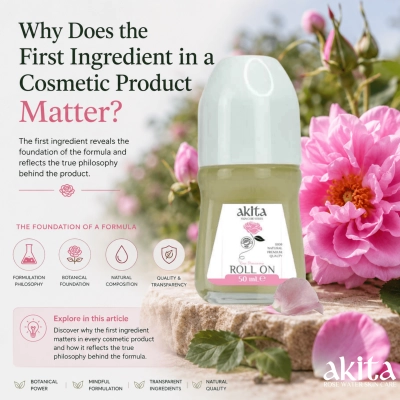
When choosing a roll-on deodorant, most people look at its scent, freshness, or packaging. However, one of the most useful clues about the product is found on the back label: the ingredient list, also known as the INCI list.
Cosmetic ingredients are generally listed from the highest to the lowest concentration. This means that the first ingredient usually makes up the largest portion of the formula and forms its main foundation.
So, why does that matter?
Most Roll-On Deodorants Begin with Water
The ingredient list of many roll-on deodorants begins with Aqua (Water).
Water helps dissolve and distribute the other ingredients evenly. It also gives the product the right consistency and allows it to spread easily across the skin. Using water in a cosmetic formula is completely normal.
However, some thoughtfully designed formulations use a botanical distillate in place of ordinary water.
What Is a Botanical Distillate?
A botanical distillate is a liquid obtained by distilling plants such as rose, lavender, chamomile, or orange blossom.
During distillation, steam carries some of the plant’s naturally occurring aromatic compounds into the resulting liquid. For this reason, a botan...
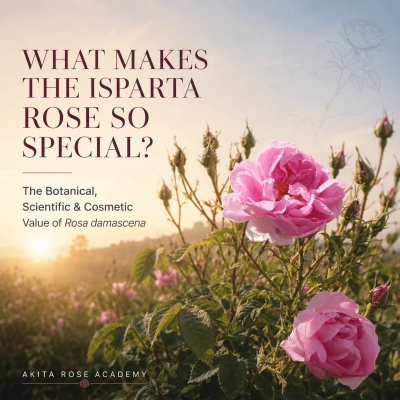
Before sunrise, while the Isparta countryside is still cool and quiet, rose growers begin gathering delicate pink blossoms by hand.
The flowers they collect belong to Rosa damascena—the fragrant oil-bearing rose for which Isparta has become internationally known.
But what makes this rose so valuable?
Its importance cannot be explained by fragrance alone. The botanical variety, growing environment, harvest time, speed of processing and distillation method all influence the character of the resulting rose oil or rose distillate.
To understand the Isparta Rose, we must therefore look beyond the flower and examine the complete journey from field to finished ingredient.
What Is the Isparta Rose?
The name “Isparta Rose” generally refers to Rosa damascena Mill., an aromatic rose cultivated in and around Isparta, Türkiye.
It is also commonly known as:
Damask rose
Oil-bearing rose
Rose of Isparta
Turkish oil rose
Rosa damascena is valued primarily for the aromatic materials contained within its flowers. These materials can be transferred into rose essential oil and the water phase created during distillation.
The flowers are typically pink, densely petalled and in...
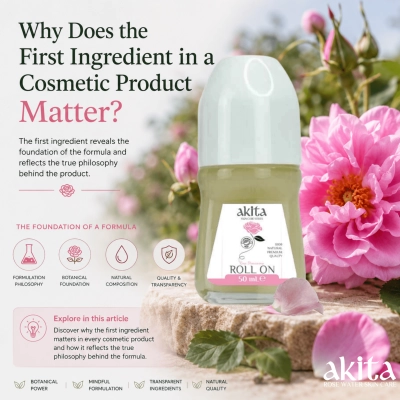
When choosing a roll-on deodorant, most people focus on its fragrance, how long it lasts, or the design of the packaging. However, one of the most important indicators of a product's formulation is often found on the back label, its INCI ingredient list.
In cosmetic products, ingredients are generally listed in descending order by weight. This means the first ingredient represents the largest portion of the formula and forms the foundation of the product.
So why does the first ingredient matter so much?
Most Roll-On Deodorants Are Primarily Water-Based
If you examine the ingredient lists of many roll-on deodorants, you will notice that the first ingredient is Aqua (Water).
There is a good reason for this.
Water serves as the primary solvent and carrier in cosmetic formulations. It helps dissolve ingredients, creates the desired consistency, and provides the liquid phase that allows the formula to function properly.
In other words, water forms the structural base of many cosmetic products.
Today, however, some premium formulations take a different approach.
Can the Carrier Phase Be Botanical Instead of Water?
Yes.
Rather than using water as the primary ingredient, som...
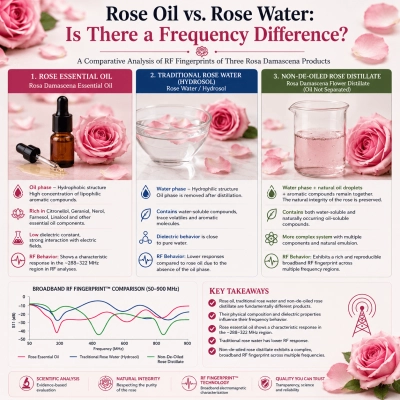
Rose Oil vs. Rose Water: Is There a Frequency Difference?
Why AKITA's Non-De-Oiled Rosa Damascena Flower Distillate May Exhibit a Richer RF Fingerprint Than Rose Essential Oil
Key Takeaway
For decades, the discussion has focused on the reported 320 MHz frequency of Rosa damascena essential oil. Almost nobody asked whether rose water itself has a measurable RF fingerprint. Our research began with that simple question—and the answer surprised even us.
Introduction
If you search online for the phrase "rose oil frequency," you will quickly encounter one familiar number:
320 MHz.
Whether this value is interpreted literally or symbolically, it has long been associated with Rosa damascena essential oil.
However, this raises an interesting question.
If rose essential oil has been discussed for decades from a frequency perspective, what about rose water?
Surprisingly, almost no one has explored this question scientifically.
Even more intriguing is another possibility:
What happens when the natural rose oil is never removed from the distillate?
Until we began our RF Fingerprint™ research,...
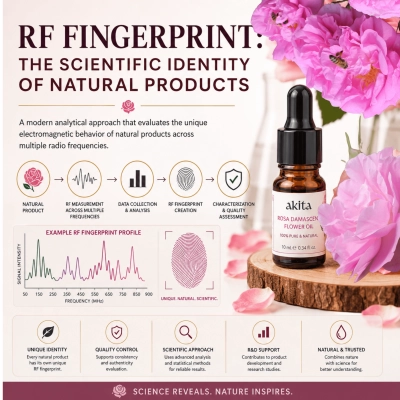
What Is RF Fingerprint?
Understanding the Scientific Identity of Natural Products Through Multi-Frequency Analysis
Could Natural Products Have Their Own Fingerprints?
Imagine arriving at an airport.
Instead of showing your passport, you simply place your finger on a scanner. Within seconds, the system recognizes you—not because of your name, your photograph, or your nationality, but because your fingerprint is unlike anyone else's.
A fingerprint is more than just a pattern. It is a unique identifier.
Now imagine applying the same idea to nature.
Could a bottle of Rosa damascena flower oil, a lavender essential oil, or a botanical distillate also possess a unique identity?
Not a fingerprint made of ridges and lines, of course, but a distinctive scientific profile that reflects how the material behaves under carefully controlled laboratory conditions.
This question has become increasingly relevant as analytical technologies continue to evolve.
For decades, researchers have relied on chemical analysis to understand natural products. Techniques such as Gas Chromatography–Mass Spectrometry (GC-MS) have made it possible to identify hundreds...
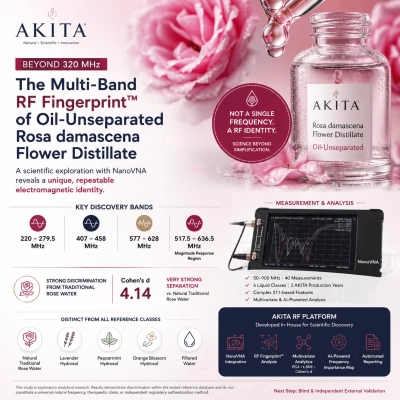
From the 320 MHz Hypothesis to a Multi-Band RF Fingerprint: New Findings from the AKITA Rosa Damascena Flower Oil Study
Broadband S11 analysis reveals that AKITA Rosa Damascena Flower Oil exhibits a reproducible multi-band RF fingerprint spanning 288–322 MHz, providing a broader scientific perspective beyond the traditionally referenced 320 MHz frequency.
Scientific knowledge advances through observation, measurement, and refinement. As new data become available, existing hypotheses are revisited, expanded, and strengthened.
Our latest broadband RF (Radio Frequency) investigation of AKITA Rosa Damascena Flower Oil follows this scientific principle. Rather than focusing on a single frequency, the study explores the product's electromagnetic behavior across a wide frequency spectrum using standardized S11 measurements.
The findings suggest that the electromagnetic identity of AKITA Rosa Damascena Flower Oil is better represented by a multi-band RF fingerprint than by a single natural frequency.
Why Revisit the 320 MHz Hypothesis?
For many years, 320 MHz has frequently been associated with Rosa Damascena essential oil in various publications and discussions.
While this refere...
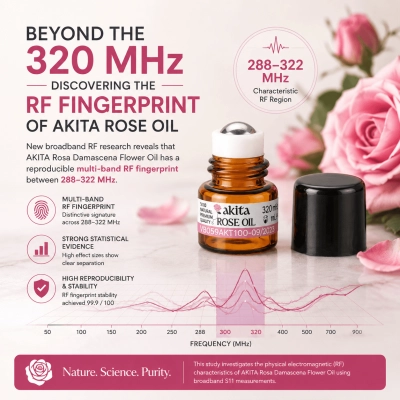
Is Rose Oil Really 320 MHz? What New Scientific Research Reveals
Beyond the 320 MHz Claim: A New Perspective on the RF Fingerprint of Rosa damascena Flower Distillate
For many years, one statement has been widely shared across aromatherapy and natural wellness communities:
"Rose vibrates at 320 MHz."
This claim has become one of the most frequently repeated facts about Rosa damascena, often presented as evidence of the flower's unique energetic properties.
But where did this number come from? Does it apply to all rose-based products, including rose water? And what happens when modern radio-frequency (RF) analysis is used to investigate this long-standing claim?
A recent exploratory study offers a different perspective. Rather than identifying a single dominant frequency, researchers observed that a non-de-oiled Rosa damascena flower distillate exhibited a reproducible multi-band RF fingerprint across a broad frequency range.
Where Did the 320 MHz Claim Originate?
An important distinction is often overlooked.
Historically, the widely quoted 320 MHz value has generally been associated with Rosa Damascena Flower Oil, the essential oil obtained during steam distillatio...

Free AI Skin Analysis & Cosmetic Ingredient Safety Checker with the Akita Skincare App
Smarter Skincare Starts with Better Information
Choosing the right skincare products has never been more challenging. Thousands of products promise healthier skin, yet understanding ingredient lists and finding products that truly suit your skin can feel overwhelming.
The Akita Skincare World mobile app was created to make skincare decisions easier. By combining AI-powered skin analysis with an ingredient safety scanner, the app helps you better understand both your skin and the products you use every day.
Whether you're shopping for a new moisturizer or building a personalized skincare routine, reliable information is now just a few taps away.
📦 Free AI Skin Analysis
Every person's skin is unique, and effective skincare begins with understanding your own skin.
Using your smartphone camera, the Akita app analyzes your skin and provides personalized insights based on its visible condition.
What the AI Skin Analysis Can Help You Discover
✔ Your skin type
✔ Visible skin characteristics
✔ Personalized skincare recommendations
✔ Suggested daily skincare routine
✔ Progress tracking over...
Pure Rosa Damascena rose essential oil is one of the most precious botanical oils in the world. It takes thousands of fresh rose petals to produce even a small amount of this aromatic oil, which is why every drop should be used thoughtfully.
Akita Rose Essential Oil is produced from Rosa Damascena roses grown in Isparta, Türkiye, a region known for its exceptional rose heritage. Because this oil is highly concentrated, a little truly goes a long way.
Many people wonder:
“Is 1 gram of rose oil enough?”
The answer is yes — when used correctly, even one small bottle can last much longer than expected.
How Many Drops Are in 1 Gram of Rose Essential Oil?
The exact number of drops may vary depending on the dropper, temperature, and natural viscosity of the oil.
As a general guide:
1 mL of essential oil usually contains about 20–30 drops.
Rosa Damascena essential oil has a density of approximately 0.85–0.90 g/mL.
This means that 1 gram of pure Rosa Damascena rose oil usually provides approximately 22–28 drops.
On average, a 1 gram bottle contains about 25 drops of pure rose essential oil.
But the real value is not only in the number of drops. It is in the strength, purity, a...
If you've searched for Rosa Damascena essential oil online, you've probably come across claims such as:
"Rose oil has the highest vibration of any essential oil."
"Rose essential oil vibrates at 320 MHz."
"It has the highest energetic frequency in nature."
These statements are widely shared across websites and social media, but they raise an important question:
Can the frequency of an essential oil actually be measured?
Understanding the answer helps us appreciate the true value of Rosa Damascena essential oil—not through myths, but through science.
What Is Frequency?
In physics, frequency describes how many times an event repeats in one second.
It is measured in Hertz (Hz).
Many physical phenomena have measurable frequencies, including:
Sound waves
Radio signals
Electrical currents
Light waves
All of these produce measurable physical oscillations that can be detected with specialized instruments.
📌 Quick Fact
A measurable frequency always refers to a specific physical signal. Without a repeating physical phenomenon, there is no meaningful frequency to measure.
Does a Plant Have One Single Frequency?
The short answer is:
No.
A living plant...