What Makes the Isparta Rose So Special?
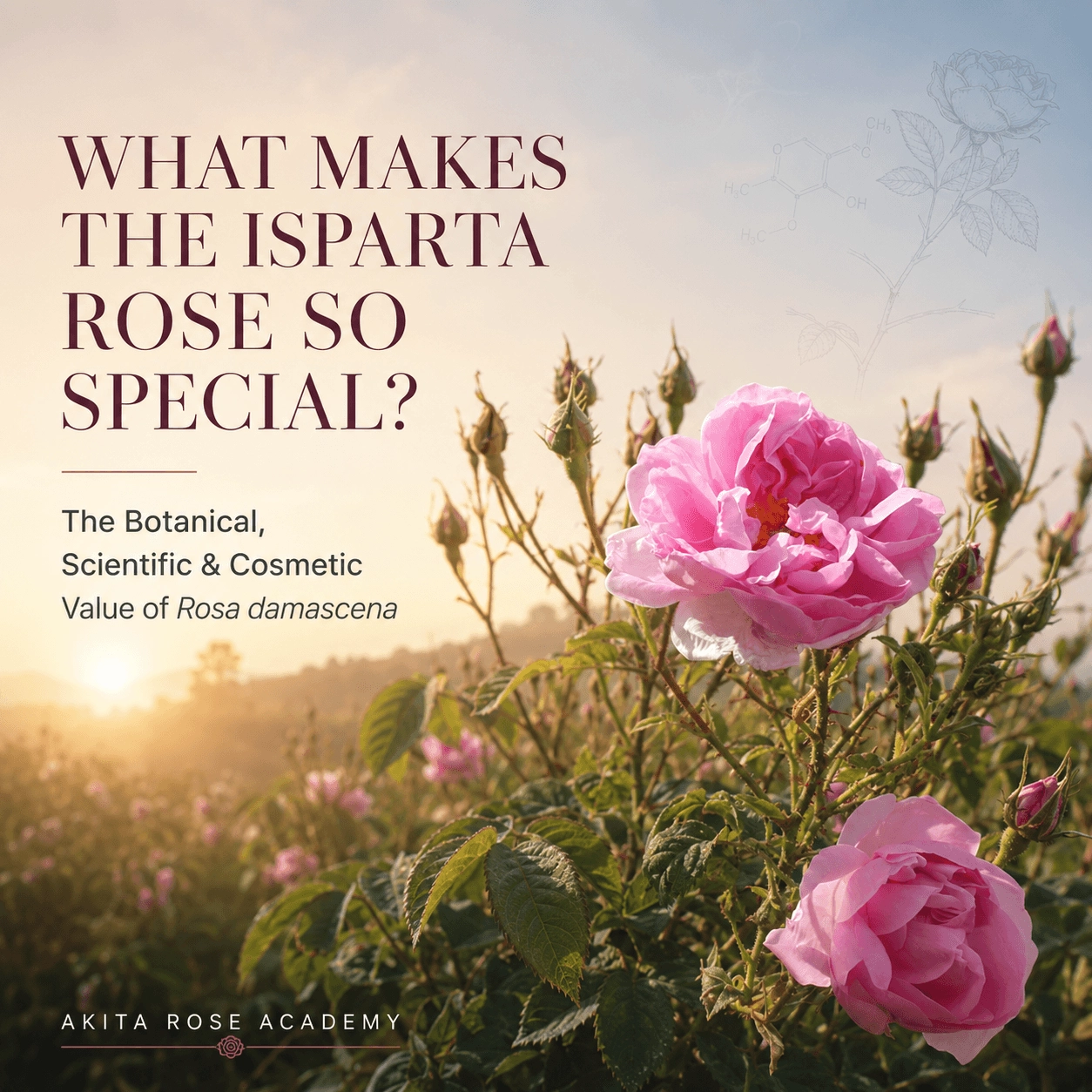
Before sunrise, while the Isparta countryside is still cool and quiet, rose growers begin gathering delicate pink blossoms by hand.
The flowers they collect belong to Rosa damascena—the fragrant oil-bearing rose for which Isparta has become internationally known.
But what makes this rose so valuable?
Its importance cannot be explained by fragrance alone. The botanical variety, growing environment, harvest time, speed of processing and distillation method all influence the character of the resulting rose oil or rose distillate.
To understand the Isparta Rose, we must therefore look beyond the flower and examine the complete journey from field to finished ingredient.
What Is the Isparta Rose?
The name “Isparta Rose” generally refers to Rosa damascena Mill., an aromatic rose cultivated in and around Isparta, Türkiye.
It is also commonly known as:
- Damask rose
- Oil-bearing rose
- Rose of Isparta
- Turkish oil rose
Rosa damascena is valued primarily for the aromatic materials contained within its flowers. These materials can be transferred into rose essential oil and the water phase created during distillation.
The flowers are typically pink, densely petalled and intensely fragrant. Their commercial value comes not simply from their appearance, but from their distinctive aromatic composition and their importance in perfumery, cosmetics and botanical research.
🌹 Rose Academy Note
Not every fragrant pink rose is Rosa damascena. The botanical species, cultivation conditions and production records should be considered when determining the identity of a rose-derived ingredient.
A Rose Shaped by Its Growing Region
The characteristics of an aromatic plant are influenced by more than its botanical name. Climate, soil, altitude, rainfall, temperature and agricultural practices can all affect its development.
Isparta offers conditions associated with the long-established cultivation of oil-bearing roses:
- Cool nights during the flowering season
- Moderate daytime temperatures
- Seasonal differences between day and night
- Suitable agricultural soils
- Generations of rose-growing experience
- A production culture developed around rapid harvesting and distillation
Research comparing Rosa damascena cultivated in different Turkish regions has found differences in essential-oil composition and plant structures. This supports an important principle: the same botanical species may not produce an identical chemical profile in every location. Sakarya University Journal of Science
Does Geography Determine Everything?
No. Geography is important, but it is only one part of the story.
The final product may also be affected by:
- The condition and age of the plants
- Weather during the flowering season
- The time of harvest
- How long the flowers wait before processing
- The ratio of flowers to water
- Distillation duration and pressure
- Whether the natural oil phase is separated
- Storage and packaging conditions
The value of the Isparta Rose therefore comes from the relationship between nature, agricultural knowledge and production technique.
Why Are Isparta Roses Harvested Early in the Morning?
Rose harvesting often begins before or shortly after sunrise.
This is not merely a romantic tradition. Rose flowers contain volatile aromatic materials, and their condition changes as the temperature rises.
During the cooler hours of the morning:
- The flowers are less exposed to daytime heat.
- Their delicate aromatic profile may be better preserved.
- Freshly opened blossoms can be collected before prolonged sun exposure.
- The harvested flowers can reach the distillation facility earlier.
As the day becomes warmer, volatile compounds may be lost or altered. For this reason, both harvesting time and the interval between harvesting and processing matter.
The flowers are generally transported for distillation as quickly as possible. A carefully grown rose can still lose part of its value if it remains waiting too long after harvest.
🌿 Did You Know?
The quality of a rose-derived ingredient begins in the field. Distillation cannot fully compensate for flowers that were harvested or handled under unsuitable conditions.
The Chemical Richness of Rosa damascena
The fragrance of Rosa damascena does not come from a single molecule. It results from a complex relationship among numerous volatile and non-volatile components.
Rose essential oil may contain aromatic compounds such as:
- Citronellol
- Geraniol
- Nerol
- Phenethyl alcohol
- Linalool
- Various hydrocarbons and trace constituents
The proportions of these components are not permanently fixed. They may vary according to the growing region, harvest period, environmental conditions and distillation technique.
This is one reason natural rose oil cannot be understood simply as “rose fragrance.” Its chemical profile reflects both the plant and the process used to transform it.
Why Does Chemical Variation Matter?
Chemical variation can influence:
- Fragrance character
- Product consistency
- Stability
- Cosmetic formulation
- Quality-control results
- The interpretation of scientific studies
A study conducted with one rose oil or extract does not automatically describe every product carrying the name Rosa damascena.
What Does Science Say About Rosa damascena?
Rosa damascena has attracted scientific attention because of its traditional uses, aromatic composition and possible biological activities.
The literature includes:
- Laboratory studies
- Animal studies
- Human clinical research
- Chemical-composition analyses
- Reviews and meta-analyses
Laboratory research has reported antioxidant, antimicrobial and other biological activities in certain Rosa damascena preparations. Human studies have also investigated areas such as anxiety, stress, pain and aromatherapy.
For example, a systematic review and meta-analysis examined randomized controlled trials involving Rosa damascena for anxiety, depression and stress. However, the results must still be interpreted according to the preparation, dose, method of application and quality of the individual studies. PubMed systematic review
An Important Scientific Distinction
The existence of research does not mean that every possible benefit has been clinically proven.
Scientific findings may differ according to:
- Whether rose oil, rose water, extract or another preparation was studied
- The concentration used
- Whether the study was performed in a laboratory or with human participants
- The route of application
- The size and duration of the study
- The quality and origin of the botanical material
🔬 What Science Tells Us
Rosa damascena is a scientifically relevant botanical with a growing body of research. Nevertheless, evidence should be evaluated product by product and application by application.
Rose Oil and Rose Distillate Are Not the Same
Rose oil and rose distillate originate from the same flower, but they are not chemically identical.
Rose Essential Oil
Rose essential oil is the concentrated oil phase obtained during distillation. It contains many of the flower’s oil-soluble and volatile aromatic compounds.
Because it is highly concentrated, it is normally used in carefully controlled quantities within perfumes, cosmetics and aromatherapy preparations.
Rose Distillate
Rose distillate is the water phase produced through the distillation of rose flowers. It contains compounds capable of transferring into or remaining dispersed within this phase.
Its character depends heavily on the purpose and conditions of production.
Traditional Rose-Water Production
In systems designed primarily to produce rose oil, the oil phase is separated as the principal product. The remaining aromatic water may then be bottled and sold as rose water.
Non-De-Oiled Rose Distillate
A different approach is possible when the rose distillate itself is designed as the main product.
In this model, distillation time, pressure and other production conditions are arranged specifically for the distillate, and the naturally occurring rose oil is not separated from the finished water phase.
This distinction is central to Akita’s Non-De-Oiled Rose Distillate approach, developed in 2003.
⚠️ Common Misconception
“Rose oil and rose water provide the same composition in different strengths.”
This is incorrect. Oil and water phases retain different groups and proportions of compounds. Production method—not simply dilution—determines the character of the finished ingredient.
Why Is Rosa damascena Used in Cosmetics?
Rosa damascena is appreciated in cosmetic formulation for several reasons.
Its Distinctive Aromatic Profile
Its fragrance is complex, floral and immediately recognizable. For this reason, it has a long history in fine perfumery and scented personal-care products.
Its Botanical Identity
Consumers increasingly want to know which plant species an ingredient comes from. The INCI name helps identify the material more precisely than a general term such as “rose water.”
For example, the INCI name of a genuine rose flower distillate may appear as:
Rosa Damascena Flower Distillate
Its Formulation Potential
Depending on its form, Rosa damascena may be incorporated into:
- Facial mists
- Toners
- Moisturizers
- Serums
- Cleansers
- Body-care products
- Hair-care products
- Perfumes
However, the quality and safety of a cosmetic product cannot be determined by one attractive ingredient alone. The complete formulation, concentration, microbiological quality, production standards and safety testing must all be considered.
Does “Natural” Automatically Mean Safe?
No.
Natural origin does not, by itself, prove that an ingredient is suitable for every person or every method of use.
Essential oils are concentrated aromatic materials. When applied improperly or at excessively high concentrations, some may cause irritation or allergic contact dermatitis in susceptible individuals. Undiluted essential oils should therefore not automatically be applied directly to the skin. DermNet guidance on essential oils
A responsible cosmetic product should consider:
- Appropriate concentration
- Compatibility with the complete formula
- Ingredient purity
- Good manufacturing practices
- Stability and microbiological quality
- Intended area of application
- Relevant safety testing
- Clear usage instructions
⚠️ Correcting a Common Belief
Myth: If an ingredient is natural, it is always harmless.
Fact: Safety depends on identity, quality, concentration, formulation and method of use—not simply on whether an ingredient is natural or synthetic.
Is Rosa damascena Automatically a “Clean Beauty” Ingredient?
“Clean beauty” is a popular marketing term, but it does not have one universally binding scientific or legal definition.
Rosa damascena can be an important botanical ingredient in naturally oriented formulations. However, the presence of rose oil or rose distillate does not automatically make an entire product safe, sustainable or scientifically validated.
A more reliable evaluation should examine:
- The complete ingredient list
- Traceability of raw materials
- Manufacturing standards
- Product safety assessments
- Test results
- Transparent labeling
- Responsible claims
The word “clean” should never replace evidence.
Türkiye’s Opportunity: From Raw Material to Scientific Value
Türkiye’s value is not limited to growing beautiful roses. Its deeper opportunity lies in combining agricultural experience with:
- Botanical research
- Advanced chemical analysis
- Product standardization
- Traceable production
- Responsible cosmetic innovation
- Modern quality-control technologies
- Higher-value finished products
The future of the Isparta Rose depends on understanding and documenting it more precisely.
A rose should not be valued only by the weight of flowers collected or the amount of oil produced. Its agricultural origin, chemical identity, distillation history and intended application all deserve scientific attention.
Transforming this knowledge into carefully characterized ingredients and responsible finished products can create greater value for growers, producers, researchers and consumers.
The Most Frequently Asked Question
Is every product labeled “rose water” the same?
No.
Two rose waters may differ significantly even when both are associated with Rosa damascena. Differences may arise from:
- The identity and origin of the flowers
- The amount of plant material used
- Harvest and transportation conditions
- Whether the product was genuinely distilled
- Distillation duration and pressure
- Whether the natural rose oil was separated
- The use of added fragrance, water or preservatives
- Storage and packaging
For this reason, consumers should examine the INCI list, manufacturing information and available quality documentation instead of relying solely on the words “rose water” on the front label.
Common Myths About the Isparta Rose
Myth 1: Every pink fragrant rose is Rosa damascena
Fact: Many rose varieties can look or smell similar. Botanical identification is essential.
Myth 2: All rose waters have the same composition
Fact: Origin, flower quantity, distillation conditions and oil separation can produce very different profiles.
Myth 3: Rose oil and rose distillate are interchangeable
Fact: They represent different phases of distillation and contain different proportions of compounds.
Myth 4: A PubMed-listed study proves every commercial product works
Fact: Research findings apply to the material, concentration and conditions studied. They cannot automatically be transferred to every product.
Myth 5: Natural rose oil can always be applied directly to the skin
Fact: Essential oils are concentrated and should be used at appropriate levels in properly designed formulations.
Myth 6: “Clean beauty” guarantees safety
Fact: Safety depends on formulation, quality, testing and proper use—not an undefined marketing label.
Did You Know?
The botanical name on a cosmetic label can reveal more than the word “rose” alone.
Names such as Rosa Damascena Flower Oil and Rosa Damascena Flower Distillate describe different ingredients. Reading the complete INCI list helps consumers understand whether they are looking at an essential oil, distillate, extract, fragrance mixture or more complex formulation.
Chapter Summary
- The Isparta Rose is generally identified as Rosa damascena Mill.
- Its value comes from more than its fragrance.
- Geography, climate and agricultural experience influence the flowers.
- Early-morning harvesting helps protect delicate aromatic materials.
- Rapid processing after harvest is important.
- Rose composition may vary between regions, seasons and production methods.
- Scientific research includes laboratory, animal and human studies.
- Scientific evidence must be interpreted according to the specific preparation studied.
- Rose essential oil and rose distillate are not identical.
- Not every rose water is produced in the same way.
- A natural ingredient is not automatically safe in every concentration.
- Transparent labeling, testing and production standards matter.
- Türkiye can create greater value by combining rose cultivation with research and innovation.
Frequently Asked Questions
1. What is the scientific name of the Isparta Rose?
The Isparta oil-bearing rose is generally identified as Rosa damascena Mill.
2. Is the Isparta Rose the same as the Damask rose?
The term “Damask rose” is commonly used for Rosa damascena. “Isparta Rose” emphasizes the plant’s cultivation and cultural connection with the Isparta region of Türkiye.
3. Why is Rosa damascena valuable?
It is valued for its complex fragrance, aromatic composition, historical use, cosmetic potential and importance in rose-oil and distillate production.
4. Why are the flowers collected early in the morning?
Cool morning conditions can help protect volatile aromatic materials before the flowers experience prolonged daytime heat.
5. Why must harvested roses be processed quickly?
The flowers remain biologically and chemically active after harvesting. Delays and heat exposure can affect their aromatic character and the quality of the distilled material.
6. Are rose oil and rose water the same ingredient?
No. Rose oil is the concentrated oil phase, while rose distillate is the water phase produced during distillation. Their compositions and uses differ.
7. Is rose water always a by-product of rose-oil production?
Not always. In conventional oil-focused production it may be treated as a secondary product. In a distillate-focused process, however, the water phase can be designed as the principal product from the beginning.
8. What does “non-de-oiled rose distillate” mean?
It describes a rose distillate produced without separating the naturally occurring rose-oil phase from the intended finished distillate.
9. Does every Rosa damascena product offer the same properties?
No. The plant’s origin, production method, concentration, storage and complete formulation can all affect the finished product.
10. Has Rosa damascena been scientifically studied?
Yes. Laboratory, animal and human studies have examined different preparations of Rosa damascena. However, the strength and relevance of the evidence vary by application.
11. Does a PubMed publication prove that every rose product is effective?
No. PubMed indexes scientific publications; it does not approve commercial products. Findings must be evaluated in relation to the particular material and conditions studied.
12. Can rose essential oil be applied directly to the skin?
Undiluted essential oils may irritate or sensitize some individuals. Rose oil should be used at an appropriate concentration within a properly formulated product.
13. How can consumers identify a genuine rose distillate?
They should examine the full ingredient list, botanical name, manufacturer information, production transparency and available quality documentation. A suitable INCI designation may be Rosa Damascena Flower Distillate.
14. Does natural automatically mean safe?
No. Safety depends on ingredient identity, purity, concentration, formulation, testing and appropriate use.
15. What truly makes the Isparta Rose special?
It is the combination of Rosa damascena’s botanical identity, Isparta’s growing conditions, early-morning harvesting, generations of production knowledge and carefully controlled distillation that gives the rose its distinctive value.
Conclusion: More Than a Beautiful Flower
The Isparta Rose is more than a symbol of beauty or a source of fragrance.
It represents the meeting point of botany, geography, agricultural knowledge, distillation expertise and modern science. Its true value cannot be understood by looking only at the flower—or by assuming that every product carrying the word “rose” is the same.
To understand Rosa damascena properly is to follow its entire journey: from the cool Isparta fields before sunrise to the production decisions that determine what ultimately reaches the bottle.
That complete journey is what makes the Isparta Rose truly special.

Comment