What Is Rosa damascena? A Scientific Guide to the Isparta Rose
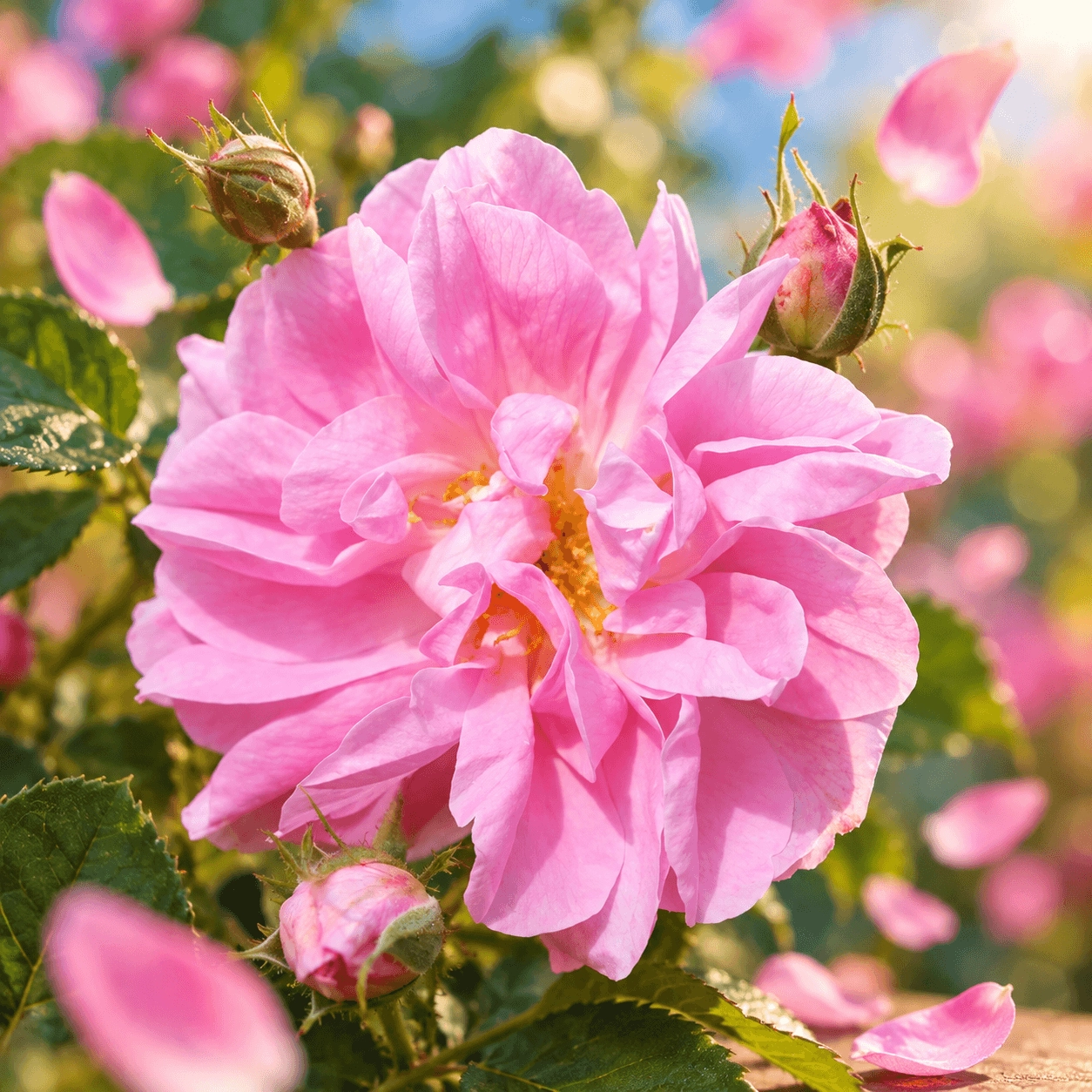
The value of a rose cannot be explained by its beauty or fragrance alone.
Every year, when the rose harvest begins in Isparta, Türkiye, work in the fields starts before the sun has fully risen. Pink blossoms are picked by hand and transported for processing as soon as possible.
The scientific name of this flower is Rosa damascena.
What makes this rose important is not simply its distinctive fragrance. Its growing environment, harvest timing, aromatic composition, suitability for distillation and long history of use in perfumery, cosmetics and traditional practices have made Rosa damascena one of the world's most important aromatic roses.
But what exactly is Rosa damascena? Is it the same as the Isparta rose? How is it different from other roses? Why are the flowers traditionally harvested early in the morning? And why is this particular rose so highly valued for rose oil and rose water production?
To understand the answers, we need to follow the Isparta rose from the field to the distillation process.
What Is Rosa damascena?
Rosa damascena is an aromatic rose belonging to the genus Rosa in the Rosaceae family. In English, it is commonly known as the Damask rose.
While many roses are cultivated primarily for their ornamental beauty, Rosa damascena has significant economic value because of its aromatic characteristics. Its flowers are an important raw material for the production of rose oil, rose water and other rose-derived ingredients.
In Türkiye, Rosa damascena is particularly associated with Isparta, a region internationally recognized for its long-established rose-growing and distillation tradition.
In brief:
Rosa damascena is much more than an ornamental rose. Its aromatic composition makes it an important cultivated plant for perfumery, cosmetics and the wider rose industry.
Are Rosa damascena and the Isparta Rose the Same?
The term “Isparta rose” is commonly used for the aromatic oil-bearing rose cultivated in Isparta and the surrounding region, particularly Rosa damascena.
There is, however, an important distinction.
Rosa damascena is the botanical name of the rose, while “Isparta rose” connects the plant with a particular growing region, production tradition and cultural identity.
A rose is therefore not automatically Rosa damascena simply because it is pink or has a strong fragrance.
There are thousands of rose varieties, cultivars and hybrids, and they can differ considerably in their botanical characteristics, fragrance profiles and intended uses.
What Does Rosa damascena Look Like?
Rosa damascena is a perennial shrub. The flowers used for aromatic production are generally pink, fragrant and composed of numerous petals.
Yet its economic importance lies less in its appearance than in the volatile and aromatic compounds present in its flowers.
When we smell a rose, what we perceive as “rose fragrance” does not come from a single molecule. It is the result of a complex combination of numerous chemical compounds.
For this reason, the botanical species is only one part of the story. Other factors may also influence the characteristics of the harvested flowers and the products obtained from them, including:
geographic growing region,
climate and soil conditions,
stage of flower maturity,
harvest time,
time between harvesting and processing,
and the production or distillation method.
Why Isn't Every Rose a Rosa damascena?
The roses we see in gardens, flower shops and parks do not all belong to the same botanical species.
Alongside Rosa damascena, there are species such as Rosa centifolia, Rosa gallica and Rosa alba, as well as numerous hybrids and cultivated varieties.
Some roses are bred mainly for appearance, others for hardiness or repeat flowering, while certain roses are particularly valued for fragrance and aromatic processing.
This distinction is also relevant when evaluating rose-based cosmetic and aromatic products.
Seeing the word “rose” on a label does not necessarily tell you which botanical species was used.
The botanical identity of the rose matters.
Why Is Isparta So Closely Associated with Roses?
The characteristics of an aromatic plant are influenced not only by genetics but also by the environment in which it grows.
In Isparta and its surrounding rose-growing areas, factors such as altitude, temperature patterns, rainfall, soil conditions and the climate during flowering and harvest all form part of the growing environment.
But geography alone does not explain Isparta's relationship with roses.
Over generations, the region has also developed a deeply rooted culture of rose cultivation and distillation. Knowledge of when to harvest, how to handle freshly picked flowers and how to process them has become part of local agricultural expertise.
Understanding the Isparta rose therefore requires looking at three elements together:
Plant + place + production knowledge.
When Does Rosa damascena Bloom?
In Isparta, the rose harvest is concentrated within a relatively short period, generally around late spring and early summer.
The exact beginning and duration of the season can vary from year to year depending on temperature, rainfall, altitude and local weather conditions.
This short flowering window creates an intense harvest period.
Rose flowers cannot simply be left indefinitely on the plant once they reach the appropriate stage for harvesting. They need to be collected at the right stage and then handled appropriately.
This is one reason why the Isparta rose harvest becomes such a concentrated period of activity each year.
Why Are Rosa damascena Flowers Harvested Early in the Morning?
One of the most recognizable traditions of the Isparta rose harvest is the early start.
Flowers are commonly picked during the cool morning hours.
This practice is not based on tradition alone.
In aromatic plants, the amount and composition of volatile compounds may be influenced by environmental conditions. Temperature, sunlight, stage of flower development and harvesting time can all be relevant.
Scientific studies on oil-bearing roses have examined how factors such as flower maturity, harvesting time and post-harvest handling may influence essential oil yield and composition.
As temperatures rise during the day, conditions around the flower change. Harvesting during the cooler morning period is therefore an important part of aromatic rose production.
Rose quality cannot be understood by asking only, “Which rose is it?”
We should also ask: “Where was it grown?”, “At what stage was it harvested?”, “What time was it picked?” and “How quickly was it processed?”
Why Does the Time Between Harvesting and Processing Matter?
Once a rose flower is separated from the plant, another stage of the production process begins.
The harvested flowers are no longer supported by the living plant. Storage time, temperature and transportation conditions can influence the raw botanical material.
For this reason, good rose production involves more than harvesting at the appropriate time. Managing the period between harvesting and processing is also important.
This reveals something fundamental about botanical products:
Quality does not begin inside the bottle.
It begins in the field and develops through an entire chain of cultivation, harvesting, transportation and processing decisions.
What Gives Rosa damascena Its Fragrance?
The fragrance of Rosa damascena is not produced by a single compound.
Depending on the material and analytical method being studied, researchers may identify numerous volatile and fragrance-related compounds. Some frequently discussed compounds include:
Citronellol: An important contributor to the characteristic floral and rosy aroma.
Geraniol: Associated with sweet, floral and rose-like aromatic notes.
Nerol: Contributes fresh and floral characteristics to the fragrance profile.
Linalool: A floral aromatic compound also found in many other fragrant plants.
2-Phenylethanol (Phenethyl Alcohol): Strongly associated with rose fragrance and particularly relevant to the aromatic profile of the water phase.
The proportions of these compounds are not necessarily identical in every Rosa damascena sample.
Geography, growing conditions, harvest year, flower maturity and processing or analytical methods can all influence the profile observed.
For this reason, it is more scientifically accurate to discuss the chemical profile of a particular sample under defined conditions rather than assuming that every Rosa damascena product has exactly the same composition.
What Products Are Made from Rosa damascena?
A Rosa damascena flower can be transformed into much more than rose oil.
Depending on the processing method, the flower may be used to produce:
Rose Essential Oil: A highly concentrated aromatic oil typically obtained through water or steam distillation.
Rose Water / Rose Distillate: The aromatic water phase produced during distillation.
Rose Concrete: A concentrated aromatic material obtained through appropriate extraction processes.
Rose Absolute: A highly aromatic material particularly valued in perfumery.
Dried Rose Flowers and Petals: Used in various food, botanical and traditional applications.
Rose Wax and Other Rose-Derived Materials: Products that may be recovered or developed through different processing methods.
Rose Biomass: Plant material remaining after distillation, which is increasingly being investigated for potential uses within more sustainable and circular production systems.
These products are not interchangeable.
The production method influences which components of the original flower are represented in the final material.
Are Rose Oil and Rose Water the Same Thing?
No.
Although rose oil and rose water can originate from the same Rosa damascena flowers, they are chemically distinct products.
During distillation, compounds distribute differently between the oil and water phases according to their chemical properties.
For this reason, it is inaccurate to think of rose water simply as “diluted rose oil.”
Rose water is a distinct distillation product with its own chemical profile.
Production methods may also differ according to whether the oil phase is subsequently separated from the rose water.
This distinction is central to Akita's Non-De-Oiled Rose Water approach, in which the naturally occurring oil fraction is not subsequently separated from the rose distillate.
Why Is Rosa damascena Studied by Scientists?
Rosa damascena has attracted scientific interest not only because of its traditional uses but also because of its complex chemistry and potential biological properties.
Research involving Rosa damascena and its different preparations has explored areas such as:
essential oil composition,
aromatic compounds,
antioxidant activity,
interactions with microorganisms,
skin and cosmetic applications,
olfactory perception,
stress and emotional responses,
learning and memory.
An important distinction is necessary, however.
A biological effect observed in a laboratory does not automatically mean that the same effect will occur in humans.
Cell studies, animal studies, observational research and controlled human trials provide different levels and types of evidence.
For this reason, scientific discussions about Rosa damascena should distinguish between traditional use, laboratory findings and evidence obtained from human research.
Good science is not simply about reporting positive findings. It is also about understanding how strong the evidence is and what conclusions the research can—and cannot—support.
What Should You Look for When Choosing a Rosa damascena Product?
A rose image on a package or the word “rose” in a product name does not provide enough information to understand the raw material.
When evaluating a rose-based product, consider questions such as:
Is the botanical identity of the rose clearly stated?
Does the product actually contain Rosa damascena?
Is the ingredient list transparent?
If it is rose water, is the production method explained?
Does it contain only rose distillate, or have other ingredients been added?
Does the manufacturer provide verifiable quality and safety information?
Are technical or scientific claims supported by appropriate testing, analysis or research?
Terms such as “natural,” “pure” and “made with rose” are not, by themselves, proof of quality.
Transparent information about ingredients, production and testing is far more useful.
Why Is Rosa damascena Important to Akita?
Akita's relationship with the rose extends beyond simply using rose as a cosmetic ingredient.
At the centre of Akita's work is Rosa damascena grown in Isparta and an approach focused on understanding and preserving the rose distillate as a more complete product of the distillation process.
Over time, this philosophy became the foundation of Akita's Non-De-Oiled Rose Water.
From botanical identity and growing region to harvesting, distillation, chemical analysis and product safety, each stage is part of a larger question:
How well can we understand and preserve what the Rosa damascena flower gives us through distillation?
There Is More to a Rose Than Meets the Eye
From a distance, a Rosa damascena flower may appear to be simply a beautiful pink blossom.
Look more closely through the lens of science, however, and a far more complex story emerges.
Its genetics, the soil in which it grows, temperature patterns, stage of flower maturity, the hour at which it is harvested, the time between picking and processing, and the method used to transform the flowers all become part of the final product.
Perhaps the true value of Rosa damascena lies not only in its fragrance.
Its remarkable story is found where botany, geography, human knowledge, tradition and science meet in a single flower.
Frequently Asked Questions About Rosa damascena
1. What is Rosa damascena?
Rosa damascena is an aromatic rose belonging to the Rosaceae family. Commonly known in English as the Damask rose, its fragrant flowers are widely used in the production of rose oil, rose water and other aromatic materials.
2. Are Rosa damascena and the Isparta rose the same?
Rosa damascena is the botanical name of the species. “Isparta rose” is a regional term strongly associated with the oil-bearing Rosa damascena cultivated in and around Isparta, Türkiye. One describes botanical identity, while the other also reflects geography and production culture.
3. Is every fragrant pink rose Rosa damascena?
No. There are many rose species, hybrids and cultivars. Colour and fragrance alone are not enough to identify a rose as Rosa damascena. Correct botanical identification is particularly important when evaluating raw materials used for rose oil and rose water.
4. Why is Rosa damascena so valuable?
Rosa damascena is valued for its aromatic characteristics, complex fragrance profile and suitability for producing rose oil, rose water and other aromatic materials. Its chemistry and biological properties have also made it the subject of scientific research.
5. Why is Rosa damascena harvested early in the morning?
Harvest time can be important in aromatic plants because temperature, sunlight and flower maturity may influence volatile compounds. For this reason, oil-bearing roses are traditionally harvested during the cooler morning hours.
6. When does Rosa damascena bloom?
In Isparta, flowering and harvesting generally occur during a relatively short period around late spring and early summer. The exact timing can vary depending on altitude, temperature, rainfall and seasonal weather conditions.
7. Why should harvested roses be processed quickly?
Once flowers are picked, storage time, temperature and transportation conditions can influence the botanical material. Managing the period between harvest and processing is therefore an important part of aromatic rose production.
8. Which compounds contribute to the fragrance of Rosa damascena?
The fragrance of Rosa damascena is created by a complex mixture of compounds. Depending on the sample and product studied, important fragrance-related constituents may include citronellol, geraniol, nerol, linalool and 2-phenylethanol. Their relative proportions can vary.
9. What products can be made from Rosa damascena?
Depending on the production method, Rosa damascena can be used to produce rose essential oil, rose water or rose distillate, rose concrete, rose absolute, dried rose petals and other rose-derived materials.
10. Are rose water and rose oil the same?
No. Although both can be produced from the same flowers, they are distinct products. During distillation, different compounds distribute differently between the oil and water phases. Rose water should therefore not be considered simply diluted rose oil.
11. What does Non-De-Oiled Rose Water mean?
Non-De-Oiled Rose Water refers to an approach in which the naturally occurring oil fraction is not subsequently separated from the rose distillate. This differs from production processes in which rose oil is separated as part of the distillation process.
12. What does scientific research investigate about Rosa damascena?
Research has examined areas including chemical composition, essential oil profiles, antioxidant and antimicrobial activity, cosmetic applications and olfactory effects. Some studies have also investigated areas such as stress, emotional responses, learning and memory. The strength of the evidence depends on whether findings come from laboratory, animal or human studies.
13. Is Rosa damascena beneficial for the skin?
Different preparations derived from Rosa damascena have been investigated in cosmetic and biological research. However, rose oil, rose distillate and rose extracts are chemically different materials. Findings from research on one preparation should therefore not automatically be applied to every rose product.
14. How can you identify genuine Rosa damascena rose water?
Start by checking the ingredient list and botanical identification of the raw material. Information about the production method, added ingredients, quality testing and manufacturer transparency can provide further guidance. Fragrance, colour or words such as “natural” and “pure” are not sufficient on their own to establish product quality.
15. Why is Rosa damascena important to Isparta?
Rose cultivation in Isparta is connected not only with agriculture but also with the region's economic and cultural history. Local growing conditions, generations of cultivation experience, harvesting practices and distillation knowledge have created a strong relationship between Isparta and Rosa damascena.
16. What should I look for when buying a Rosa damascena product?
Look for clear botanical identification, a transparent ingredient list and information about how the product is made. Manufacturers should also provide appropriate quality and safety information. When scientific or technical claims are made, it is useful to know whether they are supported by relevant testing, analysis or research.
Comment