What is Rosa Damascena Flower Distillate?
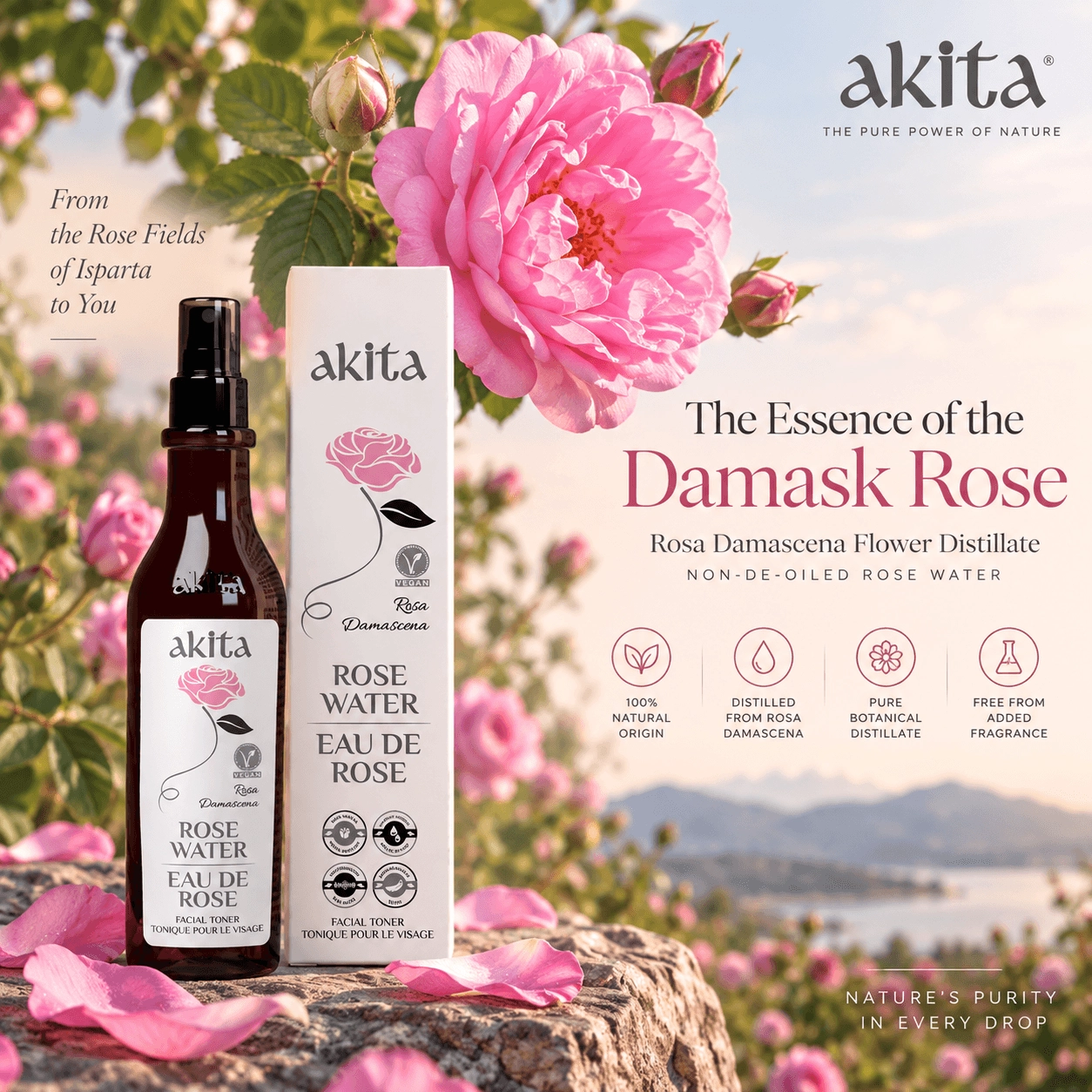
What Is Rosa Damascena Flower Distillate?
The Scientific Identity Behind Akita Non-De-Oiled Rose Water
Rose water may sound like one of the simplest botanical ingredients: roses and water. Yet the story inside a bottle can be much more complex.
The rose species, where and when the flowers are harvested, the distillation process, and what happens to the aromatic fractions during production can all influence the final distillate.
Akita’s Non-De-Oiled Rose Water, produced from Rosa damascena flowers, has been made using a distinctive approach since 2003. Rather than producing rose water as a secondary water fraction after separating the essential oil, Akita’s process is designed to retain the distillate without separating the volatile oil fraction.
The INCI name associated with this ingredient is:
Rosa Damascena Flower Distillate
INCI Application No.: 2025-14613
But what exactly does “Flower Distillate” mean? And why is the distinction between conventional rose water and a non-de-oiled rose distillate important?
To understand the difference, we need to look beyond the familiar name “rose water” and into the science of distillation.
First, What Does INCI Mean?
INCI stands for International Nomenclature of Cosmetic Ingredients.
It provides standardized names for ingredients used in cosmetic and personal care products, helping manufacturers, formulators, regulators and consumers identify ingredients consistently across markets.
This becomes particularly important with botanical ingredients.
The phrase “rose water” is a familiar commercial and traditional name, but on its own it tells us relatively little about how the ingredient was produced.
For example:
Was it made from Rosa damascena or another rose species?
Was it obtained through distillation?
Was rose essential oil separated during production?
Is it a pure distillate or part of a more complex formulation?
A more precise ingredient identity can provide additional information.
In Rosa Damascena Flower Distillate, the name itself tells part of the story:
Rosa Damascena identifies the botanical source.
Flower identifies the part of the plant being processed.
Distillate indicates that the ingredient is obtained through distillation.
That final word—distillate—is particularly important.
What Is a Rose Distillate?
A distillate is the liquid collected after vapour produced during distillation has been cooled and condensed back into liquid form.
During rose distillation, Rosa damascena flowers are processed with water. As heat is applied, steam rises through the botanical material.
Some of the volatile compounds associated with the flowers travel with that vapour.
The vapour is then directed into a cooling system, where it condenses back into liquid.
In simplified form:
Rosa damascena flowers → Distillation → Vapour carrying volatile compounds → Cooling → Condensation → Rose distillate
This distinction matters because a genuine distilled rose water is not simply water in which rose petals have been soaked or boiled and left to stand.
Distillation is a separation and transfer process.
The resulting liquid contains compounds that were able to travel through the distillation system and become part of the collected distillate.
What Does “Non-De-Oiled Rose Water” Mean?
This is where Akita’s production approach becomes especially important.
Rose essential oil and rose water are closely connected through distillation, but the way these fractions are handled can differ depending on the purpose of production.
In traditional rose oil production, the valuable essential oil fraction is a primary target. Depending on the process, oil associated with the distillate can therefore be separated and collected.
Akita takes a different approach.
The purpose is not to remove the volatile oil fraction from the rose distillate and sell it separately.
Instead, Akita produces its rose water without separating that oil fraction from the distillate.
This is what we mean by:
Non-De-Oiled Rose Water
An important distinction should be made here.
“Non-de-oiled” does not mean that rose essential oil is added to water afterward.
The product is created through distillation. The distinction lies in what happens during and after that process: the naturally occurring volatile fraction associated with the distillate is not intentionally separated from it.
This is fundamentally different from adding essential oil to ordinary water.
Is Rosa Damascena Flower Distillate the Same as Conventional Rose Water?
Not necessarily.
“Rose water” is a broad term. Products sold under this name may differ significantly in botanical source, processing method and formulation.
Differences may include:
- the species or cultivar of rose used,
- geographical growing conditions,
- flower maturity and harvest timing,
- time between harvest and processing,
- distillation parameters,
- management of the essential-oil fraction,
- concentration and composition of the resulting distillate,
- and whether other ingredients are subsequently added.
For this reason, two products both labelled “rose water” should not automatically be assumed to have identical chemical profiles.
Akita begins with Rosa damascena, the Damask rose traditionally cultivated in Isparta, Türkiye, and uses a production process specifically intended to preserve the non-de-oiled distillate.
That difference can also be investigated analytically.
What Can GC-MS Tell Us About Rose Distillate?
A botanical distillate cannot be fully characterized simply by smelling it.
Analytical techniques can help researchers examine its chemical profile.
One of the most useful methods for studying volatile and semi-volatile compounds is Gas Chromatography–Mass Spectrometry (GC-MS).
Gas chromatography separates compounds within a sample, while mass spectrometry helps identify them based on their molecular characteristics.
GC-MS analysis of Akita Non-De-Oiled Rose Water has demonstrated a measurable chemical profile containing multiple compounds.
In Akita's July 2, 2024 analysis, prominent components included:
| Compound | Relative result |
|---|---|
| Phenethyl Alcohol (PEA) | 79.54% |
| β-Citronellol | 7.81% |
| Acetic Acid | 4.87% |
| Benzyl Alcohol | 1.46% |
| α-Linalool | 0.92% |
These values should be understood as part of the analytical profile of the tested sample, rather than as a universal formula for every Rosa damascena distillate.
That distinction is important.
The chemistry of a botanical distillate can be influenced by the plant material, environmental conditions, harvest practices, processing parameters and analytical methodology.
For this reason, the scientific interest lies not only in whether one particular compound is present, but in the overall chemical profile of the distillate.
Why Isn't “Rose Water” Enough to Describe the Ingredient?
For everyday conversation, “rose water” is perfectly understandable.
For ingredient transparency, however, it can be too broad.
Imagine two bottles labelled simply Rose Water.
The flowers may come from different species.
One may be distilled while another may be formulated differently.
One distillate may have had its oil fraction separated as part of rose oil production, while another may have been produced specifically to retain that fraction.
The labels sound similar, but their production histories may be very different.
This is why botanical identity and manufacturing method matter.
Rosa Damascena Flower Distillate provides a more specific technical description by identifying both the botanical source and the distilled nature of the ingredient.
Why Did Akita Pursue an INCI Name?
Akita's Non-De-Oiled Rose Water is not a newly developed product.
Akita has been producing this distinctive Rosa damascena distillate since 2003.
The challenge was terminology.
“Rose water” communicates the product easily to consumers, while Non-De-Oiled Rose Water describes an important aspect of Akita's manufacturing approach. However, cosmetic ingredient communication also requires terminology that can function within international ingredient nomenclature.
Akita therefore pursued a formal INCI application to provide clearer and more transparent identification of the ingredient.
The resulting ingredient name is:
Rosa Damascena Flower Distillate
INCI Application No.: 2025-14613
The name brings together three essential pieces of information:
Botanical identity:Rosa damascena
Plant part: Flower
Ingredient type: Distillate
For Akita, this is more than a change in terminology. It provides a clearer way to describe a rose ingredient whose manufacturing philosophy has been part of the company since 2003.
From the Rose Fields to the Distillate
A bottle of rose water can look remarkably simple.
Its production history is not.
The chemistry of a botanical distillate begins before the flowers even enter the still.
Rose species and cultivar, geographical region, climate, soil conditions, flower maturity, harvest time and the interval between harvesting and processing can all influence the botanical raw material entering distillation.
Then the production process introduces another set of variables.
Distillation conditions, duration, condensation and fraction management can influence what ultimately becomes part of the collected distillate.
This means that when evaluating rose water, there is another useful question beyond:
“Is this real rose water?”
We can also ask:
“How was this rose water produced?”
That question reveals much more about what is actually inside the bottle.
Akita Non-De-Oiled Rose Water: Since 2003
Akita has produced its Non-De-Oiled Rose Water from Rosa damascena flowers since 2003.
At the heart of the process is a simple but important production philosophy: rather than treating rose water merely as the remaining water fraction from which the valuable rose oil has been separated, the distillate itself is the intended product.
The naturally associated volatile fraction is therefore not deliberately removed from the rose distillate.
The INCI name Rosa Damascena Flower Distillate now provides a technical identity for this ingredient and helps communicate what Akita has long described as Non-De-Oiled Rose Water.
It connects three worlds:
the Rosa damascena flower, the science of distillation, and transparent cosmetic ingredient identification.
A Better Way to Understand Rose Water
Rose water has been used for generations, but modern analytical science gives us new ways to understand what lies behind this traditional botanical product.
Rather than judging every rose water by the same definition, we can examine its botanical source, manufacturing process and analytical profile.
Rosa Damascena Flower Distillate is obtained from Rosa damascena flowers through distillation. In Akita's Non-De-Oiled Rose Water process, the volatile oil fraction associated with the distillate is not deliberately separated.
This distinction helps explain why the phrase Non-De-Oiled Rose Water is more than a marketing description. It describes a specific aspect of how the distillate is produced.
Sometimes the most important difference between botanical ingredients is not found in a long ingredient list.
It is found in how a single ingredient was made.
At a Glance
Ingredient: Akita Non-De-Oiled Rose Water
Botanical source:Rosa damascena
INCI: Rosa Damascena Flower Distillate
Production: Distillation
Key production characteristic: Volatile oil fraction is not deliberately separated from the distillate
Produced by Akita since: 2003
INCI Application No.: 2025-14613
Analytical characterization: GC-MS chemical profiling
Editorial Note
This article focuses specifically on the meaning of Rosa Damascena Flower Distillate, Non-De-Oiled Rose Water and the importance of production methodology. Other subjects—including the skin uses of rose water, pH, shelf life, purity and the broader science of Rosa damascena—are best addressed separately within the Akita Rose Water blog and Rose Knowledge Centre.
Comment