Why Do Smells Bring Back the Past? The Science of Olfactory Memory
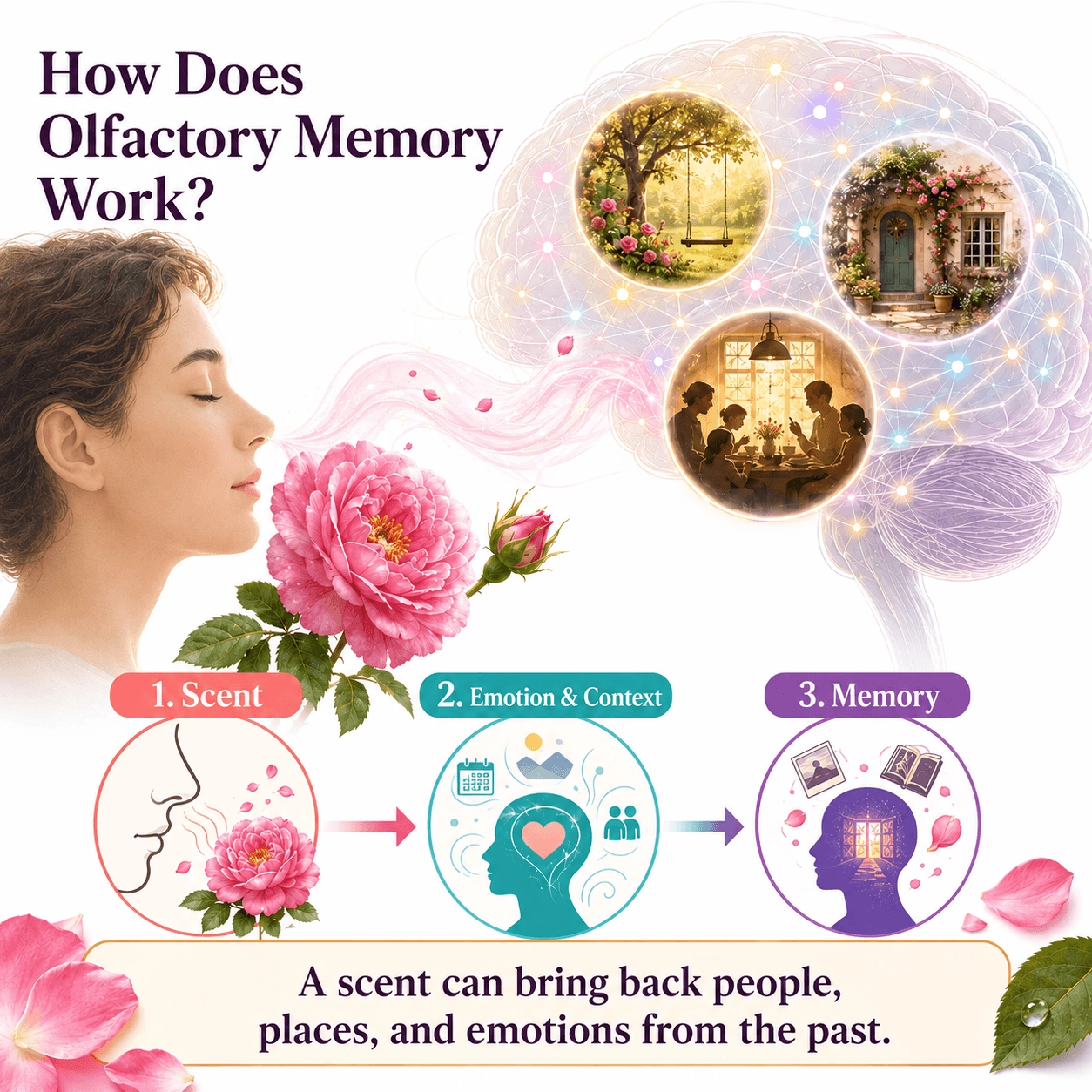
From a mother’s scent to the fragrance of roses: the invisible memory cues in our lives
A familiar soap may bring back a childhood home. A perfume may remind us of someone we have not seen for years. The scent of a rose may suddenly return us to an old garden. These experiences can revive not only an image but also the comfort, longing, or sadness associated with that time.
This shows that smell does more than help us recognize pleasant and unpleasant odours. We remember our experiences through sights and sounds, but also—often without realizing it—through scent.
What is olfactory memory?
Olfactory memory refers to the association between a smell and a person, place, event, or emotion from the past. When the same or a similar scent is encountered again, that association may be reactivated.
For someone who spent childhood summers in a rose garden, the fragrance of roses may represent more than a flower. The garden, the voices of family members, the warmth of summer, and the sense of security felt there may all have become parts of the same experience. Years later, the scent may bring some of those elements back.
“Olfactory memory” does not mean that the brain contains a separate organ devoted exclusively to memories of smell. It is a useful term describing how smell interacts with the brain networks involved in emotion and autobiographical memory.
In brief: The personal meaning of a scent is shaped not only by its chemical composition, but also by where, with whom, and under what emotional circumstances it was previously experienced.
How does the brain connect smell with memory?
When receptors in the nose detect airborne molecules, they send signals to the olfactory bulb. From there, information about the scent interacts with brain networks involved in memory, emotion, and evaluation.
Several regions are particularly important:
The amygdala contributes to emotional evaluation.
The hippocampus helps process events and their context.
The orbitofrontal cortex contributes to identifying and evaluating smells.
The familiar statement that “smell travels directly to the brain’s memory centre” is therefore an oversimplification. Memories are not stored in a single centre. A more accurate explanation is that the olfactory system has close anatomical and functional connections with brain networks involved in emotion and memory.
When an experience is encoded, the brain may process not only what happened but also the surrounding light, sounds, temperature, and smells. Encountering a familiar scent later may help reconstruct elements of that earlier context.
What is the Proust effect?
The involuntary recall of a personal memory triggered by a smell or taste is commonly known as the Proust effect.
The term comes from Marcel Proust’s novel In Search of Lost Time, in which the taste and aroma of a madeleine dipped in tea unexpectedly revive childhood memories.
Scientific studies indicate that autobiographical memories triggered by smells can sometimes feel more emotional than memories prompted by sights or sounds. In a study comparing different sensory cues, Rachel Herz found that memories evoked by odours were rated as more emotional and evocative. However, they were not necessarily more detailed or specific. (Herz, 2004)
This distinction is important. A scent may intensify the emotional experience of remembering, but it does not guarantee that every recalled detail is accurate. Human memory is not a permanent recording; it is reconstructed each time an event is remembered.
Do we first learn the importance of smell through our mother’s scent?
Our relationship with smell begins in the earliest days of life. Before newborns can communicate through words, scent can contribute to feeding, familiarity, and orientation toward their surroundings.
One study found that newborns responded to biological odours and developed a preference for their mother’s milk scent as their breastfeeding experience increased. The findings suggest that olfactory learning can be shaped by experience from the beginning of life. (Marlier, Schaal and Soussignan, 1997)
A “mother’s scent” is not a single substance. The scents of skin, hair, milk, clothing, and the home environment may be experienced together with warmth, touch, feeding, and care. Over time, this sensory combination may become associated with the mother, early childhood, and feelings of security.
Rose Academy Note: Perhaps our first lesson about the importance of smell begins with our mother’s scent. Before we can name an odour, we can begin to distinguish what is familiar from what is unfamiliar.
Why can the scent of roses carry powerful memories?
Roses have long been part of gardens, family homes, ceremonies, personal care practices, and cultural traditions. Their scent may therefore become associated with experiences that carry strong emotional value.
For one person, the scent of roses may recall a grandmother’s garden. For another, it may evoke a wedding, a religious tradition, a loved one, or a period of loss. To someone else, it may simply be a pleasant floral fragrance.
These differences show that the influence of rose scent cannot be explained by its molecules alone. Personal history and cultural learning also shape what the fragrance means.
An important scientific distinction must be made here: the ability of rose scent to trigger a past memory does not prove that rose oil improves memory in general. Odour-evoked recollection and changes in learning or memory performance are separate research questions.
Why is phenethyl alcohol used in smell research?
Phenethyl alcohol has a rose-like aroma and is often used as a controlled stimulus in olfactory research. However, phenethyl alcohol is not the same research material as a natural rose or rose essential oil.
In a study conducted by researchers at Université de Montréal, phenethyl alcohol was used as a stimulus perceived primarily through the olfactory system. Participants could not reliably determine which nostril had received the substance, whereas eucalyptol—which also stimulates the trigeminal system—was easier to locate. The study investigated nasal perception, not memory. (Frasnelli et al., 2010)
This study illustrates why the phrase “research conducted with rose scent” must be interpreted carefully. The experimental stimulus may be a natural rose, rose oil, or a standardized molecule with a rose-like aroma. Scientific conclusions should be limited to the material that was actually tested.
Why is olfactory memory personal?
The meaning of a scent is shaped by previous experience, emotional context, and repetition. This is why the same smell can evoke entirely different memories in different people.
A scent repeatedly experienced in a safe and happy environment may eventually become a reminder of that period. A smell associated with an upsetting event may instead cause anxiety or discomfort. Hospital odours, smoke, a particular perfume, or a cleaning product can carry difficult associations for some people.
Olfactory memory is therefore not always positive. A scent may help reactivate the emotion with which it was previously associated.
Why are smells important in our lives?
Our sense of smell helps us:
Experience the aroma of food,
Detect spoilage, smoke, gas, and other hazards,
Recognize familiar people and environments,
Form emotional connections with places,
Recall personal and cultural experiences.
Because smells are invisible, their contribution to everyday life is easy to overlook. Yet scent can play an important part in making a home feel familiar, a person feel recognizable, or a distant period of life feel unexpectedly close.
Conclusion: The invisible archive of our lives
Smells do more than help us identify substances in our surroundings. They can connect people, places, and emotions to our personal history.
A mother’s scent, the atmosphere of a childhood home, a rose in a garden, or a perfume encountered years later may become a key to the past. The meaning of a scent develops through the experiences connected with it.
Olfactory memory reveals a simple but important truth: we remember our lives not only through what we see and hear, but also through what we smell.
References
Frasnelli, J., La Buissonnière Ariza, V., Collignon, O., & Lepore, F. (2010). Localisation of unilateral nasal stimuli across sensory systems. Neuroscience Letters, 478(2), 102–106. https://doi.org/10.1016/j.neulet.2010.04.074
Hackländer, R. P. M., Janssen, S. M. J., & Bermeitinger, C. (2019). An in-depth review of the methods, findings, and theories associated with odor-evoked autobiographical memory. Psychonomic Bulletin & Review, 26(2), 401–429. https://doi.org/10.3758/s13423-018-1545-3
Herz, R. S. (2004). A naturalistic analysis of autobiographical memories triggered by olfactory, visual and auditory stimuli. Chemical Senses, 29(3), 217–224. https://doi.org/10.1093/chemse/bjh025
Marlier, L., Schaal, B., & Soussignan, R. (1997). Orientation responses to biological odours in the human newborn: Initial pattern and postnatal plasticity. Comptes Rendus de l’Académie des Sciences – Series III, 320(12), 999–1005. https://doi.org/10.1016/S0764-4469(97)82473-0
Comment