Natural Rose Mouthwash in Canada: A Refreshing Nighttime Oral-Care Ritual
Why Add Akita Natural Rose Mouthwash to Your Nighttime Oral-Care Routine?
A refreshing final step inspired by the delicate aroma of Isparta roses
Morning breath is a common experience. Even after brushing before bed, many people wake up with an unpleasant taste or a less-than-fresh feeling in their mouth.
Why does this happen, and how can a thoughtfully chosen mouthwash complement a nighttime oral-care routine?
Why Does the Mouth Feel Different in the Morning?
Saliva plays an important role in keeping the mouth moist and naturally clearing food particles and microorganisms. During sleep, saliva flow decreases. This creates conditions in which tongue coating and odour-producing compounds can become more noticeable by morning.
Many cases of oral malodour are associated with volatile sulfur compounds. These compounds may be produced when oral microorganisms break down food debris, proteins and other materials in the mouth. Dental plaque, tongue coating, dry mouth and certain oral-health conditions may also contribute to unpleasant breath. (American Dental Association, 2026)
This is why nighttime oral care should focus on removing accumulated plaque and food debris before the hours of reduced salivary flow begin.
The Foundation of Nighttime Oral Care
A mouthwash should complement, not replace, the essential steps of daily oral hygiene.
A complete routine generally includes:
- Cleaning between the teeth with floss or another suitable interdental cleaner.
- Brushing for approximately two minutes with fluoride toothpaste.
- Cleaning the tongue gently, particularly when tongue coating is present.
- Using an appropriate mouthwash according to its label and professional advice.
- Avoiding food and sugary drinks after the nighttime routine.
The American Dental Association recommends brushing twice daily with fluoride toothpaste and cleaning between the teeth every day. It also explains that mouthwash can be a useful addition for some people, but it is not a substitute for brushing and interdental cleaning. (American Dental Association, 2024)
Where Does Akita Natural Rose Mouthwash Fit?
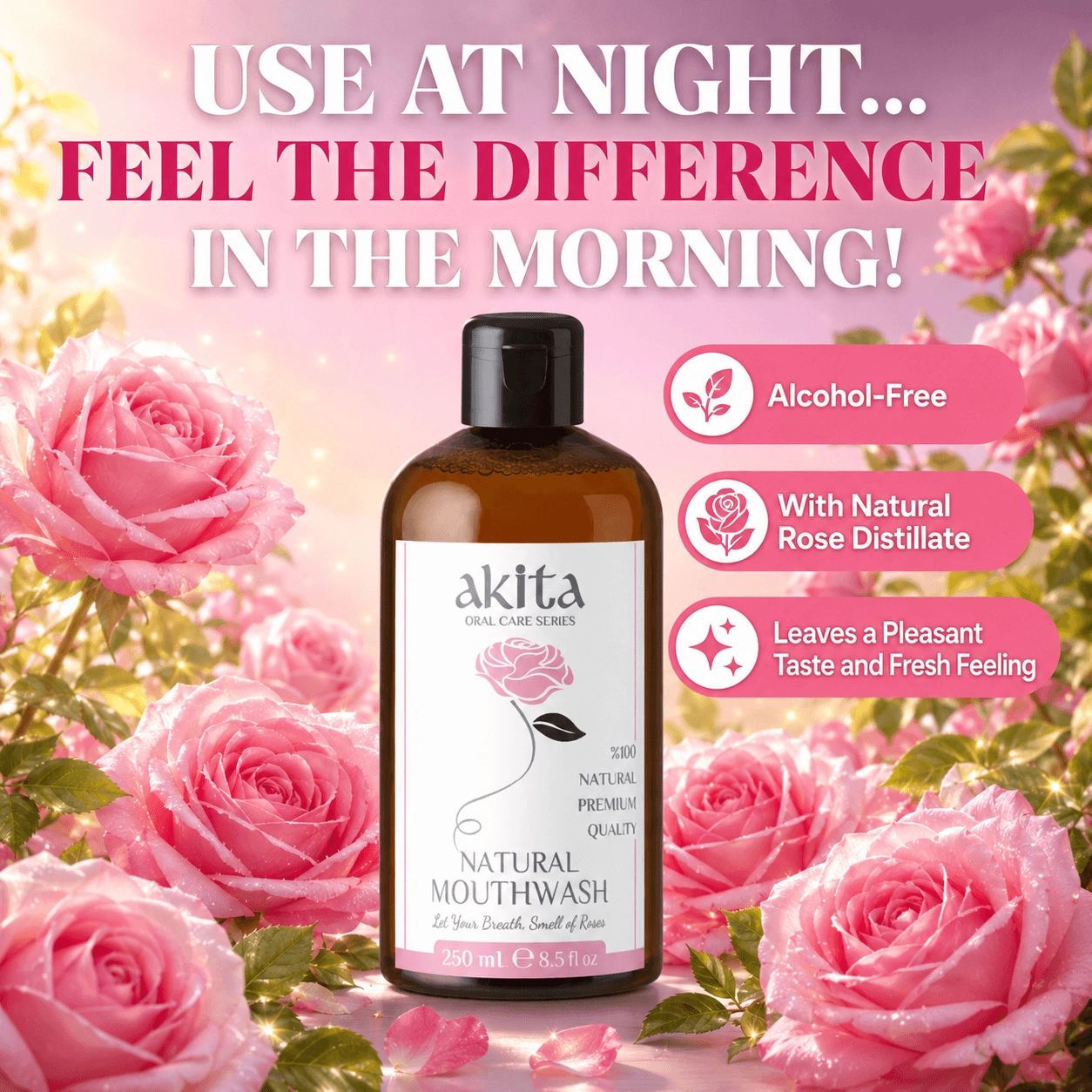
Akita Natural Rose Mouthwash offers a pleasant, rose-inspired finishing touch to daily oral care. Its distinctive sensory character comes from natural Rosa damascena flower distillate produced from Isparta roses.
When used as directed, it can:
- Leave a delicate rose flavour in the mouth
- Provide a pleasant and refreshing sensation
- Complete a nighttime oral-care ritual
- Offer an alcohol-free mouth-rinsing experience
For some users, the most enjoyable part of this routine is the light, pleasant taste they notice when they wake up. This is best described as a personal sensory experience rather than a guaranteed therapeutic result.
Brush carefully, complete your routine with Akita Natural Rose Mouthwash as directed, and let the delicate aroma of Isparta roses accompany your nighttime care.
Cosmetic Freshness and Therapeutic Claims Are Not the Same
The distinction between cosmetic and therapeutic mouthwashes is important.
According to the American Dental Association, cosmetic mouthwashes may temporarily mask unpleasant breath and leave a pleasant taste. Therapeutic mouthwashes, however, contain active ingredients supported for specific purposes, such as controlling plaque, gingivitis, tooth decay or oral malodour. (American Dental Association, 2026)
Therefore, statements such as the following require direct studies on the final product:
- “Kills oral bacteria”
- “Prevents morning breath”
- “Reduces plaque”
- “Protects against tooth decay”
- “Treats gum disease”
Without product-specific clinical evidence, the scientifically responsible approach is to describe Akita Natural Rose Mouthwash through its verified composition and sensory qualities:
An alcohol-free mouthwash made with natural rose distillate that leaves a pleasant rose taste and a refreshing feeling in the mouth.
What Does Research Say About Rose Water and Oral Bacteria?
A laboratory study investigated rose water against two bacteria associated with dental caries: Streptococcus mutans and Streptococcus sobrinus.
The study reported that the tested rose water reduced the ability of these bacteria to adhere to surfaces. However, it did not inhibit bacterial growth or remove an already established biofilm (Ramezanalizadeh et al., 2015).
This distinction matters. The study does not demonstrate that rose water kills oral bacteria, prevents cavities or treats oral disease. It was an in vitro experiment—not a clinical trial in people—and the tested rose water was not identified as Akita’s undeoiled rose distillate.
Consequently, these results cannot be used as direct proof of Akita Natural Rose Mouthwash’s effectiveness. They can, however, provide a scientific starting point for future product-specific research.
Should Mouthwash Be Used Immediately After Brushing?
The correct order can depend on the ingredients in the toothpaste and mouthwash.
Some dental guidance advises against rinsing immediately after brushing because doing so may wash away concentrated fluoride remaining from the toothpaste. An alternative is to use mouthwash at a separate time of day. The ADA also notes that the ideal order may depend on the formulations and manufacturers’ directions. (American Dental Association, 2026)
For this reason:
- Follow the directions printed on the product label.
- Do not swallow the mouthwash.
- If maintaining maximum fluoride exposure is a priority, ask your dentist whether the mouthwash should be used at a different time from brushing.
- Do not give mouthwash to young children unless a dentist recommends it and the product is appropriate for their age.
A Gentle Ritual to End the Day
A successful oral-care routine must be both effective and enjoyable enough to follow consistently.
The aroma of Isparta roses can transform an ordinary nighttime step into a pleasant daily ritual. After cleaning the teeth and mouth thoroughly, Akita Natural Rose Mouthwash adds the delicate flavour of Rosa damascena and a refreshing sensation to the routine.
Its role should be expressed accurately:
Akita Natural Rose Mouthwash does not replace brushing, flossing or professional dental care. It provides an alcohol-free, rose-distillate-based finishing touch that leaves the mouth with a pleasant taste and refreshing feel.
Persistent bad breath, bleeding gums, tooth pain, mouth sores or ongoing dryness should be assessed by a dentist or qualified healthcare professional.
References
American Dental Association. (2024). Home oral care recommendations to reduce the risk of caries and gum disease. https://www.ada.org/-/media/project/ada-organization/ada/ada-org/files/resources/library/oral-health-topics/ada_home_oral_care_flyer_2024july22.pdf
American Dental Association. (2026, August 7). Mouthrinse (mouthwash). https://www.ada.org/resources/ada-library/oral-health-topics/mouthrinse-mouthwash
Blom, T., Slot, D. E., Quirynen, M., & Van der Weijden, G. A. (2012). The effect of mouthrinses on oral malodor: A systematic review. International Journal of Dental Hygiene, 10(3), 209–222. https://doi.org/10.1111/j.1601-5037.2012.00546.x
Ramezanalizadeh, F., Rabbani, M., Khoroushi, M., & Aliasghari, A. (2015). In vitro assessment of antibacterial activity of pomegranate vinegar and rose water compared with Persica mouthwash against oral bacteria. Journal of Islamic Dental Association of Iran, 27(3), 152–160.
Comment