From Rosa damascena to the Future: Akita’s 2025–2026 Journey and Our Vision for 2027
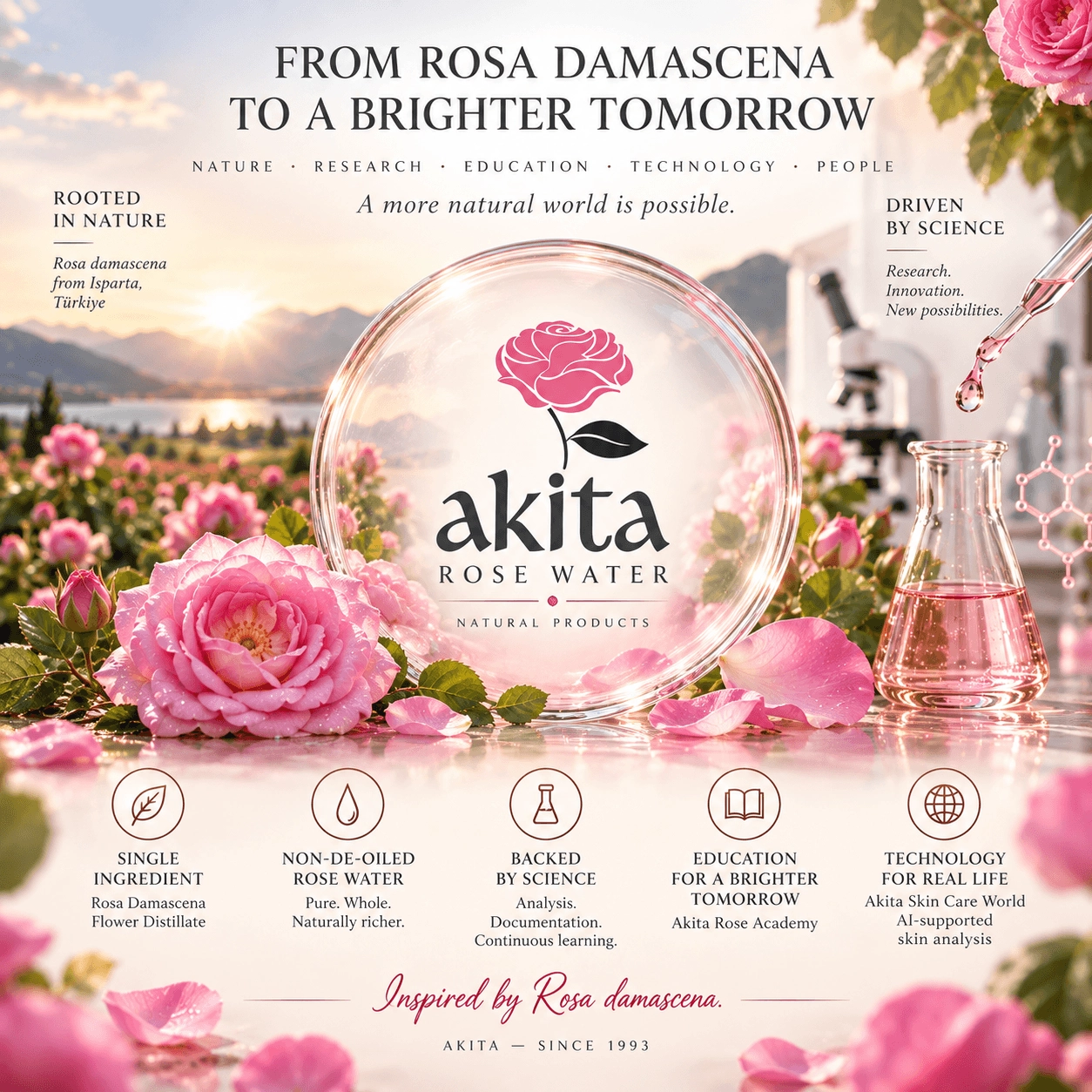
From Rosa damascena to the Future: Akita’s 2025–2026 Journey and Our Vision for 2027
From Non-De-Oiled Rose Water to scientific research, education and Akita Skin Care World: a new chapter in Akita’s journey
Some years represent more than growth for a company. They become periods of reflection—moments when a company looks beyond what it produces and asks deeper questions about what makes it different, what it has learned, and where it wants to go next.
For Akita, 2025 and 2026 have been such years.
Our journey began in 1993 and has been shaped by more than three decades of experience with natural products, botanical ingredients and skin care. At the heart of that journey has remained one remarkable flower:
Rosa damascena.
Over the years, our relationship with this flower has evolved from production into a much broader pursuit of knowledge. We have explored how it is cultivated and harvested, how distillation influences the resulting botanical distillate, how its composition can be studied, and how this knowledge can contribute to the development of natural skin care.
During 2025 and 2026, another dimension was added to this journey:
researching, measuring, documenting, educating and connecting our experience with emerging technologies.
As we look toward 2027, our vision is therefore not simply to introduce more products. It is to bring together production, scientific research, education, natural skin care and technology within a connected Akita ecosystem.
2025: Rediscovering What Makes Akita Different
Akita has a long history of working with Rosa damascena, but having decades of experience and communicating the value of that experience are two different things.
In 2025, we returned to a fundamental question:
What truly makes Akita different?
The answer brought us back to Rosa damascena and to the way we approach distillation.
Our story is not simply about producing rose water. It is about understanding what happens from flower to distillate and considering how the production process can influence the character of the final product.
This brought renewed attention to one of the most important developments in Akita's history.
Non-De-Oiled Rose Water
In 2003, Akita developed its Non-De-Oiled Rose Water approach.
In conventional rose oil production, the essential oil obtained through distillation is separated from the aqueous distillate. Akita took a different approach: rather than producing the distillate as a secondary product from which the oil had been removed, we focused on creating a rose distillate without separating its naturally occurring oil fraction.
This became what we call Non-De-Oiled Rose Water (NDORW).
Over time, NDORW became much more than another product in our portfolio. It became one of the defining elements of Akita's production philosophy and identity.
During 2025, we began communicating this distinction more systematically across our product education, digital content, research activities and corporate storytelling.
For Akita, rose water is not simply a product. It represents decades of experience with Rosa damascena, distillation and botanical skin care.
2026: When Experience Met Measurement
In 2026, another question became increasingly important:
Which characteristics we have observed through years of production can be investigated through scientific methods?
That question opened new areas of exploration.
Laboratory analyses, safety assessments, microbiological testing, stability studies and chemical profiling allowed us to examine different aspects of our products through analytical methods.
It also strengthened an important principle within Akita:
Scientific communication should begin with evidence—not with the claim we hope to make.
A laboratory result should be interpreted according to the method that produced it. Different tests answer different questions, and their conclusions should remain within the boundaries of what those methods can demonstrate.
For us, this distinction is becoming increasingly important.
Science is not simply about obtaining an interesting result.
It is also about asking the right question, selecting an appropriate method, documenting the findings and recognizing the limitations of what has been measured.
An Important Milestone for Non-De-Oiled Rose Water
One of the significant developments of 2026 was the acceptance of the INCI name:
Rosa Damascena Flower Distillate.
For Akita, this represented an important step in the continuing story of our rose distillate.
International cosmetic ingredient terminology provides a common language through which ingredients can be identified and communicated across markets.
For a company that has spent many years emphasizing the importance of the production process behind its rose distillate, this development gives us another framework through which to communicate its identity.
It also marks a new stage in a much longer journey that began with our work on Non-De-Oiled Rose Water in 2003.
Understanding a Product Requires More Than One Test
One of the most valuable lessons reinforced during 2025 and 2026 is that no single laboratory analysis can tell the complete story of a botanical product.
Chemical analysis answers one type of question.
Microbiological testing answers another.
Stability studies investigate how a product behaves over time.
Safety assessments evaluate specific endpoints according to defined methodologies.
Each piece of information contributes to a larger picture, but each must also be understood within its own scope.
This has led us toward a principle that we intend to carry into 2027:
Measure carefully. Document clearly. Interpret responsibly.
It is a simple principle, but an important one.
Asking New Questions: Exploring RF Characterization
During 2026, we also began exploring a more experimental area: the radio-frequency characteristics of Non-De-Oiled Rose Water and other botanical distillates.
Our initial curiosity began with a seemingly simple question about whether rose water could be represented by a single frequency.
As the work progressed, however, the question itself changed.
Rather than searching for one number, we began examining broader frequency ranges and comparing signal regions across different samples, production years, botanical distillates and processing approaches.
This opened a much more interesting research question:
Could RF measurements eventually provide another analytical perspective for comparing botanical distillates?
At this stage, we regard this work as experimental characterization research.
We do not interpret these measurements as evidence of health or therapeutic effects. The value of the work lies in investigating measurable patterns, developing more controlled protocols and determining whether observations can be reproduced.
In 2027, we hope to continue developing this research with greater standardization, repeatability and comparative analysis.
Sometimes innovation begins not with an answer, but with a better question.
Akita Rose Academy: Turning Experience into Education
Another major development during 2026 was the decision to organize and share the knowledge accumulated through our work with Rosa damascena.
This led to the development of the Akita Rose Academy.
The Academy goes far beyond the cosmetic use of the rose.
Its expanding knowledge structure explores the botany of Rosa damascena, growing conditions, harvest timing, distillation, rose water, rose oil and other rose-derived materials, as well as chemistry, analytical methods and scientific research.
There is another purpose behind the Academy that is equally important to us:
helping people understand how scientific evidence should be read.
What can an in vitro study tell us?
How is it different from an animal study or a human clinical study?
What is the difference between traditional use and scientific evidence?
What can legitimately be concluded from a laboratory result?
These questions matter because access to information has never been easier—but distinguishing evidence from interpretation has become increasingly important.
Our goal is to make scientific and technical knowledge more understandable without oversimplifying it.
The Akita Rose Academy is therefore becoming not only a place to learn about Rosa damascena, but also a platform for encouraging scientific curiosity and informed decision-making.
From Nature to Technology: Akita Skin Care World
Perhaps one of the most exciting parts of our recent journey is the meeting of two worlds that, at first glance, may appear very different.
On one side is Rosa damascena: a flower cultivated, harvested and distilled through traditions developed over generations.
On the other side are data, digital technologies and artificial intelligence.
Akita Skin Care World brings these worlds together.
Our work in this area explores how AI-supported skin analysis, ingredient evaluation and product compatibility can contribute to more informed and personalized approaches to skin care.
Technology does not replace our knowledge of ingredients or formulation.
Instead, we see it as another tool for understanding complexity.
The same philosophy connects our botanical work and our technology work:
observe carefully, understand more deeply and use knowledge to help people make better-informed skin care choices.
Our 2027 Vision: From Products to an Ecosystem
As we look toward 2027, our ambition is not simply to expand the Akita product portfolio.
We see Akita's future at the intersection of five areas:
Nature + Research + Education + Technology + People
Non-De-Oiled Rose Water will remain one of the foundations of our botanical and skin care work.
The Akita Rose Academy will continue developing an accessible knowledge base around Rosa damascena, distillation and rose science.
Our research activities will continue examining botanical distillates through established analytical methods while also exploring new research questions.
Akita Skin Care World will continue connecting our natural skin care experience with emerging digital and AI technologies.
And our product development will increasingly reflect the knowledge generated across these areas rather than treating research, education and products as separate worlds.
That is the Akita we envision for 2027:
not simply a collection of products, but a connected knowledge ecosystem.
What Kind of Akita Do We Want to Build?
An Akita that asks more questions.
An Akita that investigates before making conclusions.
An Akita that documents its research more systematically.
An Akita that makes scientific information understandable.
An Akita that continues learning from Rosa damascena.
An Akita that connects natural skin care with technology.
An Akita that grows internationally without losing the knowledge and values from which it began.
For us, innovation does not mean leaving the past behind.
It means taking what decades of experience have taught us and examining it with the tools of the future.
What We Know, We Share. What We Don't Know, We Investigate.
Perhaps the most important outcome of our 2025–2026 journey is not a single product, test or project.
It is a philosophy.
What we know, we share.
What we can measure, we document.
What we do not yet know, we continue to investigate.
That means communicating scientific findings according to what the evidence actually demonstrates.
It means respecting traditional knowledge without presenting tradition itself as scientific proof.
It means remaining open to new technologies while keeping people and nature at the center of our work.
And it means accepting that meaningful research often produces new questions before it produces definitive answers.
This is the culture we want to carry into 2027.
From 1993 to 2027: The Same Flower, an Expanding World of Knowledge
Akita's story began in 1993.
More than three decades later, that story continues to evolve.
1993 — The Journey Begins
Our work with natural products begins.
2003 — Non-De-Oiled Rose Water
Akita develops its approach to producing rose distillate without separating its naturally occurring oil fraction.
2025 — Rediscovering Our Identity
We begin bringing our production knowledge, brand identity and distinctive approach to Rosa damascena into a clearer and more unified story.
2026 — Research, Education and Technology
Scientific investigation, the Akita Rose Academy and Akita Skin Care World become increasingly important parts of the Akita ecosystem.
2027 — Connecting the Pieces
Our vision is to bring nature, research, education, natural skin care and technology together within a stronger international knowledge ecosystem.
Over more than three decades, much has changed.
Production technologies have evolved.
Scientific knowledge has expanded.
The digital world has transformed.
Artificial intelligence has opened entirely new possibilities.
Akita has evolved as well.
But the flower at the heart of our story remains the same:
Rosa damascena.
Our journey began with a rose.
Our vision for 2027 is to carry the knowledge we have built around that rose into the future—through research, education, responsible innovation and technology.
Inspired by nature. Investigated through science. Shared through knowledge. Carried forward through innovation.
Akita — From 1993 to the future, inspired by Rosa damascena.
Comment