Etiket: #Rose Water
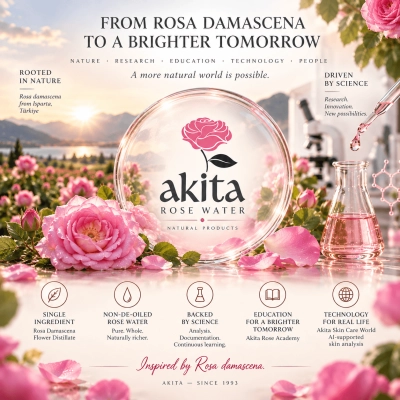
From Rosa damascena to the Future: Akita’s 2025–2026 Journey and Our Vision for 2027
From Non-De-Oiled Rose Water to scientific research, education and Akita Skin Care World: a new chapter in Akita’s journey
Some years represent more than growth for a company. They become periods of reflection—moments when a company looks beyond what it produces and asks deeper questions about what makes it different, what it has learned, and where it wants to go next.
For Akita, 2025 and 2026 have been such years.
Our journey began in 1993 and has been shaped by more than three decades of experience with natural products, botanical ingredients and skin care. At the heart of that journey has remained one remarkable flower:
Rosa damascena.
Over the years, our relationship with this flower has evolved from production into a much broader pursuit of knowledge. We have explored how it is cultivated and harvested, how distillation influences the resulting botanical distillate, how its composition can be studied, and how this knowledge can contribute to the development of natural skin care.
During 2025 and 2026, another dimension was added to this journey:
researching, measuring, documenting, educ...
A rose does not attract scientific attention simply because it smells beautiful.
When researchers study a plant, they ask very different questions:
What compounds does it contain? Can those compounds be identified and measured? What happens when they interact with cells or microorganisms? Are similar effects observed in humans? Does the production method change the final product and its properties?
Rosa damascena—the Damask rose, particularly associated with Isparta, Türkiye—is an intriguing plant because it raises many of these questions at the same time.
Scientific research is not limited to rose essential oil. Rose water, hydrosols, flower extracts, and preparations obtained from different parts of the plant have also been investigated.
🌹 IN SHORT
Rosa damascena is scientifically interesting because of its long history of use, complex chemical composition, the variety of products that can be obtained from it, and the measurable biological activities reported for some of these preparations.
However, the fact that something has been studied does not mean that every claimed benefit has been conclusively proven in humans.
1. It All Begins with the Chemistry of...
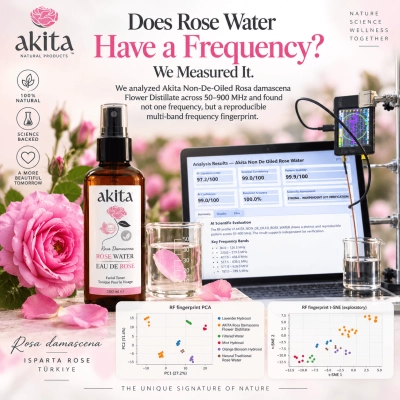
Have you ever wondered, “What is the frequency of rose water?”
If you search online for rose oil and frequency, you will often come across the number 320 MHz. There is, however, an important distinction: this widely circulated claim has been associated with Rosa damascena flower oil, not rose water.
That raised another question for us.
What happens when the naturally carried oil fraction is not separated from the rose distillate? Does Akita Non-De-Oiled Rose Water show one particular frequency when measured?
We decided to investigate.
The result was more interesting than a single number:
We did not find one frequency. We found a reproducible frequency fingerprint.
In Akita's study, Non-De-Oiled Rosa damascena Flower Distillate was examined across 50–900 MHz. The study did not find one isolated characteristic peak at 320 MHz. Instead, discriminative information appeared across multiple frequency regions, producing a reproducible multi-band measurement profile that separated from the other liquids tested in the dataset.
First, an Important Difference: Rose Oil and Rose Water Are Not the Same
When rose flowers are distilled, volatile compounds are carried with the stea...
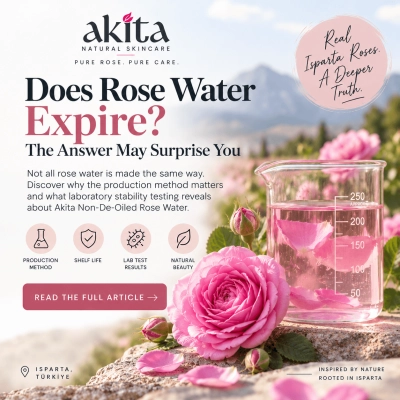
How Long Does De-Oiled Rose Water Last?
Does rose water really stay fresh for years? Prof. Dr. Hasan Baydar’s work on traditional rose water and Akita’s laboratory stability testing show why the answer begins with a more important question: What kind of rose water are we talking about?
You pick up a bottle of rose water. The label says “100% natural,” “pure rose water,” or “Rosa damascena rose water.”
But how long will it actually last?
Six months? One year? Two years?
And if it contains no preservative, how can it remain stable for an extended period of time?
There is no single answer, because not every product sold as “rose water” is made in the same way.
To understand shelf life, we first need to understand how the rose water was produced—and whether the rose oil was removed during production.
First, How Is Traditional Rose Water Produced?
Traditional rose water is closely connected to rose oil production.
In his work Oil-Bearing Rose Cultivation and Industry, Prof. Dr. Hasan Baydar of Süleyman Demirel University describes the industrial distillation of Rosa damascena in detail.
Fresh rose flowers are distilled with water. During di...
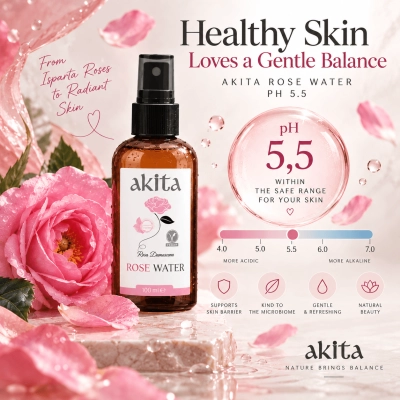
Why Does Your Skin’s pH Matter? Is 5.5 Really the Magic Number?
Your skin naturally has a slightly acidic surface. But what does that mean for your skin barrier, microbiome, and the products you use every day? Science shows that skin pH is much more interesting than a single number.
You may have seen the words “pH-balanced” on a facial cleanser, toner, or moisturizer. You may also have heard that the ideal pH for skin is 5.5.
But why 5.5?
And is everyone’s skin really pH 5.5 all the time?
The answer is more interesting than you might expect.
Your skin has a naturally slightly acidic environment at its surface. Scientists have studied this environment for decades because skin pH is closely connected with the skin barrier, the microorganisms that live on our skin, and some of the biological processes that help the skin function normally.
First, What Is pH?
pH is a way of describing how acidic or alkaline something is.
The scale generally runs from 0 to 14:
7 is neutral
Below 7 is acidic
Above 7 is alkaline
Pure water is close to neutral.
Healthy skin, however, is generally not neutral.
Its surface is naturally slightly acidic.
And that is where things become...

A practical guide to ingredients, production methods, quality testing and label transparency
Walk into a beauty store, natural health shop or online marketplace in Canada and you will find dozens of products labelled “rose water.” Their packaging may feature claims such as “natural,” “pure,” “organic,” “100% rose water” or “free from additives.”
At first glance, these products may appear almost identical. In reality, they can differ considerably in their ingredients, botanical source, production method and quality standards.
A bottle of genuine rose water may represent thousands of freshly harvested roses, careful distillation and generations of production knowledge. Another product with a similar name may simply be water combined with rose fragrance and other cosmetic ingredients.
This is why knowing how to identify genuine rose water matters.
The answer cannot be determined by scent, colour or price alone. A reliable assessment requires looking at the ingredient list, botanical species, production method, safety testing and the amount of verifiable information provided by the manufacturer.
Not Every Product Called “Rose Water” Is the Same
Rose water is often viewed as litt...
“Natural” on the front label is not enough, learn how to read the ingredients, understand the production method and recognize a genuine rose distillateRose water looks like a simple product, but choosing an authentic one can be surprisingly difficult. Many bottles display words such as “natural,” “pure” or “made with roses,” even when the formula contains added water, fragrance, preservatives or other ingredients.So how can you tell whether rose water is truly pure?There is no single home test that can prove purity with complete certainty. Colour, scent and price can provide clues, but the most reliable assessment comes from examining several details together: The ingredient list The method of production Whether rose oil has been separated The product’s natural aroma and taste profile Its microbiological stability Laboratory analysis and traceability Understanding these factors is more useful than relying on the word “natural” alone.1. Begin With the Ingredient ListIn Canada, cosmetic products must display their ingredients using the International Nomenclature of Cosmetic Ingredients, commonly known as INCI. This gives consumers a more reliable place to begin than the marketin...
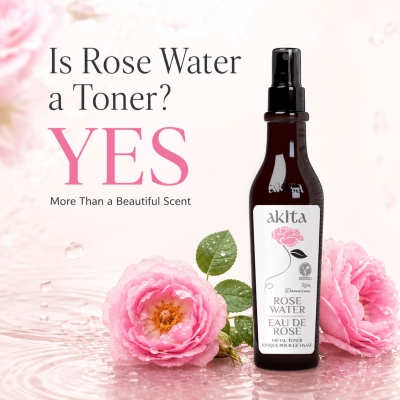
Yes, pure rose water can be used as a gentle facial toner, but its value goes far beyond its beautiful scent
Rose water is often recognized by its delicate floral aroma. Yet the fragrance is only one part of what makes genuine rose water special. When produced by distilling Rosa damascena flowers, rose water contains naturally occurring, water-soluble and aromatic compounds transferred from the petals during distillation.
This botanical composition is why high-quality rose water can serve as a simple, refreshing facial toner for daily skincare.
What Is a Facial Toner?
A facial toner is a lightweight, water-based product applied after cleansing and before serum or moisturizer. Depending on its formulation, a toner may help:
Refresh the skin after cleansing
Remove small traces of cleanser or surface residue
Prepare the skin for the next steps in a skincare routine
Provide light hydration
Leave the skin feeling softer and more comfortable
Traditional toners often contained high levels of alcohol and were designed to create a tight, dry sensation. Modern skincare has moved toward gentler formulas that focus on hydration and skin comfort rather than stripping awa...
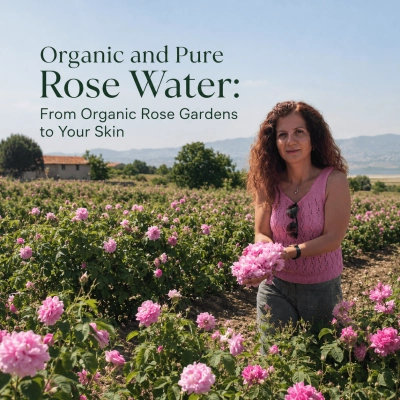
Organic and Pure Rose Water: From Akita’s Organic Rose Gardens to Your Skin
What makes rose water truly organic and pure?
“Organic rose water” and “pure rose water” are often used as if they mean the same thing. In fact, they describe two different qualities.
Organic refers mainly to how the roses are grown and how the agricultural process is managed.
Pure refers to what is inside the finished bottle.
A rose water may be produced from organically grown roses but still contain added fragrance, preservatives or other ingredients. Conversely, a product may contain only rose distillate without holding an organic certification.
This is why Canadian consumers should look beyond the words printed on the front of the bottle. The rose species, growing conditions, production method, ingredient list and supporting documents all matter.
Akita Non-De-Oiled Rose Water brings these elements together: Rosa damascena flowers grown in Akita’s organic rose gardens are distilled without separating the naturally occurring rose oil from the water. The finished product contains a single cosmetic ingredient:
INCI: Rosa Damascena Flower Distillate
What does “organic rose water” mean?
Or...
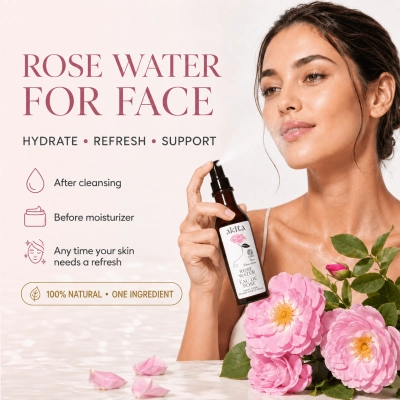
A simple, natural step that can refresh, hydrate and support your skin every day
Akita Non-De-Oiled Rose Water is more than a pleasant facial mist. It is made with one 100% natural ingredient: Rosa Damascena Flower Distillate. Independent skin analyses show that it can support hydration, smoother-looking skin, a more even-looking complexion and the skin’s natural renewal process. It has also been found safe to spray over the face while the eyes are open. Thanks to its naturally stable composition, Akita Rose Water has a long shelf life when stored correctly.
Rose water has been used in beauty routines for generations. Today, it offers an easy way to care for skin exposed to cold Canadian winters, dry indoor heating, summer sun and changing weather.
But not every product called “rose water” is made in the same way. Its ingredients, production method and intended use can make a meaningful difference. Here is what you should know before choosing rose water for your face.
What Does Rose Water Do for Your Face?
A good facial rose water can add a light, refreshing layer of moisture to your skincare routine. It can be used after cleansing, before moisturizer or whenever your skin fee...