Skin pH Explained: Is 5.5 Really the Ideal pH for Your Skin?
Why Does Your Skin’s pH Matter? Is 5.5 Really the Magic Number?
Your skin naturally has a slightly acidic surface. But what does that mean for your skin barrier, microbiome, and the products you use every day? Science shows that skin pH is much more interesting than a single number.
You may have seen the words “pH-balanced” on a facial cleanser, toner, or moisturizer. You may also have heard that the ideal pH for skin is 5.5.
But why 5.5?
And is everyone’s skin really pH 5.5 all the time?
The answer is more interesting than you might expect.
Your skin has a naturally slightly acidic environment at its surface. Scientists have studied this environment for decades because skin pH is closely connected with the skin barrier, the microorganisms that live on our skin, and some of the biological processes that help the skin function normally.
First, What Is pH?
pH is a way of describing how acidic or alkaline something is.
The scale generally runs from 0 to 14:
- 7 is neutral
- Below 7 is acidic
- Above 7 is alkaline
Pure water is close to neutral.
Healthy skin, however, is generally not neutral.
Its surface is naturally slightly acidic.
And that is where things become interesting.
Is Your Skin’s pH Really 5.5?
You will often read:
“The ideal pH of skin is 5.5.”
It is a useful way to explain the concept, but the science is more nuanced.
Your skin does not stay fixed at exactly one pH value.
Age, body area, sweating, washing, skincare products, environmental conditions, and even how pH is measured can influence the result.
One particularly interesting study was conducted by Lambers and colleagues.
Researchers investigated the skin-surface pH of 330 people. Their findings suggested that when the effects of washing and cosmetic products were minimized, the natural skin-surface pH was, on average, below 5 — around 4.7.
So does that mean pH 5.5 is wrong?
No.
It means 5.5 should not be treated as a magic number that applies to every person, every product, and every situation.
The more important scientific point is this:
Healthy skin naturally maintains a slightly acidic surface environment.
Why Is Our Skin Slightly Acidic?
This leads to a fascinating question.
Why doesn't our body simply keep the surface of our skin at a neutral pH of 7?
Because its mildly acidic environment is part of the way healthy skin functions.
This environment is commonly associated with what scientists call the acid mantle.
The name sounds complicated, but the basic idea is simple.
Think of the acid mantle as part of the skin’s invisible protective environment.
Sebum, sweat, components of the outer skin layers, and several biological processes all contribute to this acidic environment.
A 2025 review published in the Journal of Investigative Dermatology examined current scientific understanding of the acid mantle and highlighted its relationship with the skin barrier, microbiome, and inflammatory processes.
So skin pH is much more than a number printed on cosmetic packaging.
It is part of skin biology.
What Does pH Have to Do With the Skin Barrier?
The outermost layer of our skin is called the stratum corneum.
Imagine it as a brick wall.
The skin cells are like the bricks, while the lipids between them act a little like the mortar holding those bricks together.
Together, they form an important part of the skin barrier.
This barrier helps limit unnecessary water loss while creating a controlled boundary between our bodies and the outside world.
Where does pH come into this?
Some enzymes involved in maintaining the outer skin barrier are influenced by pH.
This includes processes related to ceramides, an important group of lipids found in the skin barrier.
In other words, there is a genuine biological relationship between the skin’s acidic environment and normal barrier function.
Your Skin Is an Ecosystem
Our skin is not sterile — and it should not be.
It is home to bacteria, fungi, and other microorganisms. Together, these communities are known as the skin microbiome.
An easy way to think about it is:
Your skin microbiome is a tiny ecosystem living on the surface of your body.
Not all microorganisms are harmful.
Many are normal residents of healthy skin.
pH matters here too because microorganisms differ in the environments in which they grow and survive.
Researchers are therefore increasingly interested in the relationship between skin pH, the microbiome, and barrier health.
This teaches us an important lesson about skincare:
The goal of skincare is not to make the skin as sterile as possible. It is to support a healthy skin environment.
What Happens to Skin pH When You Wash Your Face?
Here's something surprising.
Cosmetics aren't the only things that can temporarily change the pH of your skin.
Even water can influence skin-surface pH.
In the study by Lambers and colleagues, contact with tap water was associated with a temporary increase in skin-surface pH.
Does that mean water is bad for your skin?
Of course not.
It demonstrates something much more useful:
Skin pH is dynamic. It is not a number that remains perfectly fixed throughout the day.
After temporary changes, the skin has mechanisms that help restore its surface environment.
What About Soap?
This is where understanding the difference between traditional soap and modern cleansers becomes useful.
Traditional soaps are generally alkaline, meaning they have a relatively high pH.
Research has shown that alkaline cleansing can temporarily raise skin-surface pH.
But it would be an oversimplification to conclude:
“Soap is bad for your skin.”
The effect of a cleanser cannot be predicted from pH alone.
The type and concentration of surfactants, the overall formulation, how often the product is used, how long it stays on the skin, and the individual’s skin condition all matter.
What pH Should a Skincare Product Have?
This is one of the most common questions — and there is no single number that applies to every product.
Many everyday skincare products are formulated within a mildly acidic range. Approximately pH 4.5–6 can be a reasonable range for many daily-use products, depending on their formulation and purpose.
But this should not be treated as a universal rule.
Some products need different pH conditions to work as intended.
For example, certain AHA and BHA formulations may be deliberately formulated at a lower pH.
Products containing L-ascorbic acid, one form of vitamin C, can also require a more acidic formulation.
This is why:
Lower pH does not automatically mean better skincare.
And:
A product with a pH of exactly 5.5 is not automatically better than every other product.
The right pH depends partly on what the product is designed to do.
Does “pH-Balanced” Mean a Product Is Better?
Not necessarily.
This is an important point for consumers.
Having an appropriate pH can certainly be a useful characteristic, but pH alone cannot tell you whether a product is high quality, safe, or effective.
A product should be considered as a complete formulation.
That includes factors such as:
- ingredients;
- formulation;
- manufacturing method;
- microbiological quality;
- stability;
- intended use; and
- packaging.
The same principle applies to products marketed as “natural.”
Natural does not automatically mean pH-balanced.
A naturally derived product can have a pH that is appropriate or inappropriate for its intended use. The word “natural” alone cannot answer that question.
Why Does the pH of Rose Water Matter?
Rose water is often sprayed or applied directly onto the skin and left there.
For that reason, its pH is one of the characteristics worth considering.
But there is another important distinction:
You cannot judge the quality of rose water by its pH alone.
The rose species, raw material quality, distillation process, composition, microbiological quality, and manufacturing method all matter.
Two rose waters could have exactly the same pH while being very different products.
What Is the pH of Akita Non-De-Oiled Rose Water?
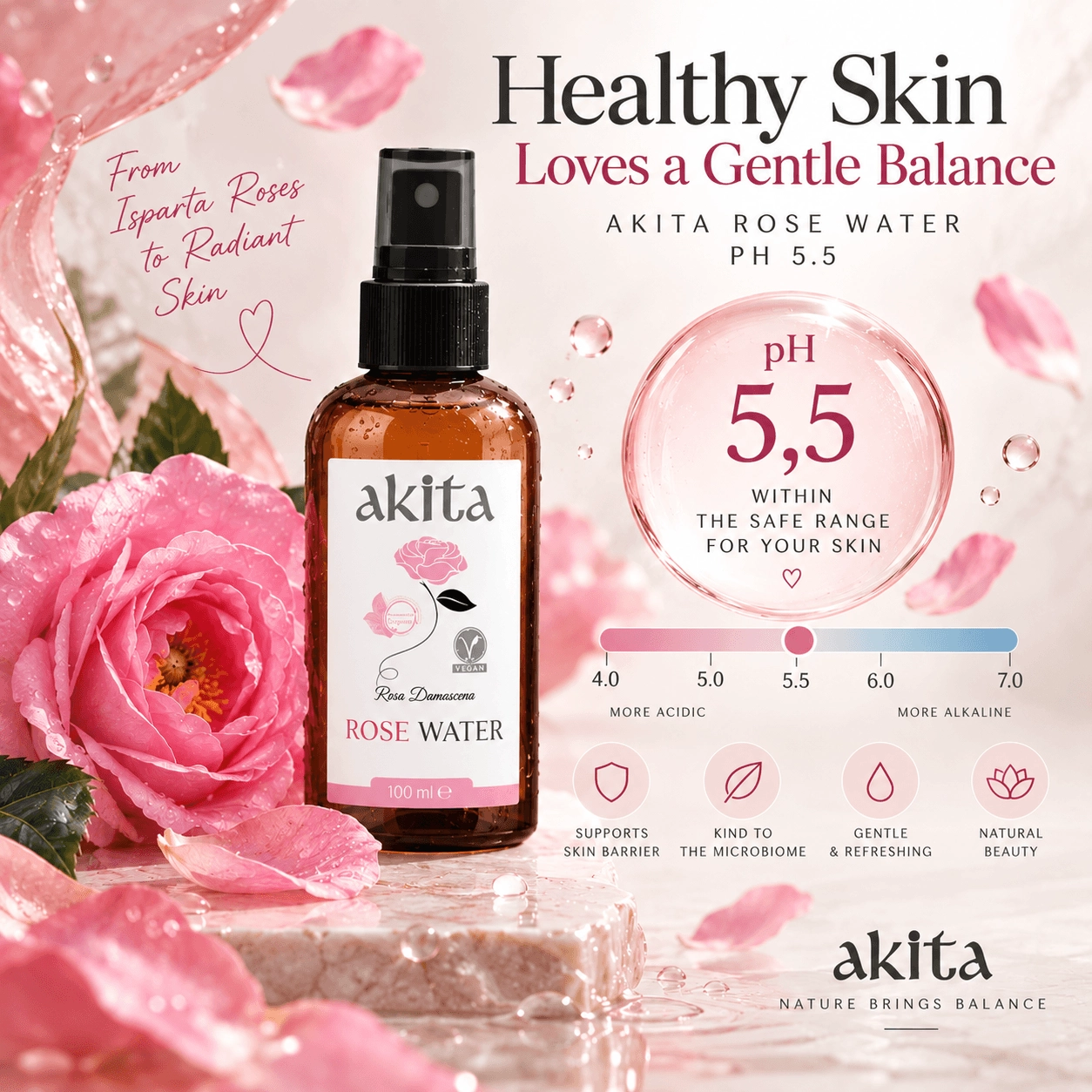
Akita Non-De-Oiled Rose Water has a pH of approximately 5.5.
This places it within a mildly acidic range compatible with the naturally acidic environment of the skin surface.
But this does not mean that 5.5 is a “magic” number.
For example, if a rose water had a pH of 4.7, we could not automatically conclude that it was better for the skin than a rose water with a pH of 5.5 simply because 4.7 may be closer to the average skin-surface pH reported in some studies.
The entire product needs to be considered.
In the case of Akita, its pH should therefore be viewed alongside the characteristics of its Rosa damascena distillate and its production method, rather than as an isolated number.
How Can You Support Your Skin’s Natural pH?
You probably do not need a complicated routine.
Avoiding unnecessary over-cleansing, choosing cleansers suitable for your skin, being careful about layering too many strong active ingredients, and supporting the skin barrier are sensible starting points.
And remember:
Your skin has its own mechanisms for regulating its surface environment.
Good skincare should work with your skin rather than constantly trying to force it toward a particular number.
5 Common Myths About Skin pH
Myth: “Healthy skin is always exactly pH 5.5.”
Not quite. Skin is generally slightly acidic, but its pH varies between individuals, body sites, and conditions.
Myth: “pH 7 is neutral, so it must be ideal for skin.”
No. Healthy skin surface is generally more acidic than neutral.
Myth: “Any product with a pH of 5.5 is good for your skin.”
No. The complete formulation matters.
Myth: “Natural skincare products automatically have a skin-friendly pH.”
No. Being natural does not guarantee a particular pH.
Myth: “The lower the pH, the better the product.”
No. A product that is too acidic for its intended use can irritate the skin.
The Takeaway: Skin pH Is More Than 5.5
pH matters in skincare.
But perhaps the most important thing to remember from this article is not the number 5.5.
It is this:
Skin pH is part of a living, changing biological system.
The surface of healthy skin is naturally slightly acidic. This environment is connected with barrier function, enzyme activity, and the skin microbiome.
So good skincare is not about forcing your skin to reach one “perfect” number.
It is about choosing products that respect the skin’s natural physiology and support its barrier.
Akita Non-De-Oiled Rose Water's approximately 5.5 pH can be understood in this context: it sits within a mildly acidic range compatible with the skin's natural surface environment. But, as with any skincare product, its quality should never be judged by pH alone.
Frequently Asked Questions
1. What is the normal pH of human skin?
Healthy skin surface is generally slightly acidic. Although 5.5 is often used as a reference value, skin does not remain at exactly pH 5.5. Research has found average natural skin-surface pH values below 5 under certain measurement conditions.
2. Why is pH 5.5 so common in skincare?
Because 5.5 falls within the mildly acidic region associated with the skin's natural surface environment. However, 5.5 is not a universal or magical ideal value for every person or every skincare product.
3. What happens when skin pH changes?
Changes in skin-surface pH can influence processes associated with the skin barrier and enzyme activity. Persistent disruption may be associated with impaired barrier function, but it would be incorrect to blame every skin problem on pH alone.
4. What is the skin’s acid mantle?
The acid mantle describes the naturally acidic environment at the skin's surface. It is associated with the skin barrier, microbiome, and normal biological processes that occur in the outer layers of the skin.
5. What pH should skincare products have?
There is no universal ideal pH for every cosmetic. Many everyday skincare products can be formulated within a mildly acidic range, often around pH 4.5–6, but the appropriate pH depends on the product's ingredients and purpose.
6. Is every product with a pH of 5.5 good for the skin?
No. Two products can have exactly the same pH and completely different formulations. Ingredients, surfactants, stability, microbiological quality, intended use, and the complete formulation matter.
7. Does soap change the skin’s pH?
Traditional soap is generally alkaline and can temporarily increase skin-surface pH. However, this does not mean that pH alone determines whether a cleansing product is suitable for your skin.
8. Can water change skin pH?
Yes. Research has shown that even contact with tap water can temporarily increase skin-surface pH. This does not mean water is harmful; it demonstrates that skin pH is dynamic rather than permanently fixed.
9. Do you need a toner to restore your skin’s pH?
Not necessarily. A toner can influence the skin's surface environment, but healthy skin also has mechanisms that help restore its pH. With modern, appropriately formulated cleansers, a toner does not need to be used solely for “pH balancing.”
10. What should the pH of rose water be?
There is no single scientifically established “perfect pH” for every rose water. Because rose water is commonly left on the skin, a mildly acidic pH can be compatible with the skin's natural surface environment. However, pH alone does not determine rose-water quality.
11. What is the pH of Akita Non-De-Oiled Rose Water?
Akita Non-De-Oiled Rose Water has a pH of approximately 5.5, placing it within a mildly acidic range compatible with the naturally acidic environment of the skin surface.
12. Would Akita Rose Water be better for the skin if its pH were 4.7 instead of 5.5?
There is no scientific basis for making that conclusion from pH alone. Although some research has reported an average natural skin-surface pH of around 4.7, this does not mean that every cosmetic product at pH 4.7 is better than one at pH 5.5.
13. What does “pH-balanced” actually mean?
The term alone does not guarantee product quality. A more useful question is: What is the product's pH, is that pH appropriate for its intended purpose, and how is the complete formula designed?
14. How can I protect my skin’s natural pH?
Avoid excessive cleansing, choose products appropriate for your skin type, use strong active ingredients thoughtfully, and support your skin barrier with a simple, consistent routine.
15. Is pH especially important for sensitive skin?
It can be an important consideration, but it is only one factor. For sensitive skin, the entire formulation matters. A product being pH 5.5 does not automatically guarantee that it will be suitable for every sensitive skin type.
Scientific References
Brooks SG et al. (2025).The Skin Acid Mantle: An Update on Skin pH.Journal of Investigative Dermatology.
A contemporary review of skin pH and its relationship with the acid mantle, barrier function, microbiome, and inflammatory processes.
Lambers H et al. (2006).Natural skin surface pH is on average below 5, which is beneficial for its resident flora.International Journal of Cosmetic Science, 28(5), 359–370.
A multicentre study involving 330 participants that provides important evidence that natural skin-surface pH can average below 5.
Schmid-Wendtner MH, Korting HC. (2006).The pH of the skin surface and its impact on the barrier function.Skin Pharmacology and Physiology, 19(6), 296–302.
A useful scientific review of the relationship between skin-surface pH and barrier function.
Note: This article is for educational purposes and is not a substitute for medical advice. Persistent irritation, redness, itching, or other skin concerns should be discussed with a dermatologist.
Comment