Etiket: #Akita Rose Water
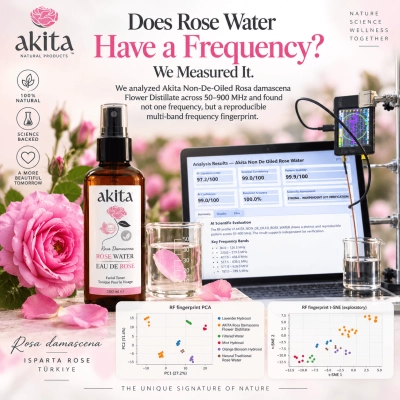
Have you ever wondered, “What is the frequency of rose water?”
If you search online for rose oil and frequency, you will often come across the number 320 MHz. There is, however, an important distinction: this widely circulated claim has been associated with Rosa damascena flower oil, not rose water.
That raised another question for us.
What happens when the naturally carried oil fraction is not separated from the rose distillate? Does Akita Non-De-Oiled Rose Water show one particular frequency when measured?
We decided to investigate.
The result was more interesting than a single number:
We did not find one frequency. We found a reproducible frequency fingerprint.
In Akita's study, Non-De-Oiled Rosa damascena Flower Distillate was examined across 50–900 MHz. The study did not find one isolated characteristic peak at 320 MHz. Instead, discriminative information appeared across multiple frequency regions, producing a reproducible multi-band measurement profile that separated from the other liquids tested in the dataset.
First, an Important Difference: Rose Oil and Rose Water Are Not the Same
When rose flowers are distilled, volatile compounds are carried with the stea...
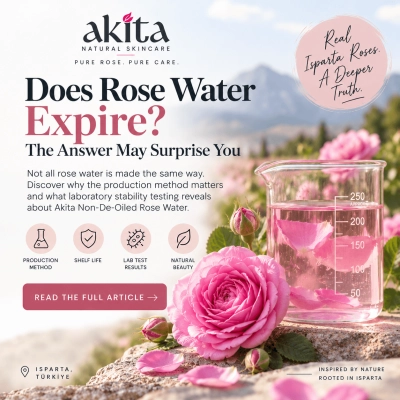
How Long Does De-Oiled Rose Water Last?
Does rose water really stay fresh for years? Prof. Dr. Hasan Baydar’s work on traditional rose water and Akita’s laboratory stability testing show why the answer begins with a more important question: What kind of rose water are we talking about?
You pick up a bottle of rose water. The label says “100% natural,” “pure rose water,” or “Rosa damascena rose water.”
But how long will it actually last?
Six months? One year? Two years?
And if it contains no preservative, how can it remain stable for an extended period of time?
There is no single answer, because not every product sold as “rose water” is made in the same way.
To understand shelf life, we first need to understand how the rose water was produced—and whether the rose oil was removed during production.
First, How Is Traditional Rose Water Produced?
Traditional rose water is closely connected to rose oil production.
In his work Oil-Bearing Rose Cultivation and Industry, Prof. Dr. Hasan Baydar of Süleyman Demirel University describes the industrial distillation of Rosa damascena in detail.
Fresh rose flowers are distilled with water. During di...
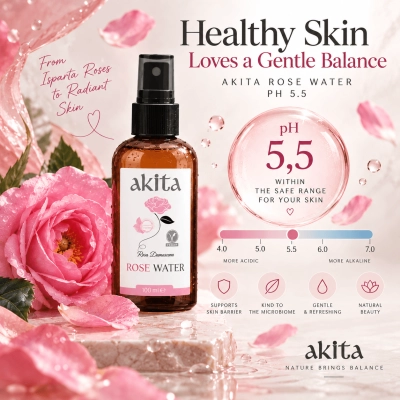
Why Does Your Skin’s pH Matter? Is 5.5 Really the Magic Number?
Your skin naturally has a slightly acidic surface. But what does that mean for your skin barrier, microbiome, and the products you use every day? Science shows that skin pH is much more interesting than a single number.
You may have seen the words “pH-balanced” on a facial cleanser, toner, or moisturizer. You may also have heard that the ideal pH for skin is 5.5.
But why 5.5?
And is everyone’s skin really pH 5.5 all the time?
The answer is more interesting than you might expect.
Your skin has a naturally slightly acidic environment at its surface. Scientists have studied this environment for decades because skin pH is closely connected with the skin barrier, the microorganisms that live on our skin, and some of the biological processes that help the skin function normally.
First, What Is pH?
pH is a way of describing how acidic or alkaline something is.
The scale generally runs from 0 to 14:
7 is neutral
Below 7 is acidic
Above 7 is alkaline
Pure water is close to neutral.
Healthy skin, however, is generally not neutral.
Its surface is naturally slightly acidic.
And that is where things become...

A practical guide to ingredients, production methods, quality testing and label transparency
Walk into a beauty store, natural health shop or online marketplace in Canada and you will find dozens of products labelled “rose water.” Their packaging may feature claims such as “natural,” “pure,” “organic,” “100% rose water” or “free from additives.”
At first glance, these products may appear almost identical. In reality, they can differ considerably in their ingredients, botanical source, production method and quality standards.
A bottle of genuine rose water may represent thousands of freshly harvested roses, careful distillation and generations of production knowledge. Another product with a similar name may simply be water combined with rose fragrance and other cosmetic ingredients.
This is why knowing how to identify genuine rose water matters.
The answer cannot be determined by scent, colour or price alone. A reliable assessment requires looking at the ingredient list, botanical species, production method, safety testing and the amount of verifiable information provided by the manufacturer.
Not Every Product Called “Rose Water” Is the Same
Rose water is often viewed as litt...
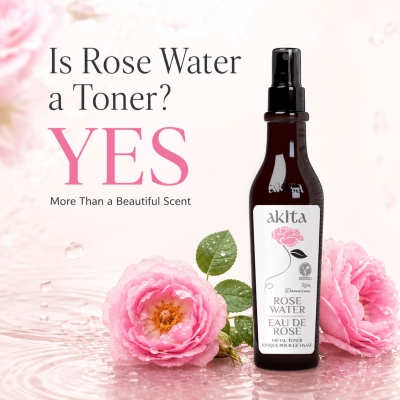
Yes, pure rose water can be used as a gentle facial toner, but its value goes far beyond its beautiful scent
Rose water is often recognized by its delicate floral aroma. Yet the fragrance is only one part of what makes genuine rose water special. When produced by distilling Rosa damascena flowers, rose water contains naturally occurring, water-soluble and aromatic compounds transferred from the petals during distillation.
This botanical composition is why high-quality rose water can serve as a simple, refreshing facial toner for daily skincare.
What Is a Facial Toner?
A facial toner is a lightweight, water-based product applied after cleansing and before serum or moisturizer. Depending on its formulation, a toner may help:
Refresh the skin after cleansing
Remove small traces of cleanser or surface residue
Prepare the skin for the next steps in a skincare routine
Provide light hydration
Leave the skin feeling softer and more comfortable
Traditional toners often contained high levels of alcohol and were designed to create a tight, dry sensation. Modern skincare has moved toward gentler formulas that focus on hydration and skin comfort rather than stripping awa...
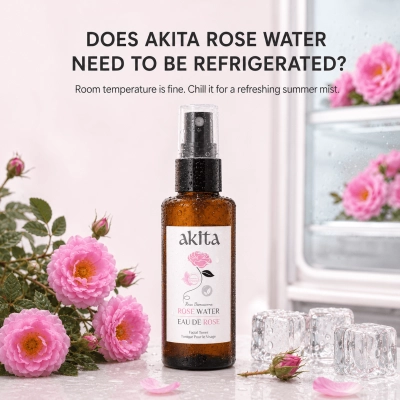
The simple answer for Canadian homes: no refrigeration is required, but chilling it can make summer skincare feel beautifully refreshing
is famous for its cold winters, but anyone who has experienced a humid Ontario summer, a heat wave in British Columbia or a sunny afternoon in Québec knows that Canadian weather is anything but predictable.
That leads to one of the most frequently asked questions about rose water:
Does rose water need to be refrigerated after opening?
For Akita Non-De-oiled Rose Water, the answer is simple:
No. Akita Non-De-oiled Rose Water does not need to be refrigerated. It can be stored at room temperature when kept away from direct sunlight and excessive heat.
You may, however, place it in the refrigerator during the summer if you enjoy the fresh sensation of a cool facial mist. Refrigeration is a matter of personal comfort, not a storage requirement.
The quick answer
Akita Non-De-oiled Rose Water can be stored:
At normal room temperature
In a cool, dry place
Away from direct sunlight
Away from radiators, fireplaces and other heat sources
Outside the refrigerator throughout the year
In the refrigerator when a cool summer...
The Hidden Difference Between Flower Water, Flower Distillate and INCI Naming
Two bottles can both say “rose water.” They may look similar, smell floral and be sold for the same skincare routine. But were they actually made the same way?
One product may be obtained directly through the distillation of rose petals. Another may be water blended with essential oil, fragrance or other aromatic ingredients. Even two genuine rose distillates may differ depending on whether the naturally occurring essential-oil fraction was separated during production.
That is why the words on the front of a bottle tell only part of the story.
To understand the identity of rose water, we need to look beyond its consumer-friendly name. We need to ask how it was produced, what was added or removed, what appears in its ingredient list and what the available documentation actually confirms.
Because rose water may be the name of the product—but distillate tells its production story.
The short answer: “Flower water” can be a broad consumer or commercial description. “Flower distillate” generally describes a water-based product obtained through the distillation of flowers. A genuine Rosa damascena disti...
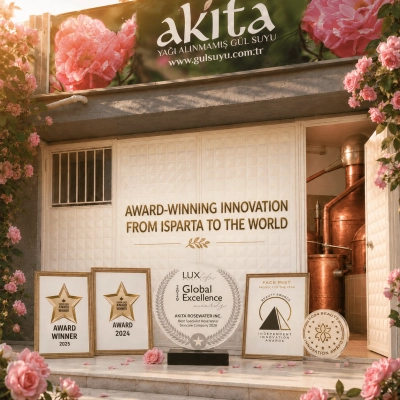
From Isparta to Canada: The Rose Water Innovation Earning International Recognition
By pioneering Non-Deoiled Rose Water, a 100% natural Rosa damascena distillate produced without separating its naturally occurring rose oil, Akita is helping redefine the value, performance, and potential of rose water in modern skincare.
A company’s awards are more than decorative symbols. Each distinction highlights a different dimension of achievement: consumer trust, product performance, clean formulation, specialized expertise, business leadership, or innovation.
Born from the celebrated Rosa damascena roses of Isparta and strengthened through years of research and product development, Akita has brought traditional rose knowledge together with modern skincare, advanced production methods, and Canadian entrepreneurship.
At the heart of this award-winning journey is one defining innovation: Akita Non-Deoiled Rose Water.
A Pioneering Approach to Rose Water
Traditional rose water is often associated with the production of rose essential oil. During conventional processing, the valuable rose oil is typically separated as the primary product, while the remaining aromatic water is collected as...
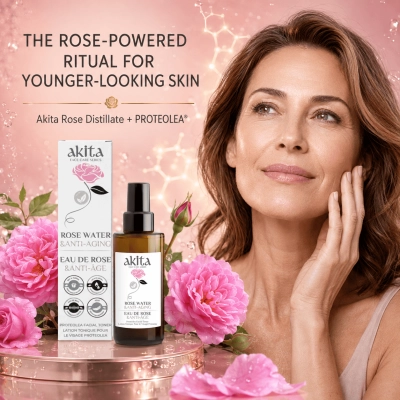
The Rose-Powered Ritual for Younger-Looking Skin: Akita Rose Water & Anti-Aging
A multi-action skincare formula combining non-de-oiled Isparta rose distillate with plant-based PROTEOLEA® to care for the appearance of fine lines, dryness, dullness and uneven texture
Does your skin look dry, tired or dull by the end of the day?
Are fine lines becoming more noticeable around your eyes, face or neck?
Perhaps you want more than a basic toner—something that combines the treasured tradition of Rosa damascena with a modern, science-informed approach to visible skin aging.
Akita Rose Water & Anti-Aging brings together two complementary skincare components:
Akita Non-De-oiled Rose Distillate, produced from Rosa damascena flowers grown in Isparta, Türkiye
PROTEOLEA®, a plant-based cosmetic active developed for multi-action anti-aging care
The result is a lightweight facial toner and mist designed to help skin look more hydrated, smooth, refreshed and youthful.
🌹 What makes this formula different?
Instead of using ordinary water as its primary skincare base, the formula is built around Akita Non-De-oiled Rose Distillate and enhanced with PROTEOLEA®.
More Than an...
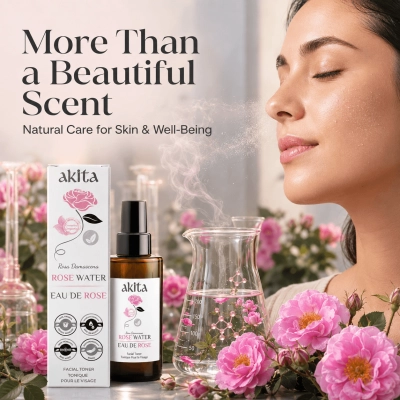
The Benefits of Rose Water for Skin and Emotional Well-Being: More Than Its Scent
Rose water is not only for those who love the scent of roses. It is for people who love their skin, care for it, and seek a natural product they can use confidently over time.
When we think of rose water, its fragrance may be the first thing that comes to mind. Yet the skincare value of a genuine, natural rose distillate extends far beyond how long its scent lasts.
Rose water may be described as a skin hydrosol, hydrolat, facial spray, face mist, or natural skincare water. Whatever term you prefer, what truly matters is why you use it.
You can choose Akita Non-De-Oiled Rose Water not simply because you enjoy its natural rose aroma, but because it is a simple, natural, and versatile product that can become part of your daily skincare routine.
A beautiful aroma may fade within minutes, but the care you give your skin, the consistency of your routine, and the refreshing sensation the product leaves on your skin can continue.
🌹 The Central Idea of This Article
Rose water is not only for those who enjoy the scent of roses. It is for people who value natural products, understand their authentic ch...