Etiket: #Eau de Rose Non Déshuilée
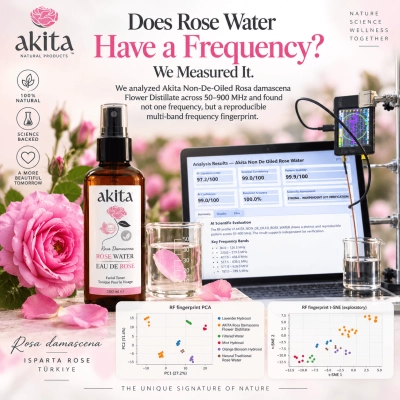
Have you ever wondered, “What is the frequency of rose water?”
If you search online for rose oil and frequency, you will often come across the number 320 MHz. There is, however, an important distinction: this widely circulated claim has been associated with Rosa damascena flower oil, not rose water.
That raised another question for us.
What happens when the naturally carried oil fraction is not separated from the rose distillate? Does Akita Non-De-Oiled Rose Water show one particular frequency when measured?
We decided to investigate.
The result was more interesting than a single number:
We did not find one frequency. We found a reproducible frequency fingerprint.
In Akita's study, Non-De-Oiled Rosa damascena Flower Distillate was examined across 50–900 MHz. The study did not find one isolated characteristic peak at 320 MHz. Instead, discriminative information appeared across multiple frequency regions, producing a reproducible multi-band measurement profile that separated from the other liquids tested in the dataset.
First, an Important Difference: Rose Oil and Rose Water Are Not the Same
When rose flowers are distilled, volatile compounds are carried with the stea...
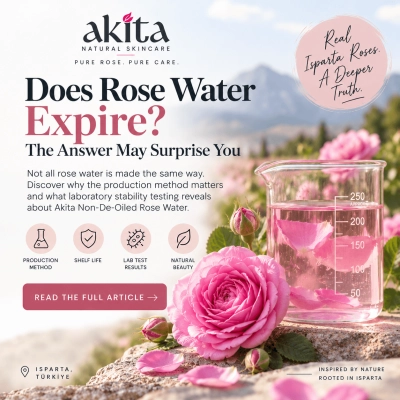
How Long Does De-Oiled Rose Water Last?
Does rose water really stay fresh for years? Prof. Dr. Hasan Baydar’s work on traditional rose water and Akita’s laboratory stability testing show why the answer begins with a more important question: What kind of rose water are we talking about?
You pick up a bottle of rose water. The label says “100% natural,” “pure rose water,” or “Rosa damascena rose water.”
But how long will it actually last?
Six months? One year? Two years?
And if it contains no preservative, how can it remain stable for an extended period of time?
There is no single answer, because not every product sold as “rose water” is made in the same way.
To understand shelf life, we first need to understand how the rose water was produced—and whether the rose oil was removed during production.
First, How Is Traditional Rose Water Produced?
Traditional rose water is closely connected to rose oil production.
In his work Oil-Bearing Rose Cultivation and Industry, Prof. Dr. Hasan Baydar of Süleyman Demirel University describes the industrial distillation of Rosa damascena in detail.
Fresh rose flowers are distilled with water. During di...
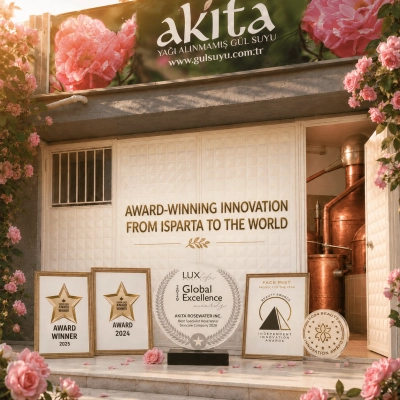
From Isparta to Canada: The Rose Water Innovation Earning International Recognition
By pioneering Non-Deoiled Rose Water, a 100% natural Rosa damascena distillate produced without separating its naturally occurring rose oil, Akita is helping redefine the value, performance, and potential of rose water in modern skincare.
A company’s awards are more than decorative symbols. Each distinction highlights a different dimension of achievement: consumer trust, product performance, clean formulation, specialized expertise, business leadership, or innovation.
Born from the celebrated Rosa damascena roses of Isparta and strengthened through years of research and product development, Akita has brought traditional rose knowledge together with modern skincare, advanced production methods, and Canadian entrepreneurship.
At the heart of this award-winning journey is one defining innovation: Akita Non-Deoiled Rose Water.
A Pioneering Approach to Rose Water
Traditional rose water is often associated with the production of rose essential oil. During conventional processing, the valuable rose oil is typically separated as the primary product, while the remaining aromatic water is collected as...