The Science Behind the Natural Fragrance of Akita Rose Water
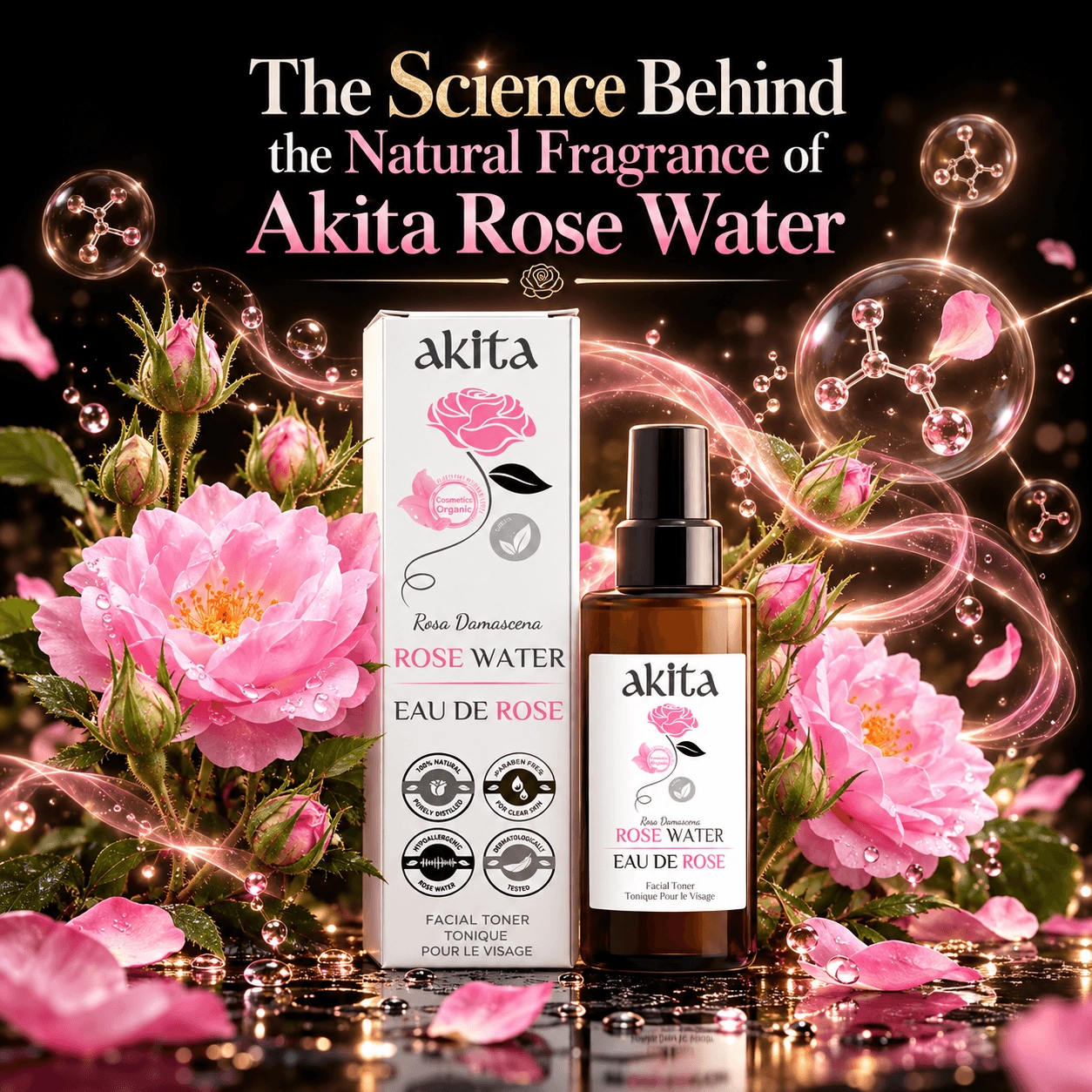
The Science Behind the Natural Fragrance of Akita Rose Water
Why does a natural Rosa damascena distillate smell different from a rose perfume? Discover the aromatic molecules, GC-MS findings, and science behind Akita's distinctive botanical fragrance.
A laboratory instrument cannot smell a rose.
But it can help us understand what makes a rose smell the way it does.
When we experience the fragrance of Rosa damascena, we are not detecting a single substance. Our sense of smell responds to a mixture of volatile molecules, each with its own chemical characteristics and potential contribution to the overall aroma.
Some create familiar floral impressions. Others may introduce fresh, green, or subtly sharp nuances.
This is especially interesting when we examine rose water.
Many people imagine that authentic rose water should smell exactly like a freshly opened rose or a sweet floral perfume.
Yet the chemistry of a botanical distillate tells a more complex story.
At Akita, we have explored this question through laboratory analysis of our Non-De-Oiled Rose Water.
What exactly creates its natural fragrance, and what can science tell us about the scent we experience?
| 🌹 THE ESSENTIAL INSIGHT |
|---|
| A rose distillate's fragrance is not determined by one molecule or by how strongly it smells. Its aromatic character reflects a complex interaction between naturally occurring volatile compounds, the distillation process, and human scent perception. |
1. Fragrance Begins With Molecules, but It Ends With Perception
To understand rose fragrance, we first need to understand how smelling works.
When volatile molecules are released into the air, some reach specialized olfactory receptors inside the nose.
These receptors respond to chemical stimuli, and the resulting signals are processed by the brain.
This process allows us to recognize familiar scents, distinguish different aromas, and associate smells with previous experiences.
However, the relationship between chemical composition and perceived fragrance is not always straightforward.
Two molecules present at similar concentrations may not smell equally strong.
One may have a noticeable aroma at a very low concentration, while another may require a higher concentration before it becomes detectable.
Scientists refer to this concept as an odour threshold.
The way a compound behaves within a mixture also matters. Other molecules, the surrounding medium, and individual differences in smell sensitivity can influence the final sensory experience.
| SCIENCE BOX — Why More Does Not Always Mean Stronger |
|---|
| Chemical abundance: How much of a compound is present or how prominently it appears in a particular analysis. |
| Odour threshold: The concentration at which an odour becomes detectable under specified conditions. |
| Sensory perception: How an individual experiences and interprets the complete aromatic mixture. |
| A prominent compound in a chemical analysis is not necessarily the compound that dominates what someone smells. |
This distinction is essential when interpreting the natural fragrance of rose water.
2. What Happens to Rose Fragrance During Distillation?
The aroma of a fresh Rosa damascena flower is not identical to the aroma of the water obtained from its distillation.
Why?
Because the distillation process selectively transfers certain compounds from the flower into the resulting distillate.
Different aromatic molecules behave differently depending on their volatility, water solubility, and affinity for the oil or water phase.
Some compounds are more readily associated with rose essential oil.
Others are more likely to remain in the water-based distillate.
Consequently, rose essential oil and rose water do not have identical chemical compositions, even when they originate from the same flowers.
Akita developed a distinctive production approach known as Non-De-Oiled Rose Water.
Instead of separating the naturally occurring rose oil fraction as an independent product, Akita's method is designed to retain that fraction within the distillate.
The objective is to preserve the naturally formed aromatic character of the distillation product rather than separate it and reconstruct it afterward.
This does not mean every compound found in a fresh rose remains unchanged in the finished product.
Distillation is a selective process.
The important distinction is how the resulting distillate is collected and handled.
| BOTANICAL INSIGHT — The Flower and Its Distillate |
|---|
| Fresh Rosa damascena: Releases an aromatic mixture directly from the living flower. |
| Rose essential oil: Contains compounds concentrated in the separated oil phase. |
| Rose distillate: Contains water-compatible and other volatile constituents transferred and retained during distillation. |
| Akita Non-De-Oiled Rose Distillate: Is produced without a separate step to recover and remove the naturally occurring rose oil fraction. |
Understanding these differences helps explain why natural rose water may possess a fragrance distinct from concentrated rose oil or commercial rose perfume.
3. Inside the Laboratory: Akita's GC-MS Findings
How can we move beyond subjective descriptions such as floral, fresh, sharp, or sweet?
One approach is to examine the chemical composition of the distillate.
Akita Non-De-Oiled Rose Water was analyzed using Gas Chromatography–Mass Spectrometry (GC-MS).
This analytical technique separates and helps identify volatile compounds within a sample.
The results provide a chemical profile rather than merely a description of how the product smells.
In Akita's analysis dated July 2, 2024, several compounds were identified as prominent constituents of the measured volatile profile.
Akita Rose Distillate: GC-MS Profile
| Identified compound | Relative GC-MS result |
|---|---|
| Phenethyl Alcohol | 79.54% |
| β-Citronellol | 7.81% |
| Acetic Acid | 4.87% |
| Benzyl Alcohol | 1.46% |
| α-Linalool | 0.92% |
Source: Akita Rose Distillate GC-MS analysis, July 2, 2024.
These findings offer valuable information about the chemical identity of the analyzed sample.
But what do the numbers actually mean?
| IMPORTANT SCIENTIFIC CLARIFICATION |
|---|
| The percentages represent relative analytical results within the GC-MS profile of the tested sample. |
| 79.54% phenethyl alcohol does not mean that 79.54% of the liquid in the bottle consists of phenethyl alcohol. |
| Relative chromatographic peak-area percentages should not be confused with absolute concentrations in the complete product. |
| Accurate concentration measurements require appropriate quantitative analytical methods and calibration. |
This distinction makes the findings more meaningful, not less.
It allows the results to be interpreted for what they actually reveal: a measurable pattern of volatile compounds in a particular rose distillate sample.
4. Meet the Molecules Behind Akita's Natural Aroma
Each compound identified in the analysis has its own chemical properties.
Understanding a few of them can help explain why the fragrance of a botanical distillate is more complex than a single familiar rose note.
Phenethyl Alcohol: The Floral Foundation
Phenethyl alcohol, also known as 2-phenylethanol, is strongly associated with the characteristic fragrance of roses.
It is often described as having a soft, floral, rose-like odour.
Because phenethyl alcohol has appreciable solubility in water, it is an important compound in studies of rose hydrosols.
Its prominence in Akita's GC-MS profile is therefore relevant to understanding the product's aromatic identity.
However, the overall fragrance cannot be explained by phenethyl alcohol alone.
β-Citronellol: Another Dimension of Rose Fragrance
Citronellol is a naturally occurring aromatic compound found in a variety of fragrant plants, including roses.
Its odour is commonly characterized by floral and citrus-like nuances.
Together with other rose-derived volatiles, it contributes to the aromatic complexity associated with Rosa damascena.
Acetic Acid: Understanding a Sharper Note
Acetic acid is especially interesting because it is associated with a recognizable sharp, sour, or vinegar-like odour.
Akita's GC-MS analysis identified acetic acid within the tested distillate's volatile profile.
This provides a plausible chemical explanation for why some individuals perceive a slightly tangy note alongside the floral rose fragrance.
However, identifying acetic acid in an analysis does not establish precisely how strongly every individual will perceive it.
It also does not mean that vinegar was added to the product.
Benzyl Alcohol and Linalool: Additional Aromatic Details
Benzyl alcohol and linalool are also found in the analyzed volatile profile.
Both are known aromatic compounds, although their sensory characteristics differ.
Linalool is often associated with floral and fresh notes, while benzyl alcohol has a relatively mild aromatic character.
Their presence contributes additional information about the product's chemical composition.
| MOLECULE SPOTLIGHT — One Aroma, Multiple Contributors |
|---|
| Phenethyl alcohol: Characteristic soft, rose-like floral notes. |
| β-Citronellol: Floral nuances with a citrus-like character. |
| Acetic acid: Potential contribution to sharp or tangy notes. |
| Benzyl alcohol: A mildly aromatic constituent. |
| Linalool: Fresh, floral aromatic nuances. |
| These descriptions refer to the general sensory characteristics of the individual compounds. They do not constitute a formal sensory evaluation of the finished Akita product. |
5. Why Can a Natural Rose Distillate Have a Slightly Tangy Scent?
This is one of the most interesting questions surrounding natural rose water.
People often associate roses with softness, sweetness, and elegance.
A sharper note can therefore be unexpected.
But our expectations of rose fragrance are influenced by the perfumes and fragranced cosmetics we encounter.
Those fragrances may be intentionally composed to emphasize certain notes and create a consistent sensory impression.
A botanical distillate follows a different process.
Its aromatic profile develops through the chemical composition of the plant material and the production conditions.
In Akita's case, the identification of acetic acid offers one possible explanation for a lightly acidic or vinegar-like nuance.
The presence of this compound in the analyzed sample is documented.
However, its exact contribution to the perceived odour would require additional sensory investigation.
There is also an important quality distinction.
A mildly tangy note that is characteristic of a product should not automatically be interpreted as spoilage.
Equally, an unexpectedly strong or unpleasant odour should not automatically be dismissed as natural.
Product quality must be evaluated through appropriate manufacturing controls, microbiological assessments, stability testing, and consideration of any unusual changes.
| MYTH VS. SCIENCE |
|---|
| Myth: Real rose water must always smell sweet, soft, and perfume-like. |
| Science: Naturally distilled rose water may have a more complex aromatic profile, including floral, fresh, botanical, or mildly tangy nuances. |
| Important: Scent alone cannot confirm a product's authenticity, quality, or microbiological safety. |
6. Can GC-MS Tell Us Exactly What a Person Will Smell?
Not entirely.
GC-MS is highly valuable for investigating chemical composition, but conventional GC-MS does not directly measure human odour perception.
A chromatographic peak represents an instrumental response associated with a detected compound.
It does not automatically tell us how strongly that compound will smell to a person.
This is where sensory science becomes particularly interesting.
Researchers may use additional approaches, including standardized sensory evaluations and gas chromatography–olfactometry (GC-O).
GC-O combines chemical separation with human odour detection, helping researchers investigate which regions of a chromatogram correspond to perceptible smells.
Other approaches consider odour thresholds and odour activity values, which relate a compound's concentration to its sensory detection threshold in a particular medium.
These methods can provide information beyond chemical identification alone.
A Question Worth Exploring Further
What would happen if the chemical profile of Akita Rose Distillate were evaluated alongside a standardized sensory panel?
Could particular aromatic notes be more directly associated with specific groups of volatile compounds?
These are meaningful questions for future investigation.
| FUTURE RESEARCH OPPORTUNITY |
|---|
| GC-MS identifies chemical compounds. Sensory evaluation describes human perception. GC-O can help connect the two. |
| Akita's documented GC-MS findings provide a foundation for understanding its volatile chemical profile. A dedicated GC-O or sensory-panel study would be a separate investigation; it should not be presented as a test Akita has already completed. |
The broader lesson is that fragrance science involves both instruments and human perception.
Neither provides the complete picture on its own.
7. One Ingredient Does Not Mean One Molecule
This is another important distinction for consumers who prefer simple cosmetic formulations.
Akita Non-De-Oiled Rose Water is identified by one declared ingredient:
INCI: Rosa Damascena Flower Distillate
Yet that botanical distillate can naturally contain multiple chemical compounds.
There is no contradiction.
An ingredient name describes the botanical material used in a formulation. It does not imply that the material consists of only one chemical substance.
The same principle applies to many botanical ingredients.
A single plant-derived ingredient may contain numerous naturally occurring constituents.
For Akita, the natural fragrance originates from the aromatic profile of the rose distillate rather than from perfume added after distillation.
But another distinction matters for sensitive consumers.
No added perfume does not mean odourless or free of naturally occurring fragrance compounds.
Some naturally occurring aromatic substances may also be relevant to individual sensitivities.
Consumers should always review the product label, follow directions, and consider their personal skin sensitivities.
| INGREDIENT TRANSPARENCY — THREE DIFFERENT IDEAS |
|---|
| One declared ingredient: The product's ingredient identity is Rosa Damascena Flower Distillate. |
| Multiple natural constituents: The distillate contains various chemical compounds naturally associated with the botanical material and its processing. |
| No added perfume: The product's characteristic scent is not created by adding a separate perfume formulation. |
| A natural aromatic profile should never be interpreted as a guarantee that every individual will tolerate the product. |
8. What Should Consumers Actually Look for in Natural Rose Water?
Fragrance can make a product memorable, but it should not be the only factor used to evaluate it.
When choosing a rose water or rose distillate in Canada, consumers can ask several more informative questions.
What is the botanical source?
The label should identify the rose-derived ingredient appropriately, such as Rosa Damascena Flower Distillate.
How was the product made?
Distillation and oil-separation methods influence the resulting material.
Has the product been analyzed?
Chemical testing can help characterize the volatile profile, while microbiological and stability tests address other aspects of quality.
Are additional fragrance ingredients present?
Reading the ingredient declaration helps consumers distinguish a botanical distillate from a product formulated with added fragrance.
Does the product appear to be in good condition?
Packaging integrity, appropriate storage, the labelled shelf life, and changes from the product's normal appearance or odour all matter.
A distinctive scent may invite curiosity.
But quality should be evaluated with more than the nose.
9. A Different Way to Experience the Rose
The next time you use a natural Rosa damascena distillate, consider its fragrance as a botanical experience rather than comparing it immediately with a perfume.
You may first notice a familiar floral character.
You may also recognize fresher, greener, or more tangy nuances.
Another person may describe the same aroma differently.
This simple observation illustrates an important point:
Chemical composition can be measured, but fragrance is experienced.
For Akita, understanding both aspects helps communicate the natural character of its rose distillate more accurately.
A rose's fragrance is not just a marketing description.
It is also a subject of chemistry, sensory science, and ongoing botanical research.
Frequently Asked Questions (FAQ)
1. Why does Akita Rose Water smell different from rose perfume?
Akita Non-De-Oiled Rose Water obtains its fragrance from the aromatic compounds naturally present in its Rosa damascena distillate. Perfumes are formulated to create a particular fragrance experience, while a botanical distillate reflects the compounds transferred and retained during production.
2. Does Akita Rose Water contain added perfume?
Akita Non-De-Oiled Rose Water is a single-ingredient product identified as Rosa Damascena Flower Distillate. Its characteristic fragrance comes from the distillate itself, without a separately added perfume formulation.
3. Why might Akita Rose Water have a slightly vinegar-like scent?
Akita's GC-MS analysis identified acetic acid among the volatile compounds in the tested sample. Because acetic acid has a characteristic sharp or vinegar-like odour, it may contribute to a slightly tangy note perceived by some users. This does not mean vinegar has been added to the product.
4. Does a tangy smell mean rose water has spoiled?
Not necessarily. Some natural distillates have characteristic sharp or acidic aromatic notes. However, an unusual change in smell, colour, clarity, or packaging condition should not be assumed to be normal. Follow the product's storage instructions and contact the manufacturer if you suspect a quality issue.
5. What does phenethyl alcohol do in rose water?
Phenethyl alcohol is a naturally occurring aromatic compound associated with the characteristic floral scent of roses. It is also relatively water-compatible, making it relevant to the chemical profiles of rose hydrosols.
Its presence in a GC-MS analysis helps characterize the product's volatile composition but does not independently establish a particular skincare benefit.
6. Does 79.54% phenethyl alcohol mean most of the bottle contains this compound?
No. The 79.54% figure refers to a relative result in Akita's analyzed GC-MS profile. It is not the percentage of the complete liquid formulation. Determining an actual concentration requires an appropriately calibrated quantitative analysis.
7. Can a product with one ingredient contain many different molecules?
Yes. A botanical ingredient can naturally contain numerous chemical substances. Akita's declared ingredient, Rosa Damascena Flower Distillate, describes the distillate as an ingredient, not as a single pure chemical compound.
8. Why can two people describe the same rose water fragrance differently?
People vary in their sensitivity to particular odours. Previous experiences, fragrance familiarity, and sensory adaptation can also influence perception. As a result, one person may notice floral notes more strongly, while another may be more sensitive to sharp or tangy nuances.
9. Does a stronger rose scent mean better rose water?
Not necessarily. Fragrance intensity is not a reliable stand-alone measure of authenticity, chemical quality, skincare effectiveness, or safety. Botanical identity, production methods, ingredient transparency, and appropriate product testing provide more useful information.
10. Can GC-MS prove that a rose water is completely natural?
GC-MS can help identify compounds and characterize a sample's chemical profile. It may also reveal unexpected substances.
However, GC-MS alone does not automatically establish the entire origin, purity, or manufacturing history of a product.
A credible assessment considers analytical data together with ingredient traceability, manufacturing documentation, and relevant quality controls.
Conclusion: The Chemistry Behind the Fragrance
A rose fragrance may feel simple because our senses recognize it instantly.
But the chemistry behind that familiar impression is anything but simple.
Akita's GC-MS findings provide insight into the volatile compounds present in its Non-De-Oiled Rose Distillate.
Phenethyl alcohol, citronellol, acetic acid, benzyl alcohol, and linalool offer different clues about the product's aromatic character.
Yet chemistry and perception are not identical.
Understanding the fragrance of Rosa damascena requires us to look at both the compounds that can be measured and the experience created when those compounds reach our senses.
For Akita, this is part of a continuing commitment to exploring the rose beyond its appearance and fragrance.
Because a rose is more than a beautiful flower, and authentic rose water is more than a familiar scent.
Akita. So Much More Than Rose Water.
Research and Further Reading
Akita's Product-Specific Analytical Information
What Is Rosa Damascena Flower Distillate? — Akita Rosewater
Includes Akita's July 2, 2024 GC-MS findings and information about its Non-De-Oiled Rose Distillate.
Published Scientific Research
Examines the volatile composition of a different rose hydrosol and reviews chemical diversity reported in rose hydrosols. Its findings should not be treated as measurements of Akita's product.
Comparative Study of the Yield and Chemical Profile of Rose Oils and Hydrosols — Resources, 2023
Investigates differences between the volatile profiles of rose essential oils and hydrosols.
Odor Thresholds in Flavor Science: A Data-Driven Review From Mechanisms to Applications — 2026
Reviews odour thresholds, sensory detection, and analytical approaches used to evaluate aroma-active compounds.
Canadian Consumer Information
Health Canada — Cosmetic Advertising, Labelling and Ingredients
Provides guidance on cosmetic ingredients, fragrance terminology, consumer safety, and product labelling.
Comment