Etiket: #Rose Science
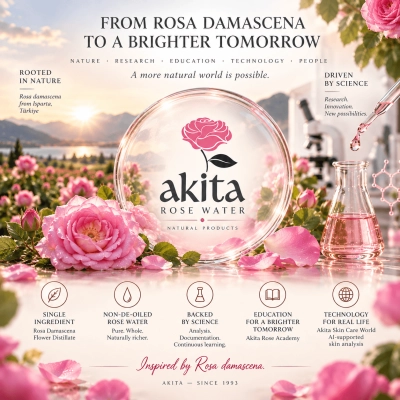
From Rosa damascena to the Future: Akita’s 2025–2026 Journey and Our Vision for 2027
From Non-De-Oiled Rose Water to scientific research, education and Akita Skin Care World: a new chapter in Akita’s journey
Some years represent more than growth for a company. They become periods of reflection—moments when a company looks beyond what it produces and asks deeper questions about what makes it different, what it has learned, and where it wants to go next.
For Akita, 2025 and 2026 have been such years.
Our journey began in 1993 and has been shaped by more than three decades of experience with natural products, botanical ingredients and skin care. At the heart of that journey has remained one remarkable flower:
Rosa damascena.
Over the years, our relationship with this flower has evolved from production into a much broader pursuit of knowledge. We have explored how it is cultivated and harvested, how distillation influences the resulting botanical distillate, how its composition can be studied, and how this knowledge can contribute to the development of natural skin care.
During 2025 and 2026, another dimension was added to this journey:
researching, measuring, documenting, educ...
A rose does not attract scientific attention simply because it smells beautiful.
When researchers study a plant, they ask very different questions:
What compounds does it contain? Can those compounds be identified and measured? What happens when they interact with cells or microorganisms? Are similar effects observed in humans? Does the production method change the final product and its properties?
Rosa damascena—the Damask rose, particularly associated with Isparta, Türkiye—is an intriguing plant because it raises many of these questions at the same time.
Scientific research is not limited to rose essential oil. Rose water, hydrosols, flower extracts, and preparations obtained from different parts of the plant have also been investigated.
🌹 IN SHORT
Rosa damascena is scientifically interesting because of its long history of use, complex chemical composition, the variety of products that can be obtained from it, and the measurable biological activities reported for some of these preparations.
However, the fact that something has been studied does not mean that every claimed benefit has been conclusively proven in humans.
1. It All Begins with the Chemistry of...