Rosa Damascena Flower Distillate: A New Botanical Raw Material for Modern Cosmetic Formulation
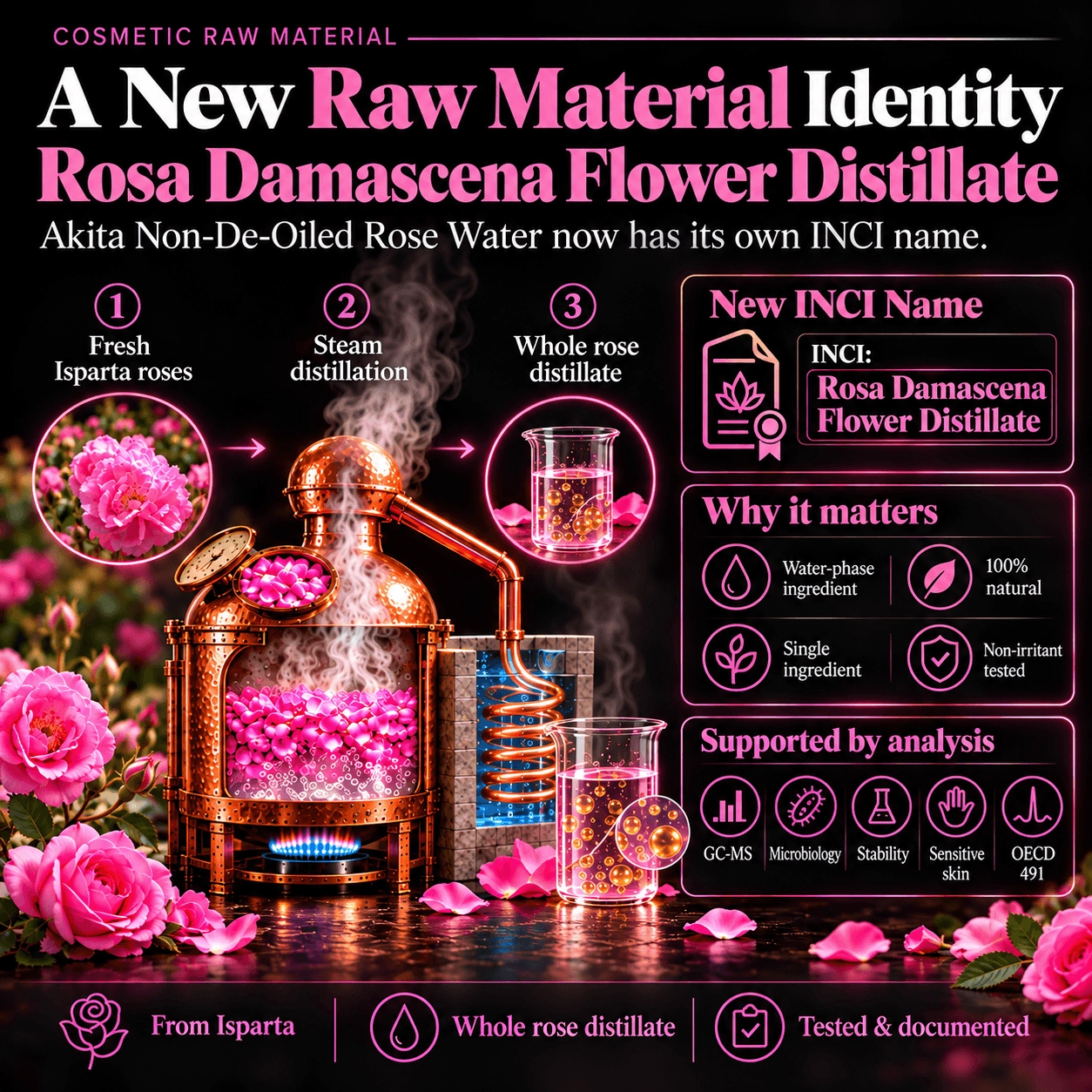
Rosa Damascena Flower Distillate: Rethinking the Water Phase in Modern Cosmetic Formulation
A new botanical raw material identity for formulators looking beyond conventional purified water
In cosmetic formulation, water is often the largest ingredient in the formula.
Yet it is also one of the ingredients that receives the least attention.
For decades, formulators have invested heavily in active ingredients, botanical extracts, peptides, oils and delivery systems while the aqueous phase has largely remained functional and invisible.
But the direction of modern formulation is changing.
Brands are increasingly looking for multifunctional raw materials, shorter ingredient lists, botanical storytelling, traceable sourcing and ingredients supported by analytical documentation.
This raises an interesting formulation question:
What if the water phase itself could contribute to the identity of the finished product?
Akita Non-De-Oiled Rose Water introduces one possible answer.
The ingredient now has a distinct INCI identity:
Rosa Damascena Flower Distillate
INCI Application No. 2025-14613
Produced from Rosa damascena flowers through Akita's non-de-oiled distillation approach, this single botanical ingredient creates an opportunity for formulators to think differently about one of the largest components of many cosmetic products.
From Supporting Ingredient to Formulation Story
Traditional cosmetic development often begins with a familiar framework:
Purified water + functional ingredients + actives + sensory modifiers + preservation system
There is nothing inherently wrong with this approach.
However, the growth of ingredient-conscious beauty has encouraged product developers to examine every part of a formulation more closely.
Consumers increasingly want to know:
- Where does an ingredient come from?
- How was it produced?
- Why is it included?
- Does it have analytical documentation?
- Is the ingredient list unnecessarily complicated?
- Does the formulation tell a coherent story?
This is creating renewed interest in botanical waters, hydrosols and distillates.
The challenge is that these terms can describe very different materials.
A cosmetic developer therefore needs more than a botanical name.
They need identity, production transparency, consistency, stability and analytical evidence.
That is where Rosa Damascena Flower Distillate becomes particularly interesting.
FORMULATOR INSIGHT
Do not evaluate a botanical water only by its fragrance or botanical name.
For formulation purposes, ask how it was produced, whether volatile fractions were removed, how the ingredient behaves over time and what testing is available.
What Is Rosa Damascena Flower Distillate?
Rosa Damascena Flower Distillate is a distillation-derived ingredient produced from the flowers of Rosa damascena.
Akita's version is produced according to a distinctive objective.
In conventional rose-oil production, the essential oil is generally a valuable primary product and the aromatic aqueous phase is collected alongside it.
Akita's approach begins with a different objective:
The rose distillate itself is the intended product.
The naturally occurring rose-oil fraction associated with the distillation process is not deliberately separated as a separate commercial product.
Akita describes this production concept as:
Non-De-Oiled Rose Water
Importantly, this does not mean rose essential oil is mixed back into ordinary water afterward.
The material is produced directly through distillation.
Akita has used this approach since 2003. The newly accepted ingredient identity, Rosa Damascena Flower Distillate, provides a more precise cosmetic terminology for the material. akitarosewater.ca
Why the Water Phase Is Becoming More Interesting
One of the notable directions in contemporary beauty formulation is the movement toward ingredient efficiency.
Instead of asking:
“How many actives can we add?”
product developers are increasingly asking:
“How much purpose can each ingredient contribute?”
This trend can be seen in several areas:
Shorter INCI lists
Consumers and brands are increasingly interested in formulas that are easier to understand.
Botanical traceability
Plant origin, species, processing and sourcing are becoming part of product differentiation.
Multifunctional formulation
Raw materials capable of contributing to more than one formulation objective may help create more coherent products.
Evidence-based natural beauty
“Natural” alone is becoming less persuasive. Technical buyers increasingly expect documentation, analytical testing and repeatable specifications.
Water-conscious formulation
The industry is paying greater attention to the role of water, concentrated formats and the environmental implications of formula architecture.
Against this background, replacing an otherwise anonymous portion of the aqueous phase with a botanical distillate can create an interesting formulation strategy.
Can Rosa Damascena Flower Distillate Be Used in the Water Phase?
Yes.
Because Rosa Damascena Flower Distillate is fundamentally an aqueous botanical distillate, it can be considered for incorporation into the water phase of cosmetic formulations, subject to the requirements of the individual formula.
Potential applications may include:
- facial mists
- toners
- serums
- emulsions
- creams
- lotions
- cleansers
- scalp products
- body-care formulations
- botanical skincare systems
The appropriate inclusion level will depend on the formulation architecture, preservation system, target pH, sensory objectives, compatibility and regulatory requirements of the final product.
This is important.
Using a botanical distillate does not eliminate the need for professional formulation work.
It creates a different starting material for the aqueous phase.
FORMULATION OPPORTUNITY
Instead of asking:
“Which botanical extract should we add to water?”
formulators may also ask:
“Can the botanical distillate become part of the water phase itself?”
What Makes a Botanical Distillate Interesting to a Raw-Material Buyer?
A compelling botanical story may attract attention.
A procurement team, however, requires much more.
For a cosmetic raw material to become commercially useful, formulators and manufacturers generally need confidence in several areas.
1. Ingredient identity
The accepted INCI identity provides a standardized way to communicate the material:
Rosa Damascena Flower Distillate
For international formulation teams, a clear ingredient name improves technical communication and helps distinguish the material from generic marketing descriptions such as “rose water.”
2. Botanical source
The ingredient begins with Rosa damascena.
Botanical identity matters because different rose species, growing conditions and production practices can result in different aromatic and analytical profiles.
Akita's raw material is associated with Rosa damascena cultivated in Isparta, a region internationally recognized for Damask rose production.
3. Manufacturing method
Two ingredients may sound similar on an ingredient list while having very different production histories.
A botanical distillate may vary according to:
- flower quality
- harvest timing
- storage before distillation
- distillation duration
- pressure
- condensation parameters
- fraction management
- oil separation practices
For buyers, the production method therefore becomes part of the ingredient specification.
Beyond “Natural”: Why Documentation Matters
The cosmetic industry has moved well beyond a period when a botanical ingredient could be differentiated simply by calling it natural.
Today, technical buyers increasingly want evidence.
For Akita Non-De-Oiled Rose Water, evaluation has included multiple forms of testing and characterization.
GC-MS profiling
Gas Chromatography-Mass Spectrometry can provide information about volatile and semi-volatile compounds within the material.
This gives formulators a more objective way to examine the ingredient than relying on fragrance alone.
Microbiological testing
Microbiological quality is particularly important for aqueous botanical ingredients.
Stability evaluation
Long-term stability becomes highly relevant when botanical ingredients are intended for commercial cosmetic manufacturing.
Akita has conducted stability work on the material under multiple storage conditions, alongside observations from older production samples.
Sensitive-skin testing
For brands developing products positioned toward sensitive-skin consumers, supporting testing can contribute to ingredient selection decisions.
Eye-irritation assessment
Akita Non-De-Oiled Rose Water has also undergone an OECD 491 eye-irritation assessment, in which the tested material was classified as non-irritant.
This does not automatically mean every final formulation containing the ingredient will be non-irritating.
The finished formulation must still be evaluated separately.
That distinction is essential.
TECHNICAL NOTE
Raw-material testing does not replace finished-product testing.
Safety, stability and performance of a cosmetic formulation depend on the complete formula, ingredient interactions, concentrations, packaging and intended use.
An Unexpected Area of Exploration: RF Measurements
Alongside conventional analytical testing, Akita has also been exploring radio-frequency measurements as an additional physical characterization method.
These measurements are exploratory.
They should not be interpreted as substitutes for GC-MS, toxicological evaluation, microbiological testing or clinical evidence.
However, they have produced observations that may be useful for future research.
Akita's measurements have shown multiple RF regions in the Non-De-Oiled Rose Water.
In comparisons performed on samples produced approximately ten years apart, the materials showed comparable frequency characteristics.
The measured whole rose distillate also demonstrated multiple peaks across frequency regions extending above the single rose-oil reference value used in the comparison.
The significance of these observations is still being investigated.
For this reason, Akita currently treats RF measurement as a physical characterization tool, rather than a biological efficacy claim.
This distinction is especially important when communicating emerging analytical approaches responsibly.
Why Long-Term Consistency Matters More Than a Single Laboratory Result
A botanical raw material may produce an impressive laboratory profile once.
For commercial buyers, that is only the beginning.
One of the more difficult questions is:
Can the ingredient maintain a recognizable quality profile over time?
Botanical materials are inherently influenced by nature.
Weather, harvest conditions, agricultural variations and processing can all introduce variability.
This makes historical comparison particularly valuable.
Akita has had the opportunity to examine material produced many years apart.
The observation that older and newer production samples continue to demonstrate comparable quality characteristics provides an interesting additional layer to the ingredient's development history.
For buyers evaluating a raw material for repeated production, consistency may be as important as novelty.
WHAT FORMULATORS SHOULD REQUEST FROM A BOTANICAL RAW-MATERIAL SUPPLIER
Before selecting a botanical water or distillate, consider requesting:
✓ INCI identification
✓ botanical species
✓ plant part used
✓ production-method description
✓ specification sheet
✓ microbiological results
✓ stability information
✓ analytical profile where available
✓ safety documentation
✓ recommended formulation conditions
✓ batch-to-batch quality controls
A Single Ingredient Can Still Be Chemically Complex
There is an important distinction between a single ingredient and a single molecule.
Rosa Damascena Flower Distillate is one cosmetic ingredient.
But botanical distillates may naturally contain multiple compounds transferred from the plant during distillation.
This is precisely why analytical characterization matters.
A one-ingredient declaration does not mean the botanical material is chemically empty or simplistic.
Instead, the ingredient represents a naturally derived matrix created during distillation.
This concept is increasingly relevant as brands seek formulations with shorter ingredient lists without abandoning botanical complexity.
Could It Replace Purified Water Completely?
Potentially in some formulations, but this should never be treated as a universal formulation rule.
The practical amount depends on:
- the intended product
- formulation pH
- emulsification system
- preservation strategy
- compatibility with other ingredients
- regulatory requirements
- colour and odour targets
- stability objectives
- packaging
- cost parameters
For some products, Rosa Damascena Flower Distillate may represent a portion of the aqueous phase.
For others, formulators may investigate much higher inclusion levels.
The correct approach is formulation-specific testing.
This is more scientifically responsible than claiming that any botanical distillate can automatically replace water at 100% in every formula.
What Could This Mean for Product Positioning?
The ingredient may be especially interesting for brands working in areas such as:
Premium botanical skincare
where raw-material provenance becomes part of brand value.
Sensitive-skin concepts
where ingredient simplicity and supporting testing are priorities.
Minimalist formulations
where each component is expected to have a clear reason for inclusion.
Rose-focused product lines
where the aqueous phase can reinforce the central botanical identity rather than merely carrying added rose-derived ingredients.
Natural and naturally positioned cosmetics
where formulators are seeking documented botanical materials rather than generic aromatic waters.
Spa and professional skincare
where ingredient provenance and sensory experience can work together.
From Consumer Rose Water to B2B Cosmetic Ingredient
Perhaps the most important change represented by Rosa Damascena Flower Distillate is not simply a change of name.
It is a change of perspective.
Rose water is traditionally understood as a finished beauty product.
But from a formulation perspective, a controlled and documented rose distillate can also be considered as a raw material platform.
That opens different conversations.
Not:
“Would you like to add rose water to the product?”
but:
“What role could a whole rose distillate play in the architecture of the formula?”
For R&D departments, contract manufacturers and ingredient buyers, that is a much more interesting question.
The Next Generation of Botanical Ingredients Will Need More Than a Story
Botanical ingredients have always had stories.
Where they came from.
How they were traditionally used.
What they smelled like.
Why people valued them.
But modern cosmetic development requires another layer.
It requires documentation.
The future of botanical formulation is likely to belong to raw materials capable of combining:
origin + processing transparency + analytical characterization + safety data + formulation relevance
Rosa Damascena Flower Distillate represents Akita's work toward that model.
A botanical material rooted in traditional rose distillation, but increasingly defined through modern cosmetic ingredient language and technical investigation.
RAW MATERIAL AT A GLANCE
INCI: Rosa Damascena Flower Distillate
Botanical source:Rosa damascena flowers
Ingredient type: Botanical distillate
Akita production concept: Non-De-Oiled Rose Water
Format: Aqueous raw material
Potential formulation role: Water-phase ingredient
Composition concept: Single cosmetic ingredient
Origin: Isparta Rosa damascena
Supporting work: GC-MS, microbiology, stability, sensitive-skin testing, OECD 491 eye-irritation assessment and exploratory RF characterization
Frequently Asked Questions
What is the INCI name of Akita Non-De-Oiled Rose Water?
The ingredient is identified as Rosa Damascena Flower Distillate. Akita's INCI application number is 2025-14613.
Is Rosa Damascena Flower Distillate the same as rose essential oil?
No. Rose essential oil is a concentrated oil fraction, while Rosa Damascena Flower Distillate is an aqueous distillate produced from Rosa damascena flowers.
Does “non-de-oiled” mean rose oil is added to water?
No. In Akita's process, the material is created through distillation and the naturally occurring oil fraction associated with the distillate is not deliberately separated. It is not ordinary water with rose essential oil added afterward. This distinction is also explained in Akita's existing technical material. akitarosewater.ca
Can Rosa Damascena Flower Distillate be used instead of purified water?
It may be used as part of the aqueous phase, and formulators may investigate higher replacement levels depending on the product. The appropriate percentage must be established through formulation, compatibility, preservation and stability testing.
Is it 100% natural?
Akita Non-De-Oiled Rose Water is produced as a single botanical distillate from Rosa damascena. Any final natural-content claim for a finished cosmetic product should still be assessed according to the relevant certification or regulatory framework.
Is it suitable for sensitive-skin formulations?
The Akita raw material has undergone sensitive-skin-related testing. However, suitability of a finished product depends on the complete formulation and should be assessed separately.
Is it safe around the eyes?
The tested Akita material was classified as non-irritant in an OECD 491 eye-irritation assessment. This result applies to the material tested and should not automatically be transferred to every finished product containing it.
Why is GC-MS relevant?
GC-MS helps characterize compounds within the distillate and provides analytical information beyond sensory evaluation such as colour or aroma.
What do Akita's RF measurements prove?
At this stage, they should be considered exploratory physical measurements. Akita has observed multiple RF regions and similarities between older and current production samples, but these observations should not be presented as proof of biological or therapeutic effects.
Why would a cosmetic manufacturer choose a botanical distillate for the water phase?
It may allow the aqueous phase itself to contribute botanical origin, formulation identity and brand storytelling while potentially supporting a more ingredient-efficient formulation strategy.
Is Rosa Damascena Flower Distillate only relevant for rose-focused brands?
No. It may be of interest to formulators working with botanical skincare, minimalist formulas, natural concepts, sensitive-skin positioning, premium personal care and other categories where the identity of the aqueous phase adds value.
Looking Beyond Water
The next generation of cosmetic formulation may not be defined only by discovering new active ingredients.
Sometimes innovation comes from reconsidering ingredients we have treated as ordinary.
Water is one of them.
With its newly established INCI identity, Rosa Damascena Flower Distillate gives formulators another way to think about the aqueous phase: not simply as a carrier, but as a deliberately selected botanical raw material.
For Akita, this milestone represents the formal technical identity of an approach that began in 2003.
For cosmetic developers, it opens a different question:
What could your formula become if its largest phase had a botanical identity of its own?
For technical information, raw-material documentation or formulation enquiries regarding Akita Rosa Damascena Flower Distillate, contact Akita Rosewater.
Comment