Rose Oil and Memory: How Rose Scent May Affect the Brain
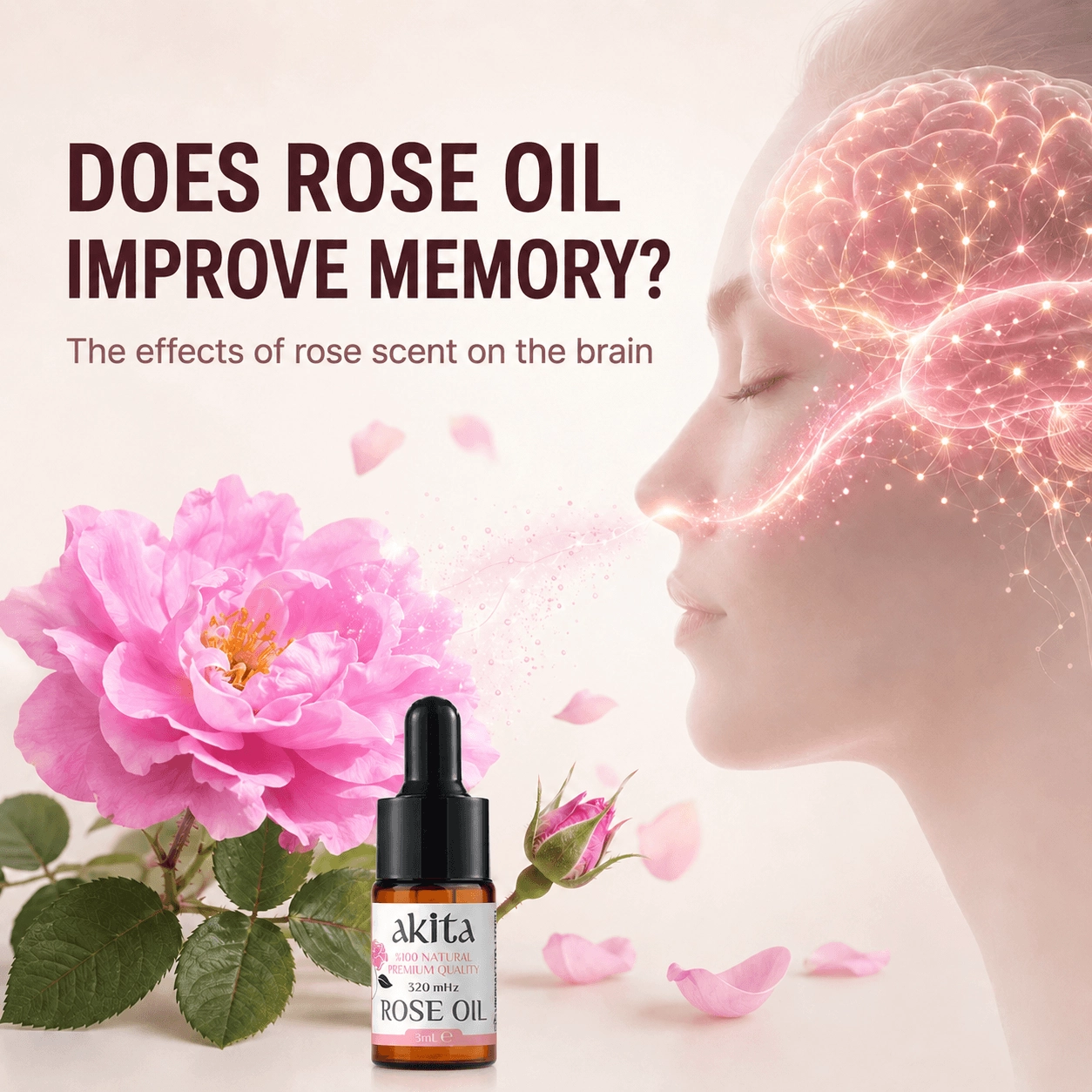
What does science tell us about Rosa damascena, rose essential oil, memory, gray matter, and the brain?
Could something as simple as the scent of a rose be associated with measurable changes in the brain?
It sounds surprising, but scientists have begun asking exactly this kind of question.
In recent years, researchers have studied Rosa damascena—the Damask rose famously cultivated in Isparta, Türkiye—and rose essential oil to better understand their possible relationship with the brain, learning, and memory.
One recent human study produced a particularly interesting finding: after one month of continuous exposure to a designated rose scent, researchers detected changes in gray matter volume using MRI brain scans.
Other studies involving Rosa damascena extract and rose essential oil have explored memory, BDNF, neurogenesis, and the systems nerve cells use to communicate.
So, does this mean smelling roses improves your memory?
Not yet.
The science is promising, but there is an important difference between discovering a change in the brain and proving that something improves memory. Here is what researchers have actually found.
🌹 One Month of Rose Scent: What Changed in the Brain?
A 2024 study published in Brain Research Bulletin investigated whether continuous exposure to a scent could produce measurable changes in the human brain.
The study included 50 healthy women. Twenty-eight were assigned to the intervention group and 22 to the control group.
The women in the intervention group were asked to wear a designated rose scent on their clothing for one month.
Researchers took MRI scans before and after the study and compared changes in the participants' brain structure.
The results were intriguing.
After one month, researchers reported an increase in whole-brain gray matter volume in the intervention group. They also observed an increase in gray matter volume in a specific area called the posterior cingulate cortex, or PCC.
However, not every part of the brain changed. No significant gray matter volume changes were found in the amygdala or orbitofrontal cortex.
The researchers described their study as the first to demonstrate that continuous scent inhalation can change brain structure.
That is an important finding—but what does it actually mean?
🧠 What Is Gray Matter?
Gray matter is an important part of our brain and nervous system. It contains many nerve cell bodies and is involved in a wide range of functions, including movement, sensation, decision-making, learning, and memory.
This is why changes in gray matter volume are interesting to neuroscientists.
But there is an important point to remember:
An increase in gray matter volume does not automatically mean that memory has improved.
The 2024 study demonstrated measurable structural changes using MRI. It did not demonstrate that participants developed better memories because of the rose scent.
This distinction is essential when interpreting the research accurately.
🌹 What Does the Posterior Cingulate Cortex Have to Do With Memory?
One of the most interesting findings was the change observed in the posterior cingulate cortex (PCC).
The PCC is connected to several areas of the brain and is part of brain networks involved in processes including memory and cognition.
That makes the increase observed in this region scientifically interesting.
However, we cannot simply say:
More gray matter in the PCC = better memory.
Researchers would need studies that directly measure memory performance alongside changes in brain structure to determine whether the two are connected.
Fortunately, the scientific story does not end with this MRI study.
Other researchers have been investigating Rosa damascena itself and asking more direct questions about learning and memory.
🌱 What Have Scientists Found About Rosa damascena and Memory?
A 2014 animal study investigated Rosa damascena extract in rats with an experimental model of Alzheimer's disease.
Researchers reported improvements in memory performance and also examined what was happening in the hippocampus, an area of the brain that plays an important role in learning and memory.
Two particularly interesting processes were studied:
neurogenesis and synaptic plasticity.
The terms sound complicated, but the ideas behind them are quite simple.
🌱 What Is Neurogenesis?
Neurogenesis means the formation of new nerve cells.
An easy way to remember the word is:
Neuro = nerve
Genesis = formation
In the 2014 Rosa damascena study, researchers reported changes related to neurogenesis in the hippocampus alongside improvements in memory performance.
Instead of simply asking whether the animals performed better on a memory test, researchers were also asking:
What could be changing inside the brain?
This is an interesting clue, but there is an important limitation.
The research was conducted in rats, not humans.
A biological effect observed in an animal study cannot automatically be assumed to occur in people.
🔗 What Is Synaptic Plasticity?
Our brains contain billions of nerve cells, and these cells communicate with one another.
The connections between them are not completely fixed. They can change as we learn and experience new things.
This ability is called synaptic plasticity.
Think about walking across a grassy field.
The first time you cross it, there may be no visible path. But if you repeatedly follow the same route, a pathway gradually begins to form.
The brain is obviously far more complicated, but this simple example helps explain why changing connections between nerve cells are important to learning and memory.
The Rosa damascena animal research also examined changes related to synaptic plasticity.
🌹 What About Rose Essential Oil and Memory?
Researchers have also studied Rosa damascena essential oil.
A 2024 study published in Brain and Behavior examined rose essential oil in rats with experimentally induced memory impairment.
Researchers reported improvements in learning and memory performance in animals receiving the rose essential oil.
But they went further.
They examined several biological systems inside the brain to better understand what might be associated with those changes.
One of the most interesting findings involved a protein called BDNF.
🧠 What Is BDNF?
BDNF stands for Brain-Derived Neurotrophic Factor.
The name may sound intimidating, but the basic idea is straightforward.
BDNF is a protein associated with the health and function of nerve cells and the brain's ability to adapt and change. It is therefore frequently studied in research on learning and memory.
In the 2024 animal study, researchers reported increased BDNF levels in the animals receiving Rosa damascena essential oil.
This gives researchers another possible clue about how rose essential oil could interact with biological processes related to learning and memory.
But once again, there is an important scientific boundary:
An increase in BDNF in rats does not prove that smelling rose essential oil increases BDNF or improves memory in humans.
Human studies would be needed to determine that.
🧠 Rose Essential Oil and Acetylcholine
The same study also examined the cholinergic system.
Our nerve cells use chemical messengers to communicate. One of these messengers is called acetylcholine.
Acetylcholine is involved in several brain functions, including attention, learning, and memory.
Researchers reported changes in acetylcholine-related mechanisms in the animals receiving rose essential oil, including decreased acetylcholinesterase (AChE) activity and increased levels of the M1 muscarinic acetylcholine receptor.
In simple terms, researchers found changes in one of the brain's communication systems involved in learning and memory.
These results help scientists identify possible mechanisms worth studying further.
They do not yet tell us that rose essential oil produces the same effects in people.
🛡️ Could Antioxidant Activity Also Play a Role?
Another area scientists have explored is oxidative stress.
Oxidative stress occurs when the balance between reactive molecules and the body's protective systems is disturbed. It can affect cells throughout the body, including cells in the brain.
Animal studies involving Rosa damascena extract have examined both memory performance and markers of oxidative stress in brain tissue.
Some results suggest that antioxidant mechanisms may be involved in the effects observed experimentally with Rosa damascena.
This shows us that researchers are not looking for one simple explanation.
Across different studies, scientists have investigated several related areas:
memory → BDNF → neurogenesis → synaptic plasticity → the cholinergic system → oxidative stress
These should not be viewed as one proven chain of events. They are different biological mechanisms being explored across different studies.
👩🔬 Has Rosa damascena Been Studied in People?
Yes, although human evidence is still limited.
A small clinical study published in 2018 included 40 people with dementia.
All participants were taking donepezil. One group also received Rosa damascena, while the other received a placebo.
After three months, researchers reported better results in some cognitive assessments among participants receiving Rosa damascena in addition to donepezil.
The study is interesting because it involved people rather than laboratory animals.
However, it also had important limitations.
There were only 40 participants, and Rosa damascena was given in addition to donepezil, rather than being studied on its own.
For that reason, the study does not prove that Rosa damascena improves memory in healthy people, nor does it establish it as a treatment for dementia.
It tells us something more measured—and scientifically useful:
The relationship between Rosa damascena and cognitive function deserves further human research.
🌹 So, Does Rose Essential Oil Improve Memory?
Based on the evidence available today, the most accurate answer is:
We don't know yet.
But there are good reasons scientists are interested in the question.
Research has found that:
| What was studied? | What did researchers report? | Type of evidence |
|---|---|---|
| Continuous exposure to a rose scent | Increased whole-brain and PCC gray matter volume | Human study, 50 healthy women |
| Rosa damascena extract | Memory, neurogenesis and synaptic plasticity-related findings | Animal research |
| Rosa damascena essential oil | Memory performance, BDNF and cholinergic-system changes | Animal research |
| Rosa damascena and cognition | Improvements in some cognitive assessments | Small human clinical study |
Taken together, these studies create an intriguing scientific picture.
But they do not yet prove that smelling roses or using rose essential oil will improve a healthy person's memory.
That question requires larger, carefully controlled human studies.
🌸 The Scientific Story of Roses and the Brain Is Just Beginning
For thousands of years, people have valued roses for their beauty and fragrance.
Science is now beginning to ask very different questions.
Can continuous exposure to rose scent produce measurable changes in the human brain?
One study suggests that it can.
Could compounds found in Rosa damascena and rose essential oil influence biological processes involved in learning and memory?
Animal research provides interesting clues involving BDNF, neurogenesis, synaptic plasticity, acetylcholine, and oxidative stress.
But perhaps the most important question remains unanswered:
Do these biological and structural changes actually lead to better memory in humans?
We don't know yet.
What we do know is that the relationship between Rosa damascena, rose essential oil, and the brain has moved beyond simple assumptions about a pleasant fragrance. It is now a subject of measurable scientific research.
And there is still much more to discover.
Scientific References
Kokubun K, Nemoto K, Yamakawa Y. (2024).Continuous inhalation of essential oil increases gray matter volume.Brain Research Bulletin. PMID: 38331299.
Esfandiary E, et al. (2014).Novel effects of Rosa damascena extract on memory and neurogenesis in a rat model of Alzheimer's disease.Journal of Neuroscience Research. PMID: 24395280.
Mohammadpour T, et al. (2015).Protection against brain tissues oxidative damage as a possible mechanism for the beneficial effects of Rosa damascena hydroalcoholic extract on scopolamine induced memory impairment in rats.Nutritional Neuroscience. PMID: 24974980.
Teralı K, et al. (2024).A comprehensive assessment of the cholinergic-supporting and cognitive-enhancing effects of Rosa damascena Mill. essential oil on scopolamine-induced amnestic rats.Brain and Behavior. PMID: 38688895.
Esfandiary E, et al. (2018).Novel Effects of Rosa damascena Extract on Patients with Neurocognitive Disorder and Depression: A Clinical Trial Study.International Journal of Preventive Medicine. PMID: 30050668.
Scientific Note: This article is intended to explain current scientific research in clear, accessible language. The findings discussed here should not be interpreted as evidence that Rosa damascena, rose essential oil, or rose scent prevents, treats, or cures any medical condition.
Comment