Damask Rose Oil: Benefits, Uses, Aroma and How It Is Made
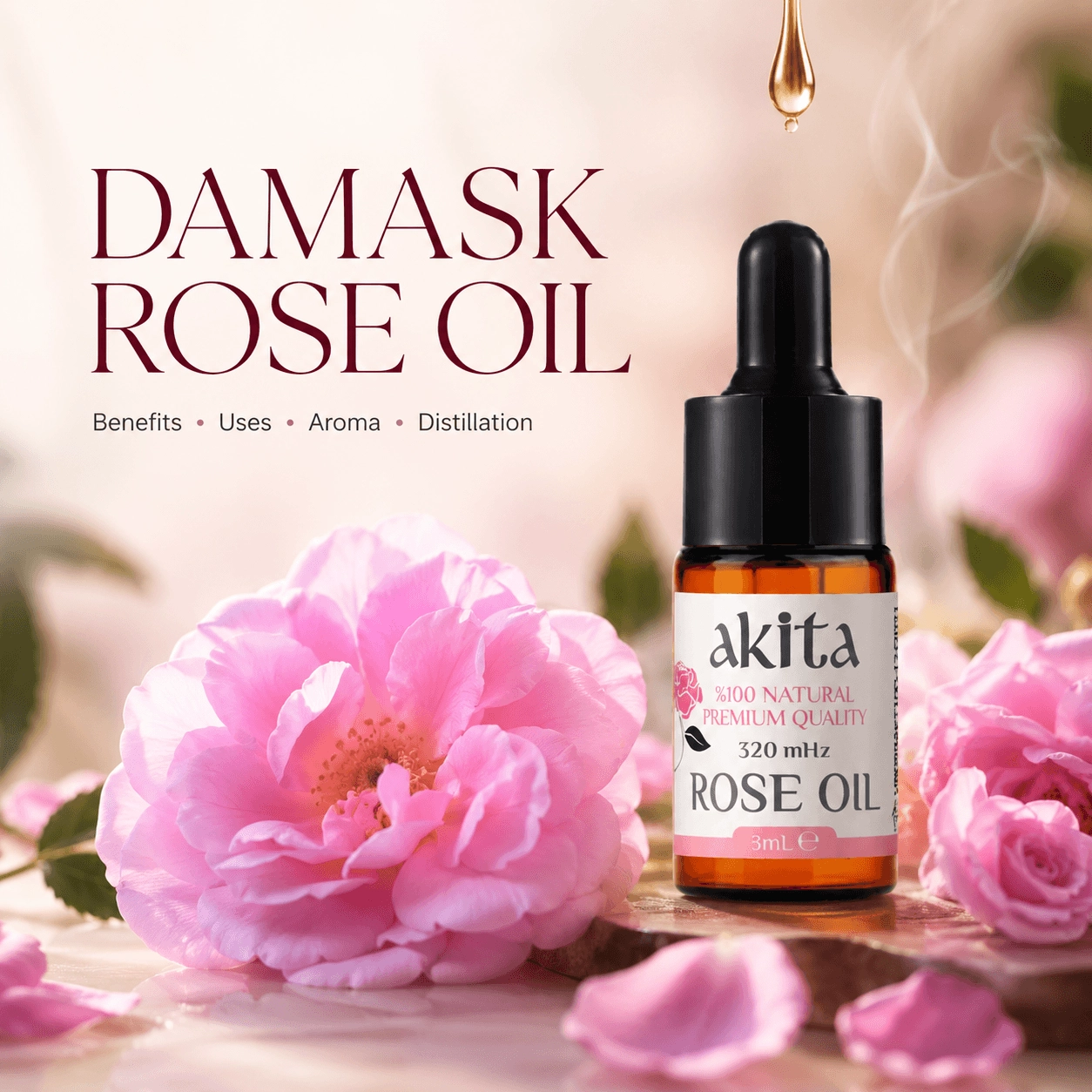
Few botanical ingredients have inspired perfume, skin care and traditional wellness practices as deeply as Damask rose oil. Also known as rose otto or Rosa damascena essential oil, this intensely aromatic oil is produced from freshly harvested Damask rose petals.
Its value comes from more than its celebrated fragrance. Damask roses have a short flowering season, the blossoms must be collected and processed carefully, and only a very small amount of essential oil is obtained from a large quantity of flowers.
But what exactly is Damask rose oil? Is rose otto the same as rose essential oil? What does it smell like, and what does scientific research actually say about its benefits?
This guide explains the complete journey—from the rose fields to the finished oil.
What Is Damask Rose Oil?
Damask rose oil is the concentrated volatile oil obtained primarily from the flowers of Rosa damascena Mill. The oil is generally produced through water or steam distillation and is widely used in fine fragrance, cosmetics, aromatherapy and natural health products.
Several names may appear on product labels:
- Damask rose oil
- Rose essential oil
- Rosa damascena flower oil
- Rose otto
- Attar of rose
“Rose otto” usually refers specifically to distilled rose essential oil. It should not be confused with rose absolute, rose fragrance oil or rose water, which are produced differently and have different compositions.
What Is Rosa damascena?
Rosa damascena, commonly known as the Damask rose, is an aromatic rose cultivated for its fragrant flowers. One of its most important growing regions is Isparta, Türkiye, where the landscape, climate and generations of distillation knowledge have supported a highly specialized rose industry.
Isparta roses are typically recognized by their layered pink petals, visible golden-yellow stamens and rich yet nuanced fragrance. The flowers are cultivated not simply for their appearance, but for the complex aromatic material contained within their petals.
The harvest season is short, usually lasting only several weeks. During this period, the flowers are traditionally picked in the cool early hours of the morning and transported for processing as quickly as possible.
Why Are Damask Roses Picked Early in the Morning?
Harvest timing can influence both essential-oil yield and aromatic quality.
Cool morning temperatures help protect the delicate volatile compounds found in fresh rose petals. As the day becomes warmer, some aromatic components may evaporate, while flowers left waiting after harvest may begin to change chemically.
For this reason, responsible rose-oil production depends on more than growing healthy roses. It also requires:
- Harvesting at the appropriate stage of flowering
- Picking during the cooler hours of the day
- Avoiding excessive crushing or overheating
- Limiting the time between harvest and distillation
- Controlling the distillation process carefully
These details help explain why the origin and production history of a rose oil matter.
How Is Damask Rose Oil Made?
Authentic rose otto is normally produced by distilling fresh Rosa damascena flowers with water or steam.
During distillation, heat releases volatile aromatic substances from the petals. These substances travel with the steam into a cooling system, where the vapour condenses back into liquid.
The condensed material naturally separates into two fractions:
- A very small oil-soluble fraction: rose essential oil
- A much larger water-based aromatic fraction: rose distillate or rose water
The amount of oil produced is extremely small compared with the volume of flowers processed. This low yield, combined with hand harvesting, a brief flowering season and the need for rapid distillation, is one of the main reasons genuine Damask rose oil is expensive.
What Does Damask Rose Oil Smell Like?
Real Damask rose oil is much more complex than a simple sweet or “rosy” fragrance.
Its aroma may be described as:
- Deeply floral
- Fresh and dewy
- Warm and honeyed
- Slightly spicy
- Green and herbaceous
- Softly fruity
- Rich, diffusive and persistent
The aroma may also vary from one harvest or production region to another. Soil, climate, harvest time, flower condition, distillation method and storage can all influence the final composition.
A natural rose oil should not necessarily smell like an artificially sweet rose perfume. Synthetic rose fragrances are often designed to emphasize a familiar, immediately recognizable floral note. Genuine rose oil has greater depth and may reveal different facets as it develops on the skin or a fragrance strip.
What Is in Damask Rose Oil?
Damask rose oil is a complex mixture of volatile aromatic compounds rather than a single substance.
Frequently reported constituents include:
- Citronellol
- Geraniol
- Nerol
- Linalool
- Phenethyl alcohol
- Rose oxides
- Various hydrocarbons and trace aromatic compounds
Citronellol, geraniol and nerol contribute significantly to the characteristic floral profile. However, the scent and identity of authentic rose oil cannot be explained by only one or two major constituents. Compounds present in very small amounts may make an important contribution to its complexity.
The chemical profile is not completely fixed. Research has shown that harvesting conditions, storage before processing and distillation practices can affect both yield and composition.
Potential Benefits of Damask Rose Oil
Damask rose oil has a long history of use in fragrance and traditional wellness practices. Modern research has investigated its possible effects on relaxation, anxiety, pain perception and emotional well-being.
However, it is important to distinguish among:
- Traditional experience
- Laboratory research
- Animal studies
- Small human trials
- Strong clinical evidence
A scientific finding from one type of rose preparation cannot automatically be applied to every rose oil, cosmetic or rose-water product.
1. Relaxation and emotional well-being
Rose aroma is frequently associated with comfort, calmness and emotional balance. Human studies have examined inhaled or topically applied rose oil in settings involving stress, anxiety and relaxation.
A systematic review and dose-response meta-analysis of randomized trials reported potentially favourable results for Rosa damascena preparations in anxiety, stress and depression-related outcomes. However, the included studies used different preparations, doses and research methods, so these findings should not be interpreted as proof that every rose-oil product treats a mental-health condition.
A separate review of clinical evidence identified possible physiological and psychological relaxation effects, while emphasizing the need for larger and better-designed trials. PubMed: systematic review of anxiety, depression and stress and PubMed: clinical evidence review.
Damask rose oil can therefore be described as an aromatic ingredient with emerging research related to relaxation—not as a replacement for professional medical treatment.
2. Pain-related research
Clinical studies have also explored Damask rose aromatherapy as a complementary approach in certain acute-pain settings.
A systematic review and meta-analysis found promising results, but differences among study designs and applications limit the strength of broad conclusions. Rose aromatherapy should not replace appropriate diagnosis, medication or medical care. PubMed: Damask rose aromatherapy and acute pain.
3. Antioxidant potential
Laboratory studies involving Rosa damascena and its different preparations have reported antioxidant activity. Antioxidants help researchers study how a material interacts with oxidation and free radicals under experimental conditions.
This does not mean that applying any rose oil directly to the skin will prevent or reverse skin ageing. Laboratory antioxidant activity and a clinically demonstrated anti-ageing result are not the same thing.
In cosmetics, rose oil may contribute to a thoughtfully formulated product’s aromatic, sensory and botanical profile. The performance and safety of the finished cosmetic depend on the entire formula—not on rose oil alone.
4. Antimicrobial potential
Laboratory research has also investigated the antimicrobial activity of rose-derived materials. The results vary according to the organism tested, concentration, chemical composition and type of rose preparation.
These findings are scientifically interesting, but rose oil should not be promoted as a disinfectant or as a treatment for infection without appropriate product-specific evidence and regulatory authorization.
5. Skin-care applications
Damask rose oil is used in facial oils, creams, serums, body products, cleansers and perfumes. In a cosmetic formula, it may provide:
- A refined natural fragrance
- A luxurious sensory experience
- Botanical positioning
- Support for an antioxidant-focused formulation
- Complementary aromatic compounds
Because essential oil is highly concentrated, more is not necessarily better. Its suitability depends on the concentration, the other ingredients and the intended user.
Does Damask Rose Oil Improve Memory?
Smell has a direct relationship with brain systems involved in emotion and memory. This helps explain why a familiar aroma can rapidly bring back a person, place or experience.
Researchers have begun studying how exposure to rose aroma may affect mood, cognition and certain brain-related measurements. This is a promising area, but current research does not establish that rose oil can prevent dementia, cure memory loss or reliably improve memory in every person.
The scientifically responsible conclusion is that rose aroma and memory deserve further study. Claims should remain specific to the material, participants, exposure method and outcomes examined in each study.
Damask Rose Oil vs Rose Absolute
Although both materials come from roses, they are not identical.
| Characteristic | Damask rose oil | Rose absolute |
|---|---|---|
| Common name | Rose otto or rose essential oil | Rose absolute |
| Main method | Water or steam distillation | Solvent extraction |
| Aroma | Fresh, diffusive and traditionally distilled | Deep, rich and highly fragrance-focused |
| Physical character | May become semi-solid or crystallize when cool | Usually more viscous |
| Common use | Aromatherapy, cosmetics and perfumery | Primarily fine fragrance and perfumery |
Neither material is automatically “better.” They are different aromatic extracts made for different purposes.
Damask Rose Oil vs Rose Water
Rose oil and rose water are two distinct fractions of distillation.
| Rose oil | Rose water or rose distillate |
|---|---|
| Oil-soluble | Water-based |
| Highly concentrated | Much more dilute |
| Obtained in a very small quantity | Forms the larger distillation fraction |
| Usually requires careful dilution | May be formulated for direct cosmetic use |
| Used in drops or small percentages | Commonly used as a mist, toner or cosmetic base |
Conventional rose water may be collected after the separated essential oil is removed. A non-de-oiled rose distillate follows a different production objective: the naturally co-distilled oil-associated fraction is not separated from the resulting water-based distillate.
These products should not be treated as interchangeable. Their concentration, chemistry, safety considerations and intended uses are different.
What Is Non-De-Oiled Rose Water?
Akita Non-De-Oiled Rose Water is made from Isparta Rosa damascena flowers through a long-duration distillation process. The naturally co-distilled rose-oil-associated fraction is not separated from the resulting flower distillate.
Its accepted cosmetic ingredient name is:
Rosa Damascena Flower Distillate
This distinction matters because Akita’s purpose is not simply to produce water remaining after rose-oil separation. The production method aims to retain a broader water-based expression of the distilled flower.
Non-de-oiled rose distillate does not replace concentrated rose essential oil. It offers a different way to experience Rosa damascena in a practical, water-based cosmetic format.
How to Use Damask Rose Oil Safely
Essential oils are concentrated botanical materials and should be used responsibly.
General precautions include:
- Do not apply undiluted rose essential oil directly to the skin.
- Use only in accordance with the manufacturer’s directions.
- Dilute it appropriately in a suitable carrier or professionally formulated product.
- Perform a patch test before wider cosmetic use.
- Avoid contact with the eyes and other sensitive areas.
- Do not swallow a cosmetic-grade essential oil.
- Keep essential oils out of the reach of children.
- Seek qualified advice during pregnancy, breastfeeding or when managing a medical condition.
- Stop use if redness, burning, swelling or irritation develops.
Health Canada notes that rose oil is used in cosmetics and natural health products and advises consumers to read labels, follow safety directions and review listed ingredients. Canadian authorities have also evaluated potential exposure risks involving certain uses, particularly for infants and toddlers. Consumers should therefore avoid assuming that “natural” automatically means safe at every concentration or for every age group. Health Canada: Rose oil.
How to Identify High-Quality Damask Rose Oil
Price alone does not establish quality. When comparing products, look for clear and verifiable information.
Check the botanical name
The label should identify the plant as Rosa damascena. A label that says only “rose scent” or “rose fragrance” does not confirm that it contains authentic Damask rose essential oil.
Look for the extraction method
“Steam distilled” or “water distilled” generally identifies rose otto. “Absolute” indicates a different extraction process.
Ask about origin
A responsible producer should be able to identify where the roses were cultivated and where the oil was distilled.
Review ingredient transparency
A genuine product should clearly distinguish essential oil from fragrance oil, diluted oil and perfume.
Consider analytical information
Chromatographic testing can help characterize chemical composition and identify unusual variations. An analysis does not independently prove every quality or therapeutic claim, but it adds useful information about identity and consistency.
Be cautious with unusually low prices
Authentic rose oil requires large quantities of flowers and significant labour. A full bottle offered at the price of a common essential oil may be diluted, reconstructed or fragrance-based.
Why Is Real Damask Rose Oil So Expensive?
The cost reflects the agricultural and technical work behind every small quantity of oil.
Important factors include:
- A short annual flowering period
- Early-morning hand harvesting
- Large quantities of fresh petals
- Rapid transportation to the distillery
- Low natural oil yield
- Skilled distillation
- Testing, storage and quality control
- Differences among harvests and growing regions
Authentic rose oil is not expensive merely because rose is associated with luxury. It is expensive because the flower provides very little concentrated essential oil relative to the work and plant material required.
How Should Damask Rose Oil Be Stored?
Rose oil should normally be stored:
- In a tightly closed container
- Away from direct sunlight
- Away from excessive heat
- In a dry place
- In accordance with the supplier’s directions
Temperature changes may affect its physical appearance. Natural rose otto can become cloudy, thick or partially solid at cooler temperatures. This behaviour does not necessarily indicate spoilage. Allowing the closed bottle to warm gently in the hands may return the oil to a more fluid state.
Frequently Asked Questions
Is Damask rose oil the same as rose essential oil?
Damask rose oil is a type of rose essential oil obtained from Rosa damascena. “Rose essential oil” can sometimes be used more broadly for oils derived from other rose species, so checking the botanical name is important.
What is rose otto?
Rose otto is the traditional name for rose essential oil produced through water or steam distillation. It differs from rose absolute, which is produced through solvent extraction.
Can Damask rose oil be applied directly to the skin?
Undiluted application is generally not recommended. Use rose oil in a properly diluted carrier or a professionally formulated cosmetic and follow the product directions.
Is Damask rose oil good for the face?
Rose oil is used in facial cosmetics, but suitability depends on its concentration and the complete formulation. People with sensitive skin should patch-test new products.
Is rose oil good for relaxation?
Some human studies have reported promising relaxation and anxiety-related outcomes. However, the evidence remains limited and rose oil should not replace professional mental-health or medical care.
Does rose oil remove wrinkles?
There is not enough evidence to claim that pure rose oil removes wrinkles. Rose oil may be included in well-designed cosmetic formulations, but the effects of a finished product depend on its complete formula and product-specific testing.
What is the difference between rose oil and rose water?
Rose oil is the concentrated oil-soluble fraction of distillation. Rose water is the water-based aromatic fraction. They have different compositions, concentrations and uses.
Can Damask rose oil be ingested?
A cosmetic essential oil should not be swallowed. Internal use raises different safety, dose and regulatory considerations and should not be attempted without appropriately qualified guidance and a product specifically intended for that use.
Why does rose oil become solid?
Natural rose otto may thicken or partially crystallize at cooler temperatures because of its natural composition. This can be a normal physical change.
Where is Damask rose grown?
Rosa damascena is cultivated in several regions, including Türkiye. Isparta is internationally associated with rose cultivation, harvesting and distillation expertise.
A Concentrated Expression of the Damask Rose
Damask rose oil represents one of the most concentrated aromatic expressions of Rosa damascena. Its complexity begins in the field: the variety of rose, local growing conditions, time of harvest, condition of the petals and distillation method can all shape the finished oil.
Scientific research offers promising observations, particularly in relation to aroma, relaxation and certain complementary applications. Nevertheless, responsible communication requires separating traditional use and early research from proven medical outcomes.
Understanding this distinction does not make Damask rose oil less valuable. It allows the material to be appreciated for what it genuinely is: a rare botanical oil, a sophisticated natural fragrance and the result of remarkable agricultural and distillation expertise.
Comment