How to Use Rose Oil: Methods Used in Scientific Studies and a Safety Guide
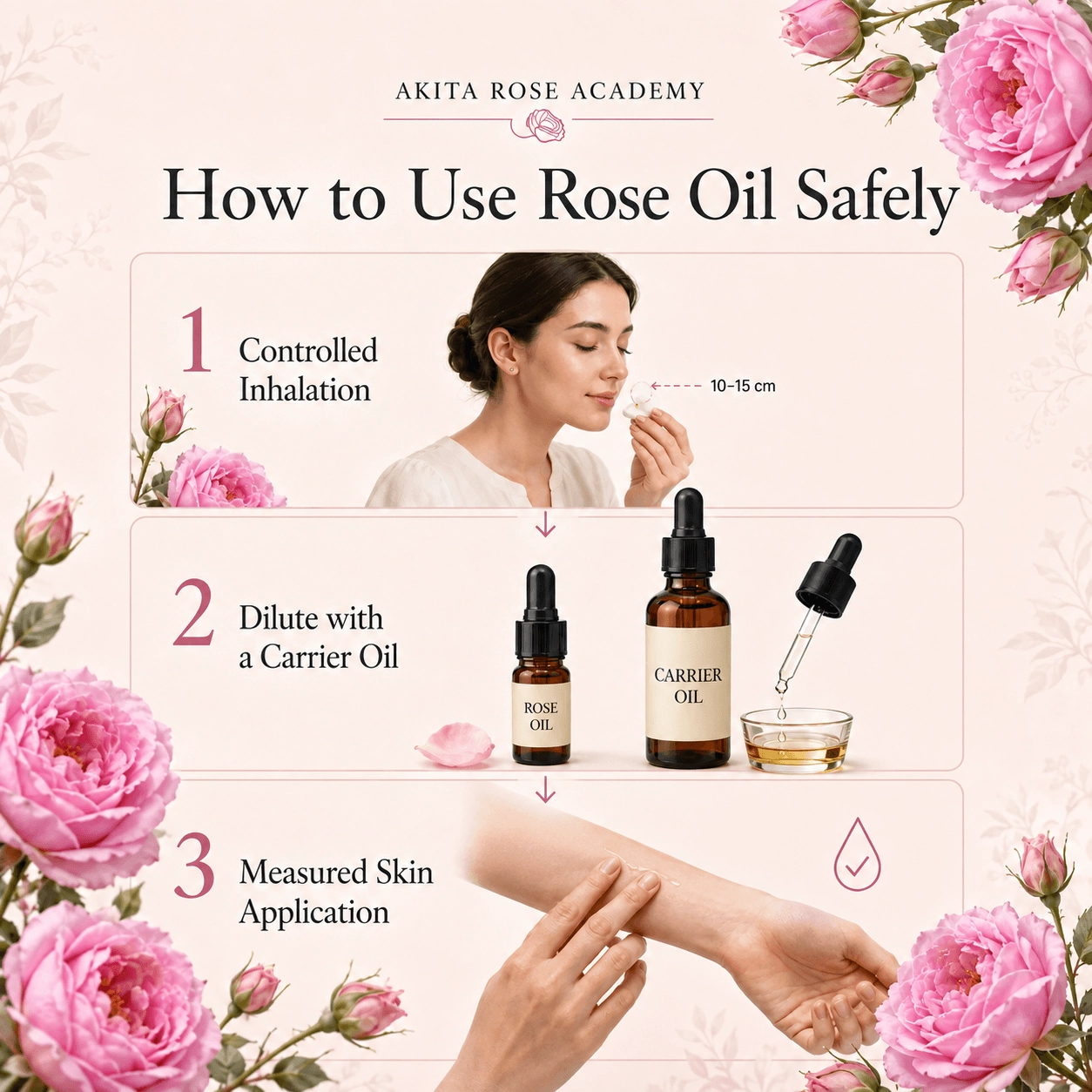
Safe inhalation and skincare methods for Rosa damascena essential oil
If you are wondering how rose oil is used, controlled inhalation is one of the most common methods reported in scientific studies. Researchers have typically placed a small amount of rose oil on cotton or cloth and asked participants to inhale its aroma for a specified period without applying the oil inside the nose. In topical studies, rose oil has generally been diluted in a carrier oil before being applied to the skin.
For everyday use, pure rose essential oil should not be applied directly to the skin, around the eyes, or inside the mouth. For inhalation, you may place one drop on a cotton pad or aroma inhaler and smell it briefly from a distance. For topical use, it should be diluted to a low concentration in a suitable carrier oil.
When choosing rose oil, look for products that clearly state their ingredients and intended use. You can review Akita Golden Rose Oil 1 mL for product information. You may also explore Akita’s carrier oil options.
How has rose oil been used in scientific studies?
In human studies involving rose oil, the method of application has varied according to the purpose of the research. The most common methods include the following.
Controlled inhalation
In some studies, rose oil has been inhaled using:
Cotton pads
Cloth
Aroma inhalers
Diffusers or similar aromatherapy devices
The oil was not applied directly inside the nose. Participants inhaled a specified amount for a predetermined period under controlled conditions.
Topical application
In some studies, rose oil was diluted in a carrier oil and applied to the skin. The application area, amount, concentration, duration and number of sessions were determined by the research protocol.
A concentration used in a scientific study should not automatically be considered appropriate for everyday use. Researchers may control the oil’s chemical composition, application time, participant group and observation conditions.
Standardized oral preparations
A smaller number of studies have used standardized capsules or similar preparations containing rose oil. This does not mean that pure rose essential oil sold for cosmetic or aromatherapy purposes can safely be taken by mouth at home.
Important: Methods used in scientific studies are not household instructions. For everyday use, follow the product label and safety warnings and consider individual sensitivities.
How should rose oil be inhaled?
One practical and controlled way to inhale rose oil is from a cotton pad or aroma inhaler.
Using a cotton pad or aroma inhaler
Place one drop of rose oil on a small cotton pad or aroma inhaler.
Hold it approximately 10–15 cm away without allowing it to touch your nose.
Breathe normally for one to two minutes at first.
If the aroma does not cause discomfort, you may continue briefly.
Stop immediately if you develop a headache, nausea, coughing, eye irritation or difficulty breathing.
There is no need to inhale repeatedly and deeply from the bottle. A stronger aroma does not necessarily produce a stronger or more beneficial effect.
Using a diffuser
If you use a diffuser, follow the manufacturer’s instructions. The appropriate amount depends on the device’s reservoir, the size and ventilation of the room and the scent sensitivity of those present.
When using a diffuser:
Begin with a small amount.
Ventilate the room regularly.
Do not operate the diffuser continuously for hours.
Do not direct it toward a sleeping person’s face.
Do not use it in a room occupied by a baby.
Exercise caution around people with asthma or fragrance sensitivity.
Aromatherapy concentrations used in scientific research cannot be converted into a universal number of drops for every household diffuser. Devices differ in design, water capacity and the volume of air into which they disperse the oil.
Can rose oil be applied directly to the skin?
Pure rose essential oil should not be applied directly to the skin.
Rose oil naturally contains fragrance compounds such as citronellol, geraniol, linalool, eugenol and farnesol. In sensitive individuals, some of these compounds may cause irritation or allergic contact dermatitis.
The Cosmetic Ingredient Review Expert Panel concluded that cosmetic ingredients derived from Rosa damascena are safe under their current conditions of use when products are formulated to be non-sensitizing. This conclusion does not declare direct application of undiluted rose oil to be safe.
Applying pure rose oil directly may cause:
Burning or stinging
Redness
Itching
Dryness and irritation
Blisters or a rash
Sensitization to fragrance compounds over time
For topical use, the safest option is generally a finished cosmetic product in which rose oil has been properly formulated and its safety assessed. If pure rose oil is used, it should first be diluted to a low concentration in a suitable carrier oil.
How should rose oil be diluted for the skin?
Rose oil may be diluted in jojoba, squalane, sweet almond oil or another fixed oil suitable for cosmetic use. When choosing a carrier oil, make sure its ingredients are clearly listed and that it is intended for topical cosmetic application.
For simple home mixtures intended for healthy adults, the following ranges may be considered cautious starting points:
| Application area | Cautious starting concentration | Approximate amount per 10 mL of carrier oil |
|---|---|---|
| Face and neck | 0.25–0.5% | Approximately 1 drop |
| Body or massage | 0.5–1% | Approximately 1–2 drops |
| Small, limited area | Up to approximately 1% | Approximately 2 drops |
| Eye area | Home mixtures are not recommended | Use a finished product developed specifically for the eye area |
For example, adding approximately one drop of rose oil to 10 mL of carrier oil may provide a cautious starting concentration for the face and neck. For body or massage applications, approximately one to two drops may be used.
The volume of a drop varies according to the dropper and the viscosity of the oil. Drop counting is therefore not a precise laboratory measurement. In professional formulation, ingredients are measured by weight and the safety of the finished product is assessed.
Important: The use of a higher concentration in a scientific experiment does not mean that the same concentration is suitable or safe for everyday use.
How can rose oil be used in facial care?
Rose oil should not be used undiluted on the face. The safest option is generally a cream, serum or facial oil that contains rose oil at an appropriately formulated concentration.
If you choose to prepare a diluted mixture at home:
Measure 10 mL of a suitable carrier oil.
Add approximately one drop of pure rose oil.
Test the complete mixture on a small area before applying it to the entire face.
If no reaction develops within 24–48 hours, apply a very small amount to clean skin.
Keep the mixture away from the eyelids, lash line and inner lips.
Homemade essential-oil mixtures may not be suitable for people with sensitive skin, rosacea, eczema or an impaired skin barrier.
The carrier oil itself may also cause a reaction in some individuals. Test the complete mixture rather than testing only the rose oil.
How can rose oil be used for massage?
For massage, rose oil should be diluted to a low concentration in a carrier oil.
A simple adult body-massage mixture may contain:
10 mL of carrier oil
Approximately 1–2 drops of pure rose oil
Test the mixture on a small area first. Do not apply it to open wounds, active eczema, freshly shaved skin or irritated areas.
Any relaxation experienced during massage may not result from rose oil alone. Touch, massage movements, the resting environment, expectations and aroma may all contribute to the experience.
Can rose oil be added to a moisturizer?
Randomly adding rose oil to a small amount of moisturizer in your palm is not recommended. One drop of pure essential oil can create a much higher concentration than expected when mixed with only a small amount of cream.
There is also no guarantee that the oil will disperse evenly. Adding another ingredient may affect the cream’s emulsion structure and preservative system.
For these reasons:
Do not add rose oil to an entire container of finished moisturizer at home.
Do not mix one full drop of pure oil into a small amount of cream at each use.
Choose a professionally formulated product that already contains rose oil.
If dilution is necessary, first mix the rose oil carefully into a suitable carrier oil.
Can rose oil be mixed with water?
Adding rose oil only to water does not create a safe or evenly dispersed mixture.
Essential oils do not dissolve in water. Even if the bottle is shaken, the oil can separate again shortly afterward. When such a mixture is sprayed, concentrated droplets of oil may come into contact with the skin or eyes.
Preparing a water-based rose oil spray requires:
A suitable solvent or solubilizer
An appropriate concentration
A compatible preservative system
pH control
Microbiological stability testing
Homemade sprays made only with water and essential oil may present problems related to both uneven dispersion and microbiological safety.
If you want a water-based product with a rose aroma, choose a rose water or rose distillate made for that purpose.
Can rose oil be used in a bath?
Rose oil should not be dropped directly into bathwater. Because it does not dissolve in water, it may remain on the surface and come into contact with the skin in a concentrated form.
Mixing rose oil with milk, salt or baking soda does not guarantee that it will disperse safely and evenly in the bath.
If rose oil is to be used in a bath, choose a bath product specifically formulated to disperse essential oils in water. A carrier oil can reduce an essential oil’s concentration on the skin, but it does not create a stable emulsion with water. A mixture of carrier oil and rose oil should therefore not be poured directly into bathwater.
Can rose oil be used around the eyes?
Pure rose oil should not be applied to the eyelids, lash line or under-eye area. Homemade diluted essential-oil mixtures should also be kept away from the eye area.
For use around the eyes, choose a finished cosmetic product that has been:
Developed specifically for this area
Formulated at an appropriate concentration
Assessed for the risk of accidental eye contact
If rose oil enters the eye, rinse continuously with lukewarm water for at least 15 minutes. Seek medical attention if pain, redness, burning or changes in vision continue.
A rose water or rose distillate that has passed an eye-safety assessment does not establish that pure rose oil is safe for the eyes. Every product must be assessed within its own formulation and concentration.
Can rose oil be taken orally?
Pure rose essential oil sold for cosmetic or aromatherapy purposes should not be taken by mouth at home.
The use of extremely small, legally permitted amounts of rose oil in food products is not equivalent to adding bottled essential oil to water and drinking it.
For oral use, a product would need to have:
Been manufactured specifically for food or medical use
A standardized dose
Purity and contaminant testing
A known chemical composition
An assessment of possible medication interactions
Appropriate professional supervision
Some clinical studies have used standardized capsules containing rose oil. These studies do not demonstrate that cosmetic rose essential oil can safely be consumed at home.
If essential oil is swallowed accidentally, do not induce vomiting. Contact a poison control centre for advice.
Can rose oil be used during pregnancy and breastfeeding?
There is insufficient human research to establish that rose oil is safe during every stage of pregnancy, at every concentration and through every route of exposure.
As a precaution during pregnancy:
Do not take it orally.
Do not apply it undiluted to the skin.
Avoid intense or prolonged inhalation.
Do not use it regularly without consulting a physician or pharmacist.
This cautious approach does not mean that rose oil has been proven harmful during pregnancy. The principal concern is that sufficient high-quality human evidence is not available to confirm safety in all circumstances.
During breastfeeding, rose oil should not be applied to the nipple or to areas of skin that the baby may lick.
Can rose oil be used for babies and children?
Babies and young children differ from adults in skin structure, respiratory development and body weight. Even a small amount swallowed accidentally may represent greater exposure relative to a child’s body weight.
For these reasons:
Do not apply pure rose oil to a child’s skin.
Do not use strong or prolonged diffusion in a baby’s room.
Do not place the oil on a child’s pillow or clothing.
Use only finished products developed for the relevant age group.
Consult the child’s healthcare professional.
Store rose oil and carrier oils in their original packaging with their caps tightly closed and out of children’s reach.
How should a skin test be performed?
Before using a new mixture on a large area of skin:
Apply a small amount of the final diluted mixture to a limited area of the forearm.
Observe the area for 24–48 hours.
Do not use the product if redness, itching, swelling, blistering or burning develops.
A home skin test does not replace diagnostic patch testing performed by a dermatologist. The absence of a reaction during a preliminary test also does not guarantee that an allergy will never develop.
People with fragrance allergies, eczema or a history of reactions to essential oils should consult a dermatologist.
When should rose oil not be used?
Rose oil should not be applied to:
Open wounds
Burns
Areas of active eczema
Infected skin
Severe sunburn
The eyes or eyelids
The inside of the mouth or nose
Sensitive genital tissues
Skin recently treated with lasers, chemical peels or microneedling
Rose oil should not be used as a substitute for the treatment of infection, burns, eczema, anxiety disorders or pain.
Can rose oil be used before sun exposure?
Rose oil is not generally classified among the strongly phototoxic essential oils associated with some cold-pressed citrus oils. This does not mean that every rose-oil blend is automatically safe before sun exposure.
A blend may contain other essential oils. Irritated skin may also become more sensitive to sunlight.
Do not apply blends with unknown ingredients before going into the sun. Rose oil is not a sunscreen and cannot replace a product with an appropriate SPF.
How should rose oil be stored?
Rose oil and carrier oils should be stored:
In dark-coloured bottles
With their caps tightly closed
Away from direct sunlight
Away from heat sources
Out of reach of children and pets
In their original packaging
Light, heat and oxygen may alter some aromatic compounds over time. Oxidized fragrance compounds may increase the risk of skin sensitization.
Do not use an oil on the skin if its aroma has changed noticeably, its source is unknown or its bottle has remained open for a prolonged period.
What should you do after accidental exposure?
Burning or redness on the skin
Stop using the product immediately. Wash the area for several minutes under lukewarm water with mild soap. Consult a healthcare professional if symptoms continue.
Eye exposure
Rinse the eye continuously with lukewarm water for at least 15 minutes. Seek medical attention if pain, blurred vision or redness continues.
Accidental swallowing
Do not induce vomiting. Contact a poison control centre for advice. Call emergency services if the person has difficulty breathing.
In Canada, the Ontario Poison Centre can be reached at 1-800-268-9017 or 416-813-5900.
Common myths about rose oil
“If it is natural, it can be applied directly to the skin.”
Incorrect. Natural substances may also cause irritation or allergic reactions depending on their concentration and chemical composition.
“Rose oil can be diluted with water.”
Incorrect. Rose oil does not dissolve in water. A suitable carrier or professionally designed formulation is required.
“If a scientific study used a 20% concentration, I can use 20% at home.”
Incorrect. A research protocol is not an everyday-use recommendation. Experimental concentrations may be used briefly under controlled conditions.
“Rose oil and rose water can be used in the same way.”
Incorrect. Rose essential oil is concentrated and oil-soluble. Rose water or rose distillate is the water phase produced during distillation. Their concentrations and methods of use are not the same.
“If a small amount helps, more will work better.”
Incorrect. Increasing the amount of an essential oil may not increase its benefit. It may instead raise the risk of irritation, headache and sensitization.
“Using a carrier oil makes rose oil completely risk-free.”
Incorrect. A carrier oil reduces the concentration of the essential oil on the skin, but it does not eliminate the possibility of irritation or allergy. The suitability of both the rose oil and the carrier oil should be considered, and the final mixture should be tested on a small area.
Rose Academy note
In human studies, rose oil has most commonly been administered through controlled inhalation using cotton, cloth or a diffuser. Some studies have used topical application after dilution in a carrier oil, while a smaller number have examined standardized oral preparations.
The amounts and exposure periods reported in these studies should not be interpreted as direct household instructions. The research objective, participant group, chemical composition of the product and application conditions must be evaluated together.
This subject should be examined in greater detail in a separate Rose Academy article titled “How Has Rose Oil Been Used in Scientific Research?”
Chapter summary
The fundamental principles for using rose oil safely are:
Understand that controlled inhalation has been one of the most common methods used in scientific studies.
For inhalation, place one drop on cotton or an aroma inhaler and smell it briefly from a distance.
Check whether the product is pure essential oil or a pre-diluted blend.
Do not apply pure rose essential oil directly to the skin.
For topical use, choose low concentrations or finished products with an appropriate safety assessment.
Dilute rose oil in jojoba, squalane, sweet almond oil or another suitable carrier oil.
Remember that water does not dilute essential oils.
Keep rose oil away from the eyes, inside the mouth, open wounds and sensitive tissues.
Do not swallow cosmetic or aromatherapy rose oil.
Seek professional guidance during pregnancy, breastfeeding, childhood or when managing a chronic health condition.
Remember that a larger amount does not necessarily produce a greater benefit.
Protect the product from light and heat and keep it away from children.
Do not reproduce experimental research concentrations at home.
Test the complete diluted mixture on a small area before wider use.
Conclusion
Rose oil is a valuable ingredient used in cosmetics, perfumery and aromatherapy when it is appropriately formulated. In scientific studies, it has most commonly been administered through controlled inhalation. Some studies have also applied it to the skin after dilution in a carrier oil.
For everyday use, pure rose essential oil should not be applied directly to the skin, around the eyes or inside the mouth. For inhalation, use a small amount on cotton or an aroma inhaler for a short period and at a reasonable distance. For topical use, dilute it to a low concentration in an appropriate carrier oil or choose a finished product whose safety has been assessed.
When selecting rose oil, look for products that clearly state their ingredients, botanical name and intended use. You can review the product information for Akita Golden Rose Oil 1 mL. Follow the product label, test topical products on a small area and seek professional guidance if you have sensitive or reactive skin.
Using rose oil safely does not diminish its value. On the contrary, it allows this concentrated and precious botanical product to be used more responsibly.
Comment