Etiket: #Rose Oil
A rose does not attract scientific attention simply because it smells beautiful.
When researchers study a plant, they ask very different questions:
What compounds does it contain? Can those compounds be identified and measured? What happens when they interact with cells or microorganisms? Are similar effects observed in humans? Does the production method change the final product and its properties?
Rosa damascena—the Damask rose, particularly associated with Isparta, Türkiye—is an intriguing plant because it raises many of these questions at the same time.
Scientific research is not limited to rose essential oil. Rose water, hydrosols, flower extracts, and preparations obtained from different parts of the plant have also been investigated.
🌹 IN SHORT
Rosa damascena is scientifically interesting because of its long history of use, complex chemical composition, the variety of products that can be obtained from it, and the measurable biological activities reported for some of these preparations.
However, the fact that something has been studied does not mean that every claimed benefit has been conclusively proven in humans.
1. It All Begins with the Chemistry of...
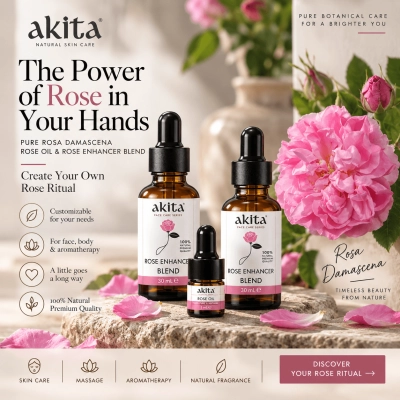
How to Use Pure Rose Oil: A Practical Guide to Skincare, Aromatherapy, Meditation & Proper Dilution
How many drops are in 1 mL of pure rose oil? How much should you add to 30 mL of carrier oil? Should you use the same dilution for your face, aromatherapy, meditation and massage? And what does science actually say about scent, memory and cognitive health?
Pure rose oil is one of those products that can be easily misunderstood.
You see a tiny 1 mL bottle and naturally wonder:
“How much can I really do with this?”
The better question is:
“How many properly diluted blends can I create from 1 mL of highly concentrated rose oil?”
Akita 1 mL Pure Rose Oil contains approximately 20 drops. Produced from Rosa Damascena through a long and carefully controlled distillation process, it is a highly concentrated aromatic oil intended to be used thoughtfully, drop by drop.
Combined with Akita Rose Enhancer Blend, those approximately 20 drops can become part of several different routines—from everyday facial care to massage, personal aroma, meditation and mindfulness.
The key is not using more rose oil.
It is using the right amount for the right purpose....
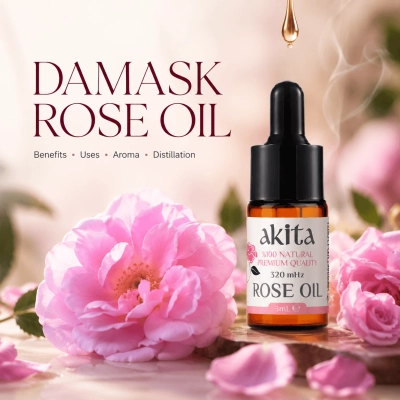
Few botanical ingredients have inspired perfume, skin care and traditional wellness practices as deeply as Damask rose oil. Also known as rose otto or Rosa damascena essential oil, this intensely aromatic oil is produced from freshly harvested Damask rose petals.
Its value comes from more than its celebrated fragrance. Damask roses have a short flowering season, the blossoms must be collected and processed carefully, and only a very small amount of essential oil is obtained from a large quantity of flowers.
But what exactly is Damask rose oil? Is rose otto the same as rose essential oil? What does it smell like, and what does scientific research actually say about its benefits?
This guide explains the complete journey—from the rose fields to the finished oil.
What Is Damask Rose Oil?
Damask rose oil is the concentrated volatile oil obtained primarily from the flowers of Rosa damascena Mill. The oil is generally produced through water or steam distillation and is widely used in fine fragrance, cosmetics, aromatherapy and natural health products.
Several names may appear on product labels:
Damask rose oil
Rose essential oil
Rosa damascena flower oil
Rose otto
At...
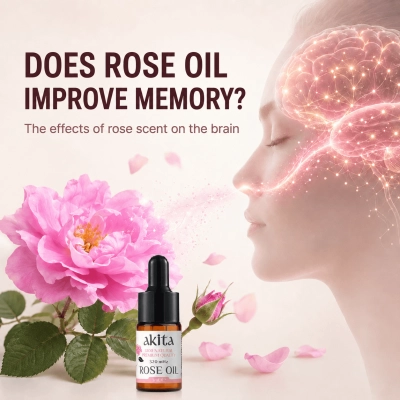
What does science tell us about Rosa damascena, rose essential oil, memory, gray matter, and the brain?
Could something as simple as the scent of a rose be associated with measurable changes in the brain?
It sounds surprising, but scientists have begun asking exactly this kind of question.
In recent years, researchers have studied Rosa damascena—the Damask rose famously cultivated in Isparta, Türkiye—and rose essential oil to better understand their possible relationship with the brain, learning, and memory.
One recent human study produced a particularly interesting finding: after one month of continuous exposure to a designated rose scent, researchers detected changes in gray matter volume using MRI brain scans.
Other studies involving Rosa damascena extract and rose essential oil have explored memory, BDNF, neurogenesis, and the systems nerve cells use to communicate.
So, does this mean smelling roses improves your memory?
Not yet.
The science is promising, but there is an important difference between discovering a change in the brain and proving that something improves memory. Here is what researchers have actually found.
🌹 One Month of...
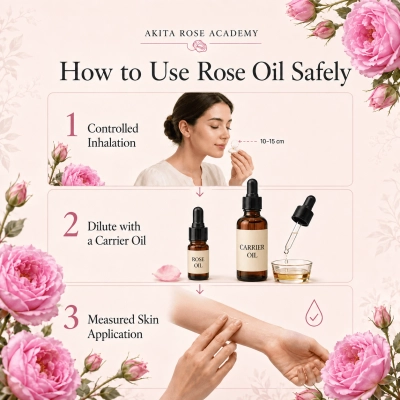
Safe inhalation and skincare methods for Rosa damascena essential oil
If you are wondering how rose oil is used, controlled inhalation is one of the most common methods reported in scientific studies. Researchers have typically placed a small amount of rose oil on cotton or cloth and asked participants to inhale its aroma for a specified period without applying the oil inside the nose. In topical studies, rose oil has generally been diluted in a carrier oil before being applied to the skin.
For everyday use, pure rose essential oil should not be applied directly to the skin, around the eyes, or inside the mouth. For inhalation, you may place one drop on a cotton pad or aroma inhaler and smell it briefly from a distance. For topical use, it should be diluted to a low concentration in a suitable carrier oil.
When choosing rose oil, look for products that clearly state their ingredients and intended use. You can review Akita Golden Rose Oil 1 mL for product information. You may also explore Akita’s carrier oil options.
How has rose oil been used in scientific studies?
In human studies involving rose oil, the method of application has varied according to the purpose of the resea...
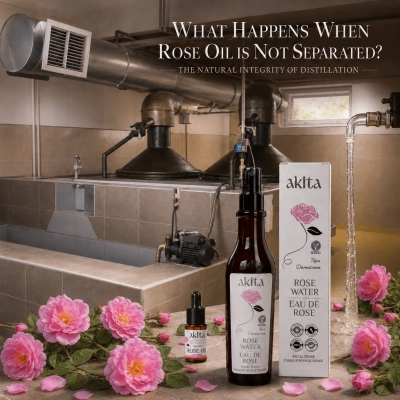
Discover how retaining the naturally occurring rose oil phase can influence the composition, appearance, aroma and character of rose distillate
When freshly harvested Isparta roses enter a distillation vessel, they produce much more than pleasantly scented water.
As heat and steam move through the rose petals, different aromatic compounds are carried away from the flowers. Once the aromatic steam is cooled, it condenses back into a liquid containing two distinct but related fractions:
An aromatic, water-based rose distillate
A small amount of water-insoluble rose essential oil
In conventional rose oil production, the visible essential oil phase is separated and collected. The remaining aromatic water is generally known as rose water or rose hydrosol.
But what happens when the naturally occurring rose oil is not separated?
The simple answer is that the oil phase produced during distillation remains within the collected distillate. This does not mean that all of the essential oil dissolves in the water. Some of it may remain dispersed as extremely small droplets, while certain water-compatible aromatic compounds stay dissolved in the water phase.
This distinction lies...
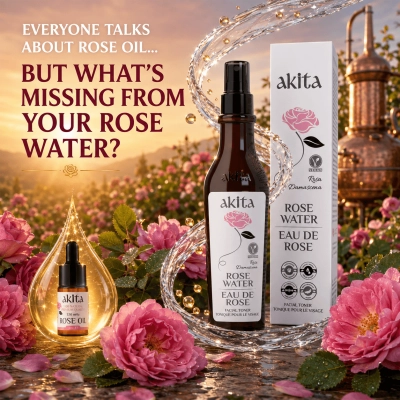
For Years, We Focused on Rose Oil, But What Did We Lose in the Rose Water?
Akita takes a different approach to rose distillation: instead of adding rose oil back later, it preserves the aromatic oil naturally present in the Rosa damascena distillate.
When Rosa damascena flowers enter a distillation vessel, attention usually turns to one highly valued result:
Rose essential oil.
Its rarity, intensive production process, and value in fine fragrance and skincare have made it the most celebrated part of rose distillation.
Yet rose oil is not the only valuable result.
Alongside a small quantity of essential oil, distillation produces a much larger volume of aromatic rose distillate. This water phase carries naturally occurring aromatic constituents transferred from the flowers during distillation.
That raises an important question:
When rose oil is separated from the distillate, what remains—and what may be removed from the rose water’s original aromatic composition?
Akita’s Non-De-Oiled Rose Water was developed around this question.
Rose Distillation Produces More Than Essential Oil
Steam distillation does not simply extract one substance from a flower.
As heat and...
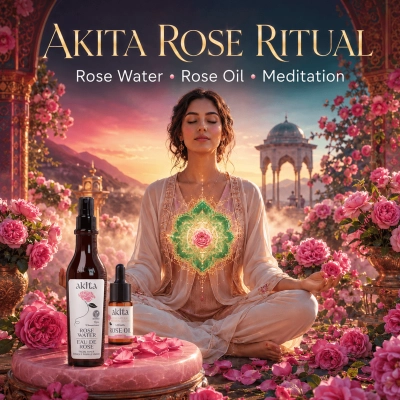
The Akita Rose Experience: Self-Observation Through Rose Water and Rose Oil Before Your Ritual
At Akita, we invite you to a ritual experience that brings together the ancient traditions of the rose with modern mindfulness practices.
This is not a medical claim. The purpose is to observe and document your personal experience through the combination of scent, breath, attention, and intention.
Some users report feeling calmer, more open, more balanced, and more at ease after rose-based rituals. These experiences vary from person to person and are entirely subjective.
Why Is the Rose Associated with Meditation and Emotional Awareness?
The olfactory system is directly connected to the brain’s limbic system, which plays a key role in emotion, memory, and internal state processing.
Because of this, rose scent may:
Trigger emotional memories
Support transition into meditation
Increase breath awareness
Encourage mental calmness
Support a sense of physical relaxation
Scientific studies suggest that aromatherapy with Rosa damascena (Damask rose) may be associated with stress perception and sleep quality improvements in some individuals. However, these eff...
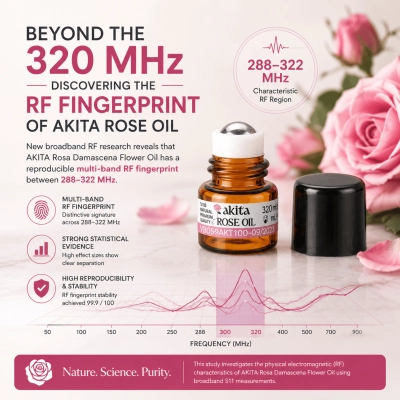
Is Rose Oil Really 320 MHz? What New Scientific Research Reveals
Beyond the 320 MHz Claim: A New Perspective on the RF Fingerprint of Rosa damascena Flower Distillate
For many years, one statement has been widely shared across aromatherapy and natural wellness communities:
"Rose vibrates at 320 MHz."
This claim has become one of the most frequently repeated facts about Rosa damascena, often presented as evidence of the flower's unique energetic properties.
But where did this number come from? Does it apply to all rose-based products, including rose water? And what happens when modern radio-frequency (RF) analysis is used to investigate this long-standing claim?
A recent exploratory study offers a different perspective. Rather than identifying a single dominant frequency, researchers observed that a non-de-oiled Rosa damascena flower distillate exhibited a reproducible multi-band RF fingerprint across a broad frequency range.
Where Did the 320 MHz Claim Originate?
An important distinction is often overlooked.
Historically, the widely quoted 320 MHz value has generally been associated with Rosa Damascena Flower Oil, the essential oil obtained during steam distillatio...
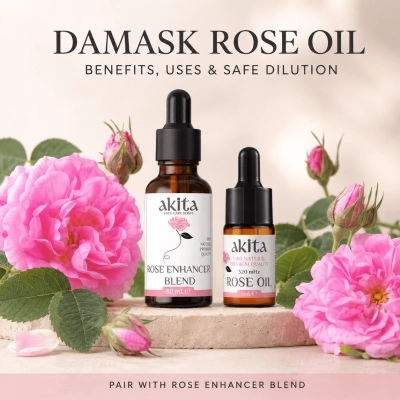
Damask Rose Oil Benefits: Uses, Skin Care and Safe Application
Discover what makes pure Rosa damascena essential oil so precious, and how to use it safely with Akita Rose Enhancer Blend.
Damask rose oil is one of the most treasured essential oils in the world. Distilled from the delicate flowers of Rosa damascena, it is valued for its complex fragrance, concentrated composition and centuries-old place in perfumery, personal care and aromatic traditions.
In Isparta, Türkiye, one of the world’s best-known rose-growing regions, the flowers are traditionally picked by hand during a brief annual harvest. Their limited flowering season, careful harvesting and extremely low oil yield help explain why authentic rose oil is both rare and valuable.
What Makes Damask Rose Oil So Special?
Rose oil is more than a rose-scented ingredient. It is a highly concentrated essential oil containing naturally occurring aromatic compounds that collectively create its distinctive fragrance and character.
Its principal constituents may include:
Citronellol: Contributes a fresh, rosy character and has demonstrated antimicrobial activity in laboratory research.
Geran...