What Happens When Rose Oil Is Not Separated During Distillation?
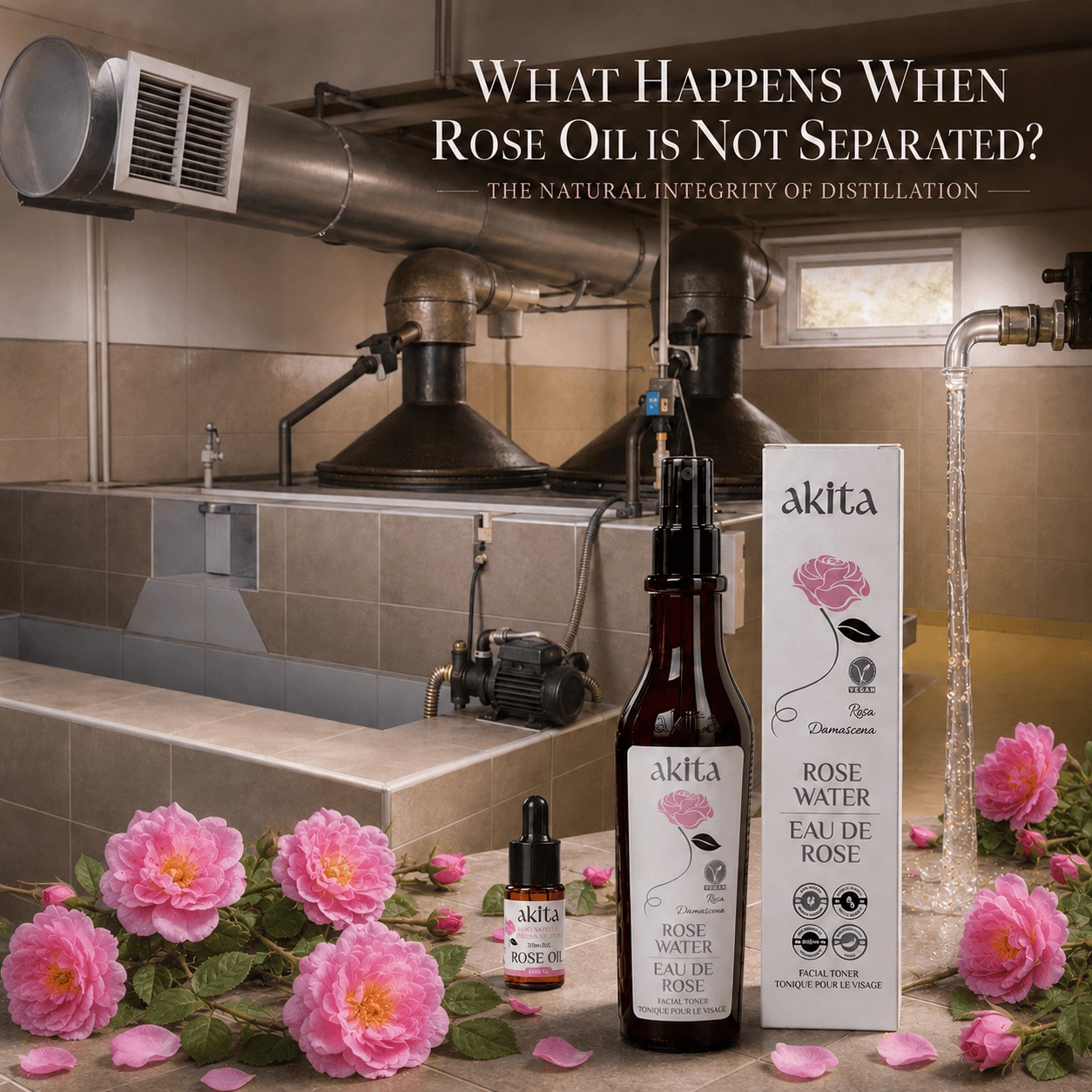
Discover how retaining the naturally occurring rose oil phase can influence the composition, appearance, aroma and character of rose distillate
When freshly harvested Isparta roses enter a distillation vessel, they produce much more than pleasantly scented water.
As heat and steam move through the rose petals, different aromatic compounds are carried away from the flowers. Once the aromatic steam is cooled, it condenses back into a liquid containing two distinct but related fractions:
- An aromatic, water-based rose distillate
- A small amount of water-insoluble rose essential oil
In conventional rose oil production, the visible essential oil phase is separated and collected. The remaining aromatic water is generally known as rose water or rose hydrosol.
But what happens when the naturally occurring rose oil is not separated?
The simple answer is that the oil phase produced during distillation remains within the collected distillate. This does not mean that all of the essential oil dissolves in the water. Some of it may remain dispersed as extremely small droplets, while certain water-compatible aromatic compounds stay dissolved in the water phase.
This distinction lies at the heart of the non-de-oiled rose water concept.
How does rose distillation work?
Rose distillation involves processing fresh rose blossoms with water or steam. Heat encourages volatile aromatic compounds to leave the petals and travel with the steam into a cooling system.
When the steam cools, it returns to liquid form.
Although the condensed liquid may initially appear to be a single substance, it contains components with different chemical properties. Some have a greater affinity for water, while others naturally favour the oil phase.
Phenethyl alcohol, for example, contributes to the characteristic floral scent of rose and is relatively important in the water-based hydrosol. Compounds such as citronellol, geraniol and nerol are more strongly associated with rose essential oil.
Research comparing industrial rose oils and hydrosols shows that the two products can have distinctly different chemical profiles even though they come from the same flowers and distillation process. Rose hydrosol should therefore not be described simply as “highly diluted rose oil.” It is a botanical distillate with its own composition. Comparative study of rose oils and hydrosols
Why does rose oil separate from water?
Oil and water have different chemical properties.
Imagine adding a few drops of olive oil to a glass of water. Even after shaking the glass, the oil does not permanently disappear. Small droplets may temporarily spread through the water, but they gradually join together and form a separate phase.
A similar physical principle applies to rose essential oil.
Many rose oil constituents have limited solubility in water. When freshly produced rose distillate is left to settle, the water and oil fractions can begin to separate. Traditional distillation systems use specialized separation equipment to collect the valuable essential oil.
However, removing the visible oil phase does not mean that the remaining rose water contains no rose-derived aromatic compounds. Water-soluble constituents and traces of dispersed volatile compounds can still remain in the hydrosol.
What remains when the rose oil is not removed?
When the naturally occurring oil phase is not separated after distillation, some of the oil-soluble volatile compounds carried from the roses remain with the distillate.
One scientific distinction is essential:
Rose oil remaining in the distillate does not mean that all of the oil has completely dissolved in the water.
When the oil is retained:
- Tiny oil droplets may remain dispersed throughout the liquid.
- Some droplets may gradually combine and move toward the surface.
- The product may appear slightly cloudy or reflect light differently.
- Water-soluble aromatic compounds remain in the water phase.
- Some oil-soluble constituents may be retained inside dispersed droplets.
- The aroma and sensory character may differ from conventional rose hydrosol.
The precise composition cannot be determined by appearance or fragrance alone. Appropriate laboratory analysis is required to identify and measure the product’s constituents.
Think of a bowl of soup
A bowl of soup provides a simple way to understand the difference.
You may see small droplets of oil floating on its surface. If you remove that oil with a spoon, the character of the soup changes slightly. However, this does not mean that every oil-derived flavour has disappeared from the remaining liquid.
If you do not skim the oil away, you retain all the naturally formed parts together. The oil is still oil and the water is still water; they have not chemically become a single substance.
Non-de-oiled rose distillate follows a comparable principle. The naturally occurring oil phase is retained, but it should not be described as if all the oil had permanently dissolved at a molecular level.
Conventional rose water versus non-de-oiled rose water
The two products are related, but they are not necessarily identical.
| Feature | Conventional rose water or hydrosol | Non-de-oiled rose water |
|---|---|---|
| Production | Obtained through rose distillation | Obtained through rose distillation |
| Natural oil phase | May be separated and collected | Retained within the distillate |
| Water-compatible aromatics | May be present | May be present |
| Dispersed oil droplets | Usually limited, depending on production | May be more noticeable |
| Appearance | Often relatively clear | May show slight cloudiness or fine droplets |
| Aroma | Often delicate and hydrosol-specific | May have a more layered or distinctive character |
| Natural batch variation | Possible | Possible |
| Production priorities | Purity, hygiene and stability | Purity, hygiene, stability and oil-phase management |
This is a general comparison. The final characteristics of any rose water depend on the roses, distillation conditions, production controls and product specifications.
What does “non-de-oiled” not mean?
Non-de-oiled rose water should not be confused with ordinary rose water to which essential oil has been added afterward.
Adding bottled essential oil to finished rose water is different from retaining the natural oil phase produced during the original distillation.
When essential oil is added to water afterward, suitable formulation methods may be required to distribute the oil evenly. Depending on the product, this can involve a solubilizer, emulsifier or another stabilization system.
With a non-de-oiled distillate, the goal is to retain the oil and water fractions that naturally arrive together during the same controlled distillation process.
This distinction is important for accurate and transparent product communication.
Can retained oil affect the product’s appearance?
Yes. Extremely small oil droplets can scatter light, giving the liquid a slightly hazy or opalescent appearance.
During storage, some droplets may combine or form a fine ring near the surface. The visibility of these changes can depend on droplet size, temperature, storage conditions and the product’s preparation.
However, not every cloudy appearance should automatically be attributed to natural oil.
Cloudiness can also result from microbial contamination, unsuitable storage, packaging interactions or production problems. A product should therefore be assessed according to its complete quality profile, not simply whether it looks clear or cloudy.
Warning signs that deserve attention can include:
- A new or unpleasant odour
- Swelling or unusual pressure inside the package
- String-like, fuzzy or unexpected particles
- A significant change from the product’s original appearance
- An expired best-before or use-by date
- Storage outside the manufacturer’s recommended conditions
Natural variation and deterioration are not the same thing. Proper production records and quality testing help distinguish between them.
Can the aroma be different?
Rose fragrance does not come from a single molecule. It is created by many aromatic constituents occurring in different proportions.
Some of these compounds are more compatible with water, while others favour the oil phase. When the natural oil phase is retained, the aroma may be perceived as more layered, fuller or simply different from that of conventional rose hydrosol.
A stronger fragrance does not automatically indicate higher quality. Aroma can also be influenced by:
- The rose variety
- Growing conditions
- Harvest time
- The interval between harvesting and distillation
- The ratio of roses to water
- Distillation time and temperature
- The fraction of distillate collected
- Packaging and storage conditions
The quality of natural rose water should be assessed through its raw materials, traceability, production controls, microbiological safety and laboratory analysis—not fragrance alone.
The Akita Organic Non-De-Oiled Rose Water approach
Akita Organic Non-De-Oiled Rose Water is based on retaining the natural rose oil phase created during distillation rather than separating it from the rose distillate.
The purpose is not to add bottled rose essential oil to finished rose water. It is to preserve the naturally occurring oil and water fractions through a carefully managed production process.
This creates a rose distillate with a character that may differ from conventional rose water from which the oil has been removed.
However, the value of the finished product depends on more than the words “non-de-oiled.” The quality of the Isparta roses, the amount of plant material used, distillation conditions, hygiene, filling, packaging and storage all contribute to the final result.
Research also demonstrates that rose hydrosols are chemically complex materials worthy of being studied independently. One 2024 study found measurable differences among several fractions obtained during Damask rose processing. Laboratory findings, however, should not be interpreted as proof that a finished cosmetic product treats medical conditions in humans. Study indexed by PubMed
Does retaining more natural material guarantee greater benefits?
No. That conclusion cannot be made solely from the production method.
Retaining the natural oil phase can alter a product’s chemical and sensory profile. Determining whether that difference delivers a particular cosmetic benefit requires additional evidence, including:
- Identification and measurement of relevant constituents
- Stability testing over the product’s intended shelf life
- Microbiological testing
- Safety assessment
- Product-specific performance testing
Non-de-oiled rose water can therefore be described as a distinct production approach. It should not be presented as automatically therapeutic, universally superior or suitable for every person.
Most Frequently Asked Question
Is non-de-oiled rose water as concentrated as pure rose essential oil?
No. Non-de-oiled rose water remains a predominantly water-based botanical distillate.
It may contain naturally retained and dispersed oil droplets, but this does not turn it into pure rose essential oil. Pure rose oil is far more concentrated and has different handling and usage requirements.
The two products are not interchangeable.
Common Misconception
Misconception: If the oil is not separated, all of it dissolves in the rose water.
The reality: Most rose essential oil does not readily dissolve in water. It may remain distributed as very small droplets, while certain rose-derived aromatic compounds can dissolve in the water phase.
Did You Know?
The aroma of rose hydrosol is not simply a weaker copy of the aroma of pure rose oil.
Because aromatic compounds distribute differently between water and oil, hydrosol may smell softer, fresher or noticeably different from the essential oil obtained from the same roses.
Scientific literature identifies many compounds and experimental effects associated with Rosa damascena. However, findings involving an isolated constituent, essential oil or laboratory model cannot automatically be applied to every finished rose-water product or interpreted as proof of a clinical effect. Review of Rosa damascena research
Key Takeaways
- Rose distillation produces an aromatic water phase and an essential oil phase.
- Rose oil and water have different chemical properties.
- Conventional production may separate and collect the oil.
- In a non-de-oiled distillate, the naturally occurring oil phase is retained.
- Retained oil may exist as small droplets; it is not necessarily completely dissolved.
- The product’s appearance, aroma and sensory character may differ from conventional hydrosol.
- Slight cloudiness can be natural, but cloudiness should not automatically be assumed to be harmless.
- Non-de-oiled does not mean essential oil was added afterward.
- Product quality depends on the complete production and testing process.
- Cosmetic product characteristics should not be confused with medical treatment claims.
Frequently Asked Questions
1. What is non-de-oiled rose water?
It is a rose distillate in which the naturally occurring essential oil phase produced during distillation is retained rather than separated.
2. Is non-de-oiled rose water pure rose essential oil?
No. It is still predominantly water-based. Pure rose essential oil is considerably more concentrated.
3. Is rose essential oil added afterward?
Not when the term is used correctly. Non-de-oiled refers to retaining the natural oil phase created during the original distillation.
4. Does all the rose oil dissolve in the water?
No. Some aromatic compounds can dissolve in the water phase, while much of the oil has limited water solubility and may remain as small droplets.
5. Should the bottle be shaken?
Follow the instructions on the product label. If the manufacturer recommends shaking before use, this can help redistribute naturally dispersed droplets.
6. Can natural rose water appear slightly cloudy?
Yes. Fine oil droplets can create slight cloudiness. Nevertheless, unexpected changes in smell, colour or texture should be evaluated carefully.
7. Does non-de-oiled rose water have a stronger aroma?
It may have a more layered or distinctive aroma, but scent intensity depends on the roses and production conditions.
8. Is conventional rose water inferior?
No. Conventional hydrosol is also a valuable botanical distillate with its own composition and uses. The products represent different production approaches.
9. Does retained rose oil automatically make the product more effective?
No. Product-specific testing is needed before a particular performance or benefit can be established.
10. Is it suitable for every skin type?
Individual responses to cosmetics vary. People with sensitive skin may wish to perform a patch test and should always follow the product directions.
11. Can a natural product cause sensitivity?
Yes. “Natural” does not mean that the possibility of sensitivity or allergy is zero.
12. How should consumers evaluate rose-water quality?
Consider the ingredient list, manufacturer, batch information, expiry date, packaging, storage instructions, traceability and available quality analyses together.
Preserving the natural character of distilled roses
When the rose oil phase is not separated, the resulting product should not be viewed as merely scented water.
It can be a distinctive botanical distillate containing water-compatible aromatic compounds alongside naturally retained, finely dispersed oil droplets.
The principle behind Akita Organic Non-De-Oiled Rose Water is not to add rose oil to a finished hydrosol. It is to retain the natural oil phase carried from the roses during distillation.
Understanding this difference requires more than an attractive fragrance or an appealing label. It requires careful consideration of the raw material, distillation process, behaviour of the oil and water phases, quality controls and laboratory findings.
Because genuine product quality is found not only in how a rose smells, but also in how it is grown, distilled, preserved and honestly explained.
References
- Marinova, E. M., et al. (2023). “Comparative Study of the Yield and Chemical Profile of Rose Oils and Hydrosols Obtained by Industrial Plantations of Oil-Bearing Roses in Bulgaria.” Resources, 12(7), 83. https://doi.org/10.3390/resources12070083
- Charoimek, N., et al. (2024). “Pharmaceutical Potential Evaluation of Damask Rose By-Products from Volatile Oil Extraction.” Plants, 13(12), 1605. https://doi.org/10.3390/plants13121605
- Akram, M., et al. (2020). “Chemical Constituents, Experimental and Clinical Pharmacology of Rosa damascena: A Literature Review.” Journal of Pharmacy and Pharmacology, 72(2), 161–174. https://doi.org/10.1111/jphp.13185
Comment