Etiket: #akita rose water
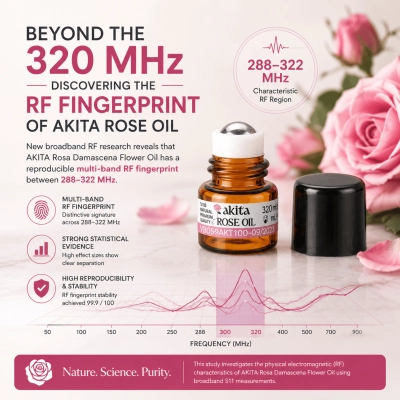
Is Rose Oil Really 320 MHz? What New Scientific Research Reveals
Beyond the 320 MHz Claim: A New Perspective on the RF Fingerprint of Rosa damascena Flower Distillate
For many years, one statement has been widely shared across aromatherapy and natural wellness communities:
"Rose vibrates at 320 MHz."
This claim has become one of the most frequently repeated facts about Rosa damascena, often presented as evidence of the flower's unique energetic properties.
But where did this number come from? Does it apply to all rose-based products, including rose water? And what happens when modern radio-frequency (RF) analysis is used to investigate this long-standing claim?
A recent exploratory study offers a different perspective. Rather than identifying a single dominant frequency, researchers observed that a non-de-oiled Rosa damascena flower distillate exhibited a reproducible multi-band RF fingerprint across a broad frequency range.
Where Did the 320 MHz Claim Originate?
An important distinction is often overlooked.
Historically, the widely quoted 320 MHz value has generally been associated with Rosa Damascena Flower Oil, the essential oil obtained during steam distillatio...

🧪 What Is Rose Water?
Rose water is made from rose flowers. It looks like normal water, but it has special things inside from the rose. These include natural oils, minerals, and a beautiful smell.
Many rose waters sold in stores are made using roses that already had their oils taken out. That means what’s left is just "rose-scented water" — not the real thing.
At Akita Rose Water, we wanted to do it differently.
🌿 Our Science: Keeping the Rose Alive
We learned something important: The essential oil in a rose is where the magic happens. It helps your skin feel calm, soft, and healthy.
So we decided to never remove the oil from our roses.
Instead, we:
Grow organic roses — no chemicals!
Grow organic roses — no chemicals!
Pick the roses by hand early in the morning.
Use a copper still to gently steam the petals.
Collect the water with all the rose's natural goodness inside.
This is called single distillation, and it keeps all the good parts in the water.
Use a copper still to gently steam the petals.
Collect the water with all the rose's natural goodness inside.
This is called single distill...