Everyone Talks About Rose Oil! But What’s Missing From Your Rose Water?
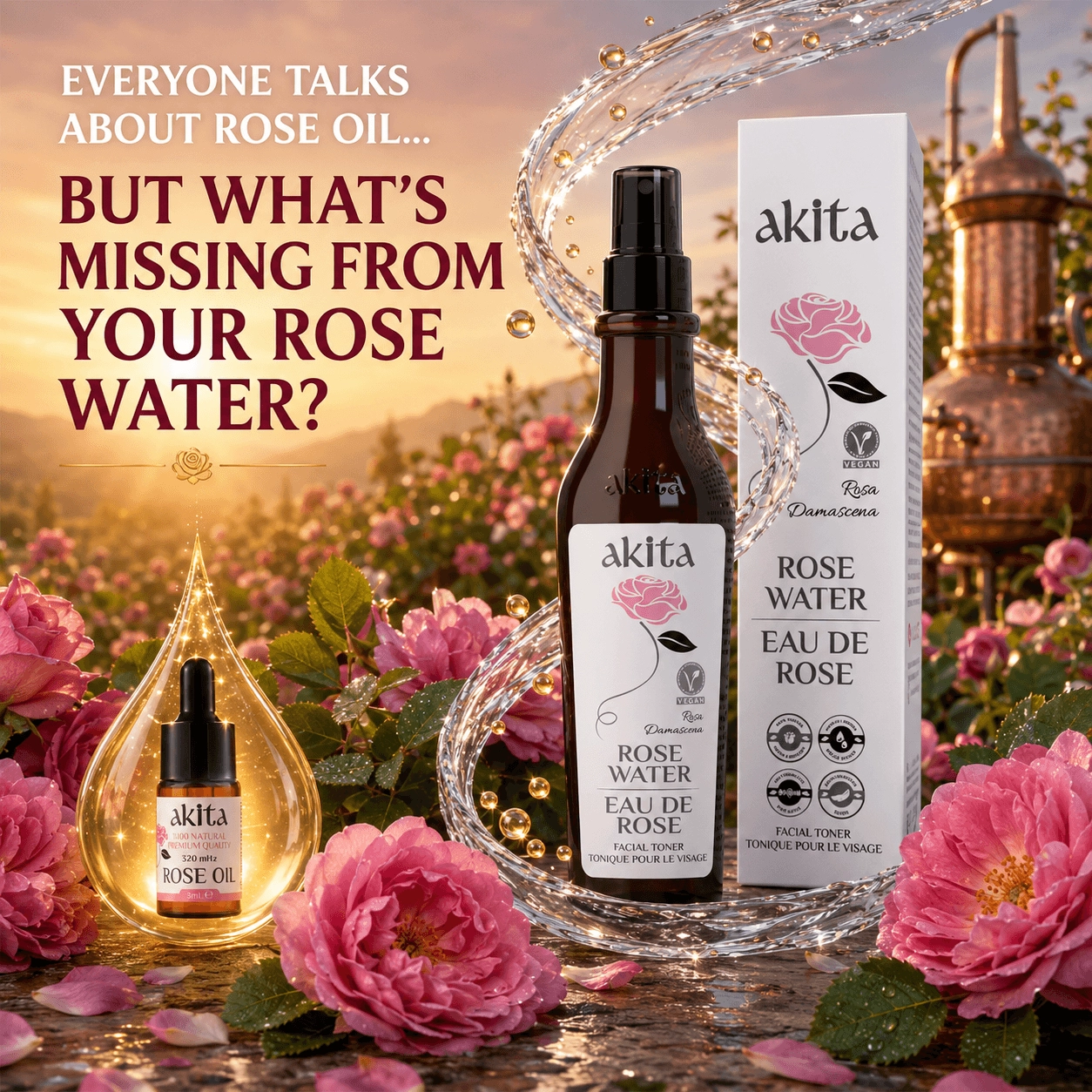
For Years, We Focused on Rose Oil, But What Did We Lose in the Rose Water?
Akita takes a different approach to rose distillation: instead of adding rose oil back later, it preserves the aromatic oil naturally present in the Rosa damascena distillate.
When Rosa damascena flowers enter a distillation vessel, attention usually turns to one highly valued result:
Rose essential oil.
Its rarity, intensive production process, and value in fine fragrance and skincare have made it the most celebrated part of rose distillation.
Yet rose oil is not the only valuable result.
Alongside a small quantity of essential oil, distillation produces a much larger volume of aromatic rose distillate. This water phase carries naturally occurring aromatic constituents transferred from the flowers during distillation.
That raises an important question:
When rose oil is separated from the distillate, what remains—and what may be removed from the rose water’s original aromatic composition?
Akita’s Non-De-Oiled Rose Water was developed around this question.
Rose Distillation Produces More Than Essential Oil
Steam distillation does not simply extract one substance from a flower.
As heat and steam pass through Rosa damascena blossoms, different volatile and aromatic constituents are carried into the condensation system. Their distribution depends on their individual physical and chemical properties.
During this process:
- Some constituents are found primarily in the oil phase.
- Some remain soluble or dispersed in the water phase.
- Some may be present in both phases at different concentrations.
- The final composition can be influenced by temperature, pressure, distillation time, equipment, and collection methods.
The resulting rose distillate is therefore more than water with a pleasant fragrance. It contains the aromatic constituents of Rosa damascena that are carried into and retained within the water phase.
A note on “preserving the whole rose”
Distillation does not preserve every component of a fresh flower unchanged. It is a selective process that transforms the botanical material.
In Akita’s terminology, preserving the rose’s natural integrity means protecting the aromatic composition that forms naturally in the distillate—without subsequently separating its naturally occurring oil fraction.
Why Is Rose Oil Traditionally Separated?
In conventional rose distillation, the oil and water phases can be separated because of their different physical properties.
This allows producers to create two distinct commercial materials:
- Rose essential oil
- Rose hydrosol or conventional rose water
Rose oil is highly concentrated and valuable in perfumery, aromatherapy, and cosmetic formulation. Separating it is therefore an established and commercially practical production choice.
This traditional method is not inherently wrong. It simply reflects a different production objective.
Akita began with another question:
What kind of rose distillate could be created if the naturally occurring rose oil were not separated from it?
The Akita Difference: Preserve Rather Than Reconstruct
Akita Non-De-Oiled Rose Water is not conventional rose water with essential oil added back afterward.
Rosa damascena flowers are distilled, and the aromatic oil naturally remaining within the distillate is not subsequently removed.
This distinction matters.
Adding essential oil to finished water is not the same as preserving the composition that forms naturally during distillation. Water and essential oil do not readily combine without additional formulation methods, such as solubilizers or emulsifiers.
Akita’s approach begins during production rather than after it.
Its purpose is to:
- Carefully control the distillation process.
- Retain the aromatic character naturally created during distillation.
- Avoid unnecessary separation of the naturally occurring oil fraction.
- Offer a minimally processed rose distillate without reconstructing it later.
In simple terms:
Akita does not separate the rose and attempt to rebuild it afterward. It preserves the naturally formed distillate from the beginning.
What Does “Non-De-Oiled Rose Water” Mean?
The term may be unfamiliar to Canadian consumers because most products are simply labelled “rose water” or “rose hydrosol.”
For Akita, non-de-oiled means that the naturally occurring rose oil present in the freshly produced distillate has not been removed through a separate oil-recovery step.
It does not mean that:
- Large amounts of essential oil are floating in the bottle.
- The product is equivalent to pure rose essential oil.
- Essential oil was added to ordinary water.
- The product is an essential-oil blend.
Akita Non-De-Oiled Rose Water remains an aromatic water-based distillate. Its distinction lies in what is not removed after distillation.
Is It the Same as Conventional Rose Water?
Both conventional rose water and Akita Non-De-Oiled Rose Water can originate from Rosa damascena distillation. The difference is found primarily in the production objective and post-distillation handling.
| Feature | Conventional de-oiled rose water | Akita Non-De-Oiled Rose Water |
|---|---|---|
| Botanical source | Rosa damascena | Rosa damascena |
| Production type | Steam distillation | Carefully controlled distillation |
| Oil-separation step | Generally performed | Not performed |
| Essential oil added afterward | Depends on the formulation | Not the basis of the product |
| Primary objective | Produce rose oil and hydrosol separately | Preserve the naturally formed distillate |
| Product philosophy | Separate the phases | Minimize unnecessary separation |
This comparison does not suggest that every hydrosol is identical or that one method is automatically suitable for every purpose.
It explains why Akita Non-De-Oiled Rose Water should not be evaluated as just another rose-scented facial mist.
Why This Approach Matters in Canadian Clean Beauty
Canadian skincare consumers are increasingly interested in more than attractive packaging or botanical marketing.
They want to understand:
- Where an ingredient comes from
- How it is processed
- Whether fragrance has been added
- Whether the product has been unnecessarily reformulated
- Whether product claims are supported by appropriate testing
- What makes one botanical product genuinely different from another
Akita’s approach aligns with this growing demand for transparency and minimal processing.
Its point of difference is not an exaggerated promise. It is a clearly defined production decision:
Do not remove the aromatic oil that remains naturally associated with the rose distillate.
This gives consumers a more meaningful way to compare rose waters—not only by checking whether “rose” appears on the label, but by asking how the product was actually made.
A Naturally Complex Aromatic Character
Many consumers expect natural rose water to smell like a sweet, uniform rose perfume.
Authentic botanical distillates can be more complex.
Their aroma may vary slightly according to:
- The growing season
- Harvest timing
- The condition of the flowers
- Distillation parameters
- The stage at which the distillate was collected
- Storage and packaging conditions
Alongside recognizable rose notes, a genuine distillate may present fresh, green, botanical, sharp, or subtly tangy nuances.
These characteristics should not automatically be interpreted as defects. Natural distillates do not necessarily smell like synthetic rose fragrance.
For consumers seeking a predictable perfume, a fragranced cosmetic may be more familiar. For those interested in an authentic botanical distillate, natural aromatic complexity is part of the experience.
Less Processing Requires More Control
Minimal processing should never mean minimal quality control.
When a botanical distillate is produced without unnecessary additives or reconstruction, careful control becomes even more important.
This includes:
- Hygienic production
- Controlled distillation conditions
- Appropriate packaging
- Microbiological quality
- Batch traceability
- Suitable storage
- Stability monitoring
“Natural” should not be used as a substitute for evidence. A responsibly produced botanical product must combine respect for the raw material with appropriate testing and documentation.
Tested With a Responsible Approach to Claims
Akita has made product testing an important part of its quality and product-development process.
The documentation shared by the company includes evaluations relating to areas such as:
- Skin moisturization
- Eye-irritation potential
- The appearance of signs associated with skin aging
- Skin pigmentation
- Laboratory assessment of cell proliferation
- Microbiological quality
- Product composition
In an eye-irritation assessment conducted on Akita rose water, the test material was reported not to produce an irritation effect under the conditions of the test.
This is relevant to cosmetic-use safety, but it should not be transformed into a medical claim. It does not mean that the product treats dry eyes, allergies, or an ophthalmic condition.
The same principle applies to every cosmetic assessment:
A result should be communicated only within the limits of the test method and report—not expanded into a treatment promise.
This evidence-led approach is essential in building long-term consumer trust, particularly in Canada’s highly informed and diverse skincare market.
Recognition in Canada and Internationally
Akita’s work in natural skincare, innovation, and entrepreneurship has received recognition from independent Canadian and international organizations.
Awards and achievements include:
- Canadian Choice Award — 2024 and 2025
- Beauty Innovation Award — 2024
- Face Mist Product of the Year
- CertClean Clean Beauty Award
- LuxLife Global Excellence Award
- Corporate LiveWire Prestige Award
- Second Place in the Siemens Innovation Award competition, organized by the Oakville Chamber of Commerce
- Finalist recognition for Small Business of the Year
- Finalist recognition for KPMG Entrepreneur of the Year
These achievements recognize Akita’s commitment to product development, quality, entrepreneurship, and innovation.
Awards are not substitutes for scientific testing, just as laboratory testing is not the same as an industry award. Each provides a different form of evidence:
- Awards recognize brand, product, or innovation achievements.
- Laboratory reports document findings from specific test methods.
- Transparent product information helps consumers make informed choices.
Together, they demonstrate a broader commitment to accountability and quality.
More Than a Production Method
Akita’s approach represents more than a technical variation in rose-water production.
It reflects a simple philosophy:
When nature creates a valuable aromatic balance, innovation does not always require adding something new. Sometimes it means understanding what is already present—and choosing not to remove it.
In skincare, products are often differentiated by increasingly complex ingredient lists.
Akita asks consumers to consider a different possibility:
What if the most important decision is not what was added, but what was preserved?
Myth vs. Fact
Myth: Non-de-oiled rose water is ordinary water with rose essential oil added to it.
Fact: Akita’s approach begins with Rosa damascena distillation. The naturally occurring aromatic oil remaining in the distillate is not separated and then artificially reintroduced.
Did You Know?
Two products may both list Rosa damascena flower water and still differ in their aromatic character.
The growing season, flower-to-water ratio, distillation time, equipment, collection stage, and oil-separation process can all influence the final distillate.
The botanical name is important, but it does not tell the complete production story.
Frequently Asked Questions
What is non-de-oiled rose water?
It is a Rosa damascena distillate in which the naturally occurring aromatic oil fraction has not been removed through a separate post-distillation oil-recovery step.
Is non-de-oiled rose water the same as rose essential oil?
No. Rose essential oil is a highly concentrated oil-based material. Non-de-oiled rose water remains primarily a water-based botanical distillate.
Is rose oil added to Akita Rose Water afterward?
Akita’s production philosophy is not based on adding essential oil to finished rose water. It is based on preserving the aromatic oil naturally present in the distillate.
Why is rose oil usually removed?
Rose oil is a rare and commercially valuable ingredient used in perfumery, aromatherapy, and cosmetics. Conventional production therefore commonly separates it from the water phase.
Does rose distillate contain the entire fresh flower?
No. Distillation is selective. Only constituents that can be carried through the distillation process become part of the resulting distillate.
Why may natural rose water smell different from rose perfume?
A botanical distillate contains a complex natural aromatic profile. Synthetic or added fragrance is usually designed to smell sweeter, stronger, and more uniform.
Can the aroma vary between batches?
Small variations are possible in natural botanical products because growing conditions, harvest timing, and distillation variables can affect the sensory profile. Quality and safety parameters should nevertheless remain controlled.
Is Akita Non-De-Oiled Rose Water suitable for skincare?
It is designed as a cosmetic rose distillate for skincare use. Consumers should follow the product directions and discontinue use if individual sensitivity occurs.
Has Akita Rose Water been tested for eye irritation?
In the assessment shared by Akita, the material was reported not to produce an irritation effect under the test conditions. This is a cosmetic safety finding, not a treatment claim for eye conditions.
Do Akita’s awards prove clinical effectiveness?
No. Awards recognize achievements such as innovation, product quality, entrepreneurship, or industry distinction. Cosmetic-effect claims must be supported separately by appropriate testing.
What should Canadian consumers look for when choosing rose water?
Look beyond the front label. Consider the botanical species, ingredient list, production method, added fragrance, preservatives, product testing, packaging, traceability, and the manufacturer’s transparency.
What makes Akita different?
Akita focuses on preserving the Rosa damascena distillate’s naturally associated aromatic oil rather than separating it and attempting to reconstruct the product later.
Experience Rosa Damascena Without Unnecessary Separation
Akita Non-De-Oiled Rose Water is created for consumers who want more than rose-scented water.
It represents a carefully considered approach to botanical skincare: preserve the naturally formed aromatic distillate, minimize unnecessary separation, test responsibly, and communicate without exaggerated promises.
Because the value of the rose may not exist only in the few drops of oil that can be removed.
It may also be found in the aromatic balance that remains when those drops are allowed to stay.
Comment