What Is Rose Water? How It Is Made, Used and Chosen
A complete guide to real rose water, rose hydrosol and Rosa damascena flower distillate
Rose water is often described simply as water that smells like roses. That description, however, leaves out what makes traditionally distilled rose water so distinctive.
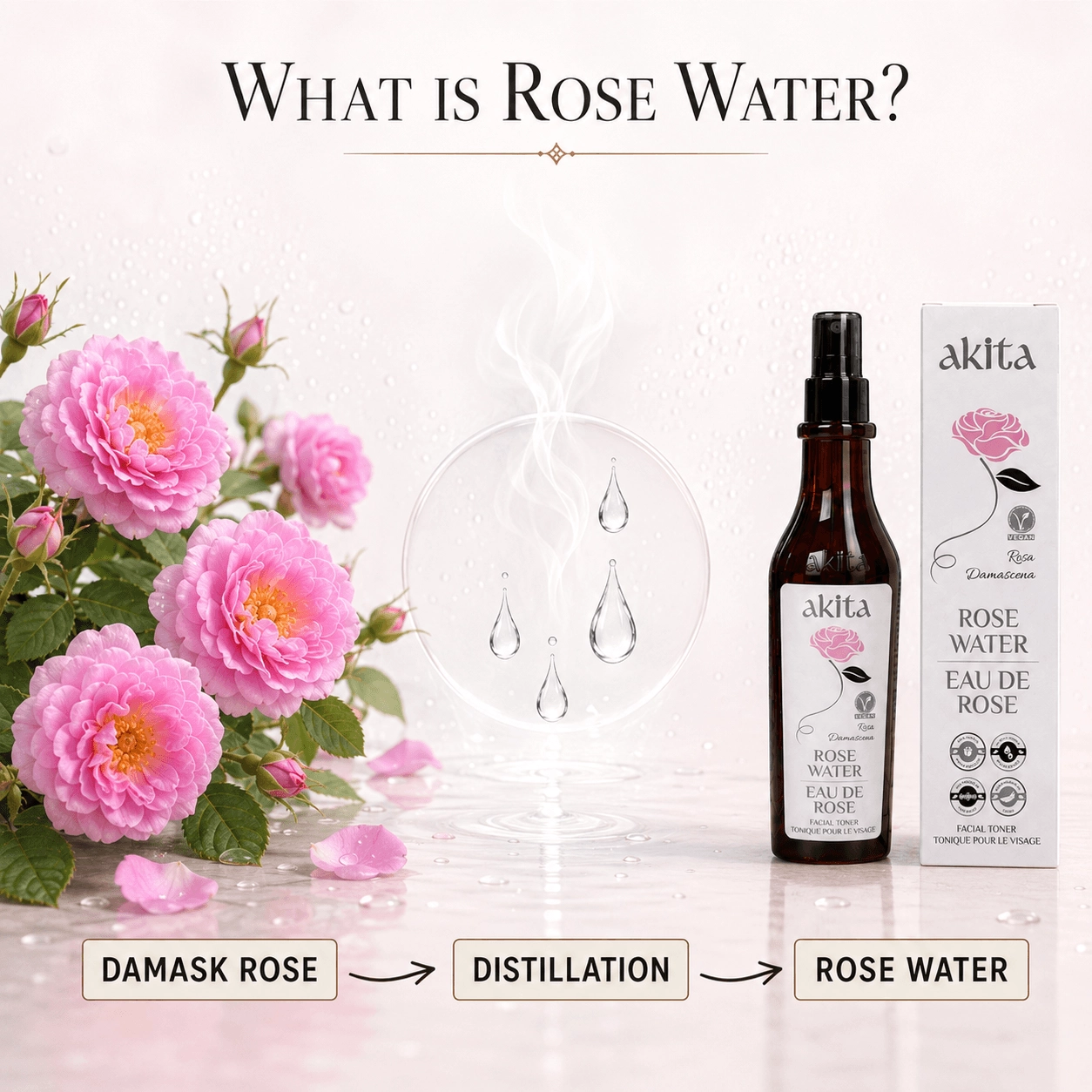
Authentic rose water is an aromatic distillate produced from rose flowers—most commonly the Damask rose, Rosa damascena. During distillation, heat releases volatile and water-soluble compounds from the petals. These compounds travel with the steam, which is then cooled and collected as a clear, fragrant liquid.
The result is more than rose-scented water. It is a plant distillate whose aroma, composition and quality depend on the rose variety, growing region, harvest conditions, distillation method and whether the rose oil is separated afterward.
This distinction matters because products sold as “rose water” in Canada can be very different from one another.
What exactly is rose water?
In its traditional sense, rose water is the water-based aromatic portion collected during the distillation of fresh rose flowers.
A scientific description would be:
Rose water is a liquid distillate containing water-soluble and small amounts of volatile aromatic compounds transferred from rose flowers during distillation.
Research on rose aromatic water has identified compounds such as:
- Phenethyl alcohol
- Citronellol
- Geraniol
- Nerol
- Linalool
- Eugenol and other compounds in smaller amounts
Phenethyl alcohol is particularly important in rose water because it is relatively water-soluble and contributes to the characteristic soft, floral aroma of fresh roses. More oil-soluble components may be present in lower concentrations or remain mainly in the essential oil layer.
The exact composition is not fixed. It changes with the rose species, geographic origin, harvest time, flower freshness, water-to-flower ratio, distillation conditions and oil-separation process.
How is real rose water made?
Traditional rose water production begins with fresh rose flowers, ideally distilled soon after harvest.
1. The roses are harvested
Damask roses are commonly collected during the cool hours of the early morning. Once picked, the flowers must be handled carefully because heat, crushing and prolonged waiting can affect their aroma.
2. Roses and water are placed in a still
The flowers are distilled in water or exposed to steam, depending on the production system. Traditional copper stills and modern stainless-steel equipment may both be used.
3. Heat releases aromatic compounds
As the still is heated, steam carries volatile and water-soluble substances away from the rose petals.
4. The vapour is cooled
The aromatic vapour passes through a cooling system and condenses back into liquid.
5. The distillate is collected
The condensed liquid may contain both rose water and a very small quantity of rose essential oil. Depending on the intended product, the oil may be separated, partially separated or retained in the distillate.
This final decision can significantly influence the character of the rose water.
Is rose water the same as rose hydrosol?
The terms are often used interchangeably, but their meaning can vary among producers.
| Term | Common meaning |
|---|---|
| Rose water | A broad commercial term that may describe distilled rose water, diluted distillate or fragranced water |
| Rose hydrosol | Usually the water-based fraction obtained during rose distillation |
| Rose distillate | A more precise description of the liquid condensed during distillation |
| Rose floral water | A general term that may refer to a distillate but does not always explain how the product was made |
| Rose-scented water | Water to which fragrance, rose aroma or other ingredients may have been added |
The product name alone therefore does not reveal its quality or production method. The ingredient list and information supplied by the producer are more useful.
Is all rose water naturally distilled?
No. Products carrying the name “rose water” may be produced in several ways.
Some are authentic distillates made directly from rose flowers. Others may contain purified water mixed with rose fragrance, essential oil, solubilizers, preservatives or botanical extracts. These products may smell pleasant, but they are not necessarily equivalent to a traditionally distilled rose water.
A simple ingredient list can help clarify the difference.
For a single-ingredient cosmetic rose distillate, Canadian consumers may see an ingredient name such as:
Rosa Damascena Flower Distillate
A formula containing water, fragrance and additional ingredients is a different type of product, even when “rose water” appears prominently on the front label.
Health Canada requires cosmetic ingredients to be disclosed using the appropriate ingredient-labelling system. Reading the full label—not only the marketing claims on the front—is therefore an important part of choosing a product.
What does “non-de-oiled rose water” mean?
During rose distillation, a small quantity of rose essential oil may appear within or above the collected distillate. In conventional rose-oil production, the primary objective is to recover that valuable oil. The remaining water becomes a secondary product.
Non-de-oiled rose water is produced with a different objective: the rose oil is not deliberately separated from the distillate.
Akita began developing this approach in Isparta, Türkiye, in 2003. Akita Non-De-Oiled Rose Water is made from Rosa damascena flowers and is collected as a whole rose distillate rather than treated merely as the water left after oil recovery.
This does not mean that rose water contains the same concentration of essential oil as bottled rose oil. Rose essential oil and rose water remain chemically different products. It means that the distillate is produced without a separate oil-removal step.
What should real rose water smell like?
Authentic rose water should have a recognizable rose character, but it may not smell like perfume.
A naturally distilled product can have an aroma that is:
- Floral but not artificially sweet
- Fresh, green or slightly herbaceous
- Soft rather than overwhelmingly strong
- Different from one harvest to another
- More complex than a single rose-fragrance note
Some distillates may also develop subtle acidic or plant-like notes. A light natural variation does not automatically indicate poor quality. Roses are agricultural materials, and genuine botanical products do not always smell identical from batch to batch.
By contrast, an intensely sweet, perfectly uniform perfume aroma may indicate added fragrance—although aroma alone cannot prove how a product was made.
What colour is pure rose water?
Properly distilled rose water is usually clear and colourless.
The pink colour of rose petals does not normally pass into a clear distillate because the pigments responsible for that colour are not carried through steam in the same way as volatile aromatic compounds.
A pink product may contain rose extract, colourants or other ingredients. That does not necessarily make it unsuitable, but it means the product should not be judged by colour alone.
Clear rose water can still contain aromatic rose compounds.
What is rose water used for?
Rose water has a long history of use in personal care, perfumery, cultural rituals and food preparation. Today, cosmetic rose water is commonly used as:
- A facial mist
- A simple toner
- A refreshing step after cleansing
- A water-based layer beneath a moisturiser
- A scalp or hair mist
- An ingredient in creams, serums, masks and cleansers
- A soothing-feeling spray during dry indoor conditions or warm weather
In Canada, where cold outdoor air and heated indoor environments can leave the skin feeling uncomfortable, a facial mist can be a pleasant addition to a skincare routine.
However, rose water is not a replacement for moisturiser. It adds a light water-based layer, while a moisturising cream or lotion helps reduce water loss from the skin.
What are the potential skin benefits of rose water?
Rose water is often associated with refreshing, soothing and skin-conditioning properties. Its practical effect depends on its composition, concentration, formulation and the individual using it.
A cosmetic rose water may help:
- Refresh skin that feels dry or tight
- Provide a light layer of hydration before moisturiser
- Make a skincare routine feel more comfortable
- Deliver naturally occurring aromatic compounds from the rose
- Replace plain water as the water phase of some cosmetic formulations
It is important not to treat every laboratory finding about rose petals, rose extracts or rose essential oil as proof of the same effect in rose water. These are different materials with different chemical profiles and concentrations.
Claims about treating acne, eczema, rosacea, infections or other medical conditions require product-specific clinical evidence. Rose water should not be presented as a medication unless it has been authorized for that purpose.
Is rose water suitable for sensitive skin?
A simple formula may be attractive to people with sensitive skin, but “natural” does not automatically mean suitable for everyone.
Botanical aromatic compounds can cause sensitivity in some individuals. Before using a new rose water widely:
- Read the complete ingredient list.
- Follow the directions on the package.
- Test a small amount on a limited area.
- Stop using it if persistent burning, swelling, itching or redness develops.
- Consult a healthcare professional if you have a known fragrance allergy or a serious skin condition.
Product-specific safety testing is more meaningful than general assumptions about rose water.
Akita Non-De-Oiled Rose Water has also undergone an OECD 491 laboratory eye-irritation assessment and was classified as non-irritant under the conditions of that test. This result applies to the tested product and should not be generalized to every rose water on the market.
Can rose water be used around the eyes?
Only use a product around the eyes if its directions and safety information support that use.
A cosmetic labelled as a facial mist is not automatically intended to be applied directly into the eyes. “Natural,” “pure” or “organic” claims do not replace appropriate testing.
If a manufacturer reports eye-safety testing, check:
- Which exact product was tested
- Which test method was used
- What the result actually showed
- Whether the evidence is available for review
If a product enters the eye and causes discomfort, rinse with clean water and seek medical advice if the irritation continues.
Can you drink rose water?
Cosmetic rose water and food-grade rose water are not automatically interchangeable.
A rose water intended for food must be manufactured, handled, packaged and labelled according to food-safety requirements. A cosmetic product should not be consumed simply because it contains a natural flower distillate or has a short ingredient list.
Before using rose water in drinks or recipes, confirm that the label clearly identifies it as food-grade and provides appropriate directions.
Does rose water need to be refrigerated?
Storage requirements depend on the product’s manufacturing process, packaging, preservation system and stability testing.
Do not assume that every natural rose water requires refrigeration or that all rose waters can remain stable indefinitely at room temperature. Follow the storage directions provided by the manufacturer.
In general, the bottle should be:
- Kept tightly closed
- Protected from direct sunlight
- Stored away from excessive heat
- Used with clean hands
- Left in its original packaging
Refrigerating a suitable product may create a cooling sensation, but it does not automatically improve its quality or safety.
How to choose a high-quality rose water in Canada
When comparing rose waters, look beyond words such as “pure,” “premium” and “natural.”
Check the botanical name
Look for the rose species used. Rosa damascena, also known as the Damask rose, is one of the most valued varieties in perfumery and aromatic distillation.
Read the complete ingredient list
A single rose distillate and a water-and-fragrance formula are not the same product.
Ask how it was produced
The manufacturer should be able to explain whether the product is distilled from fresh roses, diluted from a concentrate or created by combining water with fragrance.
Find out whether the oil was separated
This helps explain whether the rose water is a co-product of essential-oil production or a distillate made with the water itself as the primary product.
Look for product-specific testing
Microbiological, stability, composition and safety testing provide more useful information than broad claims about roses.
Consider traceability
Responsible producers should identify the rose variety and growing region and provide clear company and contact information.
Examine the packaging
Packaging should protect the contents and allow hygienic use. A spray format can reduce repeated contact with the product inside the bottle.
Why is the Isparta rose important?
Isparta, in southwestern Türkiye, is internationally associated with the cultivation and distillation of Rosa damascena. Its rose-growing tradition is supported by regional climate, altitude, soil conditions, generations of production knowledge and a concentrated seasonal harvest.
The roses bloom for only a limited period each year. They are generally collected by hand and transported for distillation soon after picking.
Origin alone does not guarantee the quality of every finished product, but clearly identified Isparta Rosa damascena provides meaningful information about the raw material and its production heritage.
Rose water, rose oil and rose extract: what is the difference?
| Product | How it is obtained | General character |
|---|---|---|
| Rose water | Water-based distillate from rose flowers | Light, water-soluble and gently aromatic |
| Rose essential oil | Volatile oil collected through distillation | Highly concentrated and must usually be diluted for skin use |
| Rose absolute | Aromatic material generally obtained through solvent extraction | Rich fragrance used mainly in perfumery |
| Rose extract | Produced by extracting plant material into water, glycerin, alcohol, oil or another solvent | Composition depends on the extraction medium |
| Rose-infused water | Water containing added rose material, aroma or extract | Not necessarily a distillate |
These products should not be treated as interchangeable. Evidence relating to one cannot automatically be applied to another.
The most important question is not “Does it smell like roses?”
A bottle can smell strongly of roses without being a traditional rose distillate. Conversely, a genuine distillate may have a softer, greener or more complex aroma than consumers expect.
The more useful questions are:
- Which rose species was used?
- Where were the roses grown?
- Was the product made through distillation?
- Is it a complete distillate or was the oil separated?
- Are fragrance, colour or other ingredients added?
- Has the finished product been appropriately tested?
- Is it intended for cosmetic or food use?
The answers reveal far more about rose water than fragrance alone.
Frequently asked questions
Is rose water just water with rose oil added?
Not necessarily. Traditionally distilled rose water is condensed during the distillation of rose flowers. Water mixed afterward with rose oil or fragrance is a different preparation.
Is pure rose water supposed to be pink?
No. A distilled rose water is generally clear and colourless. Pink colour may come from an extract, pigment or added colour.
Is rose hydrosol the same as rose water?
The terms frequently overlap, but “rose water” is used more broadly in the marketplace. Checking the production method and ingredients is more reliable than relying on the product name.
Can rose water replace a toner?
A simple cosmetic rose water can be used as a refreshing toner step if it is appropriate for your skin. It does not exfoliate or perform every function associated with treatment toners.
Can rose water replace moisturiser?
No. Rose water provides a light water-based layer, but moisturisers generally contain ingredients that help retain water and support the skin barrier.
Can I use rose water every day?
Many cosmetic rose waters are designed for daily use. Follow the product instructions and reduce or stop use if irritation develops.
Does stronger fragrance mean better rose water?
No. Aroma intensity can be influenced by the rose variety, concentration, distillation technique and added fragrance. A stronger smell is not proof of greater purity.
Is organic rose water automatically better?
Organic certification describes how eligible agricultural ingredients are grown and handled. It does not, by itself, explain distillation quality, aromatic composition, safety or product stability.
Final perspective
Rose water is not a single standardized liquid. It can be a traditional Damask rose distillate, a hydrosol remaining after essential-oil production, a diluted aromatic ingredient or simply fragranced water.
Authentic rose water begins with real rose flowers and a genuine distillation process. Its quality depends on the flower, origin, freshness, production method, oil separation, hygiene, packaging and testing.
For Canadian consumers, the best approach is simple: read the complete ingredient list, understand how the product was made and choose a producer that provides clear, verifiable information.
A rose water should be evaluated not only by how beautifully it smells, but by the story its label, production method and analytical evidence can genuinely support.
Comment