Does Rose Water Spoil? Scientific Findings on the Shelf Life of Traditional Rose Water and the Stability of Akita Unde-oiled Rose Distillate
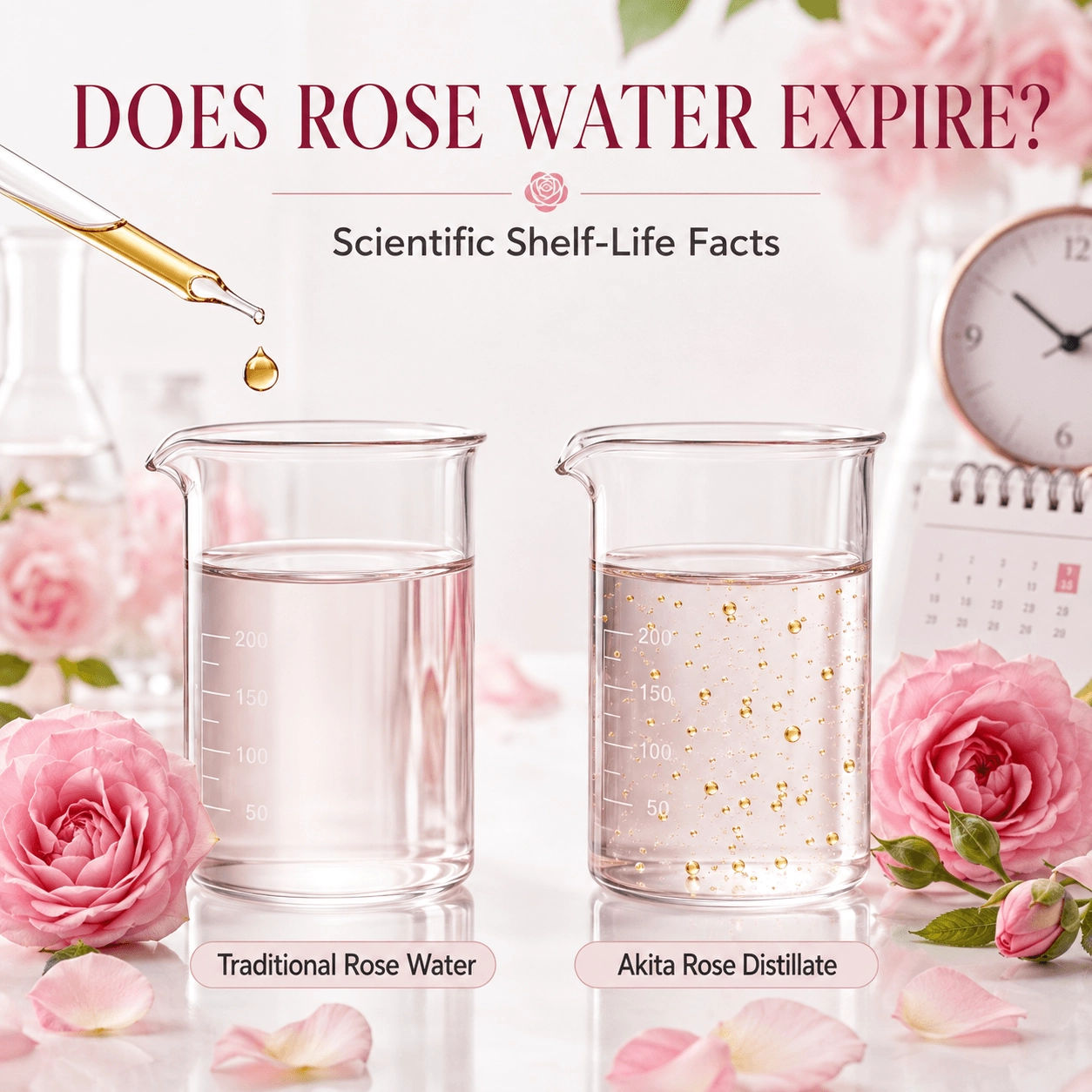
Scientific data on the shelf life of de-oiled rose water produced during rose oil production—and the difference of Akita Unde-oiled Rose Distillate
Rose water is often considered a natural product that can remain stable for many years. However, scientific research shows that not all rose waters have the same composition, production method, or storage stability.
To understand the shelf life of a rose water product, we should first ask an important question:
Is it the aromatic water remaining after rose oil has been separated, or was the rose distillate produced as the primary product without removing its naturally occurring rose oil?
This distinction matters because the production method may influence the product’s chemical composition and behavior during storage.
How Is Rose Water Produced During Rose Oil Production?
When Rosa damascena flowers are distilled with water and steam, volatile compounds from the flowers travel with the steam. After cooling, the vapor condenses back into a liquid.
The resulting distillate may contain two phases:
- An aqueous phase
- A volatile rose oil phase
In traditional rose oil production, the primary objective is to obtain rose oil. Therefore, the naturally formed oil phase is separated from the aqueous phase. The aromatic water remaining after the rose oil has been removed may then be bottled and sold as rose water.
This does not mean that traditional rose water is valueless. However, because the naturally formed oil phase has been separated, its composition differs from that of a rose distillate in which the rose oil remains.
Rose Academy Note
Not all rose waters are produced in the same way. A precise shelf-life statement cannot be made without considering the production method, packaging, storage conditions, and microbiological test results.
Why Can Traditional Rose Water Spoil?
Rose water consists mainly of water. If microorganisms enter the product during production, filling, packaging, or use, bacteria, yeasts, and molds may grow.
Microbial spoilage may cause:
- Changes in fragrance
- Sour or unpleasant odors
- Loss of clarity
- Cloudiness or sediment
- Changes in natural aromatic compounds
- Reduced product quality and safety
However, microbial contamination is not always visible. A product that remains clear may not necessarily be microbiologically acceptable.
For this reason, shelf life should not be determined only by examining color, fragrance, or appearance. It should be supported by appropriate physical, chemical, and microbiological analyses.
Professor Hasan Baydar’s Rose Water Study
Professor Hasan Baydar and his colleagues investigated microbial spoilage in traditional rose water obtained as a by-product of rose oil production.
The study was titled:
“The Effects of Pasteurization, Ultraviolet Radiation and Chemical Preservatives on Microbial Spoilage and Scent Composition of Rose Water.”
The researchers compared several methods intended to control microbial spoilage:
- Pasteurization
- Ultraviolet radiation
- Sodium benzoate
- Phenoxyethanol
The rose water samples were stored at room temperature and protected from direct sunlight for 12 months. During this period, the researchers examined bacterial, yeast, and mold growth, as well as changes in volatile aroma composition.
The Study’s Main Finding
The study demonstrated an important point:
Traditional rose water obtained during rose oil production may undergo microbial spoilage when appropriate hygiene and preservation conditions are not provided.
Microorganisms can use some of the components present in rose water, leading to acidification, undesirable odor changes, and loss of characteristic product properties during storage.
Microbial growth was observed in untreated control samples. Pasteurization and ultraviolet treatment inhibited yeast and mold growth under the experimental conditions, but some bacteria survived.
Sodium benzoate and phenoxyethanol inhibited the growth of bacteria, yeasts, and molds under the conditions examined in the study.
The researchers also reported that the preservation treatments did not cause a statistically significant change in the main scent composition of the tested rose water.
Does the Study Say That Rose Water Has a 12-Month Shelf Life?
No.
The fact that the samples were monitored for 12 months does not mean that every rose water product has a shelf life of exactly 12 months.
The research shows that:
- Traditional rose water can undergo microbial spoilage.
- The preservation method influences microbial stability.
- Bacteria, yeasts, or molds may develop in untreated products.
- A product is not necessarily self-preserving simply because it is natural.
- Each finished product must be evaluated according to its own composition, production process, packaging, and storage conditions.
Scientific Clarification
Monitoring a product for 12 months is not the same as establishing a universal 12-month shelf life. A shelf-life claim requires predetermined acceptance criteria and the combined evaluation of physical, chemical, sensory, and microbiological stability.
What Determines the Shelf Life of Rose Water?
The shelf life of rose water does not depend on a single factor.
1. Initial Microbial Load
The number and types of microorganisms present immediately after production and filling can influence later stability.
Although distillation involves heat, contamination may occur after distillation through equipment, storage tanks, filling lines, bottles, caps, or environmental exposure.
2. Production and Filling Hygiene
A freshly distilled product may have a relatively low microbial load. However, microorganisms may be introduced during transfer, filtration, filling, or packaging.
Clean and well-controlled production systems are therefore essential.
3. Preservation Method
Pasteurization, ultraviolet treatment, filtration, hygienic filling, and an appropriately validated preservative system may influence microbial stability.
However, each method should be tested on the finished product. The effectiveness of a treatment cannot be assumed solely from its general use.
4. Natural Chemical Composition
Rose-derived compounds such as phenethyl alcohol, citronellol, geraniol, linalool, and certain other volatile constituents have been studied for their effects on microorganisms.
Their presence, however, does not automatically prove that a finished rose water product is self-preserving or has a particular shelf life.
The complete formulation and finished product must be evaluated.
5. pH
The acidity of a product may make growth more difficult for certain microorganisms. Nevertheless, pH alone is not a complete preservation system.
A product’s pH must be evaluated together with its chemical composition, microbial load, packaging, and storage conditions.
6. Packaging
The bottle, cap, spray pump, and closure system may help reduce contamination after filling and during consumer use.
Packaging integrity and compatibility may also affect physical and chemical stability over time.
7. Storage Conditions
High temperatures, direct sunlight, an open or damaged cap, and contact with contaminated surfaces may shorten the useful life of a product.
How Is Akita Rose Distillate Different?
The rose water investigated by Baydar and colleagues was traditional rose water obtained as a by-product of rose oil production.
Akita Unde-oiled Rose Water is produced using a different approach.
In the production method developed by Akita in 2003, the objective is not to extract rose oil as a separate primary product. Instead, the rose distillate itself is produced as the main product.
Distillation time, pressure, and other production conditions are adjusted for this purpose, and the naturally occurring rose oil is not separated from the distillate.
Akita therefore describes its product as:
Unde-oiled Rose Water = Rose Distillate
Its cosmetic ingredient name is:
Rosa Damascena Flower Distillate
| Traditional rose water | Akita rose distillate |
|---|---|
| May be obtained as a by-product of rose oil production. | The rose distillate is produced as the primary product. |
| The naturally formed rose oil is separated. | The naturally formed rose oil is not removed. |
| It is the aromatic aqueous phase remaining after oil separation. | It retains a broader combination of water-associated and oil-associated aromatic constituents. |
| This is the product type examined in the Baydar study. | The Baydar study did not directly test Akita Rose Distillate. |
For this reason, the findings obtained from traditional de-oiled rose water should not be applied directly to Akita Rose Distillate without product-specific testing.
Scientific Data and Observations on the Stability of Akita Rose Distillate
1. Observations of Previously Produced Bottles
Akita has retained certain unopened bottles of rose distillate from earlier production years. Some of these samples have demonstrated notable physical and sensory stability for periods reaching approximately 15 years.
The following characteristics have reportedly been observed:
- Maintenance of clarity
- No noticeable discoloration
- No visible sediment
- Retention of the product’s characteristic fragrance
These samples provide valuable real-time product observations. However, they should not be presented as equivalent to a standardized shelf-life or preservative-efficacy study.
A scientifically responsible statement would be:
Notable physical and sensory stability lasting up to approximately 15 years has been observed in certain unopened Akita Rose Distillate samples stored under suitable conditions.
This does not mean that the product has an unlimited shelf life or that every bottle will remain stable for the same period.
2. GC–MS Composition Analysis
In Akita Rose Distillate’s GC–MS analysis dated July 2, 2024, phenethyl alcohol represented the highest relative peak-area percentage among the volatile compounds detected by the analytical method, at 79.54%.
This does not mean that 79.54% of the entire bottle consists of phenethyl alcohol. It represents the relative distribution among the volatile compounds detected under the particular GC–MS analytical conditions.
Phenethyl alcohol:
- Is a naturally occurring aromatic constituent associated with Rosa damascena
- Contributes to the characteristic fragrance of roses
- Has been investigated in scientific literature for its ability to inhibit or limit the growth of certain microorganisms under specific conditions
Phenethyl alcohol may therefore contribute to the product’s stability. Nevertheless, a compositional GC–MS analysis alone cannot establish the preservative effectiveness or shelf life of the finished product.
3. Naturally Occurring Acetic Acid and Other Volatile Compounds
Naturally occurring acetic acid was also identified in Akita’s analysis. The product may additionally contain rose-derived volatile constituents such as benzyl alcohol, citronellol, and linalool.
Some of these compounds have been investigated for their antimicrobial effects. Because the natural rose oil is not separated, oil-associated aromatic constituents may remain within the Akita distillate.
However, studies of individual compounds do not by themselves prove that the finished Akita product is antibacterial, self-preserving, or stable for a particular number of years.
Such claims would require appropriate testing of the finished product.
4. pH Value
The measured pH of Akita Rose Distillate is approximately 5.5.
This pH may contribute to limiting the growth of certain microorganisms, but it should not be considered a strong preservation system on its own.
The pH must be evaluated together with the product’s full composition, initial microbial load, manufacturing process, packaging, and storage conditions.
5. Production and Packaging System
The observed long-term stability of Akita Rose Distillate may be associated with the combined effect of several factors:
- Heat applied during distillation
- A closed production system
- Low initial microbial load
- Retention of the naturally occurring rose oil
- Phenethyl alcohol and other natural volatile compounds
- Naturally occurring acetic acid
- An approximate pH of 5.5
- Hygienic filling
- Suitable bottles and closures
- Storage of the unopened product under appropriate conditions
It would not be scientifically accurate to select one factor and claim that it alone preserves the product. The observed stability may result from the combined effects of composition, production conditions, packaging, and storage.
Conclusion: Not Every Rose Water Has the Same Shelf Life
The research conducted by Baydar and colleagues shows that traditional rose water remaining after rose oil production can undergo microbial spoilage when it is not adequately protected.
However, the study did not examine Akita Unde-oiled Rose Distillate.
Akita’s distinctive approach is that the rose distillate is produced as the primary product and the naturally occurring rose oil is not separated. Phenethyl alcohol, naturally occurring acetic acid, other rose-derived volatile constituents, an approximate pH of 5.5, distillation conditions, hygienic filling, packaging, and suitable storage may collectively contribute to the product’s stability.
Based on the available information, the most scientifically responsible conclusion is:
Traditional rose water remaining after rose oil production may undergo microbial spoilage, and its shelf life depends on its production, preservation, packaging, and storage conditions. Akita Rose Distillate is produced through a different method in which the naturally occurring rose oil is not separated. Although physical and sensory stability lasting up to approximately 15 years has been observed in certain unopened Akita samples, this observation should not be confused with a standardized shelf-life study or a claim of unlimited shelf life.
APA 7 Reference
Baydar, H., Kuleaşan, H., Kara, N., Seçilmiş-Canbay, H., & Kineci, S. (2013). The effects of pasteurization, ultraviolet radiation and chemical preservatives on microbial spoilage and scent composition of rose water. Journal of Essential Oil Bearing Plants, 16(2), 151–160. https://doi.org/10.1080/0972060X.2013.794043
Comment