Etiket: #rose distillate
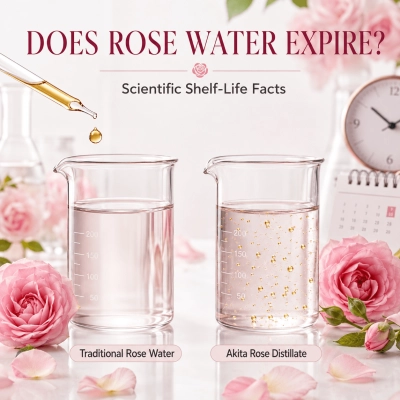
Scientific data on the shelf life of de-oiled rose water produced during rose oil production—and the difference of Akita Unde-oiled Rose Distillate
Rose water is often considered a natural product that can remain stable for many years. However, scientific research shows that not all rose waters have the same composition, production method, or storage stability.
To understand the shelf life of a rose water product, we should first ask an important question:
Is it the aromatic water remaining after rose oil has been separated, or was the rose distillate produced as the primary product without removing its naturally occurring rose oil?
This distinction matters because the production method may influence the product’s chemical composition and behavior during storage.
How Is Rose Water Produced During Rose Oil Production?
When Rosa damascena flowers are distilled with water and steam, volatile compounds from the flowers travel with the steam. After cooling, the vapor condenses back into a liquid.
The resulting distillate may contain two phases:
An aqueous phase
A volatile rose oil phase
In traditional rose oil production, the primary objective is to obtain rose oil....
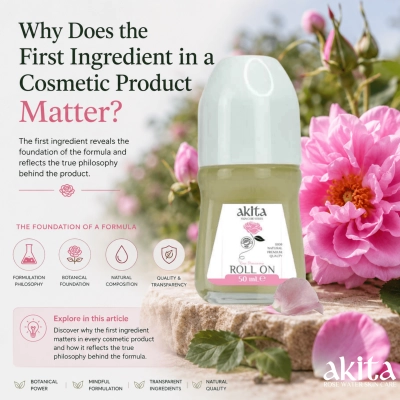
When choosing a roll-on deodorant, most people look at its scent, freshness, or packaging. However, one of the most useful clues about the product is found on the back label: the ingredient list, also known as the INCI list.
Cosmetic ingredients are generally listed from the highest to the lowest concentration. This means that the first ingredient usually makes up the largest portion of the formula and forms its main foundation.
So, why does that matter?
Most Roll-On Deodorants Begin with Water
The ingredient list of many roll-on deodorants begins with Aqua (Water).
Water helps dissolve and distribute the other ingredients evenly. It also gives the product the right consistency and allows it to spread easily across the skin. Using water in a cosmetic formula is completely normal.
However, some thoughtfully designed formulations use a botanical distillate in place of ordinary water.
What Is a Botanical Distillate?
A botanical distillate is a liquid obtained by distilling plants such as rose, lavender, chamomile, or orange blossom.
During distillation, steam carries some of the plant’s naturally occurring aromatic compounds into the resulting liquid. For this reason, a botan...
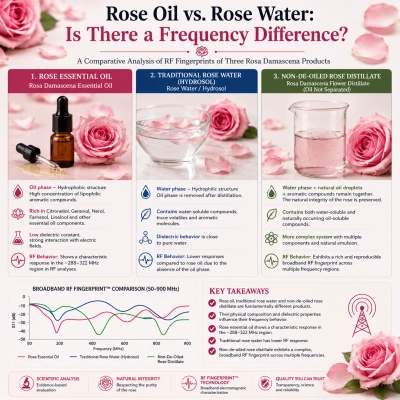
Rose Oil vs. Rose Water: Is There a Frequency Difference?
Why AKITA's Non-De-Oiled Rosa Damascena Flower Distillate May Exhibit a Richer RF Fingerprint Than Rose Essential Oil
Key Takeaway
For decades, the discussion has focused on the reported 320 MHz frequency of Rosa damascena essential oil. Almost nobody asked whether rose water itself has a measurable RF fingerprint. Our research began with that simple question—and the answer surprised even us.
Introduction
If you search online for the phrase "rose oil frequency," you will quickly encounter one familiar number:
320 MHz.
Whether this value is interpreted literally or symbolically, it has long been associated with Rosa damascena essential oil.
However, this raises an interesting question.
If rose essential oil has been discussed for decades from a frequency perspective, what about rose water?
Surprisingly, almost no one has explored this question scientifically.
Even more intriguing is another possibility:
What happens when the natural rose oil is never removed from the distillate?
Until we began our RF Fingerprint™ research,...
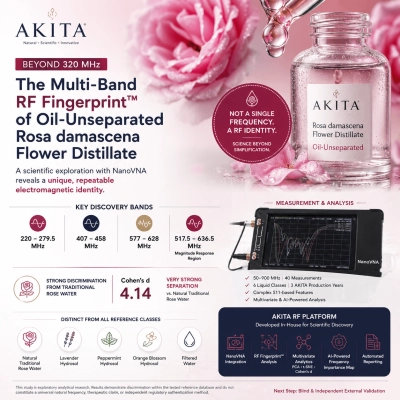
From the 320 MHz Hypothesis to a Multi-Band RF Fingerprint: New Findings from the AKITA Rosa Damascena Flower Oil Study
Broadband S11 analysis reveals that AKITA Rosa Damascena Flower Oil exhibits a reproducible multi-band RF fingerprint spanning 288–322 MHz, providing a broader scientific perspective beyond the traditionally referenced 320 MHz frequency.
Scientific knowledge advances through observation, measurement, and refinement. As new data become available, existing hypotheses are revisited, expanded, and strengthened.
Our latest broadband RF (Radio Frequency) investigation of AKITA Rosa Damascena Flower Oil follows this scientific principle. Rather than focusing on a single frequency, the study explores the product's electromagnetic behavior across a wide frequency spectrum using standardized S11 measurements.
The findings suggest that the electromagnetic identity of AKITA Rosa Damascena Flower Oil is better represented by a multi-band RF fingerprint than by a single natural frequency.
Why Revisit the 320 MHz Hypothesis?
For many years, 320 MHz has frequently been associated with Rosa Damascena essential oil in various publications and discussions.
While this refere...

Innovation in Skincare Starts with Ingredients
In today’s skincare industry, innovation is no longer defined only by packaging or marketing claims. True innovation begins at the ingredient level, how it is produced, preserved, and delivered to the skin.
Akita Rose Water has positioned itself at the center of this shift by redefining how rose water is created and used in modern botanical skincare.
Rose Distillate as a Recognized INCI Ingredient
Rose distillate is increasingly recognized within the skincare industry as a distinct and valuable ingredient. As an INCI-accepted name, rose distillate represents more than traditional rose water, it reflects a refined botanical process designed to preserve the natural integrity of the rose.
This recognition allows rose distillate to be positioned transparently in formulations, supporting clean beauty standards and ingredient clarity for conscious consumers.
The Invention of Non-Deoiled Rose Water
One of Akita’s most significant contributions to botanical skincare innovation is the development of non-deoiled rose water.
Unlike conventional rose waters that are often deoiled during processing, Akita’s method preserves the natural...
The Importance of Eye-Safe Skincare
In recent years, Canadian consumers have become more conscious about the ingredients used in their skincare products, especially for sensitive and eye-area skin. The skin around the eyes is thinner, more delicate, and more prone to irritation than other areas of the face. This makes eye-safe skincare an essential part of any daily routine.
Choosing gentle, botanical-based products can help protect the skin barrier while delivering hydration and comfort.
What Does “Eye-Safe Skincare” Really Mean?
Eye-safe skincare products are formulated to minimize irritation and discomfort. These products are typically:
Alcohol-free or low-irritant
Free from harsh chemicals
Suitable for sensitive skin
Gentle enough for daily use around the eyes
For consumers searching for safe skincare in Canada, botanical ingredients play a key role in meeting these expectations.
Rose Distillate: A Botanical Solution for Sensitive Skin
Rose distillate is a naturally derived botanical ingredient known for its soothing and hydrating properties. It has been used in skincare for generations due to its ability to calm irritated skin and sup...
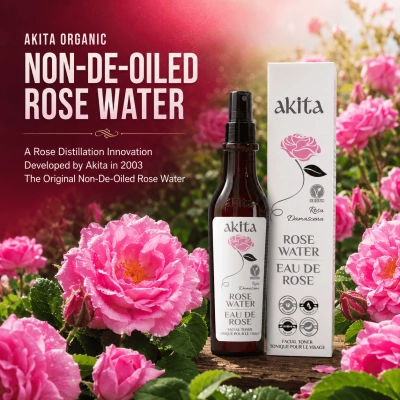
Akita Organic Non De-oiled Rose Water: A Premium Skincare Elixir Born from Nature
Akita Organic Non De-oiled Rose Water is a premium skincare product made from freshly harvested, organic Rosa Damascena, Turkey’s most precious floral treasure, grown in the heart of Isparta. Crafted with a unique, award-winning technique developed by Akita, this rose water offers unmatched purity and quality.
In the fertile lands of the Lakes Region, Rosa Damascena blooms amidst thousands of botanicals known for their therapeutic richness. These roses embody the healing essence of the soil, the sun, the stars, and the rain. Akita uses pristine water sourced from the stunning Lake Eğirdir and the mountains that nurture its rich ecosystem to create this exceptional product.
Akita has developed a specialized method that precisely calculates the optimal amount, temperature, pressure, and distillation duration, ensuring that the beneficial components of the rose are fully retained within the water.
Why Akita Rose Water is Unique:
It contains one of the richest blends of essential microelements.
It delivers a highly concentrated composition of hydrophilic aromatic co...