Is There a Frequency Difference Between Rose Oil and Traditional Rose Water?
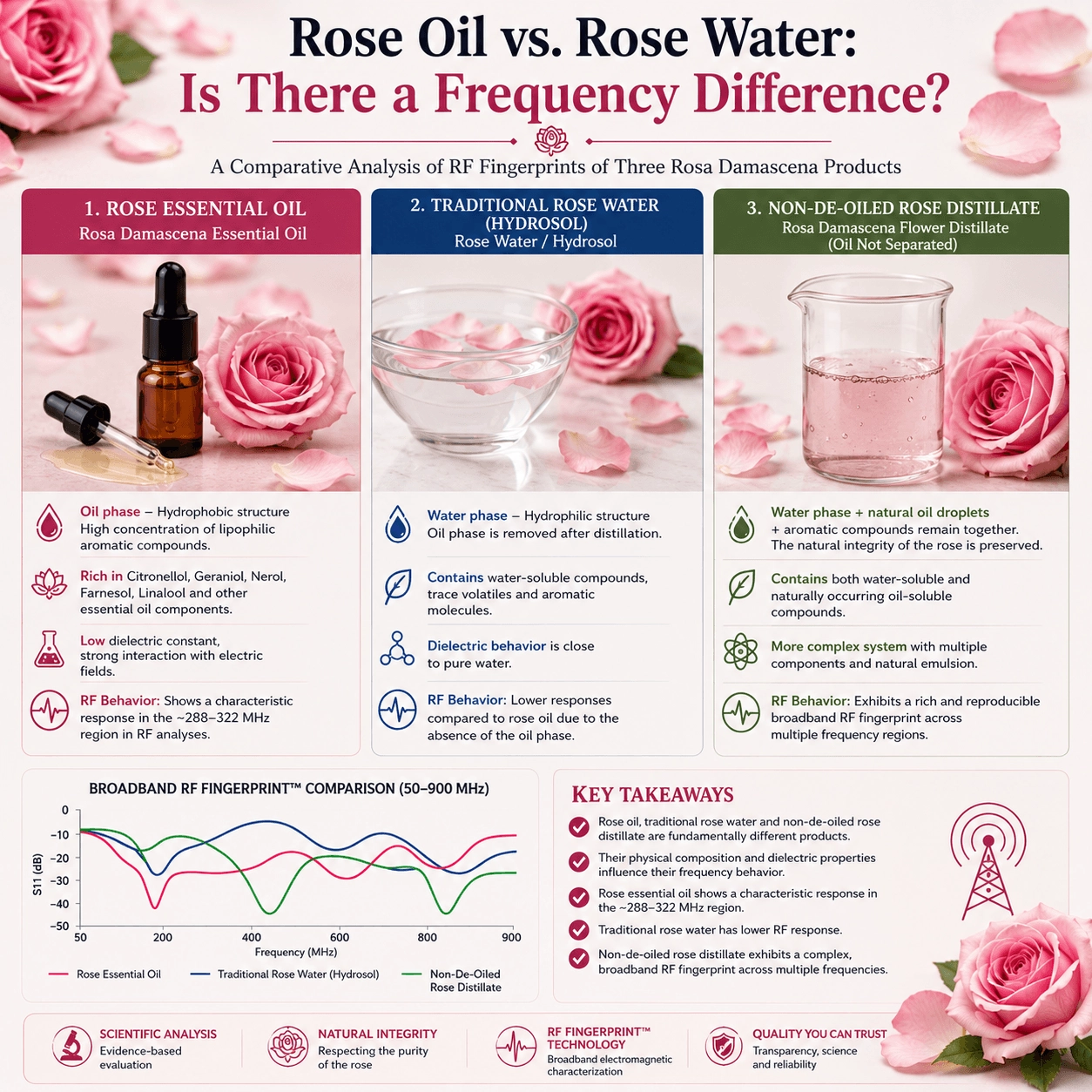
Rose Oil vs. Rose Water: Is There a Frequency Difference?
Why AKITA's Non-De-Oiled Rosa Damascena Flower Distillate May Exhibit a Richer RF Fingerprint Than Rose Essential Oil
Key Takeaway
For decades, the discussion has focused on the reported 320 MHz frequency of Rosa damascena essential oil. Almost nobody asked whether rose water itself has a measurable RF fingerprint. Our research began with that simple question—and the answer surprised even us.
Introduction
If you search online for the phrase "rose oil frequency," you will quickly encounter one familiar number:
320 MHz.
Whether this value is interpreted literally or symbolically, it has long been associated with Rosa damascena essential oil.
However, this raises an interesting question.
If rose essential oil has been discussed for decades from a frequency perspective, what about rose water?
Surprisingly, almost no one has explored this question scientifically.
Even more intriguing is another possibility:
What happens when the natural rose oil is never removed from the distillate?
Until we began our RF Fingerprint™ research, we never imagined that AKITA's Non-De-Oiled Rosa Damascena Flower Distillate might exhibit an even richer broadband RF signature than rose essential oil itself.
The results challenged our own expectations and opened an entirely new research direction.
Why This Question Matters
Traditional rose water and rose essential oil are often discussed together because they originate from the same flower.
But from a scientific standpoint, they are completely different physical systems.
If their structures differ...
their electromagnetic behavior may also differ.
That simple idea became the starting point of our investigation.
One Rose, Three Different Products
Steam distillation of Rosa damascena can produce three distinct products.
Although they originate from the same flower, their compositions are remarkably different.
1. Rose Essential Oil
Rose essential oil is the concentrated oil phase naturally formed during steam distillation.
Characteristics
✔ Rich in volatile aromatic compounds
✔ Hydrophobic
✔ Highly concentrated
✔ Low dielectric constant
Approximately 3–4 tons of fresh rose petals are required to produce only 1 kilogram of essential oil.
For many years, the reported 320 MHz frequency has been associated with this product.
2. Traditional Rose Water (Hydrosol)
Traditional rose water is the aqueous phase remaining after the essential oil has been separated.
Characteristics
✔ Primarily water
✔ Water-soluble botanical compounds
✔ Trace aromatic molecules
✔ Minimal remaining essential oil
Its physical structure differs substantially from essential oil because the oil phase has already been removed.
3. AKITA Rosa Damascena Flower Distillate
AKITA follows a different production philosophy.
Instead of separating the naturally formed rose oil after distillation, it remains within the distillate.
The result is an internationally recognized cosmetic ingredient:
Rosa Damascena Flower Distillate
Characteristics
✔ Water-soluble botanical compounds
✔ Naturally dispersed oil microdroplets
✔ Aromatic volatile compounds
✔ Preserved natural composition
Rather than behaving as a conventional hydrosol, it forms a much more complex natural system.
At a Glance
Rose Essential Oil
- Oil phase
- Hydrophobic
- High concentration of volatile compounds
Traditional Rose Water
- Water phase
- Oil removed
- Mostly water-soluble compounds
AKITA Flower Distillate
- Water phase + natural oil microdroplets
- Oil not separated
- More complex physical composition
Why Frequency May Differ
Electromagnetic behavior is determined by much more than chemical composition.
Several physical properties influence how a liquid responds to RF signals.
These include:
- dielectric constant
- polarity
- ionic composition
- molecular interactions
- phase distribution
- natural emulsification
- dielectric losses
- microstructure
This means two products obtained from the same flower can produce completely different RF responses.
Why Rose Essential Oil Shows a Characteristic RF Response
Essential oil contains concentrated lipophilic molecules.
It has:
- no water phase
- low dielectric constant
- different polarization behavior
- distinct interaction with electromagnetic fields
During AKITA's RF studies, rose essential oil consistently demonstrated a characteristic response within approximately the 288–322 MHz region.
Rather than representing one isolated frequency, this appears to be part of a broader RF signature.
The Question Nobody Was Asking
For years, discussions focused on the frequency of rose oil.
Almost nobody asked:
Does traditional rose water have its own measurable RF fingerprint?
And even fewer considered another possibility:
What if preserving the natural oil inside the distillate changes the electromagnetic behavior completely?
This became the central question behind the AKITA RF Fingerprint™ project.
What We Discovered
When we began measuring AKITA Rosa Damascena Flower Distillate, we expected its RF response to resemble traditional hydrosol.
Instead...
the measurements suggested something entirely different.
The non-de-oiled distillate behaved as a considerably more complex electromagnetic system.
Instead of exhibiting only a localized response,
it generated a rich, broadband RF fingerprint across multiple frequency regions.
Perhaps the biggest surprise was this:
Even we did not anticipate that the non-de-oiled distillate might exhibit a broader RF signature than rose essential oil itself.
Research Insight
Our objective was not to prove that one product is "better."
The objective was to determine whether preserving the flower's natural integrity changes its measurable electromagnetic characteristics.
The experimental observations suggest that it does.
AKITA RF Fingerprint™
To investigate this hypothesis, AKITA conducted broadband RF measurements under standardized laboratory conditions.
The study included:
Measurement Range
50–900 MHz
Multiple Production Years
Independent production batches were analyzed.
Repeated Measurements
Multiple measurements were performed under identical experimental conditions.
Advanced Data Analysis
The results were evaluated using:
- PCA
- t-SNE
- multivariate statistical analysis
- RF fingerprint comparison
Instead of identifying one defining frequency, the measurements consistently revealed a reproducible broadband electromagnetic signature.
Why This Could Matter
Natural products have traditionally been characterized through chemistry.
Methods such as:
- GC-MS
- HPLC
- FTIR
identify molecular composition.
Broadband RF characterization introduces another dimension.
Instead of asking:
"Which molecules are present?"
it also asks:
"How does the entire natural system interact with electromagnetic energy?"
This represents a different way of studying botanical products.
Looking Beyond 320 MHz
For decades, discussions revolved around a single number:
320 MHz.
Our findings suggest that this may only represent part of a much larger picture.
Natural botanical products may not be best described by a single frequency.
Instead, they may possess complex, reproducible electromagnetic fingerprints extending across multiple frequency regions.
If confirmed by future research, this perspective could contribute to a new generation of analytical methods for characterizing botanical distillates.
Conclusion
Frequently Asked Questions (FAQ)
1. Is rose oil the same as traditional rose water?
No. Although both originate from Rosa damascena, they are different products.
Rose essential oil is the concentrated oil phase obtained during steam distillation, while traditional rose water (hydrosol) is the water phase remaining after the oil has been separated.
2. Is the well-known 320 MHz frequency associated with rose water?
Historically, the 320 MHz claim has been associated with Rosa damascena essential oil, not with traditional rose water.
There has been very little scientific discussion regarding the RF characteristics of conventional rose water.
3. Why did AKITA investigate the frequency of rose distillate?
Because almost everyone has discussed the reported frequency of rose oil, but very few researchers have asked whether rose water or non-de-oiled rose distillate has its own RF fingerprint.
This question became the starting point of AKITA's RF Fingerprint™ research.
4. What makes AKITA Rosa Damascena Flower Distillate different from traditional rose water?
Unlike conventional hydrosol, AKITA's production process does not separate the naturally formed rose oil after distillation.
As a result, the distillate preserves both:
- water-soluble botanical compounds
- naturally dispersed oil microdroplets
- aromatic volatile components
creating a more complex physical system.
5. Does AKITA Rosa Damascena Flower Distillate have a higher frequency than rose oil?
Our broadband RF measurements suggest that AKITA Rosa Damascena Flower Distillate may exhibit a broader and richer RF fingerprint than rose essential oil.
Rather than identifying one higher frequency, the results indicate a more complex electromagnetic signature across multiple frequency regions.
6. Does RF Fingerprint™ measure a single frequency?
No.
RF Fingerprint™ analyzes a product over a broad frequency range rather than focusing on a single frequency.
This approach allows the overall electromagnetic behavior of a natural product to be evaluated.
7. Why can products from the same flower behave differently in RF analysis?
Electromagnetic behavior depends on many physical properties, including:
- dielectric constant
- polarity
- molecular interactions
- phase distribution
- natural emulsion structure
- ionic composition
Since rose oil, traditional rose water, and non-de-oiled rose distillate have different physical structures, their RF responses may also differ.
8. Does a richer RF fingerprint mean a better product?
Not necessarily.
RF Fingerprint™ is an analytical characterization method that evaluates the electromagnetic behavior of a product.
A broader RF fingerprint indicates a more complex physical response, but it should not be interpreted on its own as evidence of superior cosmetic performance or therapeutic effectiveness.
9. What was the most surprising finding of the study?
The biggest surprise was that AKITA Rosa Damascena Flower Distillate appeared to produce a richer broadband RF fingerprint than rose essential oil itself.
Before conducting the measurements, even our research team did not expect this outcome.
10. What is the future of RF Fingerprint™ technology?
Broadband RF Fingerprint™ has the potential to complement traditional analytical techniques such as GC-MS by providing additional information about the physical and electromagnetic characteristics of natural botanical products.
Future research may help establish RF fingerprinting as another valuable tool for the characterization of complex natural ingredients.
Understanding the natural components of Rosa damascena is essential to understanding what real rose water truly is. Many people believe that the most...
For centuries, people have cherished the fragrance of roses not only for their beauty but also for the sense of calm and well-being they inspire. Acro...
If you've searched for Rosa Damascena essential oil online, you've probably come across claims such as: "Rose oil has the highest vibration of any ...
Pure Rosa Damascena rose essential oil is one of the most precious botanical oils in the world. It takes thousands of fresh rose petals to produce eve...
Free AI Skin Analysis & Cosmetic Ingredient Safety Checker with the Akita Skincare App Smarter Skincare Starts with Better Information Choosing the ...
Is Rose Oil Really 320 MHz? What New Scientific Research Reveals Beyond the 320 MHz Claim: A New Perspective on the RF Fingerprint of Rosa damascena ...
From the 320 MHz Hypothesis to a Multi-Band RF Fingerprint: New Findings from the AKITA Rosa Damascena Flower Oil Study Broadband S11 analysis reveal...
What Is RF Fingerprint? Understanding the Scientific Identity of Natural Products Through Multi-Frequency Analysis Could Natural Produ...
Rose Oil vs. Rose Water: Is There a Frequency Difference? Why AKITA's Non-De-Oiled Rosa Damascena Flower Distillate May Exhibit a Richer RF Fingerpri...
When choosing a roll-on deodorant, most people focus on its fragrance, how long it lasts, or the design of the packaging. However, one of the most imp...
Before sunrise, while the Isparta countryside is still cool and quiet, rose growers begin gathering delicate pink blossoms by hand. The flowers they ...
When choosing a roll-on deodorant, most people look at its scent, freshness, or packaging. However, one of the most useful clues about the product is ...
One Bottle for Skin, Hair, and Summer Care: Akita Non-De-Oiled Lavender Water Multi-purpose lavender care for skin that feels itchy, warm, or in need...
Scientific data on the shelf life of de-oiled rose water produced during rose oil production—and the difference of Akita Unde-oiled Rose Distillate R...
For Those Looking for 100% Natural Rose Water For those who recognize the scent of nature, value pure ingredients, and seek a genuine skincare experi...
Why Add Akita Natural Rose Mouthwash to Your Nighttime Oral-Care Routine? A refreshing final step inspired by the delicate aroma of Isparta roses Mo...
The Benefits of Rose Water for Skin and Emotional Well-Being: More Than Its Scent Rose water is not only for those who love the scent of roses. It is...
The Rose-Powered Ritual for Younger-Looking Skin: Akita Rose Water & Anti-Aging A multi-action skincare formula combining non-de-oiled Isparta rose d...
Comment