Etiket: #rose
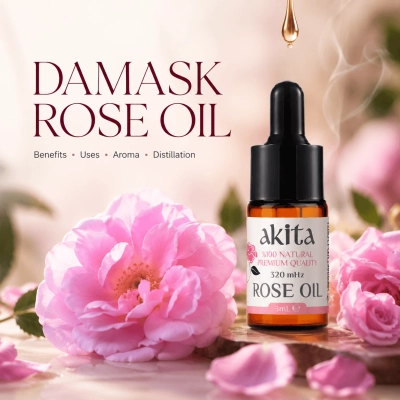
Few botanical ingredients have inspired perfume, skin care and traditional wellness practices as deeply as Damask rose oil. Also known as rose otto or Rosa damascena essential oil, this intensely aromatic oil is produced from freshly harvested Damask rose petals.
Its value comes from more than its celebrated fragrance. Damask roses have a short flowering season, the blossoms must be collected and processed carefully, and only a very small amount of essential oil is obtained from a large quantity of flowers.
But what exactly is Damask rose oil? Is rose otto the same as rose essential oil? What does it smell like, and what does scientific research actually say about its benefits?
This guide explains the complete journey—from the rose fields to the finished oil.
What Is Damask Rose Oil?
Damask rose oil is the concentrated volatile oil obtained primarily from the flowers of Rosa damascena Mill. The oil is generally produced through water or steam distillation and is widely used in fine fragrance, cosmetics, aromatherapy and natural health products.
Several names may appear on product labels:
Damask rose oil
Rose essential oil
Rosa damascena flower oil
Rose otto
At...
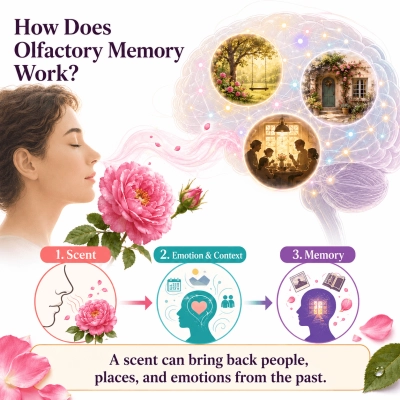
From a mother’s scent to the fragrance of roses: the invisible memory cues in our lives
A familiar soap may bring back a childhood home. A perfume may remind us of someone we have not seen for years. The scent of a rose may suddenly return us to an old garden. These experiences can revive not only an image but also the comfort, longing, or sadness associated with that time.
This shows that smell does more than help us recognize pleasant and unpleasant odours. We remember our experiences through sights and sounds, but also—often without realizing it—through scent.
What is olfactory memory?
Olfactory memory refers to the association between a smell and a person, place, event, or emotion from the past. When the same or a similar scent is encountered again, that association may be reactivated.
For someone who spent childhood summers in a rose garden, the fragrance of roses may represent more than a flower. The garden, the voices of family members, the warmth of summer, and the sense of security felt there may all have become parts of the same experience. Years later, the scent may bring some of those elements back.
“Olfactory memory” does not mean that the brain contains a separa...
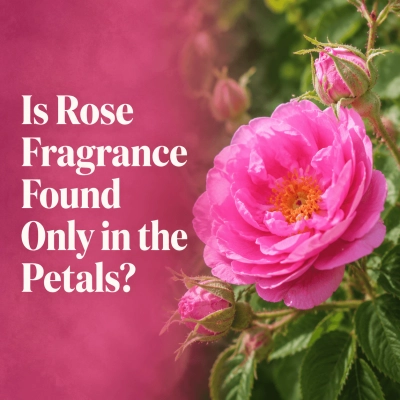
Is a Rose’s Fragrance Found Only in Its Petals? Discover the Hidden Beauty of the Whole Isparta Rose
A Rosa damascena flower is more than a collection of pink petals. Its fragrance, texture and botanical character come from a complete floral structure—petals, pollen-bearing stamens, sepals and other delicate parts working together.
When you hold an Isparta rose in your hand, the first thing you notice is its many layers of soft pink petals. It is therefore easy to associate the rose’s fragrance—and dried rose products—with the petals alone.
But Rosa damascena is not made of petals alone.
At the centre of the flower are its stamens, pistils and pollen. Beneath the petals are the sepals and receptacle that support the flower. Together, these structures form the complete botanical identity of the rose.
There is a simple and surprisingly revealing way to experience this:
Take a whole dried Isparta rose, grind it just before use and smell it immediately.
The aroma that emerges may feel deeper, warmer and more botanical than the familiar impression of sweet rose petals alone. It is not simply “a stronger rose scent.” It is a more layered encounter with the whole flower.
A Differe...
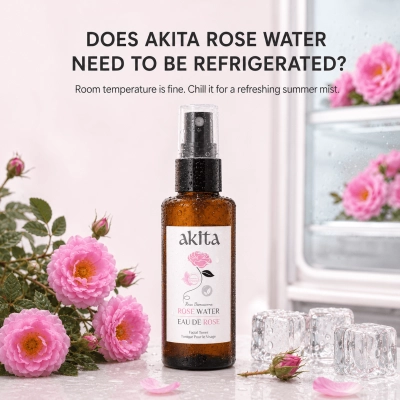
The simple answer for Canadian homes: no refrigeration is required, but chilling it can make summer skincare feel beautifully refreshing
is famous for its cold winters, but anyone who has experienced a humid Ontario summer, a heat wave in British Columbia or a sunny afternoon in Québec knows that Canadian weather is anything but predictable.
That leads to one of the most frequently asked questions about rose water:
Does rose water need to be refrigerated after opening?
For Akita Non-De-oiled Rose Water, the answer is simple:
No. Akita Non-De-oiled Rose Water does not need to be refrigerated. It can be stored at room temperature when kept away from direct sunlight and excessive heat.
You may, however, place it in the refrigerator during the summer if you enjoy the fresh sensation of a cool facial mist. Refrigeration is a matter of personal comfort, not a storage requirement.
The quick answer
Akita Non-De-oiled Rose Water can be stored:
At normal room temperature
In a cool, dry place
Away from direct sunlight
Away from radiators, fireplaces and other heat sources
Outside the refrigerator throughout the year
In the refrigerator when a cool summer...
The Hidden Difference Between Flower Water, Flower Distillate and INCI Naming
Two bottles can both say “rose water.” They may look similar, smell floral and be sold for the same skincare routine. But were they actually made the same way?
One product may be obtained directly through the distillation of rose petals. Another may be water blended with essential oil, fragrance or other aromatic ingredients. Even two genuine rose distillates may differ depending on whether the naturally occurring essential-oil fraction was separated during production.
That is why the words on the front of a bottle tell only part of the story.
To understand the identity of rose water, we need to look beyond its consumer-friendly name. We need to ask how it was produced, what was added or removed, what appears in its ingredient list and what the available documentation actually confirms.
Because rose water may be the name of the product—but distillate tells its production story.
The short answer: “Flower water” can be a broad consumer or commercial description. “Flower distillate” generally describes a water-based product obtained through the distillation of flowers. A genuine Rosa damascena disti...
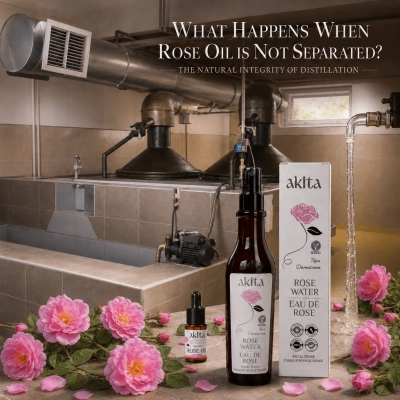
Discover how retaining the naturally occurring rose oil phase can influence the composition, appearance, aroma and character of rose distillate
When freshly harvested Isparta roses enter a distillation vessel, they produce much more than pleasantly scented water.
As heat and steam move through the rose petals, different aromatic compounds are carried away from the flowers. Once the aromatic steam is cooled, it condenses back into a liquid containing two distinct but related fractions:
An aromatic, water-based rose distillate
A small amount of water-insoluble rose essential oil
In conventional rose oil production, the visible essential oil phase is separated and collected. The remaining aromatic water is generally known as rose water or rose hydrosol.
But what happens when the naturally occurring rose oil is not separated?
The simple answer is that the oil phase produced during distillation remains within the collected distillate. This does not mean that all of the essential oil dissolves in the water. Some of it may remain dispersed as extremely small droplets, while certain water-compatible aromatic compounds stay dissolved in the water phase.
This distinction lies...
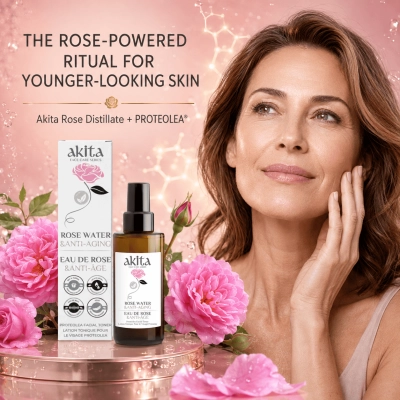
The Rose-Powered Ritual for Younger-Looking Skin: Akita Rose Water & Anti-Aging
A multi-action skincare formula combining non-de-oiled Isparta rose distillate with plant-based PROTEOLEA® to care for the appearance of fine lines, dryness, dullness and uneven texture
Does your skin look dry, tired or dull by the end of the day?
Are fine lines becoming more noticeable around your eyes, face or neck?
Perhaps you want more than a basic toner—something that combines the treasured tradition of Rosa damascena with a modern, science-informed approach to visible skin aging.
Akita Rose Water & Anti-Aging brings together two complementary skincare components:
Akita Non-De-oiled Rose Distillate, produced from Rosa damascena flowers grown in Isparta, Türkiye
PROTEOLEA®, a plant-based cosmetic active developed for multi-action anti-aging care
The result is a lightweight facial toner and mist designed to help skin look more hydrated, smooth, refreshed and youthful.
🌹 What makes this formula different?
Instead of using ordinary water as its primary skincare base, the formula is built around Akita Non-De-oiled Rose Distillate and enhanced with PROTEOLEA®.
More Than an...
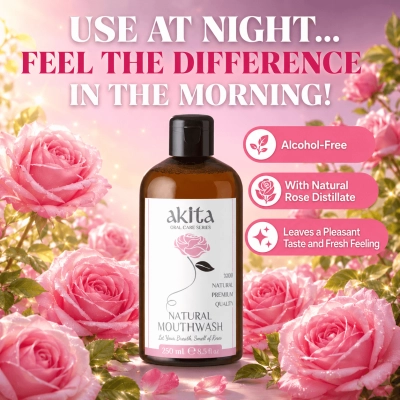
Why Add Akita Natural Rose Mouthwash to Your Nighttime Oral-Care Routine?
A refreshing final step inspired by the delicate aroma of Isparta roses
Morning breath is a common experience. Even after brushing before bed, many people wake up with an unpleasant taste or a less-than-fresh feeling in their mouth.
Why does this happen, and how can a thoughtfully chosen mouthwash complement a nighttime oral-care routine?
Why Does the Mouth Feel Different in the Morning?
Saliva plays an important role in keeping the mouth moist and naturally clearing food particles and microorganisms. During sleep, saliva flow decreases. This creates conditions in which tongue coating and odour-producing compounds can become more noticeable by morning.
Many cases of oral malodour are associated with volatile sulfur compounds. These compounds may be produced when oral microorganisms break down food debris, proteins and other materials in the mouth. Dental plaque, tongue coating, dry mouth and certain oral-health conditions may also contribute to unpleasant breath. (American Dental Association, 2026)
This is why nighttime oral care should focus on removing accumulated plaque and food debris before the ho...
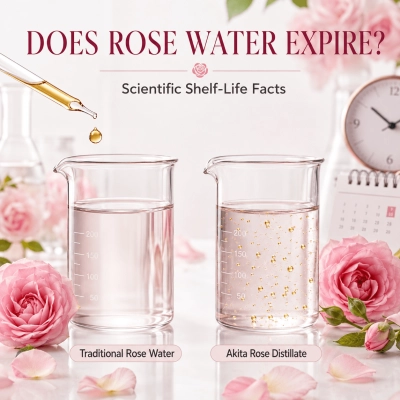
Scientific data on the shelf life of de-oiled rose water produced during rose oil production—and the difference of Akita Unde-oiled Rose Distillate
Rose water is often considered a natural product that can remain stable for many years. However, scientific research shows that not all rose waters have the same composition, production method, or storage stability.
To understand the shelf life of a rose water product, we should first ask an important question:
Is it the aromatic water remaining after rose oil has been separated, or was the rose distillate produced as the primary product without removing its naturally occurring rose oil?
This distinction matters because the production method may influence the product’s chemical composition and behavior during storage.
How Is Rose Water Produced During Rose Oil Production?
When Rosa damascena flowers are distilled with water and steam, volatile compounds from the flowers travel with the steam. After cooling, the vapor condenses back into a liquid.
The resulting distillate may contain two phases:
An aqueous phase
A volatile rose oil phase
In traditional rose oil production, the primary objective is to obtain rose oil....
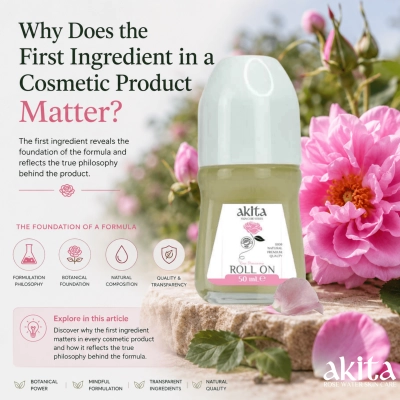
When choosing a roll-on deodorant, most people look at its scent, freshness, or packaging. However, one of the most useful clues about the product is found on the back label: the ingredient list, also known as the INCI list.
Cosmetic ingredients are generally listed from the highest to the lowest concentration. This means that the first ingredient usually makes up the largest portion of the formula and forms its main foundation.
So, why does that matter?
Most Roll-On Deodorants Begin with Water
The ingredient list of many roll-on deodorants begins with Aqua (Water).
Water helps dissolve and distribute the other ingredients evenly. It also gives the product the right consistency and allows it to spread easily across the skin. Using water in a cosmetic formula is completely normal.
However, some thoughtfully designed formulations use a botanical distillate in place of ordinary water.
What Is a Botanical Distillate?
A botanical distillate is a liquid obtained by distilling plants such as rose, lavender, chamomile, or orange blossom.
During distillation, steam carries some of the plant’s naturally occurring aromatic compounds into the resulting liquid. For this reason, a botan...