Etiket: #Distillat de rose
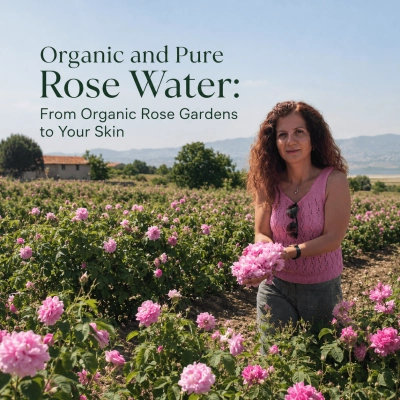
Organic and Pure Rose Water: From Akita’s Organic Rose Gardens to Your Skin
What makes rose water truly organic and pure?
“Organic rose water” and “pure rose water” are often used as if they mean the same thing. In fact, they describe two different qualities.
Organic refers mainly to how the roses are grown and how the agricultural process is managed.
Pure refers to what is inside the finished bottle.
A rose water may be produced from organically grown roses but still contain added fragrance, preservatives or other ingredients. Conversely, a product may contain only rose distillate without holding an organic certification.
This is why Canadian consumers should look beyond the words printed on the front of the bottle. The rose species, growing conditions, production method, ingredient list and supporting documents all matter.
Akita Non-De-Oiled Rose Water brings these elements together: Rosa damascena flowers grown in Akita’s organic rose gardens are distilled without separating the naturally occurring rose oil from the water. The finished product contains a single cosmetic ingredient:
INCI: Rosa Damascena Flower Distillate
What does “organic rose water” mean?
Or...
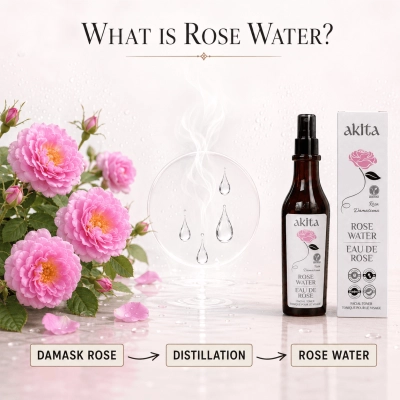
A complete guide to real rose water, rose hydrosol and Rosa damascena flower distillate
Rose water is often described simply as water that smells like roses. That description, however, leaves out what makes traditionally distilled rose water so distinctive.
Authentic rose water is an aromatic distillate produced from rose flowers—most commonly the Damask rose, Rosa damascena. During distillation, heat releases volatile and water-soluble compounds from the petals. These compounds travel with the steam, which is then cooled and collected as a clear, fragrant liquid.
The result is more than rose-scented water. It is a plant distillate whose aroma, composition and quality depend on the rose variety, growing region, harvest conditions, distillation method and whether the rose oil is separated afterward.
This distinction matters because products sold as “rose water” in Canada can be very different from one another.
What exactly is rose water?
In its traditional sense, rose water is the water-based aromatic portion collected during the distillation of fresh rose flowers.
A scientific description would be:
Rose water is a liquid distillate containing wa...
The Hidden Difference Between Flower Water, Flower Distillate and INCI Naming
Two bottles can both say “rose water.” They may look similar, smell floral and be sold for the same skincare routine. But were they actually made the same way?
One product may be obtained directly through the distillation of rose petals. Another may be water blended with essential oil, fragrance or other aromatic ingredients. Even two genuine rose distillates may differ depending on whether the naturally occurring essential-oil fraction was separated during production.
That is why the words on the front of a bottle tell only part of the story.
To understand the identity of rose water, we need to look beyond its consumer-friendly name. We need to ask how it was produced, what was added or removed, what appears in its ingredient list and what the available documentation actually confirms.
Because rose water may be the name of the product—but distillate tells its production story.
The short answer: “Flower water” can be a broad consumer or commercial description. “Flower distillate” generally describes a water-based product obtained through the distillation of flowers. A genuine Rosa damascena disti...
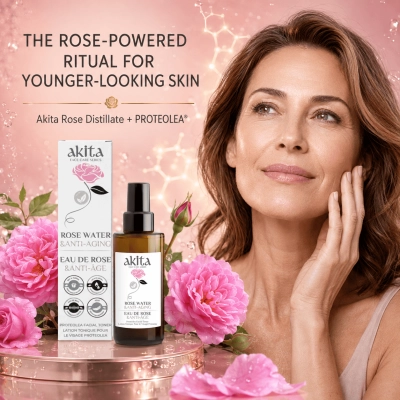
The Rose-Powered Ritual for Younger-Looking Skin: Akita Rose Water & Anti-Aging
A multi-action skincare formula combining non-de-oiled Isparta rose distillate with plant-based PROTEOLEA® to care for the appearance of fine lines, dryness, dullness and uneven texture
Does your skin look dry, tired or dull by the end of the day?
Are fine lines becoming more noticeable around your eyes, face or neck?
Perhaps you want more than a basic toner—something that combines the treasured tradition of Rosa damascena with a modern, science-informed approach to visible skin aging.
Akita Rose Water & Anti-Aging brings together two complementary skincare components:
Akita Non-De-oiled Rose Distillate, produced from Rosa damascena flowers grown in Isparta, Türkiye
PROTEOLEA®, a plant-based cosmetic active developed for multi-action anti-aging care
The result is a lightweight facial toner and mist designed to help skin look more hydrated, smooth, refreshed and youthful.
🌹 What makes this formula different?
Instead of using ordinary water as its primary skincare base, the formula is built around Akita Non-De-oiled Rose Distillate and enhanced with PROTEOLEA®.
More Than an...
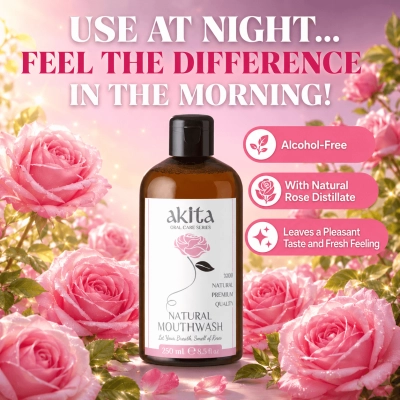
Why Add Akita Natural Rose Mouthwash to Your Nighttime Oral-Care Routine?
A refreshing final step inspired by the delicate aroma of Isparta roses
Morning breath is a common experience. Even after brushing before bed, many people wake up with an unpleasant taste or a less-than-fresh feeling in their mouth.
Why does this happen, and how can a thoughtfully chosen mouthwash complement a nighttime oral-care routine?
Why Does the Mouth Feel Different in the Morning?
Saliva plays an important role in keeping the mouth moist and naturally clearing food particles and microorganisms. During sleep, saliva flow decreases. This creates conditions in which tongue coating and odour-producing compounds can become more noticeable by morning.
Many cases of oral malodour are associated with volatile sulfur compounds. These compounds may be produced when oral microorganisms break down food debris, proteins and other materials in the mouth. Dental plaque, tongue coating, dry mouth and certain oral-health conditions may also contribute to unpleasant breath. (American Dental Association, 2026)
This is why nighttime oral care should focus on removing accumulated plaque and food debris before the ho...