Etiket: #Rose Distillate
Rethink Your Expectations of Rose Water
Not all rose waters begin with the same intention. Discover what separates conventional rose hydrosols from Akita’s Non-De-Oiled Rosa damascena Distillate, and why production methods, ingredient transparency, and scientific testing matter.
What should you expect from a bottle of rose water?
A beautiful floral fragrance? A refreshing facial mist? A natural product made from rose petals?
Perhaps all three.
But here is a question most of us rarely ask:
What happened to the rose before its distillate reached the bottle?
Two products may both carry the words rose water. They may look equally clear, contain naturally occurring aromatic compounds, and come from the same botanical species.
Yet their production histories can be different.
One may be an aromatic water collected after rose essential oil has been separated. Another may be produced specifically to retain the naturally occurring oil fraction alongside the water-based distillate.
Both can be genuine rose-derived cosmetic ingredients.
The important question is not simply which bottle sounds more natural.
It is what the manufacturer intended to produce, how the botanical material...
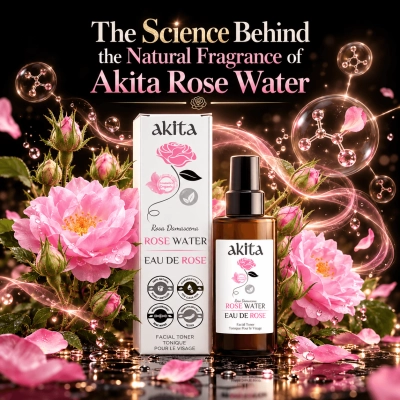
The Science Behind the Natural Fragrance of Akita Rose Water
Why does a natural Rosa damascena distillate smell different from a rose perfume? Discover the aromatic molecules, GC-MS findings, and science behind Akita's distinctive botanical fragrance.
A laboratory instrument cannot smell a rose.
But it can help us understand what makes a rose smell the way it does.
When we experience the fragrance of Rosa damascena, we are not detecting a single substance. Our sense of smell responds to a mixture of volatile molecules, each with its own chemical characteristics and potential contribution to the overall aroma.
Some create familiar floral impressions. Others may introduce fresh, green, or subtly sharp nuances.
This is especially interesting when we examine rose water.
Many people imagine that authentic rose water should smell exactly like a freshly opened rose or a sweet floral perfume.
Yet the chemistry of a botanical distillate tells a more complex story.
At Akita, we have explored this question through laboratory analysis of our Non-De-Oiled Rose Water.
What exactly creates its natural fragrance, and what can science tell us about the scent we experience?
🌹 THE E...
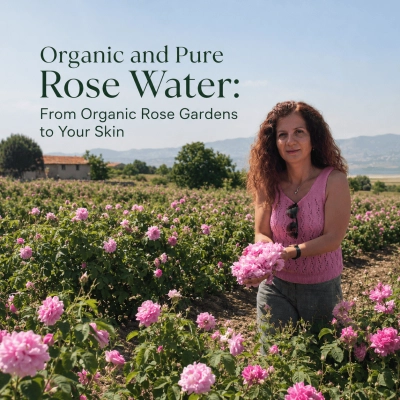
Organic and Pure Rose Water: From Akita’s Organic Rose Gardens to Your Skin
What makes rose water truly organic and pure?
“Organic rose water” and “pure rose water” are often used as if they mean the same thing. In fact, they describe two different qualities.
Organic refers mainly to how the roses are grown and how the agricultural process is managed.
Pure refers to what is inside the finished bottle.
A rose water may be produced from organically grown roses but still contain added fragrance, preservatives or other ingredients. Conversely, a product may contain only rose distillate without holding an organic certification.
This is why Canadian consumers should look beyond the words printed on the front of the bottle. The rose species, growing conditions, production method, ingredient list and supporting documents all matter.
Akita Non-De-Oiled Rose Water brings these elements together: Rosa damascena flowers grown in Akita’s organic rose gardens are distilled without separating the naturally occurring rose oil from the water. The finished product contains a single cosmetic ingredient:
INCI: Rosa Damascena Flower Distillate
What does “organic rose water” mean?
Or...
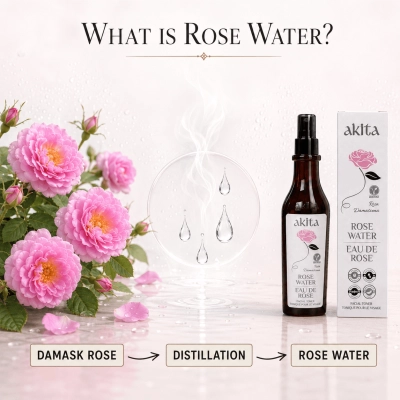
A complete guide to real rose water, rose hydrosol and Rosa damascena flower distillate
Rose water is often described simply as water that smells like roses. That description, however, leaves out what makes traditionally distilled rose water so distinctive.
Authentic rose water is an aromatic distillate produced from rose flowers—most commonly the Damask rose, Rosa damascena. During distillation, heat releases volatile and water-soluble compounds from the petals. These compounds travel with the steam, which is then cooled and collected as a clear, fragrant liquid.
The result is more than rose-scented water. It is a plant distillate whose aroma, composition and quality depend on the rose variety, growing region, harvest conditions, distillation method and whether the rose oil is separated afterward.
This distinction matters because products sold as “rose water” in Canada can be very different from one another.
What exactly is rose water?
In its traditional sense, rose water is the water-based aromatic portion collected during the distillation of fresh rose flowers.
A scientific description would be:
Rose water is a liquid distillate containing wa...
Durée de conservation de l’eau de rose Akita Non-De-Oiled : combien de temps se conserve-t-elle?
L’étiquette indique une durée de conservation de deux ans, mais les essais de stabilité, le pH naturellement acide et l’analyse d’un échantillon vieux d’environ dix ans révèlent une histoire fascinante.
Lorsqu’un produit de soin est présenté comme naturel et sans agent de conservation ajouté, une question se pose presque immédiatement : combien de temps peut-il réellement se conserver?
Cette question est particulièrement pertinente au Canada, où un produit peut être exposé à des conditions très différentes au cours de son transport et de son utilisation : froid hivernal, chaleur dans les véhicules de livraison, variations rapides de température ou humidité dans la salle de bain.
L’Akita Non-De-Oiled Rose Water, aussi appelée distillat de rose Akita ou eau de rose non déshuilée, affiche une durée de conservation de deux ans avant ouverture. Cette durée s’applique lorsque le flacon demeure fermé, que l’emballage est intact et que le produit est conservé conformément aux indications figurant sur son étiquette.
Il est important de préciser que ce produit est conditionné dans un flacon...
The Hidden Difference Between Flower Water, Flower Distillate and INCI Naming
Two bottles can both say “rose water.” They may look similar, smell floral and be sold for the same skincare routine. But were they actually made the same way?
One product may be obtained directly through the distillation of rose petals. Another may be water blended with essential oil, fragrance or other aromatic ingredients. Even two genuine rose distillates may differ depending on whether the naturally occurring essential-oil fraction was separated during production.
That is why the words on the front of a bottle tell only part of the story.
To understand the identity of rose water, we need to look beyond its consumer-friendly name. We need to ask how it was produced, what was added or removed, what appears in its ingredient list and what the available documentation actually confirms.
Because rose water may be the name of the product—but distillate tells its production story.
The short answer: “Flower water” can be a broad consumer or commercial description. “Flower distillate” generally describes a water-based product obtained through the distillation of flowers. A genuine Rosa damascena disti...
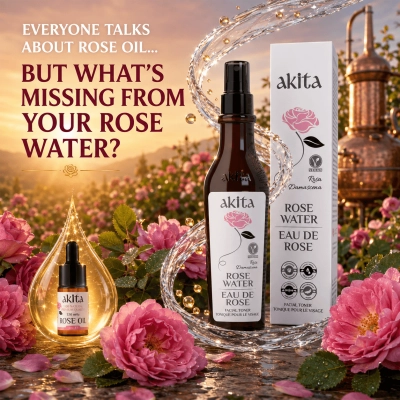
For Years, We Focused on Rose Oil, But What Did We Lose in the Rose Water?
Akita takes a different approach to rose distillation: instead of adding rose oil back later, it preserves the aromatic oil naturally present in the Rosa damascena distillate.
When Rosa damascena flowers enter a distillation vessel, attention usually turns to one highly valued result:
Rose essential oil.
Its rarity, intensive production process, and value in fine fragrance and skincare have made it the most celebrated part of rose distillation.
Yet rose oil is not the only valuable result.
Alongside a small quantity of essential oil, distillation produces a much larger volume of aromatic rose distillate. This water phase carries naturally occurring aromatic constituents transferred from the flowers during distillation.
That raises an important question:
When rose oil is separated from the distillate, what remains—and what may be removed from the rose water’s original aromatic composition?
Akita’s Non-De-Oiled Rose Water was developed around this question.
Rose Distillation Produces More Than Essential Oil
Steam distillation does not simply extract one substance from a flower.
As heat and...
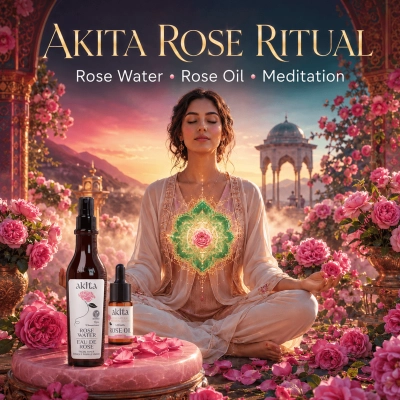
The Akita Rose Experience: Self-Observation Through Rose Water and Rose Oil Before Your Ritual
At Akita, we invite you to a ritual experience that brings together the ancient traditions of the rose with modern mindfulness practices.
This is not a medical claim. The purpose is to observe and document your personal experience through the combination of scent, breath, attention, and intention.
Some users report feeling calmer, more open, more balanced, and more at ease after rose-based rituals. These experiences vary from person to person and are entirely subjective.
Why Is the Rose Associated with Meditation and Emotional Awareness?
The olfactory system is directly connected to the brain’s limbic system, which plays a key role in emotion, memory, and internal state processing.
Because of this, rose scent may:
Trigger emotional memories
Support transition into meditation
Increase breath awareness
Encourage mental calmness
Support a sense of physical relaxation
Scientific studies suggest that aromatherapy with Rosa damascena (Damask rose) may be associated with stress perception and sleep quality improvements in some individuals. However, these eff...
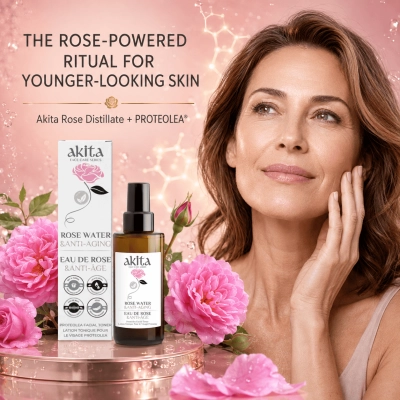
The Rose-Powered Ritual for Younger-Looking Skin: Akita Rose Water & Anti-Aging
A multi-action skincare formula combining non-de-oiled Isparta rose distillate with plant-based PROTEOLEA® to care for the appearance of fine lines, dryness, dullness and uneven texture
Does your skin look dry, tired or dull by the end of the day?
Are fine lines becoming more noticeable around your eyes, face or neck?
Perhaps you want more than a basic toner—something that combines the treasured tradition of Rosa damascena with a modern, science-informed approach to visible skin aging.
Akita Rose Water & Anti-Aging brings together two complementary skincare components:
Akita Non-De-oiled Rose Distillate, produced from Rosa damascena flowers grown in Isparta, Türkiye
PROTEOLEA®, a plant-based cosmetic active developed for multi-action anti-aging care
The result is a lightweight facial toner and mist designed to help skin look more hydrated, smooth, refreshed and youthful.
🌹 What makes this formula different?
Instead of using ordinary water as its primary skincare base, the formula is built around Akita Non-De-oiled Rose Distillate and enhanced with PROTEOLEA®.
More Than an...
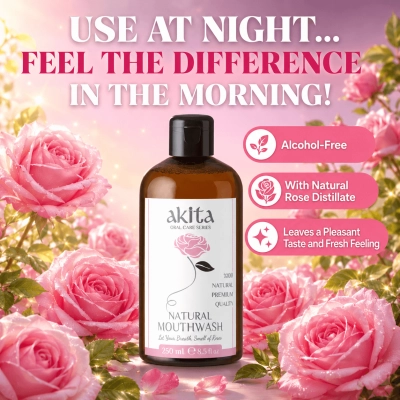
Why Add Akita Natural Rose Mouthwash to Your Nighttime Oral-Care Routine?
A refreshing final step inspired by the delicate aroma of Isparta roses
Morning breath is a common experience. Even after brushing before bed, many people wake up with an unpleasant taste or a less-than-fresh feeling in their mouth.
Why does this happen, and how can a thoughtfully chosen mouthwash complement a nighttime oral-care routine?
Why Does the Mouth Feel Different in the Morning?
Saliva plays an important role in keeping the mouth moist and naturally clearing food particles and microorganisms. During sleep, saliva flow decreases. This creates conditions in which tongue coating and odour-producing compounds can become more noticeable by morning.
Many cases of oral malodour are associated with volatile sulfur compounds. These compounds may be produced when oral microorganisms break down food debris, proteins and other materials in the mouth. Dental plaque, tongue coating, dry mouth and certain oral-health conditions may also contribute to unpleasant breath. (American Dental Association, 2026)
This is why nighttime oral care should focus on removing accumulated plaque and food debris before the ho...