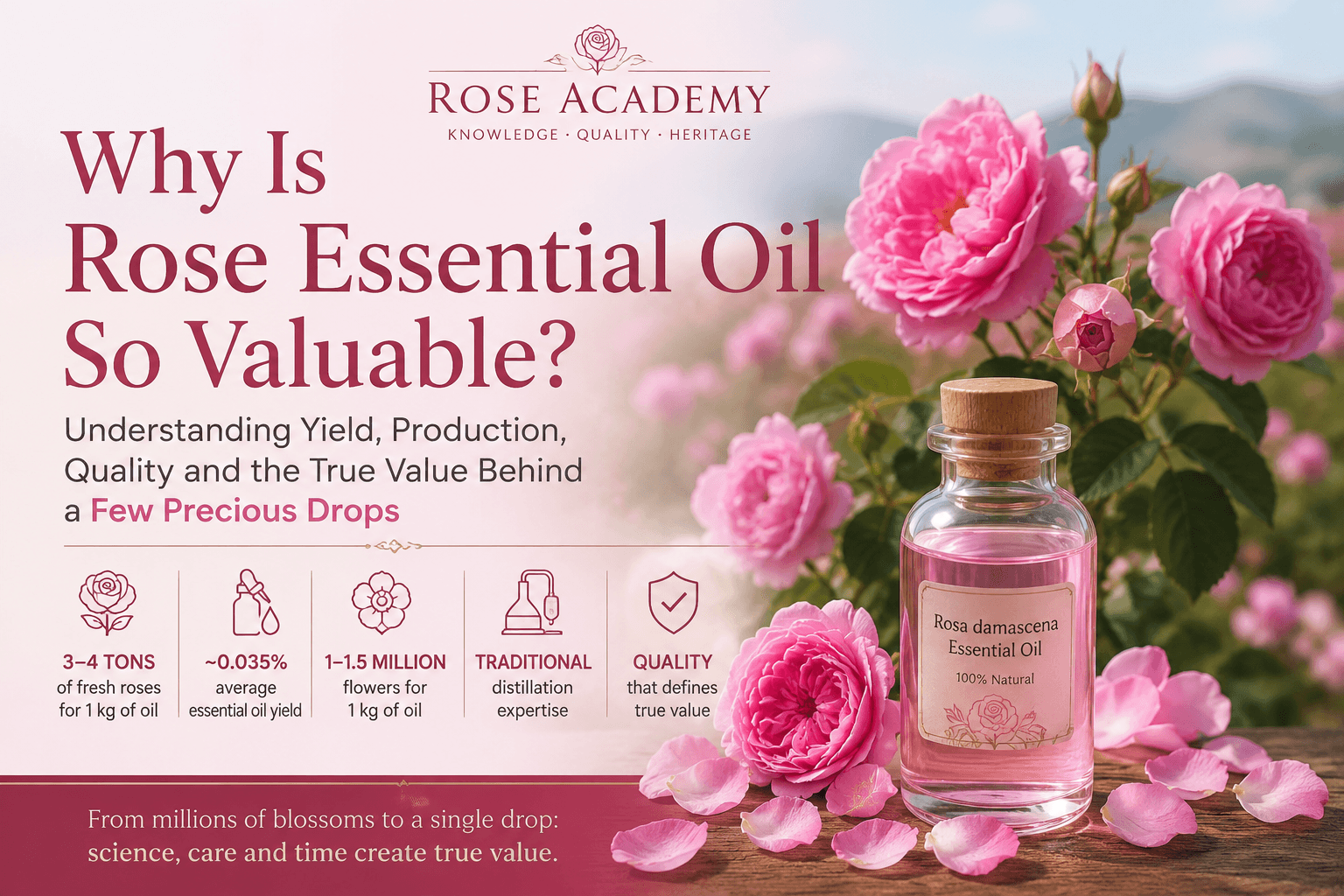
Understanding Yield, Production, Quality, and the True Cost Behind a Drop of Rosa damascena Oil
When we look at a small bottle of natural rose essential oil, we see only a few millilitres of liquid. Behind that tiny bottle, however, lies an extraordinary production journey: vast rose fields, harvesting that begins in the early morning, thousands of kilograms of freshly picked blossoms, skilled labour, and a carefully controlled distillation process.
One of the main reasons rose essential oil is so valuable is simple: rose flowers contain only a very small amount of volatile essential oil.
Yet scarcity alone does not explain its value.
The flowers must be harvested within a relatively short period, transported and processed without unnecessary delay, distilled under carefully managed conditions, and the resulting oil must meet appropriate quality and purity standards.
Understanding the value of genuine rose essential oil therefore begins with understanding yield.
What Does “Yield” Mean in Rose Oil Production?
In essential oil production, yield describes how much essential oil can be obtained from a given quantity of plant material.
For example, an essential oil yield of 0.035% theoretically means that approximately 35 grams of essential oil can be obtained from 100 kilograms of fresh rose flowers.
This is an exceptionally low yield.
As a result, producing rose essential oil requires a much larger quantity of raw botanical material than is required for many other essential oils.
In Prof. Dr. Hasan Baydar’s work Yağ Gülü Tarımı ve Endüstrisi (Oil-Bearing Rose Cultivation and Industry), the average essential oil yield of freshly harvested whole oil-bearing rose flowers is reported to be approximately 0.035%.
The same source states that, under normal industrial conditions, approximately 3–4 tonnes of fresh rose flowers are required to produce 1 kilogram of rose essential oil.
Rose Academy Knowledge Box
Rose oil yield is not a fixed number. Harvest time, temperature, stage of the flowering season, the time between harvesting and distillation, and distillation conditions can all influence the final yield.
How Many Kilograms of Roses Are Needed to Produce 1 Kilogram of Rose Oil?
Under typical industrial production conditions, the figures can be summarized approximately as follows:
| Production Scenario | Approximate Amount of Fresh Flowers | Approximate Yield |
|---|---|---|
| Typical production of 1 kg rose oil | 3,000–4,000 kg | ~0.035% |
| Favourable, higher-yield conditions | ~2,500 kg | ~0.040% |
| Lower-yield conditions | Up to ~5,000 kg | ~0.020% |
These figures should not be viewed as contradictory.
Rather, they demonstrate how significantly the essential oil yield of rose flowers can change according to harvesting and production conditions.
According to an example given by Baydar, flowers collected in the early morning may have an essential oil yield of approximately 0.04%. At this level, around 2.5 tonnes of flowers could theoretically produce 1 kilogram of oil.
If the yield falls to approximately 0.02%, as may occur with flowers collected later in the day, producing the same kilogram of oil could require approximately 5 tonnes of flowers.
When seasonal variation and normal processing losses are also considered, approximately 3–4 tonnes of fresh Rosa damascena flowers for 1 kilogram of rose essential oil is a more practical general figure for conventional factory production.
How Many Individual Rose Flowers Does That Mean?
If the average fresh oil-bearing rose flower weighs approximately 2.5 grams, producing 1 kilogram of rose essential oil may require roughly one to one and a half million individual blossoms.
Baydar reports that, under normal conditions, approximately 1,250,000 flowers may be required to produce a single kilogram of rose oil.
To put this extraordinary scale into perspective:
Behind just a few drops of genuine rose essential oil may lie the harvest of hundreds of fresh rose blossoms.
This is one of the reasons rose oil occupies such a distinctive position among natural aromatic materials.
Why Does Rose Essential Oil Yield Vary?
Not every flower in a rose garden contains exactly the same amount of volatile oil.
In fact, flowers collected from the same garden at different times of day may differ both in essential oil yield and in chemical composition.
Several factors contribute to these differences.
1. Harvest Time
Oil-bearing roses are traditionally harvested very early in the morning, often before the dew has completely evaporated.
The cooler conditions of the early morning can help preserve volatile aromatic compounds within the flowers.
As the sun rises and temperatures increase, some volatile compounds may be lost more readily to the atmosphere. Consequently, harvesting later in the day can affect not only the amount of oil obtained but potentially its chemical composition as well.
This is why harvest timing is an important part of rose oil production rather than merely a matter of scheduling labour.
2. Time Between Harvesting and Distillation
Freshly harvested rose blossoms remain biologically active plant material.
After they are separated from the plant, chemical and enzymatic changes can continue to occur.
Baydar recommends that harvested flowers be distilled within approximately six hours. According to the same source, storage for more than twelve hours may result in approximately 20% loss of essential oil yield and may alter the proportions of certain important aromatic constituents.
Time is therefore a critical production factor.
Tonnes of flowers collected in the morning must be transported to the distillery and processed as quickly as possible.
3. Weather and Climatic Conditions
Rose flower yield and essential oil production may be influenced by numerous environmental factors, including:
Daytime and nighttime temperatures
Humidity and dew formation
Rainfall
Drought and water stress
Spring frost
Altitude
Sun exposure and field orientation
Sudden temperature increases during harvest season
High temperatures may accelerate the loss of volatile compounds from the flowers, while excessive rainfall can make harvesting more difficult and may physically damage delicate blossoms.
The environment in which Rosa damascena is cultivated is therefore closely connected with both agricultural productivity and aromatic quality.
4. Age and Management of the Rose Garden
The quantity and quality of harvested flowers are also related to agricultural practices such as:
Irrigation
Fertilization
Pruning
Soil management
Disease and pest control
Age of the plantation
Importantly, a field that produces a large quantity of flowers does not necessarily produce flowers with an equally high essential oil concentration.
For this reason, flower yield per unit of land and essential oil yield per kilogram of flowers should be evaluated separately.
5. Distillation Parameters
Distillation itself plays a major role in determining both the quantity and composition of the resulting oil.
Important parameters may include:
Flower-to-water ratio
Temperature
Steam pressure
Duration of distillation
Condensation and cooling conditions
Experimental research by Kara, Erbaş, and Baydar reported yields of approximately 0.042% and 0.045% under different hydrodistillation conditions. The study also demonstrated that distillation conditions could influence the proportions of important compounds such as citronellol, geraniol, and nerol.
This illustrates an important principle:
Rose oil quality cannot be evaluated by yield alone. Chemical composition matters as well.
Why Is Rose Essential Oil So Difficult to Produce?
Harvesting Remains Highly Labour-Intensive
Oil-bearing rose blossoms are delicate.
They must be collected at the appropriate stage of flowering and within a relatively narrow harvesting window.
During the harvest season, large teams of workers enter the fields early each morning to collect the blossoms and transfer them rapidly for transportation.
This creates significant requirements for:
Seasonal labour
Harvesting containers and handling
Rapid transportation from field to distillery
Organization of harvesting teams
Processing large quantities of flowers within a short period
The human effort behind rose oil begins long before distillation.
The Harvest Season Is Short
Rosa damascena does not flower throughout the entire year.
In Isparta and the surrounding rose-growing regions of Türkiye, the principal harvest generally takes place during May and June, depending on altitude and seasonal climatic conditions.
Although rose oil facilities require maintenance, preparation, and investment throughout the year, the main production period is concentrated into only a few highly intensive weeks.
This creates an unusual production challenge: expensive equipment, facilities, and skilled personnel must be prepared to process very large quantities of fresh flowers during a remarkably short season.
Fresh Rose Flowers Cannot Simply Be Stored
Many agricultural commodities can be stored for weeks or months before processing.
Fresh rose blossoms cannot.
Their biochemical and aromatic characteristics begin changing after harvest.
A producer therefore cannot simply collect flowers today and distil them several weeks later.
Because the flowers need to be processed rapidly, the distillation facility must have sufficient capacity to handle large volumes of freshly harvested material during the peak flowering season.
The Two-Stage Distillation Process
Traditional industrial rose oil production may involve more than a single distillation.
Fresh flowers are first distilled with water. The oil separated during this initial stage is often referred to as first oil or direct oil.
The aromatic distillation water remaining from the first stage still contains valuable volatile components. When this water is redistilled, an additional oil fraction—commonly referred to as second oil or water oil—can be recovered.
The different fractions may then be blended in appropriate proportions to produce the final rose essential oil.
Rose oil production is therefore considerably more complex than simply boiling flowers and collecting oil from the surface.
The process may involve:
distillation → secondary distillation → fraction recovery → blending → resting → filtration → quality analysis
Each stage can influence the characteristics of the finished oil.
Is Every Rose Essential Oil Equally Valuable?
No.
Two bottles may both be labelled “Rosa damascena essential oil,” yet differ substantially in quality, authenticity, composition, traceability, and market value.
Important evaluation criteria include:
| Quality Criterion | Why It Matters |
|---|---|
| Botanical identity | Helps establish whether the oil genuinely originates from Rosa damascena. |
| Geographical origin | Climate, soil, altitude, and regional production traditions can influence oil characteristics. |
| Harvest timing | Can influence both essential oil yield and aromatic composition. |
| Flower freshness | Delayed processing and fermentation may alter the chemical profile. |
| Distillation method | Can influence yield and the balance of volatile compounds. |
| Purity | Dilution or adulteration reduces authenticity and value. |
| Chemical composition | The balance of citronellol, geraniol, nerol, and other constituents is important for characterization. |
| Analytical results | Help assess identity, purity, composition, and conformity with relevant specifications. |
| Traceability | Allows the product to be followed from agricultural origin to finished oil. |
| Certification | Verified attributes, such as organic production, may add both production cost and market value. |
What Determines the Price of Rose Essential Oil?
The market price of natural rose essential oil reflects much more than scarcity.
1. Seasonal Rose Flower Prices
Fresh flowers represent a major part of production cost.
When flower production decreases, raw-material prices may rise. When cultivation area or harvest volume increases, a different market balance may develop.
The cost of rose oil therefore begins in the field.
2. Labour Costs
Harvesting requires substantial human labour within a short period and often begins very early in the morning.
Wages, transportation, workforce availability, seasonal accommodation, and harvest organization can all contribute to the final production cost.
3. Flower Harvest and Essential Oil Yield
A large flower harvest does not automatically mean a large quantity of essential oil.
A season may produce abundant blossoms while the concentration of volatile oil within those flowers remains comparatively low.
Two different forms of productivity must therefore be distinguished:
The quantity of flowers harvested per unit of land
The amount of essential oil obtained from each kilogram of flowers
Both can significantly affect production economics.
4. Energy, Water, and Processing Capacity
Distilling tonnes of flowers requires substantial infrastructure.
Industrial production involves large stills, water, steam, cooling systems, energy, filtration, cleaning, maintenance, and—in traditional production systems—secondary distillation.
These requirements add to the true cost of producing authentic rose essential oil.
5. Chemical Quality and Aromatic Profile
The value of rose oil is not determined simply by how many kilograms are produced.
The fragrance industry also evaluates the oil's aromatic character and the balance of its chemical constituents.
More than 150 compounds have been identified in natural rose essential oil.
Among the important constituents are:
Citronellol
Geraniol
Nerol
Various hydrocarbons and minor aromatic compounds
The distinctive aroma of genuine rose oil arises not from a single molecule but from the complex interaction of numerous constituents.
Replicating this complete natural aromatic profile is extremely difficult.
6. Purity and Analytical Documentation
Because natural rose essential oil is highly valuable, it is also a product for which dilution and adulteration can be important quality concerns.
Reliable producers may therefore use analytical and documentation methods such as:
GC-FID analysis
GC-MS analysis
Physical and chemical quality testing
Batch-specific Certificates of Analysis
Origin and production records
Comparison with relevant international standards
Analytical testing should not be viewed simply as an additional expense.
It is an essential part of the quality assurance process that helps establish the identity, composition, purity, and reliability of the oil.
7. Global Demand and Currency Movements
Natural rose essential oil is widely used by the international fragrance and cosmetics industries.
According to a market report published by Türkiye's Agricultural Economics and Policy Development Institute (TEPGE), a very large proportion of the rose oil produced in Türkiye is exported.
Consequently, international demand, seasonal agreements between producers and buyers, exchange rates, and broader global economic conditions can all influence market prices.
Rose Oil Is Valuable for More Than Its Scarcity
It would be an oversimplification to say that rose essential oil is expensive simply because it is rare.
Its value reflects an entire production chain:
A rose garden is established in a suitable climate.
Plants are cultivated, irrigated, pruned, and protected for years.
Flowers are harvested during a short season, usually in the early morning.
Tonnes of delicate blossoms are transported rapidly to the distillery.
Fresh flowers are distilled without unnecessary delay.
First and second oil fractions may be carefully recovered.
The oil is rested, filtered, and analyzed.
After all of this work, only a very small quantity of essential oil remains.
In short:
The price of rose essential oil does not represent merely the liquid inside a small bottle. It reflects the rose fields, millions of blossoms, human labour, agricultural knowledge, distillation expertise, and quality assurance required to make that bottle possible.
Frequently Asked Questions
Exactly How Many Tonnes of Roses Are Needed to Produce 1 Kilogram of Rose Oil?
There is no single fixed number.
Under normal industrial conditions, approximately 3–4 tonnes of fresh Rosa damascena flowers are commonly required to produce 1 kilogram of rose essential oil.
Depending on harvest timing, flower quality, essential oil content, and production conditions, the amount may range from approximately 2.5 tonnes to 5 tonnes.
Does the Entire Rose Flower Contain Essential Oil?
The petals—particularly their epidermal tissues—are an important source of the volatile compounds associated with the flower's fragrance.
However, different flower parts may also influence overall essential oil yield and chemical composition when whole blossoms are processed.
Can Rose Oil Still Be Produced from Flowers Harvested Later in the Day?
Yes, but yield may decline as temperatures rise.
In the example reported by Baydar, essential oil yield may be approximately 0.04% in flowers harvested in the morning and decline to around 0.02% in flowers collected later in the day.
This demonstrates why early-morning harvesting is so important in traditional oil-rose production.
Why Is Rose Essential Oil Sold in Such Small Bottles?
Because producing even a small amount requires an extraordinary quantity of fresh flowers.
The oil is also highly concentrated and valuable, so it is commonly packaged in relatively small volumes.
A tiny bottle may therefore represent the aromatic fraction recovered from a surprisingly large harvest.
Is the Most Expensive Rose Oil Always the Best?
Not necessarily.
Price alone is not proof of quality.
Botanical identity, purity, chemical analysis, geographical origin, production method, storage conditions, documentation, and traceability should all be considered when evaluating a rose essential oil.
Conclusion
Natural rose essential oil is one of the world's most labour-intensive aromatic botanical materials.
The fact that approximately 3–4 tonnes of fresh Rosa damascena flowers may be required to produce just 1 kilogram of rose essential oil is perhaps the most visible explanation for its value—but it is only part of the story.
Its true value emerges from the entire journey: cultivating the plants, harvesting the flowers at the appropriate time, transporting them quickly, carefully controlling the distillation process, preserving their complex natural aromatic profile, and verifying the final oil through appropriate quality analysis.
Natural rose essential oil is therefore much more than a beautifully scented botanical oil.
It is the concentrated result of agriculture, climate, millions of flowers, human labour, time, distillation expertise, and scientific quality control.
References
Baydar, H. (2015). Yağ Gülü Tarımı ve Endüstrisi. Süleyman Demirel University, Faculty of Agriculture, Department of Field Crops.
Baydar, H., & Göktürk Baydar, N. (2005). The effects of harvest date, fermentation duration and Tween 20 treatment on essential oil content and composition of industrial oil rose (Rosa damascena Mill.). Industrial Crops and Products, 21(2), 251–255.
Baydar, H., Schulz, H., Krüger, H., Erbaş, S., & Kineci, S. (2008). Influences of fermentation time, hydrodistillation time and fractions on essential oil composition of Damask rose (Rosa damascena Mill.). Journal of Essential Oil Bearing Plants, 11(3), 224–232.
Kara, N., Erbaş, S., & Baydar, H. (2017). The effect of seawater used for hydrodistillation on essential oil yield and composition of oil-bearing rose (Rosa damascena Mill.). International Journal of Secondary Metabolite, 4(3, Special Issue 2), 423–428. https://doi.org/10.21448/ijsm.375120
Republic of Türkiye Ministry of Agriculture and Forestry, Agricultural Economics and Policy Development Institute (TEPGE). (2022). Agricultural Product Markets: Rose.