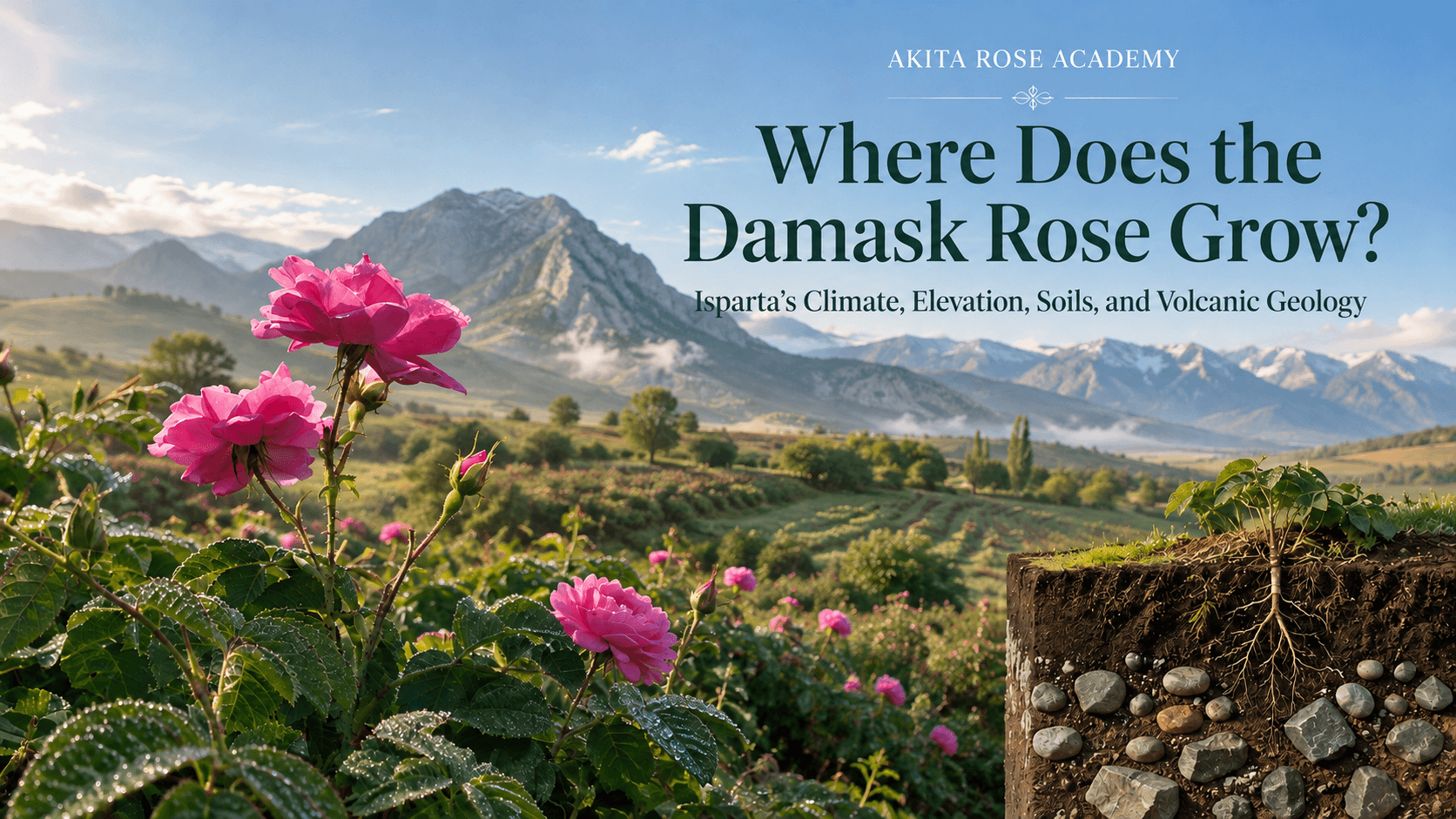
The oil-bearing Damask rose (Rosa damascena) does not grow equally well in every climate or soil. Although the plant can survive in different regions, several environmental conditions must be considered together for it to produce abundant flowers suitable for making aromatic rose products.
Light, temperature, precipitation, humidity, elevation, soil structure, drainage, and cultivation expertise are among the most important factors.
In Türkiye, commercial cultivation of the oil-bearing rose is concentrated in the Lakes Region, which includes Isparta. The province’s climate, agricultural lands at different elevations, and long-established production culture have all contributed to Isparta’s close association with the Damask rose.
But where does Isparta’s volcanic history fit into this story? Are all rose gardens established on volcanic soil? Does growing roses at a higher elevation always improve their quality?
In this chapter, we examine these questions using scientific sources.
Rose Academy Note
Isparta’s volcanic geological history contributes to the region’s overall diversity of soils and landscapes. However, not every rose garden is established on the same type of volcanic soil. The characteristics associated with the Isparta rose must be evaluated as the combined result of climate, elevation, soil, plant material, harvesting practices, and production expertise.
Where Is the Oil-Bearing Rose Grown Around the World?
Rosa damascena can be cultivated in several countries. However, commercial production of rose essential oil and other aromatic rose products is concentrated in certain regions.
Major production centres include:
- The Lakes Region of Türkiye
- Bulgaria’s Kazanlak Valley
- Certain rose-growing regions of Iran
- Selected production areas in Morocco
- Some cultivation regions in India and China
The climates and production methods used in these regions are not identical. Each region may develop its own production profile based on its plant material, environmental conditions, agricultural practices, and processing traditions.
It would therefore be inaccurate to claim that the oil-bearing rose grows only in Isparta. Isparta’s importance lies not simply in its ability to grow the plant, but also in the agricultural, harvesting, distillation, analytical, and commercial expertise that has developed there over many years.
Where Is the Oil-Bearing Rose Grown in Türkiye?
Commercial cultivation of the oil-bearing Damask rose in Türkiye is concentrated primarily in the Lakes Region.
The main production area includes:
- Isparta
- Central Burdur and the Ağlasun area
- The Dinar, Dazkırı, and Başmakçı areas of Afyonkarahisar
- Certain production areas in Denizli
The production region defined in the geographical indication registration for Isparta Rose Oil includes Isparta as well as designated areas of Burdur, Afyonkarahisar, and Denizli (Turkish Patent and Trademark Office, 2019).
This geographical boundary does not mean that the oil-bearing rose cannot be grown elsewhere in Türkiye. For the purposes of a geographical indication, it establishes the relationship between the registered product, its defined geographical area, and its specified production requirements.
Why Is Isparta an Important Oil-Bearing Rose Region?
Isparta’s prominence in oil-bearing rose cultivation cannot be attributed to a single factor. Several environmental and human influences come together in the region:
- Seasonal temperatures suitable for the oil-bearing rose
- Rose gardens established at different elevations
- Adequate sunlight
- Relative humidity and morning dew during the flowering period
- Agricultural soils suitable for rose cultivation
- Variations in elevation that extend the regional harvest season
- Cultivation knowledge developed over generations
- Distillation facilities capable of processing freshly harvested flowers
- Experience in laboratory analysis and quality control
- A production culture connected to international markets
According to data presented by Prof. Dr. Hasan Baydar, Isparta is the principal centre responsible for most oil-bearing rose production in Türkiye’s Lakes Region (Baydar, n.d.).
Isparta’s Climate
Isparta is located in the inland part of Türkiye’s Mediterranean Region. However, it does not display all the characteristics of a coastal Mediterranean climate. Because of its elevation and inland location, the region is also influenced by continental climatic conditions.
Isparta’s climate can therefore generally be described as a transitional climate characterized by:
- Hot and predominantly dry summers
- Colder winters than those experienced in coastal areas
- Variable spring conditions
- Differences in temperature and precipitation according to elevation
The oil-bearing Damask rose is a perennial plant adapted to temperate climates. Nevertheless, extreme heat, prolonged drought, heavy rainfall, and late frosts can adversely affect flower development and harvesting, particularly during the flowering season.
Climatic Requirements of the Oil-Bearing Rose
Successful cultivation of the oil-bearing rose does not require the same weather conditions throughout the year. The plant’s requirements vary according to its stage of development.
Winter Dormancy
After shedding its leaves, the oil-bearing rose enters a period of winter dormancy. Mature plants can tolerate winter cold to a certain extent.
An adequately cool winter period may contribute to:
- The plant’s natural dormancy
- The development of buds
- The formation of new shoots and flowers in the following season
This does not mean that all forms of extreme cold are beneficial. Very low temperatures may damage the plant, particularly if it has not entered full dormancy or if young tissues have already begun to develop.
Spring Growth
As temperatures rise, the buds break dormancy and new shoots begin to grow. This stage is particularly vulnerable to late spring frosts.
Young shoots and developing flower buds are more sensitive to frost than dormant woody canes. Late frosts may:
- Damage young shoots
- Cause developing buds to dry out
- Reduce the number of flowers produced
Flowering Period
In Isparta, the principal flowering and harvesting season for the oil-bearing rose generally occurs in May and June. Flowering may begin earlier in warmer areas at lower elevations and later in cooler areas at higher elevations.
During the flowering period, the rose generally benefits from:
- Moderate temperatures
- Adequate soil moisture
- Cool early-morning conditions
- Suitable relative humidity
- Adequate sunlight
Understanding the Climate
The oil-bearing rose does not require continuously hot or continuously cold weather. It is important for the plant to enter dormancy during winter, avoid late frost damage in spring, and not experience excessive heat or drought during flowering.
Does Temperature Affect the Rose’s Aroma?
Temperature can influence plant growth, flowering time, and the behaviour of volatile compounds.
Baydar reports that drought and high temperatures during the flowering season may cause some volatile compounds in rose petals to evaporate and be lost. Very low nighttime temperatures or excessively high daytime temperatures during flowering may also affect the essential oil content of the flowers (Baydar, n.d.).
This is one of the reasons roses are traditionally harvested early in the morning. Cool morning conditions and dew may help:
- Preserve the freshness of the flowers
- Allow the flowers to be collected before they become warm
- Limit the loss of volatile aromatic compounds
However, the effect of morning dew must be considered together with temperature, humidity, the flower’s developmental stage, and the length of the harvesting period.
Why Are Precipitation and Humidity Important?
The oil-bearing rose requires an adequate water supply during vegetative growth and flowering. Spring precipitation can help prevent water stress.
Suitable humidity may:
- Support bud development
- Help maintain flower freshness
- Contribute to balanced plant growth
However, more humidity or precipitation is not always better. Excessive rainfall may:
- Make flower harvesting more difficult
- Cause physical damage to petals
- Weigh down flowers and cause them to bend toward the ground
- Create conditions favourable to certain plant diseases
- Increase the risk of quality loss during harvesting and transportation
Drought, on the other hand, may expose the plant to water stress, reduce flower size, and lower the overall yield.
Did You Know?
Humidity and precipitation are not the same. Suitable atmospheric humidity can help flowers remain fresh, while heavy or prolonged rainfall can make harvesting more difficult.
Sunlight and the Location of the Rose Garden
The oil-bearing rose is a light-loving plant. Adequate sunlight supports:
- Photosynthesis
- The development of new shoots
- The formation of flower buds
However, sites that are continuously exposed to strong winds may experience increased moisture loss from both the plants and the flowers. In heavily shaded areas, shoot development may weaken and flowering may decrease.
The direction a slope faces, known as its slope aspect, affects the amount of sunlight it receives. South- and southeast-facing slopes generally receive more sunlight. However, if these areas warm too early in spring and cause premature bud break, the risk of late frost must also be considered.
A rose garden site should therefore not be selected solely on the basis of receiving the most sunlight. Frost risk, wind exposure, slope, water availability, and soil characteristics must all be assessed together.
At What Elevation Does the Oil-Bearing Rose Grow?
Oil-bearing rose gardens in Isparta can be found at different elevations.
A 2020 doctoral study examining potentially suitable cultivation areas for the Isparta rose reported that existing production was distributed across an approximate elevation range of 800 to 1,400 metres above sea level. This range reflects observations and modelling results for Isparta; it is not a fixed cultivation limit for all Rosa damascena production worldwide (Ersan, 2020).
As elevation increases:
- Air temperature may decrease
- Differences between daytime and nighttime temperatures may change
- Flowering may begin later
- The harvest period may shift
- Precipitation, wind, and humidity conditions may change
These variations help extend the overall rose harvest across the Isparta region. Harvesting may already have begun in lower-elevation gardens while buds in higher-elevation gardens are still developing.
Does Higher Elevation Always Produce a Higher-Quality Rose?
No. Elevation alone is not a measure of quality.
A garden at a higher elevation may:
- Experience cooler temperatures
- Flower later
- Have different daytime and nighttime temperature patterns
However, it may also be exposed to:
- Stronger winds
- Late frosts
- Shallower or otherwise different soils
- Limited water availability
Elevation must therefore be evaluated together with temperature, slope aspect, soil, moisture, wind, plant material, harvesting, and garden management practices.
Rose Academy Note
The statement that “roses grown at higher elevations are always better” is not scientifically valid. Elevation is an important environmental variable, but it does not determine product quality on its own.
Isparta’s Volcanic Geological Setting
Parts of the region between Isparta and Burdur contain significant volcanic formations. One of the best-known examples is the Gölcük volcanic field.
This area includes:
- The Gölcük Caldera
- Volcanic cones
- Pumice
- Tuff
- Andesite and trachyandesite rocks
A caldera is a large depression that can form following major volcanic activity and the collapse of the underlying volcanic structure. Tuff forms when volcanic ash and fragments become compacted over time, while pumice is a porous rock created when gas-rich lava cools rapidly.
Geomorphological research indicates that volcanic activity around Gölcük occurred during different periods and contributed to the formation of the region’s present-day landforms (Canpolat, 2016).
What Is the Isparta Angle?
The Isparta Angle is a geological term describing a broad tectonic region in southwestern Anatolia where geological structures form an angular or inverted “V” pattern when viewed on a map.
The term does not refer to:
- A single volcano
- A single rock type
- One uniform type of agricultural soil
Sedimentary, volcanic, and other geological formations may occur together within the Isparta Angle. This geological diversity contributes to variations in the region’s landscapes and soils.
Are Volcanic Rock and Volcanic Soil the Same?
No. Geological rock and agricultural soil are not the same.
- Rock is the solid geological material that forms the Earth’s crust.
- Soil is a living and dynamic layer formed through the combined effects of weathering, climate, water, organisms, vegetation, slope, and time.
In an area containing volcanic rocks, soils influenced by volcanic materials may develop. However, soils may also contain material transported from other locations, lake and river sediments, calcareous parent material, and components created through organic processes.
Therefore:
- Volcanic formations exist in Isparta.
- Some soils may have been influenced by volcanic materials.
- Not all rose gardens in Isparta are established on one uniform type of “volcanic soil.”
- A soil’s suitability for rose cultivation cannot be determined solely by whether it has a volcanic origin.
Understanding Soil
A region’s volcanic history does not mean that all its agricultural soils are identical. Soil is a complex system created through the combined influence of parent material, climate, water, slope, organisms, agricultural use, and time.
Does Volcanic History Directly Determine the Rose’s Aroma?
Isparta’s volcanic geology is an important part of the region’s natural diversity. However, a direct cause-and-effect claim that “volcanic soil gives the Isparta rose its uniquely characteristic aroma” would require specific comparative scientific evidence.
The rose’s aromatic characteristics may be affected by numerous interacting factors:
- The plant’s genetic characteristics
- The soil’s physical properties
- Nutrient balance
- Temperature
- Humidity
- Light
- Elevation
- Harvest time
- The time flowers are held before processing
- The distillation method
Volcanic history can therefore help explain Isparta’s broader geographical and soil diversity, but it cannot independently explain rose quality.
What Type of Soil Does the Oil-Bearing Rose Prefer?
Although the oil-bearing rose can adapt to different soil conditions, it does not grow equally well in every type of soil.
It generally performs better in soils that are:
- Deep
- Well drained
- Well aerated
- Suitable for unrestricted root development
- Loamy or sandy loam in texture
- Adequately supplied with organic matter
- Not excessively saline
Baydar reports that the oil-bearing rose can grow particularly well in deep, well-drained sandy loam soils that contain organic matter and are slightly calcareous (Baydar, n.d.).
What Do Sandy, Loamy, and Clay Soils Mean?
Soil texture is defined according to the proportions of sand, silt, and clay particles present.
Sandy Soil
Sandy soil consists primarily of relatively large particles. It drains quickly and is generally well aerated. However, it may not retain enough water or nutrients.
Clay Soil
Clay soil consists of very small particles. It can retain more water but may become heavy and compacted, potentially causing drainage problems.
Loamy Soil
Loamy soil contains a more balanced mixture of sand, silt, and clay. It can provide favourable properties for many agricultural plants by offering a balance between water retention and drainage.
Sandy Loam Soil
Sandy loam contains more sand while retaining the balanced characteristics of loam. It is generally easy to cultivate, remains well aerated, and allows excess water to drain away.
Not all rose-growing lands in Isparta have the same soil texture. Baydar reports that the region’s rose soils are predominantly sandy loam or loam. An ecological modelling study, however, indicated that medium- and fine-textured soils in the areas examined were sometimes preferred over certain sandy soils (Baydar, n.d.; Ersan, 2020).
These differing findings demonstrate why drainage, root development, and the balance between water retention and aeration should be evaluated together instead of relying on a single definition of the “ideal” soil.
Why Is Drainage So Important?
Drainage is the ability of excess water to move away from the soil surrounding the root zone.
When soil remains saturated for a prolonged period:
- Oxygen around the roots decreases
- Root development may slow
- The risk of root rot may increase
- The plant’s uptake of water and nutrients may be impaired
Although the oil-bearing rose can develop a strong root system, roots that remain continuously waterlogged cannot grow in a healthy manner. Land with a high water table or heavy, poorly drained soil must therefore be carefully assessed before a rose garden is established.
What Does Soil pH Mean?
Soil pH is a measure of how acidic or alkaline the soil is:
- A pH below 7 is acidic
- A pH of 7 is neutral
- A pH above 7 is alkaline
Baydar identifies soils with a pH between 6 and 7 as favourable for the oil-bearing rose, while also reporting that rose-growing soils in Isparta may occur across a wider range and are often alkaline (Baydar, n.d.).
This distinction is important:
- A plant’s preferred or ideal pH range
- The actual field conditions in which it can adapt and grow
These two ranges may not be identical.
A soil cannot be declared suitable or unsuitable for rose cultivation on the basis of pH alone. Soil texture, drainage, calcium carbonate content, organic matter, salinity, and nutrient levels must also be examined.
Is Calcareous Soil Poor-Quality Soil?
No. “Calcareous” and “poor quality” do not mean the same thing.
Calcareous soils contain calcium carbonate. In these soils, the availability of certain nutrients to plants may decrease. Nevertheless, successful production is possible in calcareous soils when appropriate soil analysis and agricultural practices are used.
Many rose-growing soils in Isparta may be calcareous and alkaline. Their suitability depends on:
- Soil texture
- Effective rooting depth
- Drainage
- Organic matter content
- Nutrient balance
Why Is Organic Matter Important?
Organic matter in soil consists of decomposed plant material and the remains of other living organisms. It may:
- Improve soil structure
- Help regulate water-holding capacity
- Support soil organisms
- Contribute to nutrient retention
Baydar reports that some oil-bearing rose soils in Isparta may have low organic matter content. Organic matter levels should therefore be monitored through soil analysis as part of responsible garden management (Baydar, n.d.).
However, organic matter or fertilizer should not be added according to the assumption that “more is always better.” Excessive or imbalanced applications can negatively affect both plant growth and the environment.
Salinity and Nutrient Balance
The oil-bearing rose may be adversely affected by excessively saline soils. High salinity can:
- Make it more difficult for roots to absorb water
- Slow plant growth
- Damage leaves and shoots
Nitrogen, phosphorus, potassium, iron, zinc, and other nutrients are important to plant health. However, the correct fertilizer application rate cannot be determined from a general online article.
Fertilization decisions should be based on the following steps:
- Conduct a soil analysis.
- Supplement it with leaf tissue analysis when necessary.
- Consider the age and productivity of the plants.
- Evaluate local climate and irrigation conditions.
- Obtain recommendations from a qualified agricultural engineer or local agronomist.
Is Every Property in Isparta Suitable for a Rose Garden?
No. A property’s location within Isparta does not automatically make it suitable for cultivating the oil-bearing rose.
The following factors should be considered when assessing a site:
- Elevation
- Slope
- Slope aspect
- Frost risk
- Wind exposure
- Soil depth
- Drainage
- pH
- Salinity
- Organic matter
- Water availability
- Accessibility and distance from processing facilities
Ersan’s ecological modelling study found that only a portion of the land in Isparta could be classified as “highly suitable” for oil-bearing rose cultivation. This finding demonstrates that even land located within the same province can vary considerably in its agricultural suitability (Ersan, 2020).
Is Geography Alone Enough?
A suitable geographical location is an important starting point, but it does not determine the final product’s characteristics on its own.
Even two rose gardens in the same region may produce different results because of variations in:
- Plant material
- Age of the garden
- Pruning practices
- Irrigation
- Soil fertility management
- Disease and pest management
- Time of harvest
- Transportation time before processing
- Distillation conditions
- Storage and quality-control practices
The identity of the Isparta rose is therefore the result of both natural conditions and human expertise.
Growing Conditions of the Oil-Bearing Rose
| Factor | Generally preferred conditions | Risks to consider |
|---|---|---|
| Climate | Temperate conditions with distinct seasons | Extreme heat and severe cold |
| Winter | Cool conditions that allow dormancy | Extreme cold and premature bud break |
| Spring | Gradual warming and adequate precipitation | Late spring frosts |
| Flowering | Moderate temperatures, adequate moisture, and sufficient light | Drought, hot weather, and excessive rainfall |
| Elevation | Approximately 800–1,400 m in the referenced Isparta study | Elevation alone is not a measure of quality |
| Light | Adequate sunlight | Heavy shade |
| Wind | Sheltered areas with sufficient air circulation | Persistent, strong, drying winds |
| Soil | Deep, aerated, well-drained, and loamy | Compaction and waterlogging |
| pH | Suitable field conditions ranging from mildly acidic to alkaline | Making decisions based solely on pH |
| Organic matter | Adequate and balanced levels | Excessive application without soil analysis |
| Salinity | Low | High salinity that interferes with root water uptake |
| Drainage | Soil that allows excess water to move away | A high water table and root rot |
Five Factors That Make Isparta Important for the Oil-Bearing Rose
1. Transitional Climate
The combined influence of Mediterranean and continental climatic conditions may create suitable seasonal conditions for the oil-bearing rose at different stages of its development.
2. Variation in Elevation
Rose gardens established at different elevations do not all flower at the same time. This variation helps extend the harvesting period across the region.
3. Diversity of Soils and Landscapes
Isparta contains soils influenced by volcanic, sedimentary, and transported geological materials. Agricultural lands that provide suitable drainage and support healthy root development are valuable for oil-bearing rose cultivation.
4. Long-Established Cultivation Experience
Knowledge developed over generations, including garden establishment, pruning, early-morning harvesting, and rapid processing of fresh flowers, is one of the region’s most valuable assets.
5. Production and Processing Infrastructure
Fresh rose flowers must be processed promptly. The proximity of distillation facilities to cultivation areas helps ensure that newly harvested flowers can be handled without unnecessary delay.
The Akita Approach
The oil-bearing Rosa damascena flowers used by Akita Rose Water originate in Isparta. This geographical origin is an important part of the product’s identity.
However, the quality and characteristics of a rose product cannot be explained solely by the name of the region in which its flowers were grown. Harvesting time, transportation duration, distillation conditions, storage, and quality-control practices also influence the finished product.
In Akita’s production approach, the rose distillate is treated as the primary product of distillation, and the rose oil naturally present in the distillate is not separated from it. Isparta’s botanical and geographical value is considered together with this production method and the analytical information available for the product.
What Have We Learned in This Chapter?
In this chapter, we learned that:
- The oil-bearing rose is not grown exclusively in Isparta.
- Commercial production in Türkiye is concentrated in the Lakes Region.
- Isparta’s transitional climate contributes to its suitability for rose cultivation.
- Elevation can influence flowering time.
- Higher elevation alone is not an indicator of quality.
- Volcanic formations exist in Isparta.
- Not all rose gardens are established on one uniform type of volcanic soil.
- The oil-bearing rose generally prefers deep, aerated, and well-drained soils.
- Soil pH alone does not determine agricultural suitability.
- Geography, cultivation, and production expertise must be evaluated together.
Continue Your Rose Academy Journey
In the next chapter, discover how a rose garden is established, including the selection of suitable land, healthy propagation material, cutting and seedling methods, planting time, and garden planning.
Frequently Asked Questions
1. Is the oil-bearing rose grown only in Isparta?
No. Rosa damascena can be cultivated in different countries and regions. Isparta is one of the world’s important production centres because of its environmental conditions, cultivation expertise, and processing infrastructure.
2. Are all rose gardens in Isparta established on volcanic soil?
No. Volcanic formations are present in and around Isparta, but the region’s geology and soils are diverse. Rose gardens are not all established on the same parent material or soil type.
3. At what elevation does the oil-bearing rose grow?
An ecological modelling study conducted in Isparta reported that existing cultivation occurred at elevations of approximately 800 to 1,400 metres. This range should not be interpreted as a fixed cultivation limit for every country or production region.
4. Are roses grown at higher elevations always better?
No. Elevation can influence temperature and flowering time, but quality results from the combined effects of soil, climate, plant material, garden management, harvesting, and processing conditions.
5. What is the best soil for the oil-bearing rose?
Deep, aerated, well-drained loam or sandy loam soils are generally suitable. However, a site-specific soil analysis and guidance from a qualified local agricultural specialist are necessary for an accurate assessment.
References
Baydar, H. (n.d.). Oil-bearing rose cultivation and industry [Yağ gülü tarımı ve endüstrisi]. Süleyman Demirel University, Faculty of Agriculture, Department of Field Crops.
Note: Because no publication date was provided in the PDF examined, “n.d.” has been used in accordance with APA style.
Canpolat, E. (2016). Geomorphology of the Gölcük volcanic field, Isparta, Türkiye [Gölcük Volkanik Alanının jeomorfolojisi, Isparta–Türkiye]. Journal of Geography, 31, 62–82. Access the article
Ersan, R. (2020). Ecological modelling of potential cultivation areas for the Isparta rose (Rosa damascena Mill.) [Doctoral dissertation, Isparta University of Applied Sciences]. Council of Higher Education National Thesis Centre.
Republic of Türkiye Ministry of Agriculture and Forestry, Western Mediterranean Agricultural Research Institute Directorate. (2022). Oil-bearing rose cultivation: Rosa damascena Mill.Access the publication
Turkish Patent and Trademark Office. (2019). Isparta Rose Oil: Protected designation of origin registration certificate No. 421. Access the registration certificate