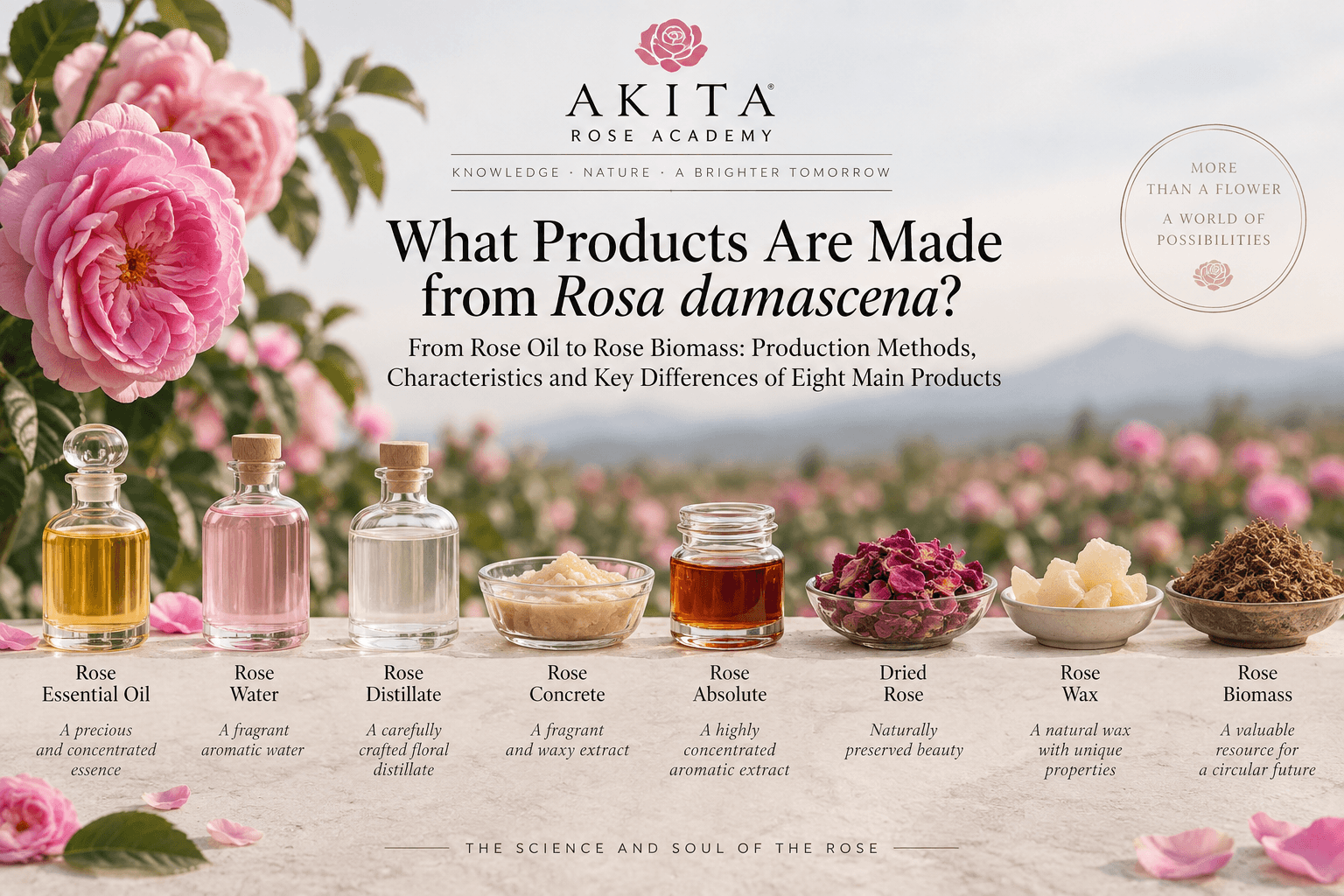
What Products Are Made from Rosa damascena Flowers?
From Rose Essential Oil to Rose Biomass: Production Methods, Characteristics, and Key Differences Among Eight Essential Rosa damascena Products
The rose is far more than an ornamental flower admired for its fragrance and beauty. In particular, Rosa damascena Mill., commonly known as the Damask rose and cultivated as an oil-bearing rose, is an important botanical raw material for the fragrance, cosmetics, food, and other industries.
A single Rosa damascena flower can give rise to a remarkable range of products, including rose essential oil, rose water, rose distillate, rose concrete, rose absolute, dried rose, rose wax, and rose biomass. However, these products are not produced by the same methods, nor do they have the same chemical composition.
Some are obtained through distillation, others through solvent extraction, while dried rose products are prepared through controlled dehydration. Materials remaining after production, such as spent rose biomass, are also gaining importance as potential resources within circular-economy applications.
For this reason, understanding a rose-derived product requires more than simply looking at its name. The rose species, production method, chemical composition, quality controls, and intended use should all be considered.
Why Are Rose-Derived Products Different from One Another?
Rosa damascena flowers contain a complex mixture of naturally occurring compounds. Some are volatile and can be carried with steam during distillation. Others have greater affinity for the aqueous phase, while certain compounds are more readily extracted into oils or suitable solvents. Natural waxes, pigments, and other non-volatile substances, for example, may not transfer into the essential oil during distillation.
The production method therefore plays a major role in determining which components of the flower are transferred into the final product.
Key factors that can influence the characteristics of rose-derived products include:
Rose species and cultivar
Geographic growing region
Climate and soil conditions
Stage of flower maturity
Harvest time
Time between harvesting and processing
Distillation or extraction method
Flower-to-water ratio
Processing time and temperature
Equipment used
Storage and packaging conditions
Even when the same rose species is used, these variables can influence the fragrance, colour, consistency, yield, and chemical profile of the finished product. Research on Rosa damascena has also demonstrated considerable variation in essential-oil yield and composition among different plant selections (Kumar et al., 2023).
Comparison of Eight Major Rosa damascena Products
| Product | Main Production Method | Product Characteristics | Principal Uses |
|---|---|---|---|
| Rose Essential Oil | Water or steam distillation | Highly concentrated volatile oil | Fine fragrance, cosmetics, aromatic products |
| Rose Water | Distillation of rose flowers | Aromatic aqueous phase containing water-compatible volatile compounds | Cosmetics, personal care, and food when appropriately produced |
| Rose Distillate | Controlled distillation designed primarily to produce the aromatic aqueous phase | Water-based distillation product containing rose-derived components transferred during distillation | Skin and personal-care products |
| Rose Concrete | Solvent extraction | Fragrant, coloured, waxy semi-solid extract | Perfumery and production of rose absolute |
| Rose Absolute | Alcohol processing of rose concrete | Highly concentrated aromatic extract | Fine fragrance |
| Dried Rose | Controlled drying | Dried buds, flowers, or petals | Food, herbal infusions, cosmetics, and decoration |
| Rose Wax | Usually separated during conversion of concrete into absolute | Non-volatile waxy fraction | Balms, creams, solid perfumes, and specialty cosmetics |
| Spent Rose Biomass | Solid botanical material remaining after distillation or extraction | Moist or dried plant biomass | Compost, soil amendment, material recovery, and circular-economy applications |
1. What Is Rose Essential Oil?
Rose essential oil is the volatile oil obtained by processing fresh Rosa damascena flowers through water or steam distillation. Rosa damascena is one of the world's most important rose species used for the commercial production of rose essential oil.
How Is Rose Essential Oil Produced?
Fresh rose flowers are placed in a distillation vessel with water or processed using steam. As the system is heated, aromatic vapour forms and carries some of the flower's steam-volatile compounds with it.
The vapour passes through a cooling system, where it condenses back into liquid. Within the resulting distillate, the aqueous phase and the very small quantity of essential-oil phase may separate because of differences in density, solubility, and physicochemical properties.
In some production systems, a second distillation step may be used in which the aromatic water from the first distillation is redistilled to improve essential-oil recovery. The exact equipment and process may vary among producers.
Which Compounds Are Found in Rose Essential Oil?
Rose essential oil is not a single chemical substance. It is a complex mixture containing numerous volatile and semi-volatile compounds.
Important constituents may include:
Citronellol
Geraniol
Nerol
Linalool
Eugenol and related compounds
Nonadecane
Heneicosane
Citronellol, geraniol, and nerol contribute significantly to the characteristic fragrance profile of rose essential oil. Certain long-chain hydrocarbons may also influence its physical properties and fragrance behaviour.
The proportions of these compounds are not fixed. Geographic origin, genetics, harvesting conditions, flower maturity, and distillation techniques can all influence the chemical profile.
Where Is Rose Essential Oil Used?
Rose essential oil is used in:
Fine fragrance
Fragrance compositions
Creams and serums
Soaps and personal-care products
Aromatic and ritual-care products
The essential-oil content of fresh Rosa damascena flowers is naturally very low. Consequently, large quantities of freshly harvested flowers must be processed to obtain a relatively small amount of rose essential oil.
Rose Academy Note: Rose essential oil is a highly concentrated botanical ingredient. Its appropriate concentration in cosmetic formulations should be determined according to formulation requirements, safety assessment, allergen declaration requirements, and applicable regulations.
2. What Is Rose Water?
Rose water is the aromatic aqueous phase produced during the distillation of Rosa damascena flowers. It should not be understood simply as water mixed with rose essential oil. During distillation, certain rose-derived aromatic compounds that can be transported into and retained within the aqueous phase become part of the resulting rose water.
Rose water may be intentionally produced as the principal aromatic water product. Alternatively, during essential-oil production, the aromatic aqueous phase remaining after separation of the essential oil may traditionally be described as rose water or rose hydrosol.
Which Compounds May Be Found in Rose Water?
The composition of rose water varies according to the production process. Depending on the method, compounds that may be detected include:
Phenethyl alcohol
Citronellol
Geraniol
Nerol
Linalool
Other aromatic compounds transferred into or retained by the aqueous phase
The behaviour of phenethyl alcohol in the aqueous phase differs from that of some components that preferentially partition into the essential-oil phase. Consequently, the aroma profile of rose water is not identical to that of separated rose essential oil.
Studies of Turkish rose products have demonstrated that rose concrete, rose absolute, and rose hydrosol have different chemical profiles resulting from their respective production methods (Başer et al., 2003).
Where Is Rose Water Used?
Rose water may be used in:
Facial and skincare products
Toners and facial mists
Soaps and cleansing formulations
Textile and ambient fragrance products
Traditional foods and beverages
Not every rose water product is suitable for food use. Products intended for drinking or incorporation into foods should be specifically manufactured for food applications and comply with relevant food-safety requirements.
3. What Is Rose Distillate?
Rose distillate is a water-based aromatic product obtained through the controlled distillation of Rosa damascena flowers. In cosmetic ingredient lists, it may appear under the INCI name Rosa Damascena Flower Distillate.
The terms rose water, rose hydrosol, and rose distillate are sometimes used interchangeably in the marketplace. Therefore, the production method cannot necessarily be determined from the product name alone.
However, the term rose distillate may also be used to describe an approach in which the aromatic aqueous product itself is intentionally designed to be the primary product of the distillation process.
What Does Non-De-Oiled Rose Distillate Mean?
In a non-de-oiled rose distillate approach, the objective is not to first produce rose essential oil and then make use of the remaining aromatic water. Instead, the distillation process is designed from the beginning around the production of the aromatic aqueous distillate itself.
In this approach:
The quantity of roses and water is predetermined.
Distillation time is controlled.
Heat transfer and operating conditions are managed.
Pressure may be monitored depending on the production system.
A single distillation may be preferred.
Any naturally occurring oil phase may not be separately collected from the finished product.
The fact that the natural rose-oil fraction is not separately removed does not mean that all rose essential oil is molecularly dissolved in water. Some constituents of rose essential oil have limited water solubility, while others may be present as extremely small droplets or as a dispersed phase.
Appropriate physical and chemical analyses are therefore necessary to understand the actual structure and composition of the product.
The Akita Approach
In Akita's production approach, Rosa damascena flower distillate is treated as the primary product of distillation rather than as secondary aromatic water remaining after essential-oil production. The naturally occurring rose-oil fraction generated during distillation is not separately removed.
This distinction does not imply that traditionally produced rose water is false, inferior, or without value. The difference relates to the purpose of production, distillation conditions, and whether the naturally occurring oil fraction is subsequently separated.
Rose Water vs. Rose Distillate
| Criterion | Rose Water | Rose Distillate Produced as the Primary Product |
|---|---|---|
| General definition | Aromatic aqueous phase of rose distillation | Distillation product intentionally produced with the aromatic aqueous phase as the primary product |
| Production objective | May be produced as rose water or may represent the aqueous phase of essential-oil production | Designed from the beginning around production of the distillate |
| Oil phase | May be separated depending on the process | May remain unseparated |
| Terminology | May be described as rose water or hydrosol | May appear as flower distillate in cosmetic ingredient terminology |
| Quality assessment | Depends on production conditions and analytical results | Depends on production conditions and analytical results |
Rose Academy Note: A product's quality cannot be established solely because it is labelled “rose water” or “rose distillate.” Botanical source, production method, microbiological quality, storage conditions, and analytical results should be considered together.
4. What Is Rose Concrete?
Rose concrete is a concentrated, fragrant, waxy product obtained by extracting fresh Rosa damascena flowers with a suitable solvent.
Distillation primarily captures compounds that can be transported under the conditions of water or steam distillation. Solvent extraction can recover a different range of lipophilic and aromatic constituents from the flower.
How Is Rose Concrete Produced?
The general production process includes:
Fresh Rosa damascena flowers are placed in an extraction system.
The flowers are treated with a suitable production-grade solvent.
Aromatic and lipid-soluble compounds migrate into the solvent.
The botanical material is separated.
The solvent is removed under controlled conditions.
A semi-solid, waxy rose concrete remains.
Solvent removal must be carefully controlled, and residual-solvent testing is important depending on the intended use of the finished material.
What May Rose Concrete Contain?
Rose concrete may contain:
Aromatic compounds
Natural floral waxes
Pigments
Lipid-soluble botanical constituents
Certain non-volatile compounds
For this reason, rose concrete does not resemble a clear, free-flowing essential oil. It may have a dense consistency, pronounced colour, and waxy texture.
Research has shown that the solvent used during extraction can influence extraction yield as well as the aromatic composition of rose concrete and absolute (Baydar et al., 2018).
5. What Is Rose Absolute?
Rose absolute is a highly concentrated aromatic extract obtained through further processing of rose concrete.
How Is Rose Absolute Produced?
Rose concrete is generally processed with ethanol. A substantial proportion of the aromatic compounds dissolves into the alcohol, while much of the natural wax fraction is separated through processes such as chilling and filtration.
The alcohol is subsequently removed under controlled conditions, leaving the concentrated rose absolute.
Rose absolute belongs to a different product category from rose essential oil. It is not an essential oil; rather, it is an aromatic extract derived through solvent extraction followed by alcohol processing.
Rose Essential Oil vs. Rose Absolute
| Characteristic | Rose Essential Oil | Rose Absolute |
|---|---|---|
| Production method | Water or steam distillation | Solvent extraction followed by alcohol processing |
| Product category | Essential oil | Aromatic extract |
| Chemical profile | Dominated by compounds recoverable under distillation conditions | May contain aromatic constituents that are less efficiently recovered by distillation |
| Fragrance character | Characteristic, volatile rose-oil profile | May provide a richer, warmer, and differently flower-like aromatic profile |
| Primary use | Perfumery and cosmetics | Particularly fine fragrance |
Describing an absolute as “closer to the fresh flower” is ultimately a sensory and formulation-dependent assessment. It does not mean that rose absolute is inherently superior to rose essential oil. The two materials provide different olfactory profiles and serve different formulation objectives.
6. What Is Dried Rose?
Dried rose products are prepared by reducing the moisture content of whole Rosa damascena flowers, buds, or petals under controlled conditions.
Drying makes botanical material easier to preserve and store. However, colour, fragrance, and certain sensitive constituents may change during the drying process.
How Is Dried Rose Prepared?
For a high-quality dried product:
Healthy, clean flowers should be selected.
Unnecessary delays after harvesting should be avoided.
Drying temperature should be controlled.
Humidity and air circulation should be managed.
Flowers should be protected from intense direct sunlight.
Once dried, the material should be stored in moisture-resistant packaging.
Higher temperatures may accelerate drying but can also increase colour loss and the loss of volatile aroma compounds. Inadequate drying, on the other hand, may increase the risk of mould growth and microbiological deterioration.
Types of Dried Rose Products
These include:
Dried rosebuds
Whole dried rose flowers
Dried rose petals
Ground rose powder
Uses of Dried Rose
Dried Rosa damascena may be used in:
Herbal infusions
Desserts and beverages
Spice and flavour blends
Cosmetic products
Soaps and bath products
Decorative products and potpourri
Dried roses intended for food use should be grown, harvested, processed, and handled specifically according to appropriate food-safety requirements. Decorative dried roses should not automatically be assumed to be edible.
7. What Is Rose Wax?
Rose wax is associated with the naturally occurring, non-volatile waxy substances present in rose flowers. It is most commonly obtained from the wax-rich fraction separated when rose concrete is processed into rose absolute.
Rose wax is not rose essential oil that has simply been cooled until solid. Rose wax and rose essential oil differ both in composition and in the processes through which they are obtained.
Characteristics of Rose Wax
Depending on processing and purification conditions, rose wax may:
Be solid or semi-solid
Retain a subtle rose aroma
Vary in colour
Provide structure and consistency to cosmetic formulations
Contribute to film formation on the skin
Form part of the structural base of solid perfumes
Uses of Rose Wax
Rose wax may be incorporated into:
Lip-care products
Balms and ointments
Solid perfumes
Creams and lotions
Specialty soaps
Anhydrous cosmetic formulations
Before rose wax is used in cosmetics, its purity, possible residues, microbiological quality, and suitability for the intended application should be evaluated.
8. What Is Spent Rose Biomass?
Spent rose biomass—often referred to as rose processing residue or rose pomace—is the solid botanical material remaining after distillation or extraction of Rosa damascena flowers.
This material may include petals, sepals, and other floral tissues.
Its composition depends strongly on the production method. Material remaining after water distillation should not automatically be treated in the same way as material remaining after solvent extraction.
Is Spent Rose Biomass Really Waste?
Historically, rose-processing residues have often been regarded primarily as production waste. Today, however, they are increasingly being investigated as potentially valuable sources of biomass within circular-economy and resource-recovery systems.
Research indicates that Rosa damascena material remaining after essential-oil distillation may continue to contain certain phenolic compounds (Todorova et al., 2024).
However, the detection of potentially useful compounds in research does not mean that untreated rose biomass can automatically be used directly in cosmetic, food, or health-related applications.
Potential Uses of Spent Rose Biomass
Following appropriate processing and safety assessment, rose biomass may potentially be considered for:
Compost production
Organic soil amendments
Biogas and energy applications
Fibre-based biomaterials
Recovery of phenolic compounds
Natural pigment research
Agricultural circular-economy applications
What Should Be Considered When Evaluating Rose Biomass?
Freshly generated rose biomass may contain a high level of moisture. If it is not processed appropriately, fermentation, odour changes, and microbiological deterioration may occur rapidly.
Before further use, factors that may need to be evaluated include:
Moisture content
Microbiological quality
Mould and yeast growth
Agricultural residues
Heavy-metal contamination
Residual solvents, where relevant
Suitability for the intended application
Rose Academy Note: The fact that a material is natural or plant-derived does not automatically make it safe for every application. The appropriate use of rose-processing biomass should be determined according to analytical results, processing conditions, intended application, and applicable regulations.
The Same Rosa damascena Flower, Different Products
A single Rosa damascena flower can be transformed into remarkably different products depending on the processing method:
Distillation can produce rose essential oil and an aromatic aqueous phase.
Distillation designed around the aromatic water as the primary product can be used to produce rose distillate.
Solvent extraction produces rose concrete.
Alcohol processing of rose concrete produces rose absolute while separating much of the waxy fraction.
Controlled drying produces dried roses, petals, buds, and rose powder.
Processing or recovering the material remaining after production creates opportunities to valorize spent rose biomass.
None of these products is automatically a “better” or “more valuable” form of another. Each has its own production method, chemical profile, quality criteria, functional properties, and intended uses.
Conclusion
To understand a Rosa damascena product correctly, it is not enough to evaluate its fragrance or the name printed on its packaging. The botanical species, geographic and production context, manufacturing method, chemical composition, quality controls, and intended application should all be considered.
Rose essential oil is a concentrated volatile oil obtained by distillation. Rose water and rose distillate are aromatic water-based products, although their production objectives and the handling of the naturally occurring oil fraction may differ. Rose concrete and rose absolute are fragrance materials produced through solvent-based extraction processes. Dried rose represents the preserved botanical flower itself, while rose wax and spent rose biomass demonstrate how additional fractions of the flower and its processing chain can also be utilized.
The value of Rosa damascena therefore extends far beyond its celebrated fragrance. Its complex botanical structure can be transformed, preserved, separated, and recovered through different production methods, giving rise to an entire family of scientifically and commercially distinct rose-derived materials.
Frequently Asked Questions
Are rose water and rose distillate the same product?
The terms are sometimes used interchangeably in everyday and commercial language. However, rose distillate may also describe a controlled production approach in which the aromatic aqueous distillate is intentionally designed as the primary product. To understand the actual difference, the manufacturing process should be examined rather than relying on terminology alone.
Does rose essential oil dissolve in rose water?
Some constituents of rose essential oil have limited solubility in water, while others may dissolve to a greater extent. When the oil fraction is not separately removed, extremely small droplets or dispersed phases may also be present. Appropriate analytical methods are required to characterize the actual physical and chemical structure of a specific product.
Are rose concrete and rose absolute the same?
No. Rose concrete is the waxy aromatic material obtained following solvent extraction. Rose absolute is produced by further processing the concrete, generally with ethanol, followed by removal of much of the natural wax fraction.
Is rose wax made from rose essential oil?
No. Rose wax is not solidified rose essential oil. It is generally associated with the natural waxy substances separated during the processing of rose concrete into rose absolute.
Is every dried rose edible?
No. Only roses specifically grown and processed for food use under appropriate agricultural, hygiene, and food-safety conditions should be used in foods and beverages.
Can spent rose biomass be applied directly to the skin?
Untreated rose-processing biomass should not automatically be applied directly to the skin. Microbiological quality, potential residues, stability, processing history, and formulation safety should first be appropriately evaluated.
References
Başer, K. H. C., Kürkçüoğlu, M., & Özek, T. (2003). Turkish rose concrete, absolute, and hydrosol: Composition and production characteristics. Flavour and Fragrance Journal.
Baydar, H., Erbaş, S., & Kineci, S. (2018). Productivity and scent analysis of concrete and absolute obtained by different solvent extractions from oil-bearing rose (Rosa damascena Mill.) flowers. Journal of Essential Oil Bearing Plants.
Kumar, R., Sharma, S., Sood, S., Agnihotri, V. K., Singh, B., & Kumar, S. (2023). Phenotyping floral traits and essential oil profiling revealed considerable variations in clonal selections of damask rose (Rosa damascena Mill.). Scientific Reports, 13.
Todorova, M., Grozdanova, T., Yordanova, Z., Ercisli, S., Petkova, N., & Popova, M. (2024). Pharmaceutical potential evaluation of Damask rose by-products from volatile oil extraction. Plants, 13(12), 1659.