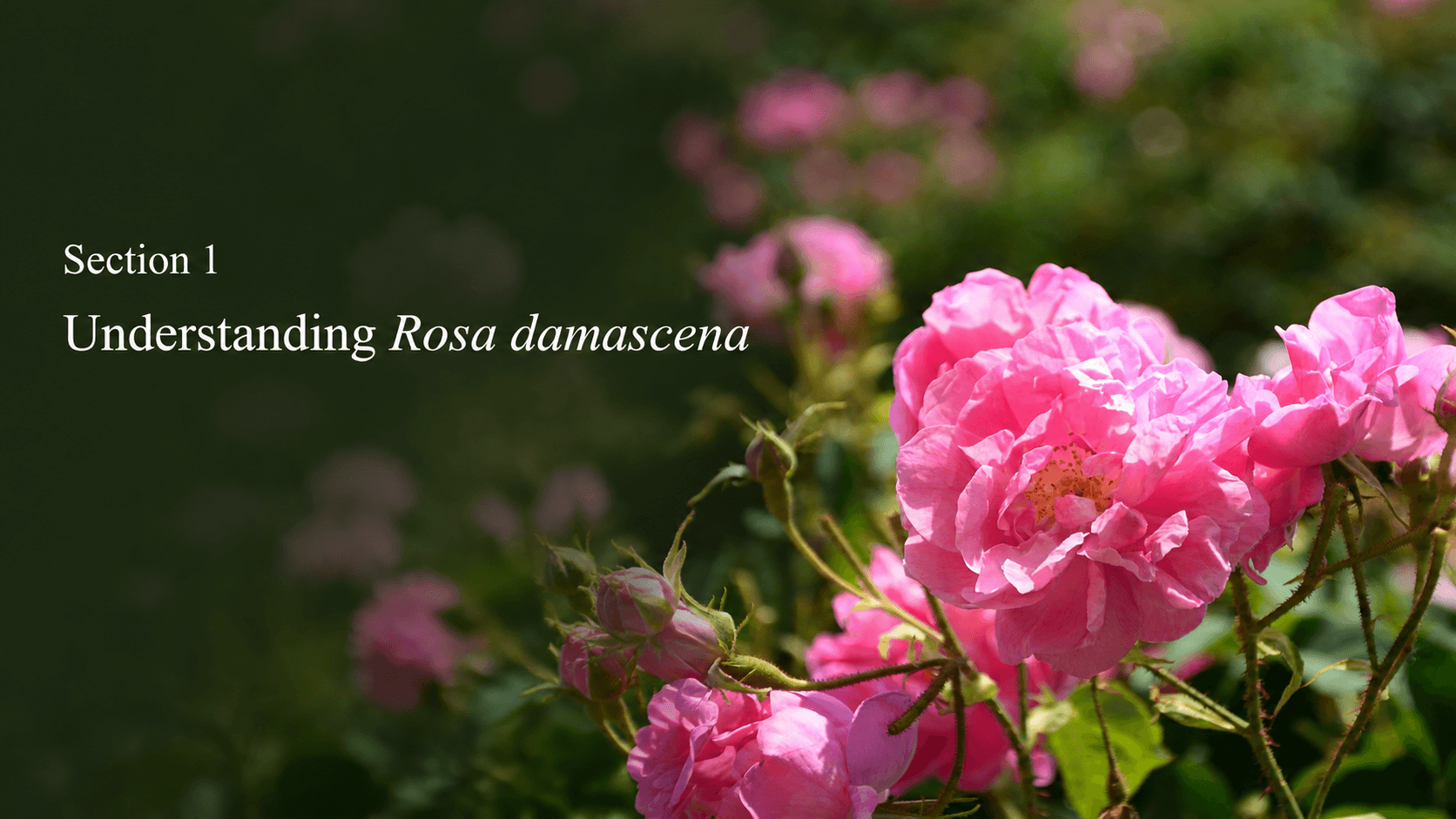
In this section of Akita Rose Academy, we explore what Rosa damascena is, why it is known as the Isparta Rose, how it differs from other roses and which botanical characteristics make it distinctive.
What Is Rosa damascena?
Rosa damascena Mill. is a perennial, shrub-forming rose species belonging to the Rosaceae family. Because of its strongly scented flowers, it is commonly known as the Damask rose or oil-bearing rose.
The pink oil-bearing rose cultivated in Türkiye is commonly referred to as:
- Isparta Rose
- Pink Oil-Bearing Rose
- Oil Rose
- Damask Rose
- Rose of Isparta
According to Hasan Baydar, Rosa damascena stands out among commercially cultivated fragrant roses because of its distinctive, intense and powerful fragrance. These qualities have made it one of the most economically valuable rose species for the perfume, cosmetics, pharmaceutical and food industries (Baydar, n.d.).
Rose Academy Note
Not every pink or fragrant rose is Rosa damascena. A rose’s botanical species cannot always be identified conclusively by looking at its colour, appearance or fragrance alone. Accurate identification may require the combined examination of its flowers, leaves, stems, prickles, fruits and genetic characteristics.
Why Is It Called the Isparta Rose?
Rosa damascena is not cultivated exclusively in Isparta. However, Isparta has become one of the world’s most important centres for the commercial cultivation and processing of this rose.
Oil-bearing rose production in Türkiye is concentrated in the Lakes Region, which includes Isparta and parts of Burdur, Afyonkarahisar and Denizli. According to Baydar, Isparta has accounted for more than 80% of oil-bearing rose production in this region (Baydar, n.d.).
İsmail Efendi played an important role in the development of commercial rose cultivation in Isparta. Historical accounts indicate that he established the first oil-rose garden in 1888 and produced the first rose essential oil using traditional stills in 1892. Isparta’s first rose-oil factory was established in 1935 (Baydar, n.d.).
Over time, Isparta developed a specialized rose culture in which:
- Rose-growing knowledge was passed down through generations.
- Commercial rose gardens expanded.
- Distillation facilities were established.
- Expertise in rose water and rose essential oil production developed.
- Cooperatives and privately owned rose-processing businesses were created.
- Scientific research and quality-control studies were conducted.
The geographical indication registration of the Isparta Rose further contributed to the official recognition of the historical and economic relationship between the rose and the region.
The term “Isparta Rose,” therefore, represents more than a plant. It also refers to a particular geography, climate, cultivation culture, harvesting tradition and body of production knowledge.
Why Is Isparta’s Climate Important?
The botanical species of the plant is essential, but it is not the only factor that matters. Climate, altitude, soil structure, humidity, rainfall and temperature can influence the development of the flowers and their aromatic composition.
The oil-bearing rose is generally well adapted to temperate climates. It grows successfully in regions with abundant light, sufficient rainfall and morning dew during the flowering season.
Characteristics that make Isparta suitable for rose cultivation include:
- Temperate climatic conditions
- Suitable daytime and nighttime temperatures during flowering
- Morning dew
- Sufficient sunlight
- Favourable humidity and rainfall patterns
- Sandy-loam, well-drained soils
Baydar explains that high temperatures and drought during the flowering season may cause some volatile compounds in the rose petals to evaporate and be lost. The geographical environment and the time at which the flowers are harvested are therefore important to their aromatic quality (Baydar, n.d.).
The Global Importance of Rosa damascena
Rosa damascena is one of the most valuable aromatic plants used by the international perfume and cosmetics industries. Türkiye’s Lakes Region and Bulgaria’s Kazanlak region are among the best-known centres of commercial oil-rose cultivation (Baydar, 2006).
Different processing methods can be used to obtain several products from the flowers:
- Rose distillate and rose water
- Rose essential oil
- Rose concrete
- Rose absolute
- Ingredients for cosmetic and perfume formulations
- Rose-derived ingredients for food and personal-care products
One of the main reasons for the high economic value of rose essential oil is its very low production yield. According to Baydar, approximately three to four tonnes of fresh rose flowers may be required to produce one kilogram of rose essential oil under standard factory conditions.
The amount obtained may vary depending on the geographical origin of the flowers, harvest time, post-harvest waiting period and distillation conditions (Baydar, n.d.; Baydar & Göktürk Baydar, 2001).
The fragrance of natural rose essential oil does not come from a single substance. Baydar reports that rose oil may contain more than 150 compounds that work together to form its characteristic aroma. Citronellol, geraniol, nerol and linalool are among its best-known aromatic constituents (Baydar, n.d.).
Did You Know?
A rose’s pleasant fragrance does not necessarily mean that it is suitable for essential-oil production. The value of a commercial oil-bearing rose depends not only on its scent but also on the quality of its aromatic compounds and its suitability for distillation.
How Does It Differ from Other Fragrant Roses?
The genus Rosa includes numerous species, hybrids and cultivated varieties. They are not all grown for the same purpose.
Ornamental roses are generally selected for characteristics such as:
- Flower colour
- Flower size
- Full or layered appearance
- Length of flowering
- Durability as cut flowers
- Decorative appearance in gardens
Rosa damascena, in comparison, is cultivated primarily for the natural aromatic compounds found in its flowers and its suitability for the production of rose distillate and rose essential oil.
Its flowers may appear less elaborate than those of some ornamental varieties, but their intense fragrance and aromatic composition make them particularly valuable for distillation.
| Characteristic | Rosa damascena | Many ornamental roses |
|---|---|---|
| Main cultivation purpose | Rose essential oil, rose water and aromatic products | Decorative use and cut flowers |
| Fragrance | Strong, intense and characteristic | Strong, light or absent, depending on the variety |
| Harvesting | Generally harvested by hand in the early morning | Usually collected according to appearance and flowering stage |
| Part used in production | Primarily fresh flowers | The entire plant or cut flower is often valued |
| Main source of value | Aromatic composition and suitability for processing | Colour, form, size and durability |
This comparison does not mean that ornamental roses are fragrance-free or without value. Different roses are cultivated for different purposes. The important distinction is that Rosa damascena has been selected and cultivated for generations as an oil-bearing rose intended for aromatic production.
Botanical Characteristics of Rosa damascena
Plant Structure
Rosa damascena is a perennial, woody, prickly shrub. Under suitable cultivation and care conditions, it can continue producing new shoots from the same root system for many years.
Its main stems bear buds that develop into leaves and new shoots.
Flowers
The oil-bearing roses cultivated in Isparta generally have flowers that are:
- Pink
- Semi-double
- Strongly and distinctly fragrant
- Composed of delicate petals that fall relatively easily
According to the average values reported by Baydar, a fresh oil-rose flower is approximately 7.5 centimetres in diameter and weighs about 2.5 grams. A flower may contain approximately 30 petals, although these values may vary according to growing conditions and the stage of flower development (Baydar, n.d.).
Leaves
The leaves are dark green with a smooth, waxy appearance. Each compound leaf generally consists of three to seven smaller leaflets.
Prickles
The stems and branches bear prickles as part of the plant’s natural structure. Although commonly called thorns, the structures found on rose stems are more accurately described botanically as prickles.
Reproductive Structure
The centre of each flower contains male and female reproductive structures. Both wind and insects, particularly bees, can contribute to pollination. Rose flowers can provide nectar and pollen for honeybees.
Fruits and Seeds
Following successful fertilization, rose hips may develop. The fruits are green at first and become dark red as they mature.
According to Baydar, Rosa damascena produces many flowers but relatively few fruits and seeds. For this reason, oil-bearing roses in Isparta are traditionally propagated using healthy cuttings and shoots rather than seeds (Baydar, n.d.).
Why Does Botanical Identity Matter?
The words “rose water” on a label do not, by themselves, identify the botanical species used to make the product. The ingredient list, botanical name and information provided by the producer should be considered together.
A cosmetic product obtained by distilling Rosa damascena flowers may list Rosa Damascena Flower Distillate in its ingredients.
Clear botanical identification can help consumers:
- Understand which rose species was used
- Distinguish oil-bearing roses from ornamental roses
- Compare products sold under similar general names
- Make a more informed assessment of the product’s origin and composition
However, an INCI name does not by itself identify the geographical origin or reveal every production detail. Whether a product originates in Isparta and how it was produced must be confirmed through the producer’s traceability and manufacturing information.
Akita Rose Academy Summary
Rosa damascena is more than a pleasantly scented pink flower. Its botanical identity, geographical origin, growing conditions, harvest time and production method all contribute to the character and value of the products obtained from it.
Understanding the identity of the Isparta Rose is the first step towards evaluating genuine rose water, rose distillate and rose essential oil more accurately.
At Akita Rose Academy, this journey begins with the botanical characteristics of the rose and continues from the rose fields of Isparta to the bottle.
References
Baydar, H. (n.d.). Oil-bearing rose cultivation and industry [Yağ gülü tarımı ve endüstrisi]. Süleyman Demirel University, Faculty of Agriculture, Department of Field Crops.
Note: The PDF examined does not provide a publication date; therefore, “n.d.” is used in accordance with APA style.
Baydar, H. (2006). Oil-bearing rose (Rosa damascena Mill.) cultivation and rose oil industry in Turkey. Euro Cosmetics, 14, 13–17.
Baydar, H., & Göktürk Baydar, N. (2001). The effects of harvest period, waiting time before distillation and distillation stages on yield and quality in oil-bearing rose (Rosa damascena Mill.). Proceedings of the Fourth Field Crops Congress, 117–122.
Baydar, H., & Kazaz, S. (2013). Oil-bearing rose and rose cultivation in Isparta [Yağ gülü ve Isparta gülcülüğü]. Gülbirlik Publications.
Göktürk Baydar, N., Baydar, H., & Debener, T. (2004). Analysis of genetic relationships among Rosa damascena plants grown in Turkey by using AFLP and microsatellite markers. Journal of Biotechnology, 111, 263–267.