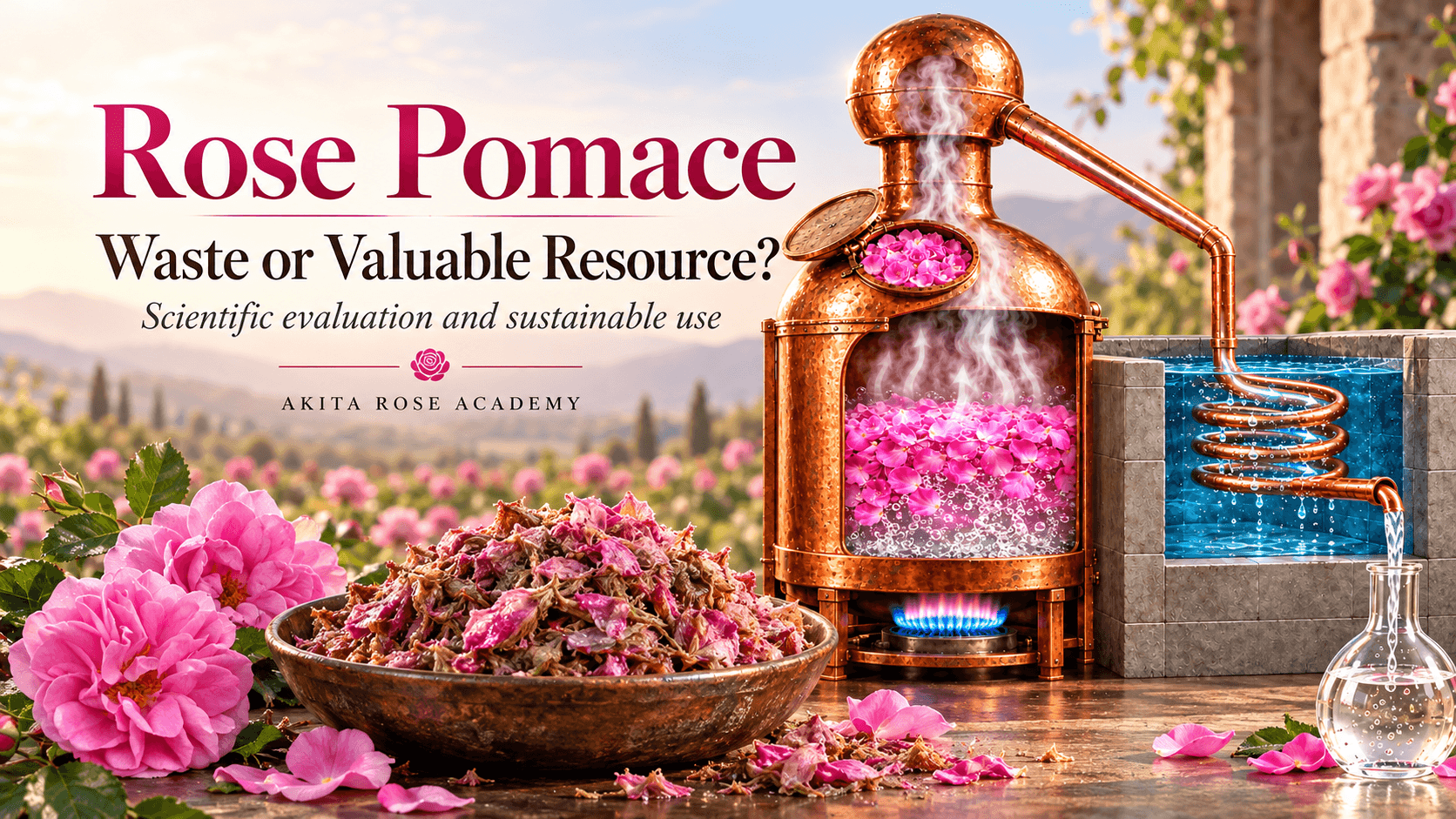
What Is Rose Pomace? A Scientific Perspective on Turning Waste into a Valuable Resource
The Composition, Environmental Impacts and Sustainable Applications of Residues from Rosa damascena Distillation
Does the value of a rose flower end when distillation is complete?
After Rosa damascena flowers are processed to produce rose essential oil and rose water, a substantial amount of wet botanical material remains. This material, commonly referred to as rose pomace, has historically been regarded primarily as a by-product or waste from the distillation process.
Scientific research, however, indicates that rose pomace may still contain plant fibres, mineral elements and certain phenolic compounds that could potentially be recovered or utilized.
These characteristics have encouraged researchers to investigate rose pomace for a variety of applications, including composting, biochar production, biogas generation and the recovery of valuable plant-derived compounds.
Nevertheless, the presence of potentially useful substances does not automatically establish that a material is suitable or safe for every application. Its production history, chemical composition, microbiological characteristics and intended use must all be considered.
Can rose pomace become a valuable resource? Which applications are supported by scientific research, and under what circumstances might it create environmental risks?
In this Akita Rose Academy article, we examine the scientific evidence concerning rose pomace produced during Rosa damascena distillation and explore its potential role in a more sustainable rose industry.
PART I — UNDERSTANDING ROSE POMACE
1. How Is Rose Pomace Produced?
Rosa damascena flowers are commonly processed through hydrodistillation or appropriate steam-distillation techniques to obtain rose essential oil and aromatic aqueous products.
During distillation, steam carries a portion of the volatile aromatic compounds present in the flowers. As the vapour cools and condenses, an aromatic aqueous phase is obtained, together with an oil phase that may be separated depending on the production process.
However, distillation does not remove every component of the rose flower.
Once the process is complete, softened floral tissues and water remain in the distillation vessel.
The solid or semi-solid botanical material remaining after processing is known as rose pomace, also described in scientific literature as spent rose biomass or rose distillation residue.
Rose pomace may contain:
Rose petals and other floral tissues
A substantial amount of water
Cellulose, hemicellulose and lignin
Non-volatile botanical compounds
Various mineral elements
Certain phenolic compounds
Small amounts of aromatic substances remaining after distillation
Rose pomace should therefore not automatically be regarded as a material without further value.
Rose Academy Note: Not All Distillation Residues Are the Same
Several different solid and liquid materials can arise during rose processing.
| Material | Description |
|---|---|
| Rose pomace | Solid botanical material remaining in the distillation vessel after processing |
| Pomace liquid | Liquid retained within wet pomace or separated through pressing |
| Distillation wastewater | Process water generated during production that is not recovered as a commercial product |
| Rose water | An aromatic aqueous product obtained through rose distillation |
| Aqueous phase beneath the rose oil | The aromatic aqueous phase remaining beneath the separated oil during conventional rose oil recovery |
These materials do not necessarily share the same chemical composition or potential applications.
For example, a mineral analysis performed on solid rose pomace does not establish the mineral composition of rose water.
Similarly, antioxidant activity measured in an extract prepared from rose pomace cannot automatically be attributed to every commercially available rose water.
2. Why Is Rose Pomace Considered a Waste Material?
Materials remaining after the principal products of an industrial process have been recovered are often described as production residues, by-products or waste, depending on their intended use and regulatory status.
In the rose oil industry, rose essential oil is a high-value commercial product. Rose water is another important product that can be recovered during distillation.
The residual botanical material, however, has not always had an established economic application.
Its high moisture content, storage requirements and processing costs can make its recovery and utilization challenging.
How Much Water Does Rose Pomace Contain?
In a study published in 2019, Baydar, Erbaş, Şanlı and Kara reported that the wet rose pomace examined contained approximately 91.7% water.
This means that only about 8.3% of the material consisted of dry matter.
For example, 100 kilograms of wet rose pomace with this moisture content would contain approximately:
91.7 kilograms of water
8.3 kilograms of dry matter
This proportion is not necessarily identical across all production systems. Nevertheless, it illustrates the considerable influence of moisture on transportation, storage and processing.
Because of its high moisture content, rose pomace:
Is heavy and relatively expensive to transport
May require considerable storage space
Can decompose rapidly when stored under unsuitable conditions
May undergo fermentation and develop unpleasant odours
Can generate liquid runoff or leachate
May accumulate in large quantities during the relatively short rose harvest season
Consequently, managing rose pomace is not simply a matter of developing new products.
It is also an important component of responsible environmental management within the rose industry.
Reference: Baydar et al. (2019).
3. Is Rose Pomace Environmentally Harmless Because It Is Natural?
No.
The fact that a material is plant-derived or biodegradable does not mean that it can be released into the environment without proper management.
When large quantities of wet rose pomace accumulate in one location, microorganisms begin breaking down the organic matter.
Depending on the environmental conditions and the volume of material, this process may lead to:
Unpleasant odours
Increased insect activity
The formation of organic-rich leachate
Runoff reaching soil or surface waters
Increased microbial oxygen consumption if substantial organic material enters aquatic environments
The extent of these effects depends on factors such as moisture, temperature, storage conditions and the quantity of residue involved.
Scientific Explanation: What Is Organic Load?
Organic load refers to the quantity of organic substances present in a material or environmental system, particularly substances that can undergo microbial decomposition.
When excessive amounts of biodegradable organic matter enter a water body, microbial activity may increase.
As microorganisms decompose these substances, they consume oxygen. Under certain circumstances, this can contribute to a reduction in dissolved oxygen levels.
Proper collection, storage and treatment of organic residues are therefore important environmental management practices.
Rose Academy Note: A natural material may become a valuable resource when appropriately managed, but uncontrolled accumulation can still create environmental problems.
4. What Remains in Rose Pomace After Rose Oil Production?
Rose distillation primarily involves the recovery of some of the compounds that can be transported with steam.
However, the rose flower contains many substances beyond its volatile aromatic fraction.
Following distillation, portions of several compound groups may remain in the botanical material.
Cellulose, Hemicellulose and Lignin
These substances are major structural components of plant cell walls.
They contribute to the fibrous character of plant biomass and are relevant to applications involving composting and biomass conversion technologies.
Mineral Elements
Some of the nitrogen, phosphorus, potassium, calcium and magnesium originally present in rose flowers may remain in the solid residue.
These elements are important in plant nutrition.
However, the presence of mineral nutrients does not mean that all of them are immediately available for uptake by plants.
Their availability depends on chemical form, microbial activity and soil conditions.
Phenolic Compounds
Phenolic compounds represent a broad group of naturally occurring plant chemicals.
They are involved in various biological processes, including plant defence, pigmentation and responses to environmental stress.
Not all phenolic compounds are volatile.
Consequently, certain phenolic substances may remain in rose biomass following distillation.
Residual Aromatic Compounds
Depending on the distillation method, temperature, duration and quantity of water used, small amounts of aromatic compounds may remain in rose pomace.
However, the presence of residual aromatic substances does not necessarily mean that a second extraction would be technically or economically worthwhile.
Scientific Conclusion
Distillation does not remove every constituent of the rose flower.
The value of Rosa damascena should therefore not be measured exclusively by the amount of essential oil obtained from its flowers.
5. Mineral Composition of Rose Pomace: Scientific Findings
One investigation examining the agricultural potential of rose pomace was published in 2019 by Hasan Baydar, Sabri Erbaş, Arif Şanlı and Nimet Kara.
The researchers analysed mineral elements present in dried Rosa damascena distillation residue.
Major Plant Nutrients Reported in Dried Rose Pomace
| Element | Reported Concentration |
|---|---|
| Nitrogen (N) | 3.497% |
| Calcium (Ca) | 1.544% |
| Potassium (K) | 0.335% |
| Magnesium (Mg) | 0.258% |
| Phosphorus (P) | 0.251% |
The study also identified additional elements, including iron, manganese, zinc, copper and boron.
These findings indicate that the dried rose pomace examined contained notable concentrations of nitrogen and several other mineral elements.
How Should These Values Be Interpreted?
The concentrations shown in the table were determined using dried rose pomace.
They should not be directly applied to wet material containing approximately 91.7% water.
Furthermore, the reported concentrations represent the particular samples examined in the study.
They are not universal values for rose pomace produced by every distillation facility.
Mineral composition may vary according to:
Soil characteristics
Fertilization practices
Cultivation conditions
Harvest timing
Distillation method
Quantity of water used
Storage duration
Drying procedures
Representative samples should therefore be analysed before rose pomace is used for agricultural or industrial purposes.
Reference: Baydar et al. (2019).
PART II — ENVIRONMENTAL SAFETY AND AGRICULTURAL APPLICATIONS
6. Can Rose Pomace Contain Potentially Toxic Elements?
Plants absorb more than the nutrients required for their growth.
They may also take up other elements naturally present in the soil or introduced through environmental and agricultural sources.
Consequently, the assessment of potentially toxic elements is important when evaluating plant-derived materials for agricultural or industrial applications.
In their 2019 study, Baydar and colleagues examined several elements in rose pomace, including aluminium, tin, nickel and lead.
How Should the Findings Be Interpreted?
The study provides valuable information about the elemental composition of the samples examined.
However, an important methodological issue should be considered when interpreting its comparisons with regulatory limits.
The publication reported a tin (Sn) concentration of 0.109 mg/g, equivalent to 109 mg/kg.
The same publication referred to a limit of 10 mg/kg while also stating that the relevant measured elements were below the applicable limits.
These statements present a numerical inconsistency.
In addition, the Turkish fertilizer regulation from 2018 cited in the research defined a specific scope for the application of tin-related requirements. The provision concerned animal-derived organic fertilizer materials and products.
Therefore, the measured concentration and a general comparison with that limit cannot, by themselves, establish whether plant-derived rose pomace complies with or violates the applicable regulations.
How Should Safety Be Evaluated?
The suitability of rose pomace for a specific application cannot be determined through a limited set of mineral measurements alone.
An appropriate evaluation should consider:
Intended use
Current applicable regulations
Relevant potentially toxic elements
Proposed application rates
Soil and environmental conditions
Microbiological characteristics
Additional safety requirements associated with the final product
Rose Academy Scientific Note: Results obtained from a particular sample do not establish that all rose pomace produced by different facilities is safe without further testing.
7. Is Rose Pomace an Organic Fertilizer?
Rose pomace contains plant-derived organic matter and various mineral nutrients.
It may therefore be considered a potential raw material for the development of organic fertilizers or soil amendments.
However, freshly discharged rose pomace should not automatically be classified as:
Mature compost
A standardized organic fertilizer
A safety-assessed soil conditioner
Organic Matter and Organic Fertilizer Are Not the Same
Organic matter is a broad term describing carbon-containing substances derived from biological sources.
An organic fertilizer, in the context of fertilizer products, is a material evaluated according to its intended purpose, defined characteristics and applicable regulatory requirements.
Before rose pomace can be developed into a commercial fertilizer or soil amendment, several characteristics may need to be examined:
Moisture content
Organic matter and organic carbon content
Carbon-to-nitrogen ratio (C/N)
pH
Electrical conductivity and salinity
Plant nutrient concentrations
Potentially toxic elements
Microbiological quality
Compounds that may inhibit plant growth
Material stability and maturity
Scientific Conclusion
Rose pomace may be a useful starting material for producing organic fertilizers or soil amendments.
However, producing a standardized, safe and suitable final product requires appropriate processing and verification.
8. Can Raw Rose Pomace Be Applied Directly to Soil?
The presence of nutrients in rose pomace does not mean that large quantities of fresh, untreated residue will always benefit the soil.
When raw pomace is incorporated into soil, microorganisms begin decomposing its organic components.
Depending on the amount applied and the environmental conditions, this process may create several challenges.
Potential Effects
Changes in oxygen availability: Intensive microbial decomposition may increase oxygen consumption, particularly where soil aeration is limited.
Temporary decomposition products: Under unsuitable conditions, certain compounds may form that interfere with plant growth.
Changes in soil chemistry: Soil pH, salinity and nutrient availability may be affected.
Germination problems: Some plants may experience reduced seed germination or impaired seedling development.
Physical effects: Thick layers of wet pomace may alter the movement of air and water through the soil.
These effects are not inevitable under every set of conditions.
The suitability of direct application depends on the characteristics of the material, application rate, soil type and crop being grown.
A study by Erdal and Aydemir (2003) investigated the agricultural potential of rose pomace in its direct and enriched forms.
The research forms part of the scientific background concerning how this residue might be used in agriculture.
9. Why Is Composting Important?
Composting is a controlled biological process in which microorganisms decompose organic materials and transform them into a more stable product.
Properly composted rose pomace may offer opportunities for agricultural use.
How Can Rose Pomace Be Composted?
A controlled composting process generally involves several stages.
Step 1: Collection
Rose pomace is collected in a suitable and controlled location following distillation.
Step 2: Moisture Adjustment
Excess moisture may need to be reduced because freshly produced pomace can contain substantial quantities of water.
Step 3: Preparing the Mixture
The pomace may be combined with dry leaves, straw, pruning residues or other carbon-rich materials when necessary.
Step 4: Monitoring Moisture and Temperature
Appropriate moisture and temperature conditions are maintained to support microbial decomposition.
Step 5: Aeration
Turning or other suitable methods are used to maintain sufficient oxygen availability.
Step 6: Maturation
The material is allowed to undergo further stabilization and maturation.
Step 7: Final Product Evaluation
The resulting compost is tested according to its intended application.
Why Is the Carbon-to-Nitrogen Ratio Important?
Microorganisms require both carbon and nitrogen as they break down organic materials.
Carbon serves as an important energy source, while nitrogen contributes to the production of cellular structures.
The balance between these elements influences the composting process.
Because rose pomace may contain considerable nitrogen, combining it with suitable carbon-rich materials may help establish more favourable composting conditions.
However, an appropriate mixing ratio should not be determined using a universal recipe without measuring the actual moisture content and carbon-to-nitrogen ratio of the materials.
Potential Benefits of Composting
A properly managed process may:
Improve the stability of organic matter
Reduce the volume of wet residues
Help control odour problems
Make agricultural utilization more practical
Reduce certain negative effects associated with applying untreated material
Rose Academy Note: Compost suitability should be evaluated using relevant indicators of maturity, stability and safety, rather than composting duration alone.
PART III — SCIENTIFIC AND INDUSTRIAL POTENTIAL OF ROSE POMACE
10. Can Rose Pomace Contain Antioxidant Compounds?
Not every compound naturally occurring in a rose flower is removed during distillation.
Certain non-volatile phenolic compounds may remain in the solid botanical material.
This has encouraged researchers to investigate rose pomace as a potential source of recoverable plant-derived compounds.
What Are Phenolic Compounds?
Phenolic compounds are naturally occurring plant substances with a wide variety of chemical structures.
Some exhibit antioxidant activity in laboratory systems.
However, measured antioxidant capacity depends on the extraction procedure, sample composition and analytical conditions.
A Scientific Study Published in 2020
In 2020, Liu and colleagues published a study titled Antioxidation and Active Constituents Analysis of Flower Residue of Rosa damascena in Chinese Herbal Medicines.
The researchers investigated an extract prepared from Rosa damascena flower residues.
Antioxidant activity was examined using laboratory methods, including DPPH and ABTS assays.
Several phenolic compounds were also isolated and identified.
The reported compounds included:
Quercetin
Kaempferol
Gallic acid
Protocatechuic acid
Methyl gallate
These findings support the scientific interest in rose distillation residues as potential sources of recoverable phenolic substances.
What Do These Findings Demonstrate?
The study established that the investigated rose residue extract exhibited antioxidant activity under the laboratory conditions used.
However, the findings do not directly demonstrate that:
Raw rose pomace produces the same effects when consumed
Applying raw pomace to the skin prevents ageing
Every rose pomace sample contains identical concentrations of phenolic compounds
Rose pomace can treat a disease
A concentrated laboratory extract is not chemically equivalent to untreated rose pomace.
Furthermore, antioxidant activity observed in a chemical assay does not establish clinical effectiveness in humans.
Scientific Conclusion
Rose pomace is being investigated as a potential source of recoverable phenolic compounds and measurable antioxidant activity in laboratory systems.
Reference: Liu et al. (2020).
11. Can Biochar Be Produced from Rose Pomace?
Biochar is a carbon-rich material produced by heating suitable biomass under controlled conditions with limited oxygen availability.
This process is generally referred to as pyrolysis.
Certain biochars may be suitable for soil amendment applications, provided that their physical, chemical and safety characteristics are appropriate for the intended use.
Research Involving Rose Pomace
In a study published in 2018, Alaboz and Işıldar investigated the effects of biochars produced from rose pomace and apple pomace on selected physical properties of sandy soil.
The researchers applied biochar at defined rates and evaluated the resulting changes under laboratory conditions.
The investigation examined characteristics including:
Soil aggregation
Soil moisture retention
Different biochar application rates
The findings indicated that biochar derived from rose pomace warranted further investigation for its potential influence on certain water-retention properties of sandy soil.
However, the results should not be generalized to all soil types or all biochar materials.
Biochar Production Is Not the Same as Open Burning
Producing biochar under controlled conditions differs fundamentally from burning rose pomace outdoors.
A proper pyrolysis process requires control of factors such as temperature, oxygen availability and gas emissions.
The resulting biochar must also be assessed before agricultural use.
Reference: Alaboz and Işıldar (2018).
12. What Other Applications Are Being Investigated?
The potential uses of rose pomace extend beyond compost and biochar.
Scientific investigations have explored several additional biological and industrial applications.
Biogas Production
Biogas is a gas mixture containing methane that can be generated when microorganisms break down organic materials in the absence of oxygen.
This biological process is known as anaerobic digestion.
Rose pomace may be investigated as a potential feedstock for biogas production in suitable facilities.
However, biogas yield depends on several factors:
Dry matter content
Biodegradable organic matter
Processing temperature
Retention time
Microbial populations
Reactor design and operating conditions
The technical ability to generate biogas does not automatically establish that the process is economically viable for every rose-processing facility.
Natural Dye Production
Certain pigments and phenolic compounds remaining in rose pomace may be recovered for investigation in natural textile dyeing.
Research involving rose-processing residues has explored their potential as alternative sources of colouring compounds.
However, colour and colourfastness may vary according to:
Extraction procedure
Mordant selection
Processing temperature
Treatment duration
Textile fibre characteristics
Producing a natural dye does not necessarily guarantee satisfactory colour durability.
Bedding Material in Animal Production
In a study published in 2004, Aktan and Sağdıç investigated the use of dried rose pomace as bedding material in broiler chicken production.
The researchers compared rose pomace with conventional wood-shaving bedding.
Differences were observed in certain microbiological measurements, and the study did not report adverse effects on animal performance under the investigated conditions.
An important distinction must be emphasized:
The research examined rose pomace as floor bedding, not as a feed ingredient for animals.
The findings therefore do not establish that raw rose pomace is safe or nutritionally suitable for animal consumption.
Recovery of Phenolic Compounds
Rose pomace is also being investigated as a possible source of valuable botanical substances that can be recovered through suitable extraction and purification techniques.
These compounds may eventually be evaluated for different industrial applications.
However, not every extract obtained from rose-processing residues can automatically be considered suitable for food or cosmetic use.
Additional research is required concerning composition, purity, safety, stability and regulatory compliance.
13. Can Rose Pomace Be Used in Food, Animal Feed or Cosmetics?
The development of new products from rose-processing residues is an important area of scientific interest.
Research into the valorization of agricultural and industrial by-products has expanded as industries seek more efficient approaches to resource utilization.
In 2025, Kolev and colleagues published a literature review in Processes examining the potential use of residues from the Rosa damascena oil industry as ingredients for food and feed applications.
However, such investigations should not be interpreted as evidence that untreated rose pomace is safe for all uses.
Food Applications
Any ingredient intended for food use must undergo appropriate chemical and microbiological safety evaluations.
Other relevant factors include:
Agricultural production history
Extraction methods
Unwanted residues
Product standardization
Intended consumption levels
Applicable food regulations
Animal Feed Applications
The presence of nutrients in rose pomace does not automatically qualify it as animal feed.
Suitability would require assessment of:
Nutritional value
Digestibility
Potentially undesirable compounds
Safe inclusion levels
Species-specific requirements
Applicable feed regulations
Cosmetic Applications
Certain compounds recovered from rose pomace may be of interest for cosmetic ingredient development.
However, untreated pomace and a purified, characterized cosmetic ingredient are fundamentally different materials.
Cosmetic applications may require evaluation of:
Chemical composition
Microbiological quality
Purity
Unwanted residues
Toxicological safety
Stability
Intended concentration
Regulatory compliance
Rose Academy Safety Note
Scientific evidence indicating that rose pomace contains potentially valuable compounds does not justify recommending that untreated pomace be consumed, added to beverages or applied directly to the skin.
The appropriate scientific approach is to consider rose pomace a research material from which new ingredients or products may potentially be developed following suitable processing and evaluation.
PART IV — THE FUTURE OF A SUSTAINABLE ROSE INDUSTRY
14. Does All Rose Pomace Have the Same Characteristics?
No.
The chemical and physical characteristics of rose pomace can vary considerably according to production conditions.
Important variables include:
Rose species and cultivar
Growing region
Soil and climate
Agricultural practices
Harvest timing
Time between harvesting and processing
Distillation method
Quantity of water added
Distillation temperature and duration
Whether the residual material is pressed
Drying method
Storage conditions and duration
Consequently, a rose pomace sample examined in one scientific study may not represent all residues generated by the wider rose industry.
Akita Rose Academy Note: Why Production Methods Matter
When evaluating rose pomace, it is important to consider the distillation process used.
In conventional rose essential oil production, the separation and recovery of the volatile oil fraction is a principal objective.
By contrast, Akita Non-De-Oiled Rose Distillate is produced using an approach designed to retain the naturally occurring rose oil fraction within the distillate instead of intentionally removing it as a separate product.
This difference in production approach represents a potential research variable that may influence processing conditions and the distribution of constituents among the resulting materials.
However, the effects of different distillation methods on the phenolic, mineral or other properties of the residual biomass cannot be established without comparative analytical investigations.
Therefore, findings obtained from rose pomace generated during conventional rose oil production should not automatically be attributed to pomace resulting from Akita's particular production process.
Production-specific research may help explain how different distillation systems influence not only the principal rose products, but also the botanical biomass remaining after processing.
15. From Waste to Resource: Circular Production in the Rose Industry
The circular economy aims to improve resource efficiency and encourage the responsible recovery and reuse of materials wherever technically, economically and environmentally appropriate.
Within this framework, residues generated by one production process may become valuable inputs for another.
In the Rosa damascena industry, the recovery and utilization of rose pomace may offer opportunities such as:
Reducing the accumulation of organic residues at processing facilities
Preventing uncontrolled waste disposal
Returning stabilized organic matter to agricultural systems
Developing suitable soil amendments
Producing biochar
Generating biogas
Recovering phenolic compounds
Developing alternative biomaterials
Creating additional economic opportunities for producers and regions
However, an important question must be addressed:
If a material can be successfully processed in a laboratory, does that mean the same process is practical at an industrial scale?
Not necessarily.
Technical feasibility is only one part of a comprehensive sustainability assessment.
How Should New Applications Be Evaluated?
Several factors should be considered together.
Technical feasibility: Can the process consistently produce sufficient quantities of material at the required quality?
Safety: Is the final material appropriate for its intended application?
Energy consumption: How much energy is required for collection, drying, processing and recovery?
Water consumption: Is the process compatible with efficient and responsible water management?
Economic cost: Can collection, transportation, storage and processing costs be justified?
Environmental impact: Does the new process actually reduce environmental burdens when the entire production system is considered?
Regulatory compliance: Does the resulting product meet the legal requirements applicable to its intended market?
Without a comprehensive evaluation, a process should not automatically be described as sustainable merely because laboratory results are promising.
Scientific Overview of Rose Pomace Applications
| Potential Application | Area of Scientific Interest | Important Evaluation Requirements |
|---|---|---|
| Compost | Agricultural utilization of stabilized organic matter | Maturity, nutrient content and safety |
| Organic fertilizer | Recovery and utilization of plant nutrients | Standardization, regulatory requirements and laboratory analysis |
| Biochar | Improvement of selected soil properties | Production conditions, biochar characterization and soil testing |
| Biogas | Energy generation from organic biomass | Gas yield, technical feasibility and economic evaluation |
| Natural dyes | Recovery of plant-derived colouring compounds | Colourfastness and processing safety |
| Animal bedding | Development of alternative bedding materials | Hygiene, moisture management and animal welfare |
| Phenolic extracts | Recovery of potentially valuable botanical compounds | Purity, stability and toxicological assessment |
| Food and feed ingredients | Development of new functional materials | Safety, nutritional evaluation and regulatory compliance |
This table summarizes areas that have been investigated or proposed for further research.
It does not mean that every method has been commercially validated or is equally suitable for industrial implementation.
Common Misconceptions About Rose Pomace
“Once rose oil has been extracted, nothing valuable remains in the flower.”
Incorrect.
Distillation primarily removes a portion of the volatile constituents.
The remaining material may contain plant fibres, mineral elements and certain non-volatile compounds.
“Rose pomace is natural, so it can be discarded into the environment without consequences.”
Incorrect.
Large quantities of wet organic material may create odours, leachate and organic pollution when improperly managed.
“Rose pomace is already an organic fertilizer.”
Not necessarily.
Rose pomace may serve as a raw material for fertilizer or soil amendment production.
Fresh pomace is not equivalent to mature compost that has been appropriately processed and evaluated.
“If rose pomace contains antioxidants, it can be safely eaten or applied directly to the skin.”
Incorrect.
Antioxidant activity observed in laboratory assays does not establish safety or effectiveness in humans.
“Rose pomace from every processing facility has the same mineral and phenolic composition.”
Incorrect.
Composition may vary with cultivation, harvesting, distillation and storage conditions.
“If a new product can be made from rose pomace, the production method must be sustainable.”
Incorrect.
Sustainability also requires evaluation of energy use, water consumption, economic costs, product safety and environmental impacts.
Frequently Asked Questions (FAQ)
What Is Rose Pomace?
Rose pomace is the wet botanical material remaining after Rosa damascena flowers have undergone distillation.
It contains residual plant tissues, water and various non-volatile constituents.
What Does Rose Pomace Contain?
Depending on the production process, rose pomace may contain plant fibres, organic matter, mineral elements such as nitrogen, phosphorus, potassium, calcium and magnesium, and certain phenolic compounds.
The concentrations vary according to cultivation and processing conditions.
Should Rose Pomace Be Discarded?
The priority should be to prevent uncontrolled disposal and investigate appropriate recovery or treatment methods.
If utilization is not feasible, the material should be managed according to applicable waste-management requirements.
Can Rose Pomace Be Used in Gardens?
Properly composted material may be suitable for gardening when its maturity, composition and safety have been appropriately assessed.
Applying large quantities of untreated wet pomace directly to soil is not generally recommended.
Can Rose Essential Oil Be Extracted Again from Rose Pomace?
A substantial portion of the recoverable volatile oil is removed during the original distillation process.
Small amounts of aromatic compounds may remain, but the technical and economic feasibility of further recovery requires separate investigation.
Can Biochar Be Produced from Rose Pomace?
Yes.
Scientific studies have investigated biochar produced from rose pomace, including its effects on selected physical properties of sandy soils.
However, production requires controlled processing conditions, and the resulting material must be evaluated before use.
Is Rose Pomace Suitable for Animal Feed?
Untreated rose pomace should not automatically be considered suitable for animal feed.
Its potential use would require investigation of nutritional value, digestibility, safety, appropriate inclusion rates and applicable regulations.
Can Rose Pomace Be Used as a Cosmetic Ingredient?
Certain extracts or compounds recovered from rose pomace may be investigated for cosmetic applications following appropriate extraction, purification, characterization and safety evaluation.
This is different from applying untreated pomace directly to the skin.
Is All Rose Pomace the Same?
No.
Rose species, cultivation conditions, distillation methods, processing duration and storage conditions can influence the composition of the residual material.
Conclusion: Is Rose Pomace Waste or a Valuable Resource?
Rose pomace is a water-rich botanical material remaining after the distillation of Rosa damascena flowers.
When improperly stored or discarded, it may contribute to environmental problems such as odours, organic pollution and leachate generation.
From this perspective, it is a production residue that requires responsible management.
However, scientific investigations indicate that rose pomace is not necessarily without value.
It may contain plant fibres, organic matter, mineral nutrients and phenolic compounds that could potentially be recovered or utilized.
Research involving compost, biochar, biogas, natural dyes and other industrial applications demonstrates several possible pathways for the further evaluation of this material.
Nevertheless, each application involves its own technical, economic, environmental and safety requirements.
The future value of rose pomace will depend not only on which compounds it contains, but also on whether those compounds and materials can be recovered and utilized safely, efficiently and sustainably.
Rose pomace can become an environmental burden when poorly managed, or a potentially valuable biomass resource when processed through appropriate, scientifically informed methods.
The sustainable future of the rose industry therefore depends not only on the production of rose essential oil and rose water, but also on understanding and responsibly managing the botanical materials remaining after distillation.
Scientific References
1. Baydar, H., Erbaş, S., Şanlı, A., & Kara, N. (2019).
Yağ gülünün damıtma atığı olan posanın element içeriği ve değerlendirme olanakları üzerine bir araştırma [An investigation into the elemental composition and utilization potential of oil-bearing rose distillation residue]. Türk Bilim ve Mühendislik Dergisi, 1(1), 1–4.
https://dergipark.org.tr/tr/pub/tjse/article/645156
2. Baydar, H., & Göktürk Baydar, N. (2017).
Yağ gülünde distilasyon ürünlerinin uçucu yağ ve fenolik madde içerikleri ile antiradikal ve antioksidan aktiviteleri [Essential oil and phenolic contents, antiradical and antioxidant activities of distillation products of oil-bearing rose]. Tarım Bilimleri Dergisi, 23(1), 1–9.
https://dergipark.org.tr/en/pub/ankutbd/article/786544
3. Göktürk Baydar, N., & Baydar, H. (2013).
Phenolic compounds, antiradical activity and antioxidant capacity of oil-bearing rose (Rosa damascena Mill.) extracts. Industrial Crops and Products, 41, 375–380.
4. Erdal, İ., & Aydemir, O. (2003).
Gül posasının doğrudan ve zenginleştirilmiş formunun tarımda kullanılabilme olanakları [Potential agricultural uses of rose pomace in its direct and enriched forms]. Süleyman Demirel Üniversitesi Fen Bilimleri Enstitüsü Dergisi, 7(1), 20–26.
5. Onursal, E. (2006).
Gül işleme atıklarının kompostlaştırılmasında optimum C/N oranlarının belirlenmesi üzerine bir araştırma [An investigation into optimal carbon-to-nitrogen ratios for composting rose-processing residues] [Master's thesis, Süleyman Demirel University].
6. Alaboz, P., & Işıldar, A. A. (2018).
Elma ve gül posası biyoçarlarının kumlu toprağın bazı fiziksel özellikleri üzerine etkileri [Effects of apple and rose pomace biochars on selected physical properties of sandy soil]. Toprak Bilimi ve Bitki Besleme Dergisi, 6(2), 67–72.
https://dergipark.org.tr/tr/pub/tbbbd/article/504831
7. Aktan, S., & Sağdıç, O. (2004).
Dried rose (Rosa damascena Mill.) dreg: An alternative litter material in broiler production. South African Journal of Animal Science, 34(2), 75–79.
https://doi.org/10.4314/sajas.v34i2.3809
8. Liu, W.-Y., Chen, L.-Y., Huang, Y.-Y., Fu, L., Song, L.-Y., Wang, Y.-Y., Bai, Z., Meng, F.-F., & Bi, Y.-F. (2020).
Antioxidation and active constituents analysis of flower residue of Rosa damascena. Chinese Herbal Medicines, 12(3), 336–341.
https://doi.org/10.1016/j.chmed.2020.05.005
9. Kolev, N., Ivanova, M., Balabanov, A., Vlahova-Vangelova, D., Kišová, A., & Vizzarri, F. (2025).
Utilization of agro-industrial residues from the Rosa damascena Mill. oil industry: A literature review on biomass potential for food and feed ingredients. Processes, 13(6), 1945.
https://doi.org/10.3390/pr13061945
10. Republic of Türkiye, Official Gazette. (2018).
Regulation on fertilizers derived from organic, mineral and microbial sources used in agriculture (February 23, 2018, No. 30341). Subsequent regulatory amendments should be reviewed when assessing current compliance.
https://www.mevzuat.gov.tr/mevzuat?MevzuatNo=24410&MevzuatTur=7&MevzuatTertip=5
Continue Exploring with Akita Rose Academy
The journey of a rose flower extends from cultivation in the field to distillation and the development of a wide range of botanical products.
That journey can continue even after distillation, as researchers investigate new possibilities for the responsible recovery and utilization of residual plant materials.
Explore our other educational articles on Rosa damascena cultivation, rose essential oil, rose water, distillation methods, sustainable production and botanical research.
Akita Rose Academy — Exploring the Rose, Science and a Sustainable Future.