Rose Essential Oil, Rose Water, Rose Concrete and Rose Absolute: What Is the Difference?
Rose essential oil, rose water, rose concrete and rose absolute can all be produced from the same fragrant rose flower. Yet sharing the same botanical source does not make them the same product.
The fundamental difference lies in how the rose flowers are processed.
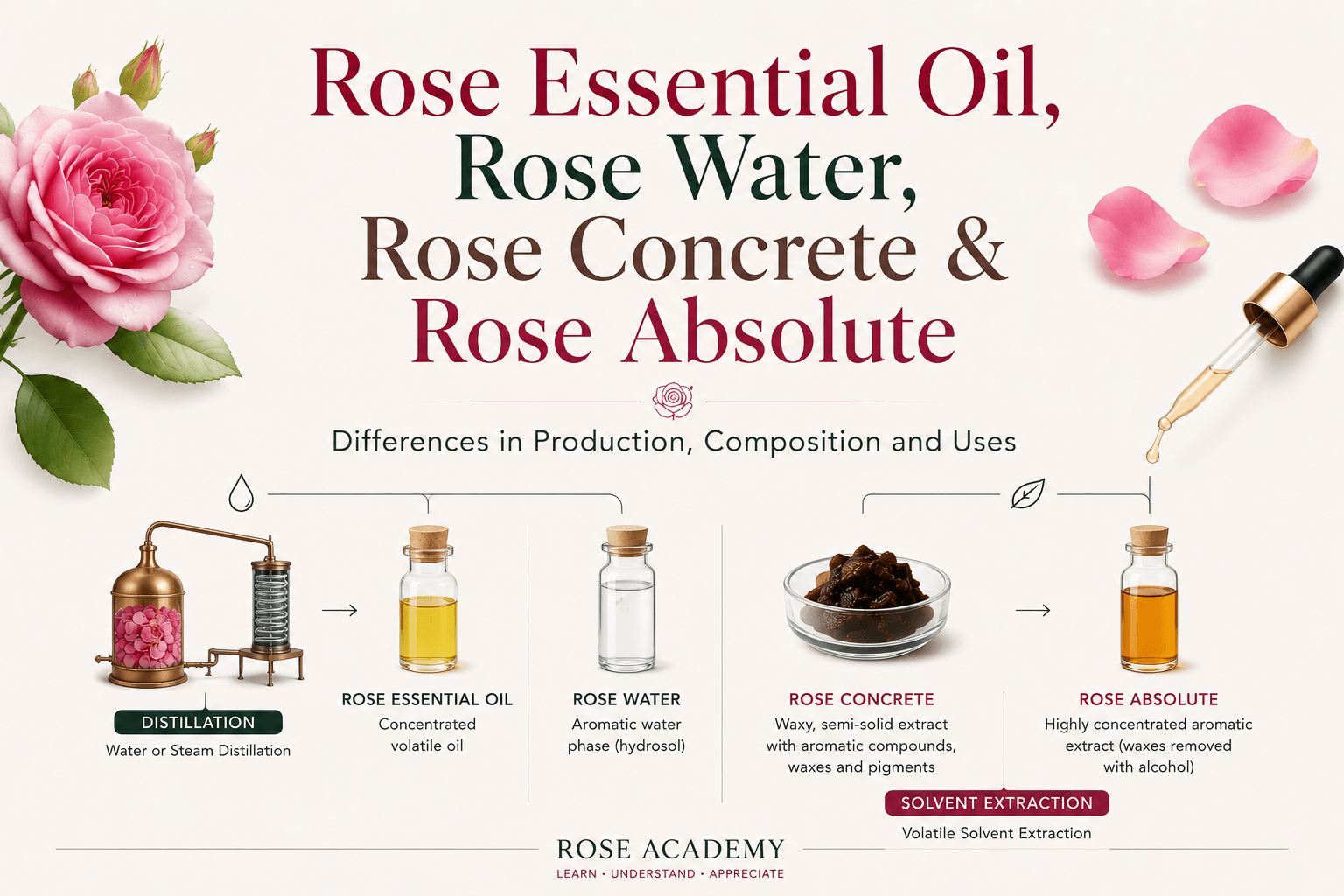
When rose flowers are distilled with water or steam, the process produces an essential oil phase and an aromatic aqueous phase. When the flowers are extracted with a suitable solvent instead, the process can produce rose concrete, which may then be further refined to obtain rose absolute.
This is why the simple statement “made from roses” tells us very little about what a rose-derived ingredient actually is.
To understand a rose product properly, we need to ask several questions:
Was it produced by distillation or solvent extraction?
Were the oil and water phases separated?
Does the product contain waxes and other lipophilic compounds in addition to aromatic constituents?
Was it obtained directly from the flower, or by further processing another rose-derived material?
Is the final product an essential oil, an aromatic water, a semi-solid concrete or a concentrated aromatic extract?
Let us explore the differences between rose essential oil, rose water, rose concrete and rose absolute, step by step.
1. What Is Rose Essential Oil?
Rose essential oil, often referred to in perfumery as rose otto, is the volatile oil obtained from fragrant rose flowers—most notably Rosa damascena—through water or steam distillation.
In Türkiye, oil-bearing roses cultivated particularly in Isparta and the surrounding region are traditionally harvested in the early morning and transported to the distillery as quickly as possible.
How Is Rose Essential Oil Produced?
The basic stages of rose oil production are:
Fresh rose flowers are loaded into the distillation still.
A controlled quantity of water is added, or steam is passed through the plant material.
Heat causes volatile aromatic compounds from the flowers to travel with the steam.
The aromatic vapour passes through a condenser.
As it cools, the vapour condenses back into liquid.
The condensate contains an aqueous phase and an essential oil phase.
The essential oil is separated from the aromatic water using an appropriate separation system.
Because of the physical properties of rose oil—including its density and its behaviour at lower temperatures—the separation process must be carefully controlled.
In industrial rose oil production, the oil recovered from the initial distillation may be combined with a second oil fraction obtained by redistilling the aromatic distillation water.
What Is Rose Essential Oil Made Of?
Rose essential oil is a concentrated aromatic raw material that:
does not mix homogeneously with water;
has an intense and characteristic aroma;
consists largely of volatile and semi-volatile compounds;
may partially solidify or crystallise depending on temperature and storage conditions; and
is highly concentrated compared with rose water.
Citronellol, geraniol and nerol are among the important aroma compounds associated with rose essential oil.
Long-chain hydrocarbons such as nonadecane, nonadecene and heneicosane may also contribute to its chemical composition and physical characteristics.
However, no two rose oils are necessarily identical.
Harvest time, stage of flower development, the length of time between harvesting and processing, flower-to-water ratio, distillation time, temperature and pressure can all influence essential oil yield and chemical composition.
Research has demonstrated that variables such as distillation pressure, temperature and duration can produce measurable differences in the composition of Rosa damascena essential oil (Babu et al., 2002; Kumar et al., 2018).
For quality assessment, the current ISO 9842:2024 standard specifies certain characteristics of the essential oil obtained from Rosa × damascena cultivated in Türkiye, Bulgaria and Morocco.
Where Is Rose Essential Oil Used?
Rose essential oil is primarily used in:
fine fragrance and perfumery;
cosmetic formulations;
soaps and personal care products;
home-fragrance products; and
aromatic formulations.
Because it is a highly concentrated aromatic raw material, undiluted application directly to the skin may not be appropriate. Safe use depends on the chemical composition of the material, its concentration in the finished formulation, the intended route of use and applicable regulatory requirements.
Rose Academy Note: Rose essential oil is not simply a carrier oil scented with rose fragrance. Genuine rose essential oil is a concentrated volatile oil obtained through distillation.
2. What Are Rose Water and Rose Distillate?
Rose water is the aromatic aqueous phase produced during the water or steam distillation of rose flowers.
Depending on the technical and commercial context, related terms such as rose hydrosol, rose hydrolat and rose distillate may also be encountered.
Although these terms are sometimes used interchangeably in the marketplace, understanding the actual production process is more informative than relying on terminology alone.
How Is Rose Water Formed?
When rose flowers are heated during distillation, steam carries volatile and steam-transportable aromatic compounds through the distillation system.
The vapour is subsequently cooled and condensed, producing an aromatic liquid distillate.
This aqueous distillate may contain:
water-soluble volatile compounds;
aromatic molecules with limited but meaningful water solubility; and
oil-derived constituents that may be present in very small dispersed droplets.
One particularly important compound is 2-phenylethanol (phenethyl alcohol), which has greater affinity for the aqueous phase than many of the principal components of rose essential oil and can make an important contribution to the characteristic aroma profile of rose water.
For this reason, rose water should not be understood simply as “the scented water left over after the rose oil has been removed.”
It has its own distinctive chemical profile.
Scientific research comparing rose essential oil, rose hydrosol and rose absolute has demonstrated substantial compositional differences among these rose-derived materials (Ulusoy et al., 2009).
Is Traditional Rose Water the Same as Non-De-Oiled Rose Distillate?
Not necessarily.
Although both products are obtained through distillation, their production objectives and processing conditions can differ considerably.
Traditional Rose Oil Production
In conventional rose essential oil production, the primary objective is to recover the essential oil.
Following distillation, the oil phase is separated from the aromatic aqueous phase. The remaining aromatic water may be used as rose water or may undergo further distillation as part of the rose oil production process.
Rose Distillate as the Primary Product
A different approach is possible when the rose distillate itself is designed to be the primary product.
In this case, variables such as:
distillation time;
pressure;
flower-to-water ratio; and
collection conditions
can be selected according to the desired characteristics of the rose distillate rather than with the primary objective of maximising essential oil recovery.
The naturally occurring oil phase formed during distillation may then be retained rather than deliberately separated from the product.
Akita's Non-De-Oiled Rose Distillate
In Akita's production approach, Non-De-Oiled Rose Distillate is not made by taking previously separated rose essential oil and adding it back into water.
Instead, the rose distillate is produced as the primary product of the distillation process, and the naturally occurring oil phase formed during that same distillation is not intentionally removed from the resulting distillate.
This is an important technical distinction.
It does not mean that rose essential oil becomes completely soluble in water.
Many constituents of rose essential oil are hydrophobic, meaning they have limited affinity for water. Depending on their physicochemical properties and the characteristics of the distillate, some aromatic constituents may be dissolved in the aqueous phase, while others may occur as extremely small dispersed droplets or in other dispersed states.
Important distinction: Adding previously separated rose essential oil to water is not the same production process as obtaining a rose distillate in which the naturally occurring oil phase has not been separated during distillation.
3. What Is Rose Concrete?
Rose concrete is an aromatic material obtained not by distillation, but by extracting rose flowers with a suitable volatile solvent.
In extraction, selected constituents of a botanical raw material are transferred into a solvent capable of dissolving them.
How Is Rose Concrete Produced?
A simplified production process involves the following stages:
Fresh—or otherwise appropriately prepared—rose flowers are placed in an extraction system.
The flowers are brought into contact with a suitable solvent capable of extracting aromatic and oil-soluble constituents.
Aromatic compounds, natural waxes, pigments and other lipophilic substances migrate into the solvent phase.
The spent plant material is separated.
The volatile solvent is carefully removed under controlled conditions.
A highly aromatic, waxy or semi-solid material remains: rose concrete.
Unlike rose essential oil, rose concrete does not contain only the constituents that can be carried through steam distillation.
It can also contain:
natural flower waxes;
long-chain hydrocarbons;
pigments; and
other solvent-extractable lipophilic constituents.
Therefore, rose concrete is:
not rose essential oil;
not concentrated rose water;
not solidified rose essential oil; and
not a direct product of distillation.
The extraction solvent is an integral part of the manufacturing process and is largely removed during production.
Nevertheless, quality assessment of the finished material should take into account factors such as residual solvent levels, purity, chemical profile and applicable regulatory requirements.
Rose concrete is particularly valuable as a raw material for fine fragrance production and the manufacture of rose absolute.
Because solvent extraction can recover certain aromatic and waxy constituents that are not transferred in the same way during steam distillation, rose concrete can smell noticeably different from distilled rose essential oil.
4. What Is Rose Absolute?
Rose absolute is a highly concentrated aromatic material used primarily in fine perfumery. It is most commonly produced by further processing rose concrete with alcohol, typically ethanol.
Rose absolute is not obtained by directly distilling rose flowers.
Its production involves a second extraction and purification stage after rose concrete has already been produced.
How Is Rose Absolute Produced?
The general process can be described as follows:
Rose concrete is mixed with ethanol.
A substantial proportion of the aromatic compounds dissolves into the ethanol phase.
The mixture may be chilled to reduce the solubility of waxes and other less alcohol-soluble constituents.
The precipitated or solidified waxes are removed by filtration.
The ethanol is carefully removed under controlled conditions.
The remaining highly aromatic, fluid extract is known as rose absolute.
Research by Aydınlı and Tutaş (2003) demonstrated that processing temperature and ethanol concentration can affect both the yield and composition of rose absolute.
The study identified compounds including 2-phenylethanol, citronellol, geraniol and nerol, together with a range of other aromatic constituents.
Rose absolute should not be described as inherently “better,” “purer” or “more authentic” than rose essential oil.
Nor should rose essential oil automatically be considered superior to rose absolute.
They are different aromatic raw materials produced through fundamentally different processes, each with its own chemical and olfactory profile.
Why Does Rose Absolute Smell Different from Rose Essential Oil?
Distillation and solvent extraction do not recover the same constituents from the flower in the same proportions.
For example:
Distillation preferentially transfers compounds capable of being carried with steam.
Solvent extraction can recover a broader range of lipophilic constituents.
Important rose aroma compounds such as 2-phenylethanol may be retained to a greater extent in an absolute.
Much of the wax originally present in rose concrete is removed during the production of the absolute.
As a result, rose absolute can present a rich, warm and full-bodied aroma that many perfumers perceive as being particularly reminiscent of the fresh flower.
However, the exact sensory profile depends on the raw material, extraction conditions, processing parameters and chemical composition of the finished product.
Rose Academy Note: The term “absolute” does not mean that a product is absolutely pure or automatically free from all traces of processing solvents. Quality and purity should be established through appropriate analytical testing.
Rose Essential Oil vs Rose Water vs Rose Concrete vs Rose Absolute
| Product | Primary Production Method | Physical Form | General Composition | Is the Essential Oil Separated? | Solvent Extraction? | Principal Uses |
|---|---|---|---|---|---|---|
| Rose Essential Oil | Water or steam distillation | Concentrated oil phase | Citronellol, geraniol, nerol, long-chain hydrocarbons and other volatile/semi-volatile constituents | Yes, separated from the aqueous phase | No organic extraction solvent | Fine fragrance, cosmetics, personal care |
| Traditional Rose Water | Aromatic aqueous phase generated during rose distillation | Clear to slightly opalescent liquid | Water-soluble and water-dispersible aromatic constituents | Generally yes | No organic extraction solvent | Cosmetics, personal care and, where appropriately produced, food applications |
| Non-De-Oiled Rose Distillate | Distillation designed primarily to produce the rose distillate | Aromatic liquid | Aqueous distillate with naturally occurring oil-derived constituents retained without deliberate oil separation | Natural oil phase is not intentionally removed | No organic extraction solvent | Cosmetics and personal care |
| Rose Concrete | Volatile-solvent extraction | Waxy, viscous or semi-solid material | Aromatic compounds, waxes, pigments and other lipophilic constituents | No oil-water separation as in distillation | Yes | Fine fragrance and absolute production |
| Rose Absolute | Further processing of concrete, usually with ethanol | Highly concentrated fluid aromatic extract | Aroma-rich extract with much of the wax fraction removed | Not applicable in the same sense as distillation | Yes, typically involving ethanol during refinement | Fine perfumery and fragrance formulation |
A Note on INCI Names
For cosmetic applications, the exact INCI (International Nomenclature Cosmetic Ingredient) name should always be verified against the current official cosmetic ingredient nomenclature or applicable regulatory database.
An INCI name may identify the botanical source and general ingredient category, but it does not necessarily reveal every detail of the manufacturing process.
For example, the INCI name alone may not tell you:
how long the material was distilled;
the distillation pressure;
the flower-to-water ratio;
whether the naturally occurring oil phase was separated;
or every subsequent processing step.
Commonly Confused Rose Products
Are Rose Water and Rose Essential Oil the Same Thing?
No.
Rose essential oil is a concentrated, hydrophobic volatile oil phase.
Rose water is the aromatic aqueous phase generated during rose distillation.
Although both can originate from the same distillation process, their physical properties and chemical profiles are distinctly different.
Is Rose Concrete Simply Solid Rose Essential Oil?
No.
Rose essential oil can partially solidify or crystallise at lower temperatures, but this does not make it rose concrete.
Rose concrete is produced through solvent extraction and contains aromatic compounds together with natural waxes and other lipophilic constituents extracted from the flower.
Is Rose Absolute Produced by Distillation?
No.
Rose absolute is generally produced after rose concrete has first been obtained by solvent extraction.
The concrete is then typically processed with ethanol, waxes are removed, and the ethanol is subsequently evaporated to yield the absolute.
Can Rose Water Be Produced Directly from Rose Concrete?
No.
Rose water is an aromatic aqueous product of distillation.
Rose concrete is a concentrated, waxy product of solvent extraction.
They belong to fundamentally different production pathways.
Is Rose Absolute More Natural or Purer Than Rose Essential Oil?
There is no scientifically meaningful universal ranking of this kind.
Rose essential oil and rose absolute are produced using different technologies and therefore capture different fractions of the flower's chemistry.
Purity and quality should instead be assessed according to factors such as:
chemical composition;
authenticity;
residual-solvent testing where applicable;
production standards;
analytical specifications; and
intended use.
Does “Rose Extract” Always Mean the Same Thing?
No.
Rose extract is a broad term and, without further information, does not identify a single manufacturing method.
A rose extract may be produced using water, ethanol, glycerin, oil or another extraction medium.
The botanical species, plant part, extraction medium and manufacturing method should therefore be examined separately.
Does Adding Rose Essential Oil to Water Make Rose Water?
Not in the traditional distillation sense.
Rose essential oil does not naturally dissolve homogeneously in water because many of its constituents are hydrophobic.
Without an appropriate solubilising or dispersing system, essential oil added to water may accumulate at the surface or form droplets.
Such a mixture does not have the same production history—or necessarily the same chemical distribution—as rose water obtained directly through the distillation of rose flowers.
Is Water with Added Rose Oil the Same as Non-De-Oiled Rose Distillate?
No.
In one case, previously produced rose essential oil is subsequently added to water.
In the other, the aromatic aqueous phase and naturally occurring oil-derived constituents are generated together during the same distillation process, and the naturally occurring oil phase is not intentionally separated from the distillate.
The distinction lies in the manufacturing process itself.
Where Are Different Rose Products Used?
In Perfumery
Rose essential oil and rose absolute are both highly valued fragrance materials.
Rose essential oil offers the characteristic profile of a distilled rose oil, while rose absolute can present a fuller and often more flower-like character because solvent extraction captures a different spectrum of aromatic constituents.
Neither profile is universally superior; they serve different creative and technical purposes in perfumery.
In Cosmetic Formulation
Rose water and rose distillate can be incorporated into water-based cosmetic formulations.
Rose essential oil and rose absolute, by contrast, are concentrated aromatic raw materials and must be used at appropriate concentrations with consideration of formulation compatibility and safety assessment.
In Personal Care
Finished rose water and rose distillate products may be formulated for direct personal-care use.
However, not every product sold as “rose water” is intended for the same application.
Cosmetic-grade, food-grade and fragrance raw materials may be subject to different quality, safety and regulatory requirements.
In Home Fragrance
Rose essential oil, rose absolute and fragrance compositions containing these materials can be used in home-fragrance applications.
Consumers should distinguish between a concentrated aromatic raw material and a finished, ready-to-use fragrance product by carefully reading the label and usage instructions.
How to Read the Label of a Rose Product
Rather than relying solely on the word “rose” on the front of the packaging, consider the following information:
botanical name of the rose;
whether the ingredient is a rose water, essential oil, concrete, absolute or extract;
full ingredient list;
production or extraction method;
batch or lot number;
manufacturer and country of origin;
analytical documentation, where relevant;
storage conditions; and
intended use.
Terms such as rose water, rose essential oil, rose concrete, rose absolute, rose extract and Rosa damascena Flower Distillate are not interchangeable.
The INCI name alone may also be insufficient to reveal the complete manufacturing history of a material.
Products sold under the same general distillate designation may differ in:
distillation duration;
flower-to-water ratio;
oil-separation practices;
processing parameters; and
storage conditions.
Understanding the process therefore matters.
Akita's Approach to Rose Distillate
Akita approaches rose water not simply as an aqueous by-product remaining after the production of rose essential oil, but as the primary product of a purpose-designed distillation process.
The objective is not to maximise the quantity of essential oil separated from the flowers.
Instead, distillation time, pressure and other process variables are managed with the characteristics and integrity of the rose distillate itself in mind.
The naturally occurring oil phase formed during distillation is not intentionally separated from the distillate, allowing the product to remain as a single, directly obtained distillation product.
Accordingly, Akita Non-De-Oiled Rose Distillate:
is not made by adding previously separated rose essential oil back into water;
is not produced by diluting rose concrete or rose absolute;
is not a solvent-extraction product;
is obtained directly through the distillation of rose flowers; and
retains the naturally occurring oil phase rather than deliberately removing it during production.
This distinction does not mean that conventional rose water is somehow “fake” or inferior.
Both products may begin with the same botanical raw material.
What differs is the production objective, processing conditions and treatment of the naturally occurring oil phase.
Understanding these differences allows rose products to be compared on the basis of how they are actually made rather than on marketing terminology alone.
Frequently Asked Questions
1. What is the main difference between rose essential oil and rose water?
Rose essential oil is the concentrated volatile oil phase recovered during distillation. Rose water is the aromatic aqueous phase produced during the same general process.
2. Which is more concentrated: rose absolute or rose essential oil?
Both are highly concentrated aromatic raw materials, but they have different chemical compositions and fragrance profiles. Concentration alone is not a meaningful measure of quality or superiority.
3. What Does Rose Concrete Look Like?
Rose concrete is generally a dense, waxy or semi-solid aromatic material. Its colour, texture and consistency can vary according to the raw material and processing conditions.
4. Is Rose Absolute Made from Rose Concrete?
Usually, yes.
Rose concrete is typically processed with ethanol, after which much of the wax fraction is removed. The ethanol is then evaporated under controlled conditions, leaving the concentrated aromatic material known as rose absolute.
5. Can Rose Water Be Made by Diluting Rose Essential Oil?
A rose-scented water mixture can be prepared using rose essential oil with an appropriate solubilising or dispersing system.
However, such a product does not have the same production history as traditional rose water obtained directly through the distillation of rose flowers.
6. Can Rose Concrete Be Applied Directly to the Skin?
Rose concrete is generally a concentrated raw material intended for professional fragrance or cosmetic formulation.
Whether it is appropriate for direct skin application depends on its composition, residual-solvent profile, concentration, safety assessment and applicable regulations.
7. Does Rose Absolute Contain Solvent Residues?
Solvents used during production are removed under controlled processing conditions.
However, the word “absolute” alone does not establish that a material contains zero residual solvent. Where relevant, residual solvent levels should be confirmed through appropriate analytical testing.
8. What Does “Non-De-Oiled Rose Distillate” Mean?
It describes an aromatic rose distillate produced with the distillate itself as the primary product, in which the naturally occurring oil phase formed during distillation is not intentionally separated and removed from the final distillate.
9. Why Doesn't Rose Essential Oil Completely Dissolve in Water?
Many of the compounds found in rose essential oil are hydrophobic.
In other words, they have limited affinity for water and therefore do not naturally form a completely homogeneous molecular solution in the aqueous phase.
10. Can You Identify the True Type of a Rose Product from Its Label?
A label can provide important clues, but it may not tell the whole story.
For a more complete assessment, consider the ingredient list, botanical name, manufacturing method, analytical documentation and information provided by the manufacturer.
Conclusion: One Rose, Different Products
Rose essential oil, rose water, rose concrete and rose absolute can all originate from the same Rosa damascena flower.
Yet each manufacturing method captures a different part of the flower's complex chemistry.
Rose essential oil is the volatile oil obtained and separated through distillation.
Rose water is the aromatic aqueous phase produced during distillation.
Non-De-Oiled Rose Distillate is a distillation product in which the naturally occurring oil phase is not intentionally separated from the aromatic aqueous distillate.
Rose concrete is the waxy aromatic material obtained through solvent extraction.
Rose absolute is the highly concentrated fragrance material most commonly obtained by further processing rose concrete with ethanol and removing much of its wax fraction.
In short, the fact that these materials come from the same rose does not make them the same product. Their essential differences lie in the production method, separation and purification processes, and the resulting chemical profile.
To explore this subject further, continue with our Rose Academy article:
“What Happens When Rose Oil Is Not Separated During Distillation?”
References
Aycı, F., Aydınlı, M., Bozdemir, Ö. A., & Tutaş, M. (2005). Gas chromatographic investigation of rose concrete, absolute and solid residue. Flavour and Fragrance Journal, 20(5), 481–486. https://doi.org/10.1002/ffj.1487
Aydınlı, M., & Tutaş, M. (2003). Production of rose absolute from rose concrete. Flavour and Fragrance Journal, 18(1), 26–31. https://doi.org/10.1002/ffj.1138
Babu, K. G. D., Singh, B., Joshi, V. P., & Singh, V. (2002). Essential oil composition of Damask rose (Rosa damascena Mill.) distilled under different pressures and temperatures. Flavour and Fragrance Journal, 17(2), 136–140. https://doi.org/10.1002/ffj.1052
Baydar, H., & Baydar, N. G. (2010). Comparison of scent quality of organic and conventional oil-bearing rose (Rosa damascena Mill.). Süleyman Demirel University Journal of the Faculty of Agriculture, 5(2).
International Organization for Standardization. (2024). Essential oil of rose (Rosa × damascena Miller) (ISO Standard No. 9842:2024).https://www.iso.org/standard/86897.html
Kumar, R., Sharma, S., Sood, S., Agnihotri, V. K., & Singh, B. (2018). Influence of flower-to-water ratio and distillation time of damask rose (Rosa damascena Mill.) flowers on essential oil content and composition in the Western Himalayas. Journal of Essential Oil Research, 30(5), 355–363. https://doi.org/10.1080/10412905.2018.1473814
Ulusoy, S., Boşgelmez-Tınaz, G., & Seçilmiş-Canbay, H. (2009). Tocopherol, carotene, phenolic contents and antibacterial properties of rose essential oil, hydrosol and absolute. Current Microbiology, 59(5), 554–558. https://doi.org/10.1007/s00284-009-9475-y