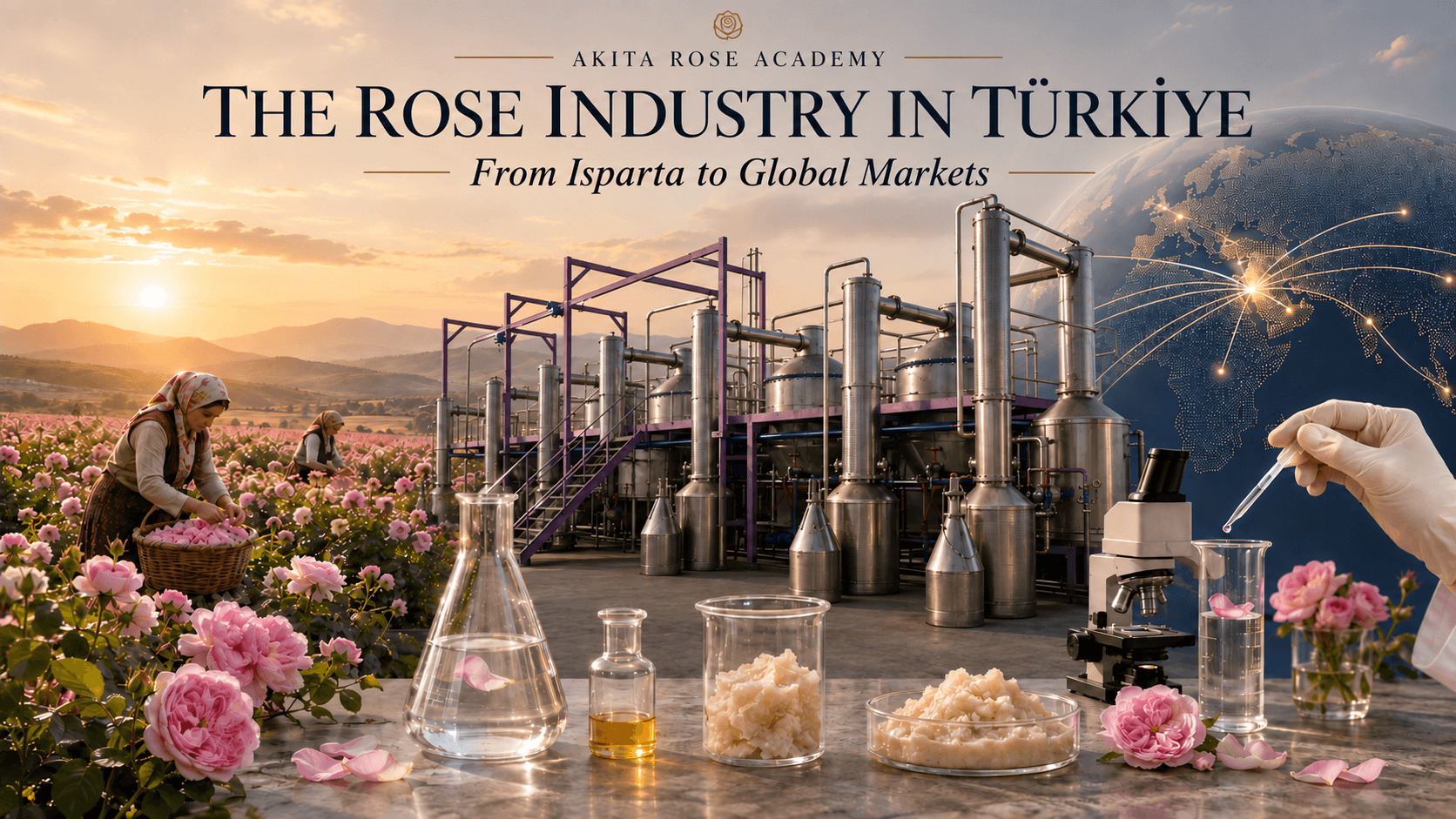
The Rose Industry in Türkiye: From Isparta to Global Markets
From Rosa damascena Cultivation to Rose Oil, Rose Water, Extracts and High-Value Products
Throughout human history, the rose has been admired as a symbol of beauty and fragrance. Today, however, it is also an important industrial crop and a valuable raw material traded internationally.
Among the many cultivated rose species, the oil-bearing rose, Rosa damascena Mill., holds particular economic importance. Its flowers can be transformed into a wide range of products, including rose essential oil, rose water, rose distillates, rose concrete and rose absolute.
Türkiye is one of the world’s important producers of oil-bearing roses, supported by generations of cultivation experience, an established production infrastructure centred in Isparta, and the capacity to manufacture several categories of rose-derived products.
Yet the rose industry cannot be understood simply by measuring how many flowers are harvested.
The complete value chain includes cultivation, harvesting, transportation, distillation, extraction, laboratory analysis, quality standardization, packaging, branding, trade and export.
For this reason, the rose industry should be viewed as an integrated value chain that begins in the field and extends to the international perfume, cosmetics, personal care and natural-products industries.
What Is the Rose Industry?
The rose industry is much broader than rose cultivation alone.
Rose gardens form the agricultural foundation of the sector, but the value chain continues through numerous technical, industrial and commercial activities, including:
Propagation of oil-bearing rose plants
Establishment and maintenance of rose gardens
Hand harvesting of flowers
Transportation of freshly harvested roses to processing facilities
Distillation and extraction
Production of rose oil, rose water, rose distillates, concrete and absolute
Physical, chemical and microbiological analysis
Storage and packaging
Formulation for perfume, cosmetics, personal care and food applications
Domestic and international trade
Branding
Rose tourism and regional promotion
The rose industry is therefore a multidisciplinary economic field in which agriculture, chemistry, cosmetics, perfumery, international trade, tourism and cultural heritage intersect.
Rose Academy Note
The oil-bearing rose industry should not be confused with the cut-flower industry.
In floriculture, roses are primarily produced for their visual and decorative value. In the oil-bearing rose industry, by contrast, the flower is an industrial raw material used to produce essential oil, aromatic waters, extracts and other value-added products.
Oil-Bearing Rose Cultivation in Türkiye
Commercial oil-bearing rose production in Türkiye is based primarily on Rosa damascena Mill., commonly associated with the Isparta region.
The species is highly valued for its distinctive aromatic profile and has particular importance for the perfume and cosmetics industries.
Commercial cultivation is concentrated mainly in Türkiye’s Lakes Region, particularly in:
Isparta
Burdur
Afyonkarahisar
Denizli
Experimental or smaller-scale production has also occurred in other provinces at different times, but the principal industrial production centre remains the Lakes Region.
According to a study by Erbaş and Mutlucan based on Turkish Statistical Institute data, the area devoted to oil-bearing rose cultivation in the Lakes Region increased from 30,832 decares in 2012 to 41,668 decares in 2022.
In 2022, approximately:
82.3% of the production area was located in Isparta
8.7% in Burdur
6.4% in Afyonkarahisar
The remaining area was largely located in Denizli
The same research reported total rose flower production of approximately 16,932 tonnes in 2022, with 85.2% of the flowers originating from Isparta.
These figures demonstrate that Isparta is not merely symbolically associated with the rose. It is also the agricultural centre of Türkiye’s oil-bearing rose industry.
However, these figures describe the 2022 production season. Cultivation area, flower yield and total production can vary from year to year depending on weather conditions, agricultural productivity, the age of plantations and economic factors.
Why Did Isparta Become a Centre of the Rose Industry?
Isparta’s importance cannot be explained by climate alone.
Its development as a specialized rose-producing region reflects the interaction of:
Geography
Agricultural knowledge
Generations of producer experience
Processing infrastructure
Distillation expertise
Research capacity
Commercial networks
Climate and Soil Conditions
Oil-bearing roses are generally cultivated in well-aerated locations with adequate sunlight, suitable soil conditions and good drainage that prevents prolonged water accumulation around the root zone.
Variations in elevation around Isparta, together with differences between daytime and nighttime temperatures and regional spring conditions, can provide favourable conditions for oil-bearing rose cultivation.
Flowering can begin earlier at lower elevations and later at higher elevations.
As a result, the overall regional harvesting season may be extended, even though the period of intensive flowering within an individual rose garden remains relatively short.
This short harvest window makes careful coordination of labour and distillation capacity especially important.
A Historical Production Tradition
Academic sources trace commercial oil-bearing rose cultivation in Isparta to the late nineteenth century.
İsmail Efendi is reported to have begun cultivating oil-bearing roses in Isparta in 1888, producing rose oil using traditional techniques.
During the Republican period, the establishment of modern distillation systems, followed by the development of cooperatives and private companies, increased the region’s production capacity.
Over time, an extensive regional network developed that included:
Rose growers
Harvest workers
Distillation specialists
Cooperatives
Processing facilities
Laboratories
Universities
Export companies
The concentration of these activities in the same geographical region transformed Isparta from a rose-growing area into a specialized agricultural and industrial cluster.
Geographical Indication: Isparta Rose Oil
Isparta Gülyağı, or Isparta Rose Oil, was registered as a protected designation of origin by the Turkish Patent and Trademark Office on March 7, 2019.
The registration documentation defines elements such as:
The geographical area
Raw-material origin
Production methods
Product characteristics
Inspection and verification procedures
The purpose of a geographical indication is not simply to protect a product name.
It also formally documents the relationship between a product and its geographical origin, traditional production knowledge and characteristic qualities.
From the Rose Field to an Industrial Product
Transforming a fresh rose flower into a commercially valuable product requires the successful management of several interconnected stages.
1. Cultivation
Establishing a rose garden requires:
Suitable land
Healthy planting material
Appropriate planting design
Long-term crop management
Pruning, irrigation, fertilization, soil management, weed control and integrated pest management may all influence flower yield and crop quality.
2. Harvesting
Oil-bearing rose flowers are generally harvested by hand during the early morning.
The objective is to collect the flowers before daytime temperatures rise significantly and while minimizing damage to the delicate floral material.
Because the flowering period is relatively short, large numbers of workers may be required within a limited period.
Manual labour is therefore an important factor affecting both the economics and long-term sustainability of the rose industry.
3. Transportation and Holding Time
Freshly harvested flowers should reach the processing facility as quickly as practicable.
Compression, heat accumulation and prolonged holding before processing can encourage fermentation and may alter the aromatic profile of the flowers.
For this reason, proximity between rose gardens and processing facilities can provide an important production advantage.
If harvesting volume exceeds available distillation capacity, flowers may need to wait before processing, potentially affecting the quality of the resulting material.
4. Distillation and Extraction
Rose flowers can be processed in different ways depending on the product being manufactured.
Distillation may produce:
Rose essential oil
Aromatic aqueous products
Rose water
Rose distillates
Extraction may produce:
Rose concrete
Further processing of rose concrete may produce:
Rose absolute
Different production methods lead to products with different chemical profiles, sensory characteristics, applications and commercial values.
For this reason, terms such as rose oil, rose water, rose distillate, rose concrete and rose absolute should not be treated as interchangeable.
5. Quality Control
Following production, several characteristics may need to be evaluated depending on the product and its intended application.
These include:
Botanical identity
Raw-material origin
Physical characteristics
Chemical composition
Purity
Microbiological quality
Suitability for the intended application
Analytical evaluation is therefore an essential component of professional rose production.
6. Packaging, Storage and Trade
Light, temperature, oxygen exposure and packaging material can affect the stability of rose-derived products.
Products stored under appropriate conditions can subsequently enter domestic or international markets together with the relevant documentation and analytical results required for their intended use.
Major Products of the Rose Industry
| Product | Main Production Approach | Typical Applications |
|---|---|---|
| Rose Essential Oil | Distillation followed by separation of the oil phase | Fine fragrance, cosmetics and aromatic formulations |
| Rose Water | Aromatic aqueous phase obtained through distillation | Cosmetics, personal care, traditional uses and some food applications |
| Rose Distillate | Distillation of rose flowers under defined production conditions | Cosmetic products and skincare formulations |
| Rose Concrete | Extraction of flowers using an appropriate solvent system | Perfumery raw material |
| Rose Absolute | Further processing of rose concrete | Fine fragrance and specialized perfume compositions |
| Dried Roses and Rosebuds | Controlled drying | Tea, food, decoration and cosmetic applications |
| Rose Wax | Waxy fraction separated during concrete processing | Cosmetic and perfumery applications |
| Spent Rose Biomass | Plant material remaining after distillation | Compost, organic-matter applications and research into new materials |
These materials are not synonymous.
Rose water, rose distillate, rose essential oil, rose concrete and rose absolute differ in their production methods, composition and intended uses.
By-Product or Waste?
Distillation produces more than the principal commercial product.
Plant biomass and process water remaining after production may become waste if no suitable recovery or utilization system is available.
However, these materials may potentially be converted into useful by-products through approaches such as:
Controlled composting
Recovery of plant-derived compounds
Development of new materials
Research into alternative industrial applications
This represents an important area of future research within the circular economy.
The challenge is therefore not simply how to produce rose-derived materials, but also how to use the entire production stream more efficiently.
How Is the Quality of Rose Products Evaluated?
The quality of a natural rose product cannot be determined by aroma alone.
Botanical authentication, production documentation, laboratory analysis and traceability should be considered together.
Depending on the product category and intended application, quality evaluation may include:
Botanical species and raw-material source
Production location
Harvest date
Batch number
Distillation or extraction method
Density
Refractive index
Optical rotation
Acid value
Ester value
Chemical profiling by GC-FID or GC-MS
Microbiological quality
Pesticide residues
Heavy metals
Allergen information
Appropriate storage conditions
Rose essential oil contains compounds such as citronellol, geraniol, nerol and linalool, together with numerous constituents present at much lower concentrations that may nevertheless contribute significantly to the overall aroma.
The concentration of any single compound should not be used in isolation to classify an oil as either “good” or “bad.”
The chemical profile should be interpreted as a whole and, where applicable, assessed in relation to appropriate specifications and standards.
It is also important to recognize that a perfumery raw material, a cosmetic ingredient and a food-grade product are not necessarily governed by the same regulatory requirements.
The intended use of a rose-derived material determines which analyses, specifications and documentation may be required.
Türkiye’s Rose-Product Exports
Rose oil, rose concrete, rose absolute and other aromatic materials produced in Türkiye are exported for use primarily in:
Perfumery
Cosmetics
Personal care
Aromatic raw-material applications
A 2023 study by Erbaş and Mutlucan reported that, for the 2020 production period, Türkiye produced approximately:
2,250 kg of rose oil
13 tonnes of rose concrete
3.5 tonnes of rose absolute
1.1 tonnes of phenethyl alcohol
The same study reported an export value of approximately US$19.4 million for rose-based products in 2020.
These figures relate specifically to the period examined in that study and should not automatically be presented as current production or trade values.
A Critical Note on Interpreting International Trade Data
Measuring rose-product exports is more complicated than it may first appear.
Some international customs classifications combine several essential oils and aromatic extracts within the same product code.
For example, World Bank WITS data under HS 330129 cover a broad category of “other essential oils,” including certain concretes and absolutes.
Under this category, Türkiye’s exports in 2024 were recorded at approximately:
US$44.84 million
with a reported quantity of approximately:
352,567 kg
The leading destinations by export value included approximately:
| Country | 2024 Export Value |
|---|---|
| France | US$25.13 million |
| United Kingdom | US$4.12 million |
| United States | US$2.23 million |
| Germany | US$1.97 million |
| Hungary | US$1.39 million |
However, these figures must not be interpreted as rose oil exports alone.
HS 330129 may include other essential oils, concretes and absolutes.
Rose Academy Data Note
It would therefore be incorrect to state:
“Türkiye exported US$44.84 million worth of rose oil in 2024.”
A more accurate statement is:
In 2024, Türkiye exported approximately US$44.84 million in products classified under HS 330129, a broad category covering other essential oils and certain concretes and absolutes. The total does not represent rose products alone.
A rose-specific export figure would require examination of more detailed national customs classifications, product declarations and official trade records for the relevant period.
This distinction is essential when presenting commercial statistics in an academic or professional context.
Why Are European Markets Important for Turkish Rose Products?
European countries such as France, Switzerland, Germany and the United Kingdom have significant industries in:
Fine fragrance
Fragrance ingredients
Cosmetics
Personal care
Aromatic raw-material trading
Natural aromatic materials produced in Türkiye may therefore enter these markets for use in:
Perfume compositions
Cosmetic formulations
Fragrance blends
Personal-care products
Aromatic raw-material processing and trade
France is particularly significant because of its established position within the global fragrance and perfumery industry.
However, the destination listed in international trade statistics is not always the country where the product is ultimately consumed.
Certain countries also function as processing, trading and re-export centres.
The Global Rose-Products Market
The oil-bearing rose is not an ordinary agricultural crop that can be produced commercially at the same scale in every region.
Successful production depends on the interaction of:
Suitable plant material
Climate
Labour availability
Harvest organization
Processing infrastructure
Technical expertise
Countries and regions associated with commercial rose production include:
Türkiye
Bulgaria
Iran
Morocco
India
China
However, the rose species cultivated, production volumes, processing methods and final products are not identical across these countries.
Türkiye and Bulgaria are particularly well known for Rosa damascena-based rose essential oil production.
Iran also has a major tradition of rose water production and use.
Morocco has regional rose-production systems, while India has its own traditions involving different rose species and attar production.
For this reason, comparisons between producing countries should consider much more than the question:
“Which country produces the most roses?”
A meaningful comparison should also evaluate:
Species and cultivar
Flower production volume
Essential-oil yield
Production method
Chemical profile
Purity
Traceability
Organic certification
Labour costs
Product diversity
Branding
Target markets
Türkiye’s Position in the Global Market
In their assessment of the 2020 period, Erbaş and Mutlucan estimated global rose oil production at approximately 6–6.5 tonnes and rose concrete production at approximately 12–14 tonnes.
In the same study, Türkiye’s share was estimated at approximately:
30% of global rose oil production
90% of rose concrete production
These figures are significant, but they represent estimates for a particular period and source.
There is no single publicly available global database that consistently collects production figures from every producer using exactly the same methodology each year.
Consequently, these percentages should not be presented as permanent values applicable to every harvest year.
A more academically appropriate conclusion is:
Türkiye is one of the world’s major producers and suppliers of Rosa damascena-based rose oil, rose concrete and other rose-derived products. Its share of the global market varies according to the product category, harvest year, production volume and data source used.
What Determines the Price of Rose Products?
There is no single universal price for one kilogram of rose oil or rose absolute.
Price is influenced by multiple variables extending from agricultural production to laboratory evaluation and global demand.
Agricultural Factors
Winter and spring conditions
Frost
Hail
Excessive rainfall
Drought
Age and management of rose plantations
Flower yield
Pests and plant diseases
Harvest labour costs
Production Factors
Time of harvesting
Time between harvest and processing
Distillation or extraction method
Energy consumption
Water consumption
Product yield
Storage conditions
Quality Factors
Botanical authenticity
Chemical profile
Purity
Residue testing
Organic certification
Geographical indication
Batch traceability
Buyer-specific quality requirements
Commercial Factors
Global perfume and cosmetics demand
Currency exchange rates
Labour costs
Energy costs
Order volume
Logistics costs
Whether the material is sold as a raw ingredient or transformed into a branded finished product
For these reasons, statements such as:
“One kilogram of rose oil costs X dollars”
can be misleading if they are presented without a date, quality specification, production origin and commercial context.
Strengths of Türkiye’s Rose Industry
Türkiye has several important advantages in the international rose sector:
Generations of oil-bearing rose cultivation experience
A specialized production infrastructure centred in Isparta
Experienced growers and distillation facilities
Production at different elevations within the same region
Capacity to manufacture rose oil, concrete, absolute and aromatic aqueous products
Geographic proximity to European and Middle Eastern markets
Collaboration between universities, laboratories and industry
The Isparta Rose Oil geographical indication
A strong regional rose culture
Rose tourism
Potential for the development of high-value cosmetic products
However, being a major producing country does not mean that every product automatically has the same quality.
Quality must be verified at the level of the individual producer, product and batch through appropriate analytical and documentation systems.
Major Challenges Facing the Sector
An academic assessment must consider the challenges of the rose industry as well as its strengths.
Climate Change and Water Management
Changes in temperature, irregular rainfall, drought, late frost and extreme weather events may influence flowering time and crop yield.
Efficient water management is therefore likely to become increasingly important for the future of the industry.
Labour Availability
Rose flowers are harvested during a short seasonal window and are still largely collected by hand.
This creates a high demand for labour over a limited period.
Declining rural populations and increasing labour costs may make harvest organization more difficult in the future.
Delays Before Processing
When harvest volume exceeds the available processing capacity, flowers may remain unprocessed for extended periods.
Inappropriate or prolonged holding conditions can contribute to fermentation and changes in the relative proportions of volatile compounds.
Matching harvesting capacity with processing capacity is therefore an important quality-management issue.
Variability in Quality and Standardization
Producers may differ in their approaches to:
Raw-material acceptance
Distillation conditions
Storage
Laboratory analysis
Documentation
Traceability
Strengthening shared quality principles and standardized production practices may help reinforce Türkiye’s position in international markets.
Exporting Raw Materials Versus Creating Added Value
Exporting high-value raw materials such as rose oil and rose concrete creates important economic activity.
However, even greater added value may be generated when natural raw materials are transformed into:
Branded cosmetics
Finished personal-care products
Fine fragrance
Scientifically characterized botanical ingredients
Innovative formulations
For this reason, Türkiye’s long-term opportunity is not limited to being a supplier of raw materials.
Scientific research, product development, formulation technology and international brand building can significantly expand the economic value created from the rose.
Adulteration and Imitation Products
High-value natural products may be vulnerable to adulteration.
Potential problems can include:
Dilution with less expensive oils
Addition of synthetic components
Misleading labelling
False statements regarding botanical or geographic origin
Laboratory analysis, traceability and reliable supply-chain documentation are therefore critical components of quality assurance.
Natural origin alone should never be accepted as a substitute for analytical verification.
Rose Tourism and the Regional Economy
In Isparta, the rose is more than an agricultural crop.
It has become part of the region’s cultural identity.
During the harvest season, activities such as:
Rose-garden visits
Photography tours
Festivals
Cultural events
Local-product experiences
can contribute to rural tourism.
Rose tourism may help:
Connect growers directly with consumers
Increase awareness of regional products
Support accommodation and food-service businesses
Preserve the visibility of traditional harvesting practices
Strengthen Isparta’s international identity as a rose-producing region
However, rose fields should not be presented merely as visual attractions.
Responsible rose tourism should also communicate the realities behind production, including:
Harvest labour
Agricultural management
Water use
Biodiversity
Rural livelihoods
The economic contribution of local communities
In this way, tourism can help visitors understand not only the beauty of the rose field, but also the agricultural system behind it.
The Future of the Rose Industry
The future of Türkiye’s rose industry will not depend solely on producing more flowers.
The greater opportunity lies in transforming existing agricultural resources into higher-value products through science, technology, traceability and brand development.
Priority Areas for Future Development
Key areas include:
Water efficiency
Energy efficiency
Climate-adaptive cultivation practices
Integrated and organic pest-management strategies
Protection of soil health
Batch-level traceability
Standardized production protocols
Advanced chemical analysis
New distillation technologies
New extraction technologies
Utilization of spent rose biomass
Utilization of process water
Planned development of organic production
University-industry collaboration
Export of branded finished products
International promotion of geographical indications
Sustainable development of rose tourism
From Raw-Material Export to Knowledge Export
There is a fundamental difference between selling rose flowers, rose oil or rose concrete and developing proprietary technologies, analytical methods, formulations and internationally recognized brands.
The future value of the rose industry will not be measured only by the amount of essential oil in a bottle.
Value will increasingly be created through:
Scientific characterization of the product
Documentation of production methods
Chemical analysis
Traceability of origin
Development of innovative formulations
Quality assurance
Intellectual and technological know-how
International branding
This represents a transition from exporting raw materials to exporting knowledge, technology and finished products.
Conclusion: A Value Chain Extending from Isparta to the World
Türkiye is one of the major centres of the global oil-bearing rose industry, particularly through the production culture that has developed in Isparta and the surrounding Lakes Region.
Isparta’s importance is not based on climate and soil alone.
Its strength lies in the concentration of:
Experienced growers
Harvest knowledge
Distillation facilities
Laboratories
Universities
Commercial expertise
Export networks
within the same production region.
Yet production volume alone is not sufficient for long-term success in international markets.
Quality, standardization, traceability, sustainability, scientific research, product diversification and brand development must progress together.
The major opportunity for Türkiye is therefore not simply to export the Isparta rose as a valuable raw material.
The greater opportunity is to transform it into scientifically characterized, innovative, high-value and trusted finished products.
The future of the rose industry will be shaped at the point where traditional production knowledge meets modern science, technology and innovation.
Frequently Asked Questions
Where are oil-bearing roses mainly grown in Türkiye?
Oil-bearing rose production in Türkiye is concentrated primarily in Isparta. Burdur, Afyonkarahisar and Denizli are also important production areas within the Lakes Region.
According to 2022 data cited in the source study, approximately 82.3% of the regional production area was located in Isparta.
Why is Isparta important for rose production?
Isparta has developed into a specialized rose-industry centre because of the combination of suitable growing conditions, generations of producer experience, processing facilities, cooperatives, laboratories, research institutions and established commercial infrastructure.
What percentage of the world’s rose oil does Türkiye produce?
There is no single percentage that remains valid every year.
An academic study evaluating the 2020 period estimated Türkiye’s share of global rose oil production at approximately 30%.
This figure should be understood as an estimate for a particular period rather than a permanent market share.
How much does Türkiye export in rose products?
A study using 2020 data reported rose-based product exports of approximately US$19.4 million.
Separately, international trade data recorded approximately US$44.84 million of exports in 2024 under HS 330129.
However, HS 330129 is a broader category that includes products beyond roses. The US$44.84 million figure must therefore not be presented as Türkiye’s rose-product exports alone.
Which markets are important for rose-derived products from Türkiye?
France, the United Kingdom, Germany, Switzerland and the United States are among the significant markets for natural aromatic materials.
However, rankings vary according to product category, customs classification and year.
Are rose oil and rose concrete the same product?
No.
Rose essential oil is obtained through distillation, whereas rose concrete is produced through an appropriate extraction process.
They differ in their production methods, composition, aromatic characteristics and applications.
Does Isparta Rose Oil have a geographical indication?
Yes.
Isparta Rose Oil was registered by the Turkish Patent and Trademark Office as a protected designation of origin on March 7, 2019.
What will shape the future of the rose industry?
Important areas include:
Sustainable agriculture
Climate-change adaptation
Water and energy efficiency
Traceability
Scientific analysis
New production technologies
By-product utilization
Standardization
University-industry cooperation
Development and export of branded finished products
The future of the industry will depend increasingly on how effectively traditional knowledge can be integrated with modern science, technology and responsible production.
References
Batı Akdeniz Kalkınma Ajansı. (2021). Yağ gülü tarımı ve endüstrisi [Oil-bearing rose cultivation and industry].
Baydar, H., & Erbaş, S. (2018). Ülkemizin dünya yağ gülü (Rosa damascena Mill.) pazarındaki yeri [Türkiye’s position in the global oil-bearing rose (Rosa damascena Mill.) market]. TÜRKTOB Dergisi, 26, 14–20.
Baydar, H., & Kazaz, S. (2013). Yağ gülü ve Isparta gülcülüğü [Oil-bearing rose and rose cultivation in Isparta]. Gülbirlik Publications.
Erbaş, S., & Baydar, H. (2016). Variation in scent compounds of oil-bearing rose (Rosa damascena Mill.) produced by headspace solid-phase microextraction, hydrodistillation and solvent extraction. Records of Natural Products, 10(5), 555–565.
Erbaş, S., & Mutlucan, M. (2023, May 11–12). Oil bearing rose (Rosa damascena Miller) farming and production of rose-based products in Turkey. International Flower Conference, Baku, Azerbaijan.
Turkish Patent and Trademark Office. (2019). Isparta Gülyağı: Geographical indication registration certificate No. 421.
Turkish Statistical Institute. (2025). Crop Production Statistics, 2024.
World Bank. (2026). Turkey exports of essential oils, including concretes and absolutes, HS 330129, 2024. World Integrated Trade Solution.