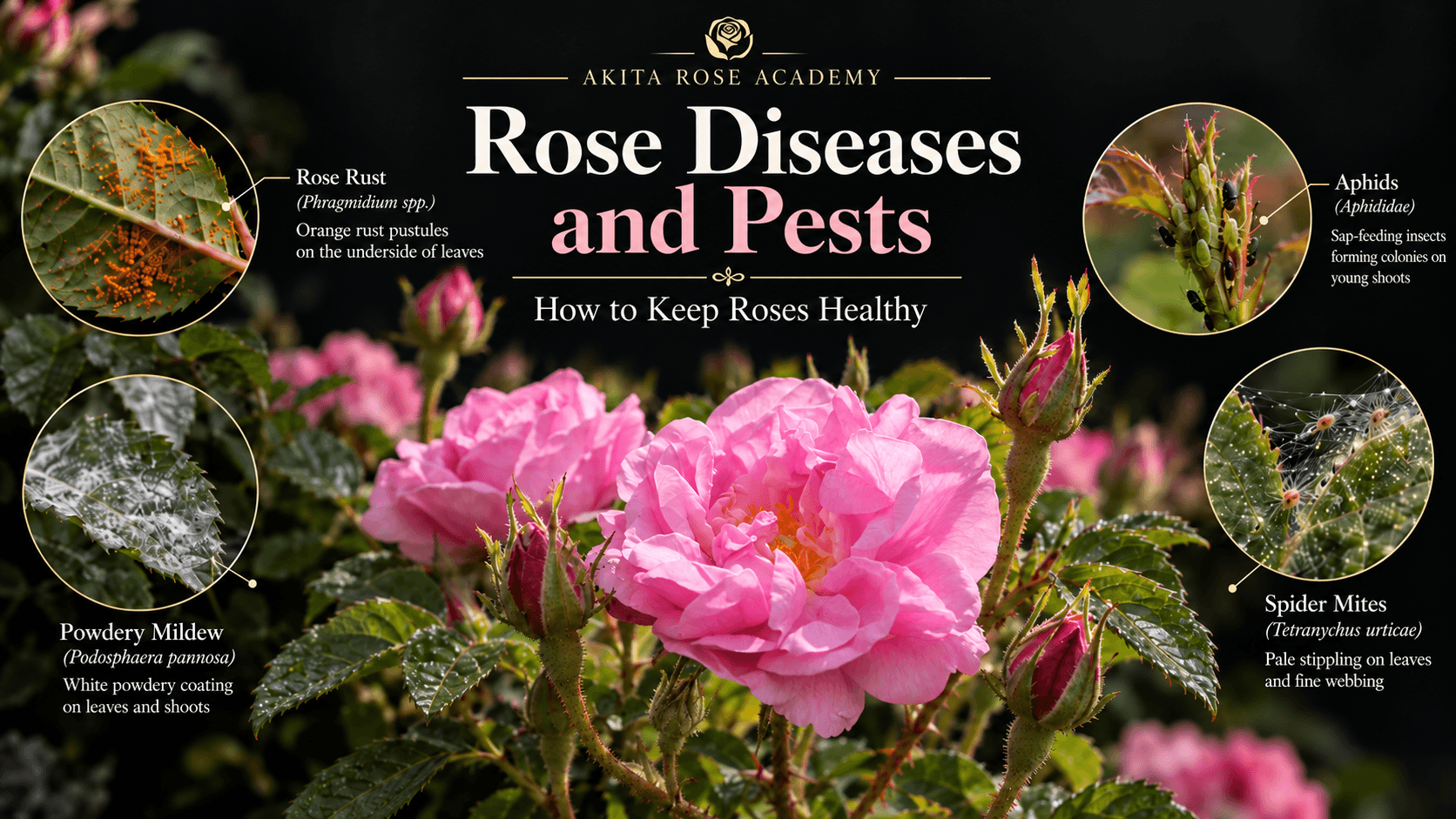
Rose Diseases and Pests
How to Keep Roses Healthy
Roses are strong and resilient plants. However, like all plants, they can sometimes be affected by diseases and pests. The good news is that most roses can remain healthy when they are cared for properly. Recognizing problems early and responding with natural, environmentally responsible methods can help protect both the plant and the surrounding ecosystem.
In this article, we explore some of the most common diseases and pests encountered in rose growing, using clear and easy-to-understand language.
Why Do Rose Diseases Develop?
Rose diseases can develop for several reasons. In most cases, plant stress and environmental conditions play an important role.
Excess Moisture
When leaves remain wet for long periods, fungal diseases are more likely to develop.
Poor Air Circulation
When roses are planted too closely together, air movement decreases, creating a more favourable environment for disease.
Improper Watering
Watering late in the day or wetting the leaves unnecessarily can increase the risk of disease.
Unbalanced Fertilization
Too much nitrogen can encourage weak, overly soft growth that may be more vulnerable to disease.
Stress
Drought, frost, and extreme heat can reduce a rose plant’s natural resistance.
1. Rose Rust
Rose rust is one of the most common fungal diseases found on roses. It is caused by a fungus and is seen most often in spring and fall.
Symptoms
- Small orange or rust-coloured pustules appear on the undersides of leaves
- Yellow spots may appear on the upper leaf surface
- In more advanced stages, leaves dry out and fall prematurely
- The plant becomes weaker and may produce fewer flowers
What Causes It?
- Constant moisture
- Rainy weather
- Poor air circulation
- Wet foliage
How to Help Prevent It
- Remove and discard infected leaves
- Avoid planting roses too closely together
- Water in the morning
- Try to keep leaves from staying wet for long periods
2. Powdery Mildew
Powdery mildew is one of the easiest rose diseases to recognize. It appears as a white, powder-like coating on the leaves, as though flour has been dusted over the plant.
Symptoms
- White powdery growth on leaves and shoots
- Curling or distortion of leaves
- Poor development of young shoots
- Flower buds may fail to open properly
Why Does It Occur?
- Cool nights followed by warm days
- Poor air circulation
- Excessive use of nitrogen-rich fertilizers
Prevention
- Prune the centre of the plant to improve airflow
- Avoid overusing high-nitrogen fertilizers
- Remove infected shoots promptly
What Are Rose Pests?
While diseases are often caused by fungi, pests are small organisms that feed on the plant.
Some chew on leaves.
Some suck sap from plant tissues.
Others interfere with bud and flower development.
3. Aphids
Aphids are very small insects. They may be green, black, yellow, or brown. They are commonly found on tender new shoots and young buds.
Symptoms
- Curling leaves
- Sticky residue on the plant, known as honeydew
- Poor bud development
- Ants moving around on the plant
Ants are often seen alongside aphids because they are attracted to the sweet honeydew aphids produce.
How They Harm the Plant
Aphids feed by sucking sap from the plant. As a result:
- growth may slow down
- flowering may be reduced
- shoots may become weak
4. Spider Mites
Spider mites are not actually spiders. They are tiny mites, and they multiply quickly in hot, dry conditions.
Symptoms
- Tiny pale or yellow speckles on the leaves
- Fine webbing on the plant
- Leaves may take on a bronzed appearance
- Early leaf drop may occur
When Are They Most Common?
- During summer
- In greenhouses
- In dry periods
Organic and Environmentally Responsible Control Methods
Whenever possible, the first choice should be natural and environmentally responsible methods. Chemical products should be used only when truly necessary and always according to label directions and local regulations.
1. Inspect Roses Regularly
Examine your roses at least once a week.
Problems that are detected early are usually much easier to manage.
2. Remove Diseased Leaves
Collect infected leaves and remove them from the garden.
It is generally safer not to place diseased plant material in home compost.
3. Improve Air Circulation
Do not plant roses too closely together.
Prune as needed to allow better air movement and sunlight penetration.
4. Water Properly
Water early in the morning.
Whenever possible, water the soil rather than the leaves.
5. Protect Beneficial Insects
Some insects are natural allies in the garden.
- Ladybugs feed on aphids
- Some hoverfly larvae also feed on aphids
- Bees support the broader garden ecosystem
Protecting beneficial insects helps strengthen the natural balance of the garden.
6. Maintain Good Plant Hygiene
- Remove fallen leaves
- Keep pruning tools clean
- Separate diseased branches from healthy ones during pruning
Golden Rules for Healthy Roses
🌹 Check your roses regularly
🌹 Water in the morning
🌹 Maintain good air circulation
🌹 Use balanced fertilizer
🌹 Remove diseased leaves promptly
🌹 Protect beneficial insects
🌹 Avoid unnecessary chemical use
Conclusion
With proper care, roses can remain healthy and beautiful for many years. Problems such as rose rust, powdery mildew, aphids, and spider mites can often be managed successfully when they are noticed early. Through regular observation, proper watering, good pruning practices, and environmentally responsible control methods, it is possible to protect both your garden and the beneficial organisms that support it.
References (APA 7)
Agrios, G. N. (2005). Plant pathology (5th ed.). Elsevier Academic Press.
Horst, R. K. (2013). Westcott's plant disease handbook (8th ed.). Springer.
Royal Horticultural Society. (2024). Rose pests and diseases. https://www.rhs.org.uk
University of California Integrated Pest Management Program. (2024). Roses: Pests in gardens and landscapes. https://ipm.ucanr.edu
Suggested Section Headings
- Why Do Rose Diseases Develop?
- Rose Rust
- Powdery Mildew
- Aphids
- Spider Mites
- Organic and Environmentally Responsible Control Methods
- Golden Rules for Healthy Rose Growing
Explore More with Akita Rose Academy
🌹 Would you like to learn more about roses?
Discover our other educational resources on rose growing, pruning, care, distillation, and Rosa damascena. With Akita Rose Academy, you can continue exploring the scientific and natural world of roses step by step.