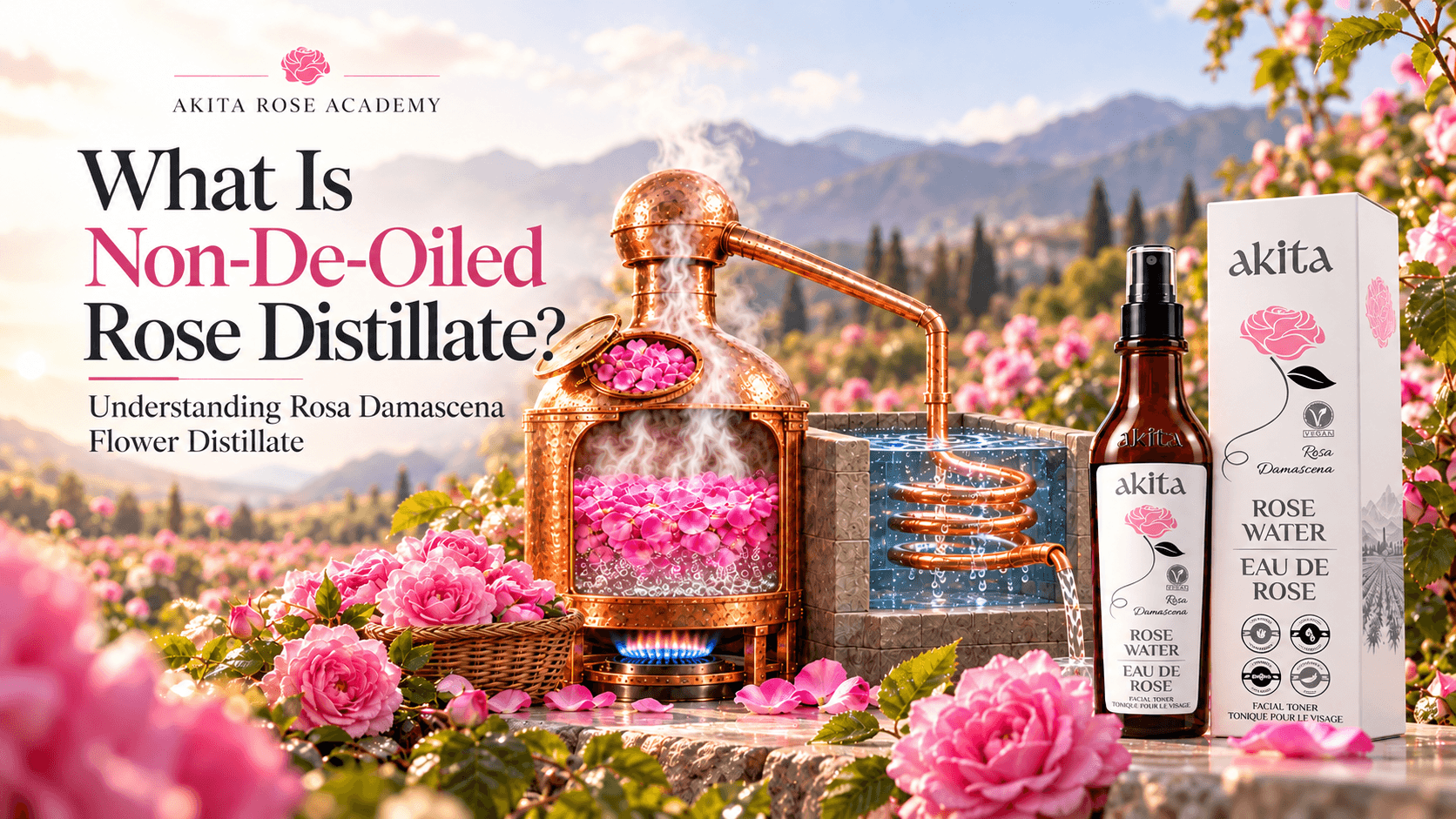
What Is Non-De-Oiled Rose Distillate? Understanding Rosa Damascena Flower Distillate and Its INCI Name
Explore Akita's non-de-oiled rose distillate, developed in 2003, its distinctive production process, its contribution to international cosmetic ingredient nomenclature, and its chemical characteristics examined through GC–MS analysis.
When reading the ingredient list of a cosmetic product, you may come across the following name:
Rosa Damascena Flower Distillate
What does this name mean? Why is Rosa Damascena Flower Distillate used instead of the more familiar Rosa Damascena Flower Water? Is the difference simply a matter of terminology, or can it also reflect differences in how the ingredients are produced?
Understanding these questions takes us back to 2003, when Akita developed its Non-De-Oiled Rose Water production approach.
In conventional rose essential oil production, the oil phase formed during distillation may be separated and collected as a distinct product. Akita's approach follows a different production objective: rather than extracting rose essential oil as the primary product, the process is designed to obtain the rose distillate itself without deliberately separating the essential oil fraction.
To establish an appropriate identity for this botanical ingredient within international cosmetic terminology, Akita initiated an application for an INCI name.
According to Akita's published company records, the INCI name Rosa Damascena Flower Distillate was accepted on January 18, 2026, marking an important milestone in the company's ongoing work with rose-derived ingredients.
Through this initiative, Akita contributed to bringing the ingredient name Rosa Damascena Flower Distillate into international cosmetic ingredient nomenclature.
However, an ingredient's INCI name, its manufacturing process, and its chemical composition are three different matters.
An INCI name provides a standardized designation for a cosmetic ingredient. Analytical techniques such as gas chromatography–mass spectrometry (GC–MS) help researchers examine its chemical profile. Manufacturing records explain how the ingredient is produced.
In this article, we explore the science behind non-de-oiled rose distillate, Akita's contribution to INCI nomenclature, and what GC–MS analysis can reveal about the chemical characteristics of this botanical ingredient.
What Is a Distillate? Is It Different from Rose Water?
A distillate is a liquid obtained by cooling and condensing vapour generated during a distillation process.
When Rosa damascena flowers are heated together with water, certain volatile aromatic compounds naturally present in the flowers can be carried along with the resulting water vapour.
As this vapour passes through a cooling system, it condenses back into liquid form.
The collected aromatic liquid is known as rose distillate.
Not every chemical compound found in a rose flower is transferred during distillation.
Some volatile compounds enter the distillate, while many non-volatile substances remain in the water or plant material inside the distillation vessel.
Rose distillate is therefore not an exact chemical replica of the original flower.
It is a distinct product containing compounds that can be transferred and collected under the conditions of the distillation process.
Do Rose Water and Rose Distillate Mean the Same Thing?
In everyday language, distilled rose water may also be described as rose distillate.
However, the term rose water does not, by itself, explain every aspect of how the product was manufactured.
Rose water may be:
Obtained directly through distillation.
Collected as the aromatic aqueous phase after rose essential oil has been separated.
Produced through a process specifically designed to obtain rose water as the principal product.
Manufactured using different distillation methods, operating conditions, or production durations.
Consequently, two products described by the same general name do not necessarily have identical chemical compositions or manufacturing histories.
Rose Academy Note
Rose distillate is not an infusion made by soaking rose petals in water.
It is obtained by cooling and collecting the aromatic vapour produced during the distillation of rose flowers.
Nevertheless, not every rose distillate is manufactured under the same conditions or has the same chemical composition.
What Is Non-De-Oiled Rose Distillate?
Non-de-oiled rose distillate is obtained through a production process in which the volatile essential oil fraction formed during the distillation of Rosa damascena flowers is not deliberately removed to produce a separate essential oil product.
According to Akita's technical manufacturing documentation, its process is based on a single, extended distillation operation.
The central distinction lies in the objective of production.
Rather than producing rose essential oil as the primary product, the process is designed from the beginning to obtain the rose distillate itself.
How Does Akita's Production Process Work?
According to Akita's documented manufacturing approach:
Fresh Rosa damascena flowers are placed in the distillation system together with water.
A single, extended distillation process is carried out.
Distillation time, pressure, and cooling conditions are controlled according to the manufacturing method.
The collected distillate is not subjected to decantation or centrifugation for the purpose of removing the oil fraction.
The volatile essential oil fraction is not collected as a separate product.
No second distillation step is performed.
Rose essential oil, ethanol, solvents, preservatives, or other additives are not subsequently introduced into the distillate.
The resulting distillate is treated as the intended final product of the manufacturing process.
Under this approach, rose distillate is not regarded as a secondary material remaining after essential oil production.
The distillate itself is the intended primary product from the beginning of the process.
What Does “Non-De-Oiled” Actually Mean?
The term non-de-oiled does not mean that rose essential oil has been added to finished rose water.
Instead, it describes a manufacturing approach in which the volatile essential oil fraction is not deliberately separated from the distillate to obtain an independent essential oil product.
There is, however, an important scientific distinction:
Not separating the essential oil does not mean that all of the oil becomes completely dissolved in water.
Depending on the chemical properties of the compounds and the production conditions, aromatic constituents may be present:
Dissolved in the aqueous phase.
As extremely small oil droplets dispersed throughout the liquid.
Within a portion of a separable oil phase, if the conditions allow such a phase to form.
The precise chemical composition and physical stability of a non-de-oiled rose distillate therefore cannot be established from the manufacturing description alone.
Appropriate laboratory measurements are also necessary.
Is Non-De-Oiled Rose Distillate the Same as Adding Rose Essential Oil to Water?
No.
Adding rose essential oil to previously prepared rose water does not automatically reproduce the distribution of aromatic compounds formed during distillation.
Rose essential oil is not fully miscible with water. When added afterward, the oil may accumulate at the surface or form droplets dispersed throughout the liquid.
Consequently, a distillate obtained directly through a process that does not separate the oil fraction and a formulation prepared by adding essential oil to water do not share the same manufacturing history.
Determining their precise chemical differences, however, requires appropriate comparative analysis.
Rose Essential Oil Production Versus Akita's Non-De-Oiled Distillation Approach
Both rose essential oil and aromatic rose water can be obtained from Rosa damascena flowers.
However, the objectives and operating conditions of a distillation process may influence the characteristics of the resulting products.
In conventional production systems focused on rose essential oil, a separable oil phase may form during condensation and be collected as a distinct product.
The remaining aromatic aqueous phase may then be used as rose water.
Some production methods also involve cohobation, in which aromatic water undergoes further distillation or is returned to the distillation system to recover additional volatile components.
Not all traditional rose water production, however, is directed primarily toward extracting essential oil. There are also manufacturing methods designed specifically to produce rose water.
Akita's approach is organized from the outset around obtaining the non-de-oiled distillate itself.
| Rose Essential Oil-Focused Distillation | Akita's Non-De-Oiled Distillate Approach |
|---|---|
| One of the principal objectives is to obtain rose essential oil. | The principal objective is to obtain the rose distillate itself. |
| A separable essential oil phase may be collected. | The essential oil fraction is not deliberately removed as a separate product. |
| Rose essential oil and rose water may be collected as distinct products. | The distillate is treated as the intended final product. |
| Certain methods may involve cohobation or further distillation. | Akita's documented method involves one extended distillation process. |
| Operating conditions may be optimized for essential oil recovery. | Operating conditions are established according to the desired distillate characteristics. |
These differences are scientifically relevant.
However, retaining the essential oil fraction does not, by itself, establish that one product is safer, higher in quality, or more effective than another.
Such comparisons require appropriate analytical testing and, where relevant, biological studies.
What Is INCI? The International Naming System for Cosmetic Ingredients
INCI stands for International Nomenclature of Cosmetic Ingredients.
It is a standardized naming system used to identify ingredients in cosmetic products.
INCI names are developed through the International Nomenclature Committee and published by the Personal Care Products Council (PCPC) in the International Cosmetic Ingredient Dictionary and Handbook.
Canada also uses INCI terminology for cosmetic ingredient labelling and notification.
Why Is the INCI System Important?
The same cosmetic ingredient may be sold under different commercial names in different countries.
Without a common naming system, comparing ingredient lists and identifying substances could become unnecessarily complicated.
INCI provides a shared terminology for the international cosmetics industry.
This system helps:
Identify cosmetic ingredients using standardized names.
Establish consistent terminology for manufacturers and formulators.
Improve clarity across scientific and technical documentation.
Support ingredient identification by regulatory authorities and industry professionals.
Help consumers understand and compare cosmetic ingredient lists.
An important distinction must be made.
Assigning an INCI name does not constitute official approval of an ingredient's safety, effectiveness, or quality.
The primary purpose of INCI is to establish internationally recognized ingredient names.
What Does the INCI Name Rosa Damascena Flower Distillate Mean?
The INCI name used for Akita's non-de-oiled rose distillate is:
Rosa Damascena Flower Distillate
Each part of this name provides information about the ingredient's identity.
Rosa Damascena
This identifies the botanical source of the ingredient.
Rosa damascena is an aromatic rose widely associated with the Isparta region of Türkiye, where it is cultivated for rose essential oil and rose water production.
Flower
This identifies the part of the plant used to obtain the ingredient.
It indicates that the ingredient is derived from the flowers rather than the leaves, roots, fruit, or seeds.
Distillate
This indicates that the ingredient is obtained through distillation.
The term refers to a product obtained through a process involving vapour formation and subsequent condensation.
The essential meaning of Rosa Damascena Flower Distillate is therefore a botanical distillate obtained from the flowers of Rosa damascena.
However, the name does not disclose every technical detail of the manufacturing process.
For example, the INCI name alone cannot establish precisely how long the distillation was carried out, what pressure conditions were applied, or whether an essential oil separation step was performed.
Why Rosa Damascena Flower Distillate Instead of Rosa Damascena Flower Water?
This question is important for understanding the identity of the ingredient developed by Akita.
In the cosmetics industry, Rosa Damascena Flower Water is a name used for rose water ingredients derived from Rosa damascena flowers.
Such rose waters may also be obtained through distillation.
Therefore, the term Flower Water does not imply that the ingredient was produced without distillation.
Rosa Damascena Flower Distillate is the name for which Akita submitted an INCI application and which, according to the company's published records, was subsequently accepted.
This name identifies the botanical source and distillate nature of the ingredient within international cosmetic ingredient terminology.
However, the term Flower Distillate is not, by itself, a technical guarantee that the essential oil fraction has not been separated.
The characteristics of Akita's production approach must be described through:
Manufacturing methods and production records.
Technical data sheets.
Raw material specifications.
Batch documentation.
Chemical and physical analysis results.
The INCI name and manufacturing process are therefore complementary forms of information, but they do not communicate exactly the same details.
Akita's Contribution to International Cosmetic Ingredient Nomenclature
Akita's work in this field can be understood through two important developments.
2003: Development of the Non-De-Oiled Rose Distillate Process
According to Akita's manufacturing history, its non-de-oiled rose water approach was developed in 2003.
Rather than focusing on recovering rose essential oil as a separate product, the process was designed to obtain the aromatic distillate from Rosa damascena flowers as the principal product.
The production method was organized to avoid deliberately removing the volatile essential oil fraction as a separate product.
This approach became an important part of Akita's subsequent manufacturing experience and technical development.
2025–2026: The INCI Naming Process
Developing a botanical raw material and establishing its identity within international cosmetic ingredient nomenclature are two distinct processes.
Akita initiated an INCI application to establish an appropriate standardized name for the ingredient produced through its manufacturing approach.
INCI name: Rosa Damascena Flower Distillate
INCI application reference: 2025-14613
Acceptance date reported by Akita: January 18, 2026
This development represented a significant step toward identifying the botanical ingredient associated with Akita's manufacturing approach within the international cosmetic ingredient naming system.
Through its application, Akita contributed to the inclusion of Rosa Damascena Flower Distillate in international cosmetic ingredient nomenclature.
The nature of this contribution should be clearly understood.
It does not mean that Akita discovered rose water or invented rose distillation.
Rose water and rose essential oil have long histories of production and use.
Akita's contribution relates to its particular production approach and its initiative to establish an internationally recognized cosmetic ingredient name for the botanical material it developed.
Similarly, acceptance of an INCI name does not automatically:
Grant patent protection for a manufacturing process.
Give a single company exclusive rights to use the ingredient name.
Approve an ingredient's safety or effectiveness.
Demonstrate that every ingredient marketed under the same INCI name has identical chemical characteristics.
INCI names are standardized ingredient designations intended for shared use throughout the cosmetics industry.
The significance of Akita's contribution lies in connecting its manufacturing innovation with analytical characterization and international cosmetic ingredient terminology.
What Is GC–MS? How Is the Chemical Composition of Rose Distillate Examined?
Rose distillate has a characteristic fragrance.
However, smelling a product cannot conclusively establish which chemical compounds it contains or the concentrations at which those compounds are present.
Scientists therefore use analytical instruments to investigate the chemical composition of aromatic botanical products.
One important analytical technique is GC–MS.
GC–MS stands for Gas Chromatography–Mass Spectrometry.
It combines two complementary analytical techniques to help separate and identify volatile and certain semi-volatile compounds under appropriate testing conditions.
How Does a GC–MS Instrument Work?
A GC–MS instrument combines two analytical systems.
1. Gas Chromatography (GC): Separating the Compounds
A sample of rose distillate is prepared using an appropriate analytical method and introduced into the instrument.
The compounds suitable for analysis travel through a specialized chromatography column.
Different molecules interact differently with the column and therefore may pass through it at different rates.
As a result, various components of the sample can be separated before entering the next part of the instrument.
Gas chromatography essentially helps separate the individual compounds within a complex mixture.
2. Mass Spectrometry (MS): Helping Identify the Compounds
After leaving the gas chromatography column, the separated compounds enter the mass spectrometer.
There, molecules are ionized, and the mass-to-charge ratios of the resulting ions are measured.
These measurements produce a mass spectrum associated with each detected compound.
The spectrum can be compared with reference data and, when needed, additional analytical information to help identify the substance.
What Is a Chromatogram?
One of the key outputs of GC–MS analysis is a graph called a chromatogram.
The horizontal axis generally represents the time at which compounds emerge from the chromatography system.
The vertical axis represents the magnitude of the detected signal.
The rises visible on the graph are called peaks.
Under suitable analytical conditions, a peak may be associated with a particular compound. If separation is incomplete, it may contain signals from more than one compound.
The size and area of a peak provide information about the signal measured by the instrument.
However, different compounds may produce different signal intensities even when present at the same concentration.
Peak areas should therefore not automatically be interpreted as the actual mass proportions of compounds in the complete product.
Understanding the Science: A Simple Way to Think About GC–MS
Imagine that a rose distillate contains many different aromatic compounds.
Gas chromatography helps separate those compounds from one another.
Mass spectrometry helps investigate their chemical identities.
Together, the techniques produce a measurable profile of volatile compounds detected in the sample.
This profile is sometimes described as a product's chemical fingerprint.
What Do Akita's Rose Distillate GC–MS Results Show?
Analytical testing carried out on Akita's non-de-oiled rose distillate has provided information about the product's volatile compound profile.
According to the results shared by Akita from a GC–MS analysis dated July 2, 2024, the principal reported constituents included:
| Chemical Compound | Reported Relative Percentage |
|---|---|
| Phenethyl Alcohol (2-Phenylethanol) | 79.54% |
| β-Citronellol | 7.81% |
| Acetic Acid | 4.87% |
| Benzyl Alcohol | 1.46% |
| α-Linalool | 0.92% |
Source: Chemical constituent profile shared by Akita from its GC–MS analysis dated July 2, 2024.
An important scientific distinction applies to these figures.
The percentages represent the reported relative GC–MS results for the sample analyzed. They should not automatically be interpreted as the absolute concentrations of these compounds in the entire product.
The values must be considered alongside the original laboratory report, sample preparation method, analytical conditions, and method of calculation.
They also do not establish that every production batch has an identical chemical composition.
Phenethyl Alcohol: A Compound Associated with the Floral Scent of Roses
Phenethyl alcohol, also known as 2-phenylethanol, is one of the aromatic compounds contributing to the characteristic floral fragrance of roses.
Because it can dissolve in water to a meaningful extent, it may also be an important constituent of the aromatic profile of distilled rose water.
The high relative value reported for phenethyl alcohol in Akita's analysis is relevant to understanding the chemical characteristics of the sample examined.
However, phenethyl alcohol is not exclusive to non-de-oiled rose distillates.
It can also occur in conventionally distilled rose waters from which a separable essential oil fraction has been removed.
Therefore, the presence of phenethyl alcohol, even at a high relative level in a GC–MS profile, does not by itself demonstrate that the essential oil fraction was retained during production.
β-Citronellol: A Characteristic Aromatic Component of Rose Essential Oil
Citronellol is a monoterpene alcohol associated with the aromatic composition of rose essential oil.
It contributes to the recognizable fragrance of roses.
The detection of β-citronellol in Akita's GC–MS profile is relevant to characterizing the volatile compounds measured in the sample.
However, the presence of citronellol alone cannot establish whether a particular essential oil separation procedure was or was not used.
Acetic Acid: Another Component of the Aromatic Profile
Acetic acid is an organic acid known for its distinctive sharp, sour odour.
It is strongly associated with the characteristic smell of vinegar.
The presence of acetic acid in Akita's GC–MS results may be relevant when assessing the product's chemical and sensory characteristics.
It is possible that acetic acid contributes to the slightly sour or vinegar-like note that some people perceive alongside the rose fragrance.
However, detecting acetic acid through GC–MS does not, by itself:
Indicate that vinegar has been added to the product.
Establish precisely how or when the compound was formed.
Demonstrate that the product has deteriorated.
Provide a definitive conclusion about microbiological safety.
These questions require appropriate additional testing and manufacturing information.
Benzyl Alcohol and Linalool
Benzyl alcohol and linalool are volatile aromatic compounds that can occur in various botanical materials.
They may contribute to the chemical profile measured in a rose distillate.
However, the fragrance, overall quality, or biological properties of a botanical product cannot be attributed solely to the presence of one individual compound.
A more complete understanding of rose distillate requires consideration of the combined chemical profile and the methods used to obtain it.
What Do the Percentages in a GC–MS Report Actually Mean?
One of the most common misunderstandings about GC–MS results is the assumption that percentages reported in a chromatographic profile represent the composition of the entire product.
For example, a reported phenethyl alcohol value of 79.54% does not mean that 79.54% of a bottle of rose distillate consists of phenethyl alcohol.
In many GC–MS profiling methods, percentages are calculated from the relative areas of the peaks associated with detected compounds.
However, different compounds can produce different responses in the instrument, even when they are present in equal quantities.
Sample preparation and analytical conditions can also influence the results.
Therefore, relative peak area percentages and actual compound concentrations are different measurements.
Determining the absolute concentration of a substance, for example in milligrams per litre (mg/L), requires an appropriately calibrated quantitative analytical method.
What Can GC–MS Analysis Reveal?
When properly applied, GC–MS can help researchers:
Identify detectable volatile and certain semi-volatile compounds in a sample.
Characterize the aromatic chemical profile of a botanical product.
Compare volatile compound profiles across production batches.
Investigate how different manufacturing methods may influence chemical composition.
Measure the concentrations of selected compounds when appropriate quantitative calibration is used.
What Can GC–MS Not Establish on Its Own?
GC–MS results alone cannot:
Identify every chemical constituent present in the product.
Prove that the essential oil fraction was not physically separated during manufacturing.
Establish that the product is fully homogeneous or will never undergo phase separation.
Demonstrate microbiological safety.
Prove that one product is inherently superior in quality to another.
Establish moisturizing, anti-aging, or other biological effects on human skin.
Such characteristics require different types of testing and, where appropriate, comparative research.
Rose Academy Note
GC–MS helps investigate the question:
"Which volatile compounds can be detected in this sample using the selected analytical method?"
However, GC–MS alone cannot explain every aspect of how the product was manufactured, whether the entire essential oil fraction was retained, or how the product may affect human skin.
Why Must GC–MS Results Be Considered Alongside the Manufacturing Process?
Even rose distillates obtained from the same botanical species may exhibit different chemical profiles.
Several variables can contribute to these differences:
The geographical region in which the roses were cultivated.
Harvesting time.
Flower freshness and post-harvest storage conditions.
The rose-to-water ratio.
Distillation temperature and duration.
The efficiency and design of the cooling system.
Whether an essential oil separation process was used.
Storage conditions of the analyzed sample.
The GC–MS method used for testing.
For these reasons, results from different laboratories should not be compared directly without considering the analytical methods applied.
For example, a meaningful comparison between conventionally de-oiled rose water and Akita's non-de-oiled rose distillate should ideally use samples examined under the same analytical conditions.
This helps researchers distinguish differences associated with manufacturing processes from those caused by raw material characteristics or analytical methods.
The scientific objective is not simply to detect individual compounds, but to understand the chemical profile in relation to the manufacturing process used to obtain the product.
What Does It Mean That No Ethanol Is Added During Production?
According to Akita's manufacturing description, ethanol and other solvents are not added to the rose distillate.
However, an important chemical distinction should be understood.
Phenethyl alcohol and benzyl alcohol belong to the chemical class of compounds known as alcohols.
Their natural presence in a rose distillate does not mean that ethanol has been added during manufacturing.
Ethanol, phenethyl alcohol, and benzyl alcohol are different chemical substances.
Consequently, "no ethanol is added during manufacturing" is a more technically precise statement than claiming that a product contains no molecules belonging to the alcohol chemical family.
How Do INCI Naming, Manufacturing Methods, and GC–MS Analysis Differ?
Understanding the identity of a cosmetic raw material requires more than one type of information.
INCI nomenclature, manufacturing documentation, and laboratory analysis answer different scientific and technical questions.
| Area of Evaluation | Main Question Addressed |
|---|---|
| INCI name | What is the standardized international name of the cosmetic ingredient? |
| Manufacturing process | How was the ingredient obtained, and which processing steps were applied? |
| GC–MS analysis | Which volatile compounds can be measured or identified using the selected analytical method? |
| Physical and stability testing | How does the product maintain or change its physical and chemical characteristics under different conditions? |
| Microbiological analysis | What are the microbiological quality characteristics of the product? |
| Safety and efficacy testing | What evidence is available regarding safety and the specific effects being investigated? |
The INCI name Rosa Damascena Flower Distillate, Akita's manufacturing documentation, and its GC–MS results do not simply repeat the same information.
Each provides a different part of the ingredient's technical identity.
Together, they can contribute to a more comprehensive scientific understanding of the botanical raw material developed by Akita.
Akita's Manufacturing Innovation and Scientific Characterization
Akita's work with non-de-oiled rose distillate began with the development of a manufacturing approach and subsequently expanded to include chemical characterization and international ingredient nomenclature.
This development can be understood through three stages.
First Stage: Development of the Manufacturing Process
In 2003, Akita developed a process intended to obtain rose distillate without deliberately collecting the essential oil fraction as a separate product.
The distillate itself became the focus of production.
Second Stage: Chemical Characterization
Analytical methods such as GC–MS were used to investigate the volatile compound profile of the resulting distillate.
These analyses contributed to the chemical characterization of the botanical ingredient.
Third Stage: International Cosmetic Ingredient Naming
Through Akita's INCI application, the company sought to establish the name Rosa Damascena Flower Distillate within international cosmetic ingredient nomenclature.
According to Akita's published records, the name was accepted on January 18, 2026.
These three developments should not be confused with one another.
Manufacturing innovation, analytical characterization, and international ingredient naming are distinct but complementary activities.
For Akita, their significance lies in connecting decades of manufacturing experience with technical documentation, measurable chemical characteristics, and standardized international terminology.
Frequently Asked Questions
1. Is Rosa Damascena Flower Distillate a Natural Ingredient?
It is a botanically derived ingredient obtained through the distillation of Rosa damascena flowers.
However, whether a complete cosmetic product meets a particular natural cosmetic standard depends on the applicable criteria and the product's full formulation.
2. Are Rosa Damascena Flower Water and Rosa Damascena Flower Distillate the Same?
Both names are associated with cosmetic ingredients derived from Rosa damascena flowers.
However, the names alone do not establish that the manufacturing conditions or chemical profiles of two products are identical.
Their actual characteristics should be evaluated through technical documentation and appropriate analytical testing.
3. Why Did Akita Apply for the INCI Name Rosa Damascena Flower Distillate?
Akita submitted an application to establish an appropriate international cosmetic ingredient name for the non-de-oiled rose distillate associated with its manufacturing approach developed in 2003.
According to Akita, the name was accepted on January 18, 2026.
4. Did Akita Contribute This Ingredient Name to International Cosmetic Nomenclature?
Akita initiated the INCI application associated with Rosa Damascena Flower Distillate, contributing to its inclusion in international cosmetic ingredient nomenclature.
This does not mean that Akita discovered rose water or rose distillation. The contribution concerns the naming and identification of the botanical ingredient within the cosmetic ingredient nomenclature system.
5. Does Non-De-Oiled Rose Distillate Contain Rose Essential Oil?
Under the manufacturing method described by Akita, the volatile essential oil fraction is not deliberately removed as a separate product.
However, the physical distribution and concentrations of oil-related aromatic components within the distillate require appropriate analytical evaluation.
6. Is Rose Essential Oil Added After Distillation?
No. According to Akita's manufacturing description, rose essential oil is not added to the finished distillate.
The aromatic compounds are obtained through the distillation process itself.
7. Does the Product Undergo a Second Distillation?
According to Akita's technical manufacturing description, the process consists of one extended distillation operation, without a second distillation stage.
8. Are Preservatives or Ethanol Added?
According to the described manufacturing method, ethanol, preservatives, and other additives are not added.
However, naturally occurring aromatic compounds such as phenethyl alcohol may belong to the chemical family of alcohols.
9. What Is GC–MS Analysis?
Gas chromatography–mass spectrometry is an analytical method that helps separate and identify volatile and certain semi-volatile chemical compounds in a sample.
10. Do GC–MS Percentages Represent Exact Compound Concentrations?
Not necessarily.
Relative GC–MS results depend on the analytical method used.
Determining absolute compound concentrations requires appropriate quantitative methods and calibration.
11. Can GC–MS Prove That Rose Distillate Has Not Been De-Oiled?
Not on its own.
GC–MS provides information about chemical composition. Establishing whether an essential oil fraction was physically removed during manufacturing also requires production documentation and, where appropriate, additional technical evaluation.
12. Does Acceptance of an INCI Name Mean the Ingredient Has Been Approved as Safe?
No.
An INCI name provides a standardized designation for a cosmetic ingredient.
Safety and efficacy require separate and appropriate evaluation.
13. Are Two Ingredients with the Same INCI Name Completely Identical?
Not necessarily.
Botanically derived ingredients can differ in their manufacturing conditions, chemical compositions, and physical characteristics.
Technical data sheets and analytical results are therefore important, in addition to INCI names.
Chapter Summary: Understanding the Scientific Identity of a Rose Distillate
Rose distillate is an aromatic product obtained through the distillation of Rosa damascena flowers.
In the non-de-oiled rose distillate approach developed by Akita in 2003, the volatile essential oil fraction formed during distillation is not deliberately removed as a separate product.
The distillate itself is the intended primary product of the manufacturing process.
To establish an internationally standardized identity for this botanical ingredient, Akita initiated an INCI application.
According to the company's published records, the name Rosa Damascena Flower Distillate was accepted on January 18, 2026.
This development represents Akita's contribution to the naming of the ingredient within international cosmetic ingredient nomenclature.
However, an INCI name does not independently establish every detail of the manufacturing process or the product's precise chemical composition.
GC–MS analysis provides an additional means of examining the volatile compound profile of rose distillate.
The phenethyl alcohol, β-citronellol, acetic acid, benzyl alcohol, and α-linalool reported in Akita's 2024 analysis contribute to the chemical characterization of the sample examined.
Nevertheless, a chemical profile alone cannot establish every physical property, safety characteristic, or potential skincare benefit of a botanical product.
A scientifically informed understanding of rose distillate requires three essential elements:
Botanical origin: Which rose species and plant parts were used?
Manufacturing process: How were the flowers distilled, and what processing steps were applied to the essential oil fraction?
Analytical characterization: What measurable chemical and physical characteristics does the resulting distillate possess?
Akita's work illustrates how manufacturing knowledge can be explored through modern analytical methods and connected with internationally standardized cosmetic ingredient terminology.
The identity of a botanical ingredient is defined not simply by its name, but by its botanical origin, manufacturing history, and measurable characteristics.
Scientific References and Technical Documentation
1. Personal Care Products Council (PCPC).International Nomenclature of Cosmetic Ingredients (INCI). Overview of international cosmetic ingredient naming and the scope of the INCI system.
https://www.personalcarecouncil.org/resources/inci/
2. Personal Care Products Council (PCPC).INCI Regulatory Information. Guidance regarding the limitations of INCI naming, including the distinction between ingredient identification and safety or efficacy approval.
https://incipedia.personalcarecouncil.org/regulatory-information/
3. Lovestead, T. M., & Urness, K. N. (2019). Gas Chromatography–Mass Spectrometry (GC–MS). ASM Handbook, Volume 10: Materials Characterization. National Institute of Standards and Technology (NIST).
https://www.nist.gov/publications/gas-chromatography-mass-spectrometry-gc-ms
4. Baydar, H., & Göktürk Baydar, N. (2017). Yağ Gülü (Rosa damascena Mill.)'nde Distilasyon Ürünlerinin Uçucu Yağ ve Fenolik Madde İçerikleri ile Antiradikal ve Antioksidan Aktiviteleri [Essential Oil and Phenolic Compound Contents and Antiradical and Antioxidant Activities of Oil-Bearing Rose Distillation Products]. Journal of Agricultural Sciences, 23(1), 1–9.
https://dergipark.org.tr/en/pub/ankutbd/article/786544
5. Health Canada.Notification of Cosmetics: Guide for Cosmetic Notifications. Guidance on cosmetic ingredient naming and the use of INCI terminology in Canada.
6. Akita Doğal Ürünler.Akita Gül Suyunun Doğal Kokusunun Ardındaki Bilim [The Science Behind the Natural Fragrance of Akita Rose Water]. Company-published constituent profile from the GC–MS analysis dated July 2, 2024.
https://akita.com.tr/article/gul-suyunun-dogal-kokusunun-ardindaki-bilim
7. Akita Doğal Ürünler.Akita'nın 2025–2026 Yolculuğu ve 2027 Vizyonu [Akita's 2025–2026 Journey and 2027 Vision]. Company announcement reporting acceptance of the INCI name Rosa Damascena Flower Distillate on January 18, 2026.
https://akita.com.tr/article/akita-2025-2026-yolculugu-2027-vizyonu
8. Akita Technical Manufacturing and INCI Application Documentation. Application reference: 2025-14613. Company-reported technical information describing its single extended distillation process, the absence of a separate essential oil removal step, and associated manufacturing conditions.