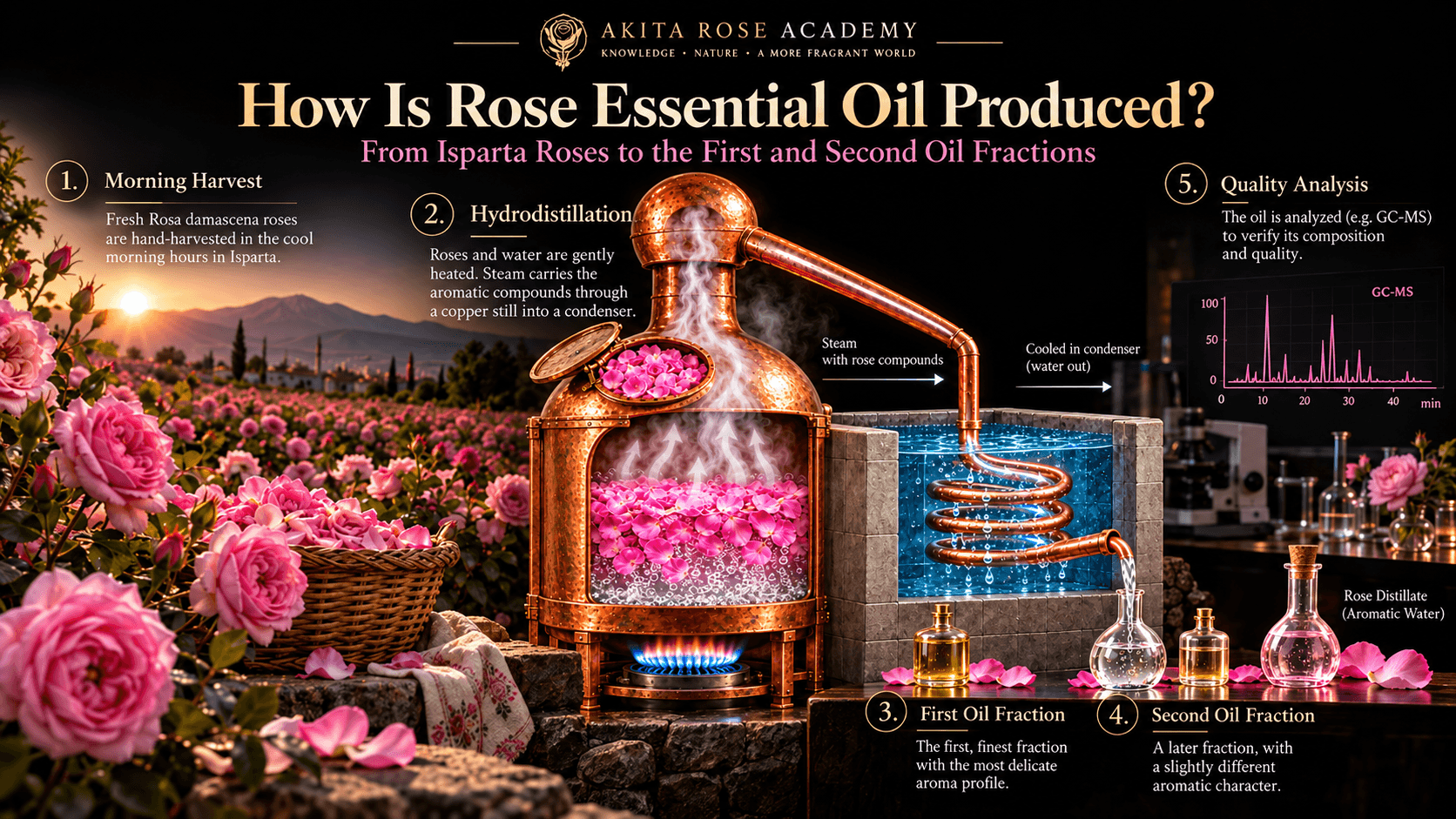
How Is Rose Essential Oil Produced? From Isparta Roses to the First and Second Oil Fractions
The Scientific Journey of Rosa damascena: From Early-Morning Harvesting and Hydrodistillation to Florentine Separation and Laboratory Analysis
How can several tonnes of freshly harvested Isparta roses produce approximately one kilogram of precious rose essential oil?
Rose essential oil is a highly valued aromatic product obtained through the distillation of Rosa damascena flowers. However, producing genuine rose oil involves much more than simply boiling rose petals in water.
The time of harvesting, the interval between picking and processing, the quantities of flowers and water placed in the distillation vessel, the heating conditions, the efficiency of the cooling system and the method used to separate the oil from the water can all influence the yield and chemical composition of the final product.
In traditional industrial rose oil production, the process may not end with the first distillation. A second distillation can be performed to recover additional volatile compounds remaining in the aromatic water.
Understanding this process requires distinguishing between several important terms: first rose oil, second rose oil, distillation water, rose water and rose distillate.
In this Akita Rose Academy article, we explore how rose essential oil is produced, beginning with the early-morning harvest of Rosa damascena in Isparta and continuing through distillation, oil separation, laboratory testing and quality control.
We also examine the scientific research behind these production methods and explain why the chemistry of a rose flower plays such an important role in the character of the oil obtained.
PART I — UNDERSTANDING ROSE ESSENTIAL OIL
1. What Is Rose Essential Oil?
Rose essential oil is a natural aromatic oil obtained by distilling the flowers of suitable rose species, particularly Rosa damascena.
The term volatile describes substances that can enter the vapour phase under suitable conditions.
Many of the molecules contributing to the characteristic fragrance of rose flowers can be carried with steam during distillation.
When this vapour mixture is cooled, it condenses into an aromatic liquid. Under appropriate conditions, a separate oil phase can then be recovered from the aqueous distillate.
Rose essential oil is fundamentally different from fixed vegetable oils such as olive oil or sunflower oil.
| Characteristic | Rose Essential Oil | Fixed Vegetable Oils |
|---|---|---|
| Botanical source | Aromatic rose flowers | Usually oil-rich seeds or fruits |
| Production method | Primarily distillation | Commonly pressing or extraction |
| Chemical composition | A mixture of volatile aromatic compounds | Predominantly triglycerides |
| Typical applications | Perfumery, fragrance and aromatic products | Food, cosmetics and carrier-oil applications |
Rose Academy Note: Rose Essential Oil Is Not the Same as Rose-Scented Oil
Genuine rose essential oil is obtained through distillation from suitable botanical sources.
Adding a rose fragrance or synthetic aroma to a carrier oil does not make that product genuine rose essential oil.
Similarly, rose concrete and rose absolute are related aromatic products, but they are produced using different extraction technologies.
2. Why Is the Isparta Rose Used for Essential Oil Production?
Although thousands of rose varieties are cultivated worldwide, only a relatively small number have significant commercial importance for essential oil production.
In Türkiye, the principal species used for rose oil production is Rosa damascena Mill., commonly known as the Isparta rose or oil-bearing rose.
Some international botanical and technical sources use the designation Rosa × damascena, with the multiplication symbol indicating its hybrid origin.
The Isparta rose is particularly valued for several reasons:
Its strong, distinctive floral fragrance
Its naturally occurring aromatic compounds of interest to perfumery
Its suitability for distillation
Its adaptation to the climate and growing conditions of Isparta
The region's long-established expertise in rose cultivation and processing
However, not every Rosa damascena flower contains exactly the same quantity of essential oil or the same proportions of aromatic compounds.
Climate, soil conditions, flower development, harvesting practices and distillation methods may all influence the results.
Scientific perspective: The botanical identity of the rose provides the foundation for its essential oil composition, while cultivation and processing conditions contribute to variations in the final chemical profile.
PART II — FROM THE ROSE FIELD TO THE DISTILLERY
3. Why Does Rose Harvesting Begin Early in the Morning?
The production of rose essential oil begins in the field, long before the flowers reach the distillery.
In Isparta, Rosa damascena flowers are traditionally harvested by hand during the early morning hours.
At this time, temperatures are generally cooler, and the flowers have not yet been exposed to the higher temperatures of the day.
As sunlight increases and temperatures rise, some volatile aromatic compounds may be released into the surrounding air.
Harvesting during cooler hours therefore helps limit conditions that may contribute to the loss or alteration of valuable volatile constituents.
Early-morning harvesting is both an established production tradition and an important consideration in the scientific management of rose oil quality.
How Are Rose Flowers Harvested?
During harvesting:
Flowers at a suitable stage of development are selected.
The flowers are picked by hand.
Excessive compression and physical damage are avoided.
Appropriate transportation methods are used to limit heat accumulation.
The flowers are delivered to the distillation facility as quickly as practical.
Are Only Rose Petals Harvested?
Not necessarily.
Industrial harvesting for rose essential oil production commonly involves collecting whole flowers, including the petals and associated floral structures such as sepals and the receptacle.
These different floral tissues do not have identical chemical compositions.
Although petals are an important source of volatile constituents, the presence of other floral tissues may also influence the material entering the distillation process.
4. Why Should Freshly Harvested Roses Be Processed Quickly?
A rose flower does not become chemically inactive immediately after it is removed from the plant.
Biological and chemical processes can continue after harvesting.
Enzymatic activity, respiration and other reactions may affect the composition of the flowers during storage.
If freshly harvested roses are tightly compressed into sacks or left in large piles for extended periods:
Heat may accumulate within the flowers.
Bruising and discolouration may occur.
Microbial activity may increase.
Fermentation may develop.
Some volatile compounds may be lost.
Essential oil yield and composition may change.
Scientific Research: How Does Storage Affect Rose Oil?
In a study published in 2008, Baydar, Schulz, Krüger, Erbaş and Kineci investigated the effects of fermentation time, hydrodistillation duration and distillation fractions on the composition of Damask rose essential oil.
The researchers stored rose flowers under defined experimental conditions and subsequently distilled them using a laboratory-scale Clevenger apparatus.
The study reported the following essential oil yields:
| Experimental Condition | Essential Oil Yield |
|---|---|
| Fresh rose flowers | 0.055% |
| After 36 hours of storage and fermentation | 0.025% |
Under these experimental conditions, prolonged storage and fermentation were associated with a substantial reduction in measured essential oil yield.
The researchers also observed changes in the chemical composition of the resulting oil.
Reported changes included:
An increase in the proportion of citronellol
Decreases in geraniol and nerol
An increase in methyl eugenol
Increases in certain long-chain hydrocarbons
These findings relate to the specific experimental conditions used in the study.
They should not be interpreted as universal values for every harvest, growing region or industrial distillation facility.
Nevertheless, they demonstrate why prolonged or poorly controlled storage can represent an important quality risk.
Rose Academy Scientific Note
Essential oil yield is influenced not only by the distillation equipment, but also by the condition of the flowers before distillation begins.
Careful quality management therefore starts immediately after harvesting.
Reference: Baydar et al. (2008).
PART III — THE SCIENCE OF ROSE DISTILLATION
5. Which Distillation Method Is Used to Produce Rose Oil?
The principal method traditionally used in Isparta for rose essential oil production is hydrodistillation, also known as water distillation.
In this process, rose flowers are placed directly in water inside a distillation vessel.
As the water is heated, steam forms and carries a portion of the volatile aromatic constituents from the flowers.
The resulting vapour mixture is directed through a cooling system, where it condenses back into liquid form.
Are Water Distillation and Steam Distillation the Same?
These terms are sometimes used interchangeably in general descriptions, but they can refer to different technical arrangements.
| Distillation Method | Operating Principle |
|---|---|
| Hydrodistillation (water distillation) | Plant material is immersed in water and heated together with it. |
| Water-and-steam distillation | Plant material is held above boiling water, and the generated steam passes through it. |
| Direct steam distillation | Steam is generated separately and passed directly through the plant material. |
These distinctions are important when describing traditional and industrial rose oil production.
For example, a modern distillation vessel may use steam generated by a separate boiler to heat the rose-and-water mixture indirectly through internal heating coils.
In that arrangement, the steam used for heating is not the same as the process vapour carrying aromatic compounds from the rose flowers.
The heating system and the actual distillation process must therefore be distinguished.
6. What Is the Difference Between a Traditional Copper Still and an Industrial Distillation Vessel?
Rose essential oil has been produced using different types of equipment throughout history.
Traditional copper stills and modern industrial systems operate according to similar physical principles, but they differ in capacity, heating methods and process control.
Traditional Copper Still
Traditional rose distillation has often been carried out using copper alembic-style equipment.
In a typical arrangement:
Rose flowers and water are placed inside the copper boiler.
The vessel is heated from below.
Steam develops inside the vessel.
The vapour mixture passes through the still head and vapour pipe.
The pipe leads to a cooling system.
Condensed liquid is collected in a receiving vessel.
In Professor Hasan Baydar's educational publication Yağ Gülü Tarımı ve Endüstrisi (Oil-Bearing Rose Cultivation and Industry), one traditional production example uses approximately 20 kilograms of rose flowers and 60 kilograms of water.
These figures illustrate a particular production arrangement and should not be treated as fixed quantities for all traditional stills.
Industrial Distillation Equipment
Modern production facilities generally use larger vessels and more controlled heating and cooling systems.
Depending on the facility, distillation vessels may be made from copper or suitable grades of stainless steel.
Some industrial systems employ indirect steam heating.
In such systems:
Steam is generated in a separate boiler.
The steam passes through heating coils inside the distillation vessel.
Heat is transferred to the rose-and-water mixture.
Process vapour forms inside the vessel.
Aromatic compounds are carried with the process vapour.
The vapour enters the condenser.
The resulting distillate is collected and processed.
The heating steam and the product vapour remain separate streams.
What Do Both Systems Have in Common?
Both traditional and industrial systems rely on the same fundamental scientific processes:
Heating and evaporation
Transfer of volatile compounds into the vapour phase
Vapour transportation
Cooling and condensation
Recovery of the aromatic distillate
Separation of the desired oil fraction, where applicable
Differences in vessel design, production capacity and process control can influence operational efficiency and the characteristics of the recovered product.
7. How Is the Distillation Vessel Prepared?
Once the freshly harvested roses arrive at the production facility, they undergo appropriate quality and quantity checks.
The flowers are then transferred to the distillation vessels.
A typical preparation process involves:
Adding a measured quantity of fresh rose flowers to the vessel.
Introducing an appropriate amount of water.
Closing and securing the vessel for its intended operating conditions.
Activating the heating system.
Heating the rose-and-water mixture under controlled conditions.
Directing the generated process vapour toward the cooling system.
An Example from Industrial Rose Oil Production
Professor Hasan Baydar's production documentation describes an industrial example in which approximately:
500 kilograms of fresh rose flowers
1,500 litres of water
are introduced into a distillation vessel with a capacity of approximately three tonnes.
These values are not universal operating instructions.
The appropriate flower-to-water ratio depends on factors including:
Vessel capacity
Equipment design
Heating configuration
Process requirements
Operating procedures
Common Misconception
Misconception: Adding more roses to the vessel will always produce more essential oil.
Scientific explanation: Overfilling a vessel can interfere with water movement, vapour formation and efficient heat transfer.
Effective distillation requires an appropriate balance between flower quantity, water quantity and equipment capacity.
8. What Happens Inside the Distillation Vessel?
As the rose-and-water mixture is heated, the water temperature rises and steam begins to form.
Hot water and steam interact with the tissues of the rose flowers.
Some of the volatile constituents present in the flowers enter the vapour phase and are carried with the water vapour.
The resulting vapour mixture moves through the vapour outlet toward the condenser.
Scientific Explanation: How Are Aromatic Compounds Transported?
The central principle of distillation is the transfer of volatile constituents into the vapour phase, followed by their transportation and subsequent condensation.
Mechanical entrainment of small liquid droplets may also occur under certain operating conditions, but this is not the fundamental mechanism of distillation.
The combined vapour behaviour of water and volatile aromatic compounds allows some constituents to be recovered under process conditions that differ from their individual normal boiling points.
Is Rose Essential Oil Created Inside the Vessel?
The rose flower already contains many of the aromatic compounds that contribute to the essential oil.
The principal purpose of distillation is to recover suitable volatile constituents from the botanical material.
However, temperature, water contact and processing time can influence the proportions of compounds and may cause certain chemical transformations.
Distillation is therefore not simply a mechanical separation operation.
It is a production process capable of influencing the chemical profile of the final rose oil.
9. How Does the Condenser Work?
The vapour leaving the distillation vessel must be cooled before a liquid distillate can be collected.
This takes place in a cooling device called a condenser.
In traditional copper distillation systems, a vapour pipe commonly passes through a container or tank holding cooling water.
The Condensation Process
Hot vapour leaves the distillation vessel.
The vapour travels through a copper or other suitable metal pipe.
Cooling water removes heat through the outer surface of the pipe.
The temperature of the vapour decreases.
The vapour condenses into liquid.
The distillate flows from the condenser outlet into a receiving vessel.
An Important Technical Distinction
Under normal operating conditions, the cooling water does not mix with the rose distillate.
The cooling water circulates or remains outside the vapour pipe, providing the temperature difference required for condensation.
The product travels within the separate vapour and condensate pathway.
Understanding this distinction is essential when interpreting technical diagrams of rose distillation systems.
Did You Know?
Condensation is the physical process through which vapour changes into liquid.
A familiar example occurs when water droplets form on the outside of a cold glass.
Although the operating conditions differ, the underlying phase change is the same.
10. What Is Rose Distillate?
The liquid obtained by cooling and condensing the vapour generated during distillation is called the distillate.
Rose distillate consists primarily of water.
Depending on the production conditions, it may also contain:
Water-soluble aromatic compounds
Small droplets of condensed essential oil
Dispersed volatile oil constituents
The essential oil therefore does not generally flow from the distillation vessel as a pure, separate product.
Instead, a water-rich aromatic distillate is first obtained.
In conventional rose essential oil production, the free oil phase is subsequently separated and recovered.
Why Is the Distillate Chemically Important?
The chemical composition of rose distillate is not identical to that of the original flower.
Individual compounds differ in their:
Volatility
Solubility in water
Distribution between aqueous and oil phases
Behaviour during heating and condensation
These differences help explain why rose essential oil and rose water have distinct chemical and sensory profiles.
PART IV — RECOVERING THE FIRST AND SECOND ROSE OIL FRACTIONS
11. How Are Rose Essential Oil and Aromatic Water Separated?
In conventional industrial rose oil production, the condensed distillate is transferred to an oil-separation system.
A traditional separation vessel used for this purpose is known as a Florentine separator, sometimes called a Florentine vessel.
This equipment takes advantage of differences in physical properties between oil and water.
Some rose oil constituents have limited solubility in water.
As a result, when enough free oil is present, a separate oil phase may form.
Rose essential oil is generally less dense than water, allowing the free oil phase to accumulate above the aqueous phase under appropriate conditions.
However, not all volatile compounds are recovered in this separated oil layer.
Some remain dissolved in the aromatic water, while others may remain dispersed as very small droplets.
What Does a Florentine Separator Do?
A Florentine separator helps:
Separate the free oil phase from the aqueous distillate
Collect the recovered essential oil
Direct the remaining aromatic water to a separate collection system
Support further processing when additional recovery is desired
This initial separation represents a major stage in conventional two-stage rose essential oil production.
12. What Is the First Rose Oil Fraction?
The oil recovered directly from the distillate produced during the initial distillation is known as the first oil fraction.
In production literature, this fraction may also be described as:
First rose oil
Directly recovered oil
Decanted oil
Primary oil fraction
The first fraction consists of the volatile oil that separates from the aqueous distillate during the initial recovery stage.
However, this does not mean that every recoverable aromatic constituent has been collected.
Following the first separation, the remaining aqueous phase may still contain volatile substances.
Some are dissolved in water, while others may remain dispersed in small quantities.
This is why a second distillation may be used in traditional production.
13. What Is the Aqueous Phase Remaining After the First Oil Separation?
After the first oil fraction has been removed in the Florentine separator, an aromatic aqueous phase remains.
In Turkish rose production terminology, this is called yağ altı suyu, literally meaning the water beneath the oil.
It can be described in English as the aqueous phase remaining after the first oil separation or, more simply, the first-stage aromatic water.
This material still contains a portion of the aromatic compounds transferred from the rose flowers during the initial distillation.
Some of these compounds may be recovered through additional processing.
Why Is Phenylethyl Alcohol Important?
Phenylethyl alcohol (PEA), also known as 2-phenylethanol, is an important aromatic compound associated with the characteristic fragrance of roses.
Compared with many other constituents of rose essential oil, phenylethyl alcohol is relatively soluble in water.
As a result, a substantial portion may remain in the aqueous phase during distillation.
This is one reason why the separated oil and aromatic water can have noticeably different fragrance profiles.
Rose Academy Note
The aromatic character of the rose is not confined exclusively to the essential oil phase.
The aqueous distillate also contains important fragrance-related compounds and has its own distinct chemical composition.
14. How Is the Second Rose Oil Fraction Produced?
In traditional two-stage rose oil production, the aromatic water remaining after the first oil separation may be distilled again.
This process is commonly referred to as cohobation or redistillation.
During this stage, the first-stage aromatic water is heated again.
Some of the volatile compounds remaining in the water enter the vapour phase and are carried into a second condensation process.
The resulting distillate is collected and, where an oil phase forms, further separation allows additional essential oil to be recovered.
This recovered oil is known as the second oil fraction.
Other terms include:
Second rose oil
Secondary oil fraction
Indirectly recovered oil
Oil recovered through redistillation
Why Is a Second Distillation Necessary?
The original distillation does not transfer all recoverable aromatic compounds into the first separated oil fraction.
Some remain in the aqueous distillate because of their solubility and distribution behaviour.
Redistillation provides an additional opportunity to recover part of the remaining volatile fraction.
However, even after a second distillation, it cannot be assumed that every aromatic compound originally present in the water has been recovered.
At Which Stage Is Rose Water Obtained?
In some conventional two-stage industrial production systems, commercial rose water is obtained from the aromatic aqueous phase remaining after the second oil separation.
However, the precise production stage and composition of commercial rose water can vary according to the method used.
Therefore, the following materials should not automatically be regarded as identical:
The initial distillate
The aromatic water remaining after the first oil separation
The aqueous product remaining after the second oil separation
Their compositions can differ because each processing stage changes the distribution of aromatic constituents.
15. What Is the Difference Between First and Second Rose Oil?
The first and second oil fractions are recovered through different stages of the distillation process.
Consequently, they may differ in chemical composition and fragrance character.
The proportions of certain monoterpene alcohols and long-chain hydrocarbons can vary between these fractions.
| Characteristic | First Oil Fraction | Second Oil Fraction |
|---|---|---|
| Recovery stage | Initial distillation | Redistillation of the first-stage aromatic water |
| Source | Free oil separated from the initial distillate | Additional recoverable oil from the remaining aqueous phase |
| Alternative description | Directly recovered oil | Indirectly recovered oil |
| Chemical profile | Reflects the compounds collected during initial separation | Reflects the compounds recovered during redistillation |
| Commercial application | May contribute to the final blended rose oil | May contribute to the final blended rose oil |
Professor Hasan Baydar's educational work on the rose industry describes differences in composition between these fractions.
In the traditional production examples discussed, the second oil fraction may contain higher proportions of certain monoterpene alcohols than the first fraction.
However, these compositional relationships are not fixed for every production facility.
Is First Rose Oil Better Than Second Rose Oil?
Neither fraction can be considered universally superior solely because of when it was recovered.
Their chemical and sensory profiles may differ, and both may contribute to the desired character of the finished product.
In conventional commercial production, the fractions can be combined in appropriate proportions.
This process is known as blending.
The appropriate blend depends on:
The production method
The composition of the individual fractions
The desired fragrance profile
Relevant quality specifications
Rose Academy Note
The term second oil does not mean counterfeit oil or automatically indicate inferior quality.
First and second rose oils are distinct fractions recovered through different stages of a traditional two-stage distillation process.
16. First and Second Rose Oil Production: Step by Step
The basic principles of conventional two-stage production can be summarized as follows.
Stage One: Distillation of the Rose Flowers
Fresh Rosa damascena flowers + water
↓
First hydrodistillation
↓
Condenser and condensation
↓
Initial distillate
↓
Separation in a Florentine vessel
↓
First oil fraction + remaining aromatic water
Stage Two: Redistillation of the Aromatic Water
Aromatic water remaining after the first separation
↓
Cohobation (second distillation)
↓
Second distillate
↓
Separation of the recoverable oil phase
↓
Second oil fraction + remaining aromatic water
Final Rose Essential Oil
First oil fraction + second oil fraction
↓
Blending in appropriate proportions
↓
Quality assessment
↓
Finished commercial rose essential oil
This description represents the basic principles of a traditional two-stage production system.
Equipment design, collection arrangements and processing details may differ between facilities.
17. How Does Akita Non-De-Oiled Rose Distillate Differ from This Process?
One of the fundamental differences between conventional rose essential oil production and the production of a non-de-oiled rose distillate concerns whether the naturally occurring oil fraction is intentionally separated and removed.
In conventional two-stage rose oil production, the objective is to recover the volatile essential oil as a separate product.
The oil is therefore separated from the aromatic water, and further redistillation may be performed to recover additional volatile constituents.
By contrast, Akita Non-De-Oiled Rose Distillate is produced using an approach designed to retain the naturally occurring rose oil fraction within the distillate rather than intentionally removing it as a separate product.
These production approaches therefore have different objectives.
An Important Scientific Distinction
Research into conventional rose essential oil production helps explain the properties of the first and second oil fractions.
However, the chemical characteristics reported for those fractions cannot automatically be used to describe the composition of a distillate produced through a different method in which the oil is not intentionally removed.
Scientific comparisons between products require appropriate analytical investigations of the actual samples and their respective production conditions.
The educational objective of Akita Rose Academy is to explain different rose distillation technologies accurately, without treating products made by different methods as chemically identical.
PART V — ESSENTIAL OIL YIELD AND CHEMICAL QUALITY
18. Why Is Distillation Time Important?
Distillation duration can influence both the quantity of essential oil recovered and its chemical composition.
If the process is stopped too early, some recoverable volatile constituents may remain in the botanical material or the process system.
If distillation continues longer than necessary:
Energy consumption may increase.
Processing time and operating costs may rise.
The composition of later fractions may change.
The proportion of certain long-chain hydrocarbons may increase.
The relative amounts of compounds such as methyl eugenol may be affected.
A Laboratory Study Published in 2008
Baydar and colleagues investigated different hydrodistillation durations using a Clevenger-type laboratory apparatus.
The study examined distillation periods of:
30 minutes
60 minutes
90 minutes
120 minutes
150 minutes
180 minutes
The researchers reported that essential oil yield increased up to 150 minutes, with no further increase observed between 150 and 180 minutes under the conditions investigated.
The chemical compositions of fractions collected during different periods were also examined.
As distillation progressed, the relative proportions of certain monoterpene alcohols decreased, while some long-chain hydrocarbons increased.
The researchers also reported changes in methyl eugenol content associated with prolonged distillation.
Is the Same Distillation Time Used in Industrial Production?
Not necessarily.
Professor Hasan Baydar's documentation of industrial rose oil production describes a typical distillation period of approximately 90 minutes in the production arrangement discussed.
This differs from the laboratory study, which examined longer periods in a Clevenger apparatus.
The distinction matters because laboratory equipment and industrial distillation vessels operate under different physical and processing conditions.
A laboratory result indicating that oil yield increased up to 150 minutes does not establish that every industrial system should operate for 150 minutes.
Industrial distillation time depends on:
Vessel capacity
Heating configuration
Flower and water quantities
Heat and vapour transfer
Cooling performance
Desired yield
Target chemical composition
Scientific conclusion: There is no single distillation duration that can automatically be considered optimal for every rose oil production system.
19. How Many Rose Flowers Are Needed to Produce One Kilogram of Rose Oil?
Rose flowers contain relatively small amounts of essential oil.
For this reason, producing even a modest quantity of rose oil requires a substantial amount of fresh botanical material.
Professor Hasan Baydar's educational publication describes a production example in which approximately 3.5 tonnes of fresh rose flowers yield one kilogram of rose essential oil.
However, this is an illustrative production figure rather than a universal conversion rate.
The quantity of flowers required may vary according to:
Harvest year
Weather conditions
Flower maturity
Harvesting time
Post-harvest storage
Distillation technology
Efficiency of first and second oil recovery
Why Are Laboratory and Industrial Yields Different?
The 2008 laboratory investigation discussed earlier reported an essential oil yield of 0.055% from fresh flowers under the experimental conditions used.
By comparison, recovering one kilogram from 3.5 tonnes of flowers corresponds to an overall yield of approximately 0.029%.
These values are not automatically contradictory.
They may reflect differences in:
Botanical samples
Experimental conditions
Equipment design
Processing methods
Recovery efficiency
A yield measured under laboratory conditions should not be assumed to represent the yield obtained in every commercial facility.
Rose Academy Note
For general educational purposes, the most appropriate explanation is:
Depending on production conditions, several tonnes of fresh rose flowers may be required to produce just one kilogram of genuine rose essential oil.
20. Why Is the Chemical Composition of Rose Oil Important?
Rose essential oil is not a single chemical substance.
It is a complex natural mixture containing numerous volatile compounds.
The proportions of these compounds influence:
Fragrance character
Chemical identity
Physical behaviour
Analytical quality assessment
Important Compounds Found in Rose Essential Oil
| Compound or Group | Scientific Significance |
|---|---|
| Citronellol | An important monoterpene alcohol that contributes floral and fresh notes to the fragrance profile |
| Geraniol | A monoterpene alcohol associated with characteristic floral notes |
| Nerol | Another monoterpene alcohol contributing to the aromatic character of rose oil |
| Linalool | An aromatic monoterpene alcohol also found in various other botanical essential oils |
| Phenylethyl alcohol (PEA) | An important rose-associated aromatic compound that is relatively soluble in water |
| Nonadecane | A long-chain hydrocarbon occurring in rose essential oil |
| Heneicosane | A long-chain hydrocarbon contributing to the oil's hydrocarbon profile and physical characteristics |
| Eugenol | An aromatic compound that may contribute to the fragrance profile |
| Methyl eugenol | A constituent relevant to chemical quality assessment and safety-related evaluation |
The presence of these compounds does not mean that their concentrations are identical in every rose oil sample.
Variations may result from cultivation, harvesting and distillation conditions.
The blending proportions of first and second oil fractions may also influence the final composition.
What Is Stearoptene?
Certain long-chain hydrocarbons in rose essential oil contribute to a fraction that can crystallize or solidify at lower temperatures.
This fraction is commonly referred to as stearoptene.
The tendency of rose oil to become partially solid or cloudy when cooled is associated with these constituents.
However, solidification behaviour alone cannot definitively establish the authenticity or quality of rose essential oil.
21. How Is Rose Essential Oil Analysed?
Rose essential oil quality cannot be assessed reliably through fragrance alone.
Sensory evaluation is important, but it should be supported by appropriate physical and chemical testing.
A. Sensory Evaluation
Trained evaluators may examine:
Overall fragrance character
Aromatic intensity
Balance and complexity
Unusual or undesirable odours
Changes associated with storage
B. Physical Testing
Physical quality assessment may include:
Density
Refractive index
Optical rotation
Colour and appearance
Solidification behaviour under defined conditions
C. Chemical Analysis
Gas chromatography-based methods play an important role in modern essential oil analysis.
What Is Gas Chromatography (GC)?
Gas chromatography is an analytical method used to separate volatile compounds, or compounds suitable for analysis under defined chromatographic conditions.
In simple terms, it is a laboratory technique that helps separate the chemical constituents present in a sample.
What Is GC-FID?
GC-FID stands for Gas Chromatography–Flame Ionization Detection.
The technique is widely used to measure separated organic compounds.
With suitable calibration and analytical procedures, it can help determine the amounts of selected constituents in a sample.
What Is GC-MS?
GC-MS stands for Gas Chromatography–Mass Spectrometry.
This technique combines chromatographic separation with mass spectrometric analysis.
It helps researchers identify compounds by examining their mass spectra and comparing the results with appropriate reference data.
For readers unfamiliar with analytical chemistry, GC-MS can be described as:
A Laboratory System for Separating and Identifying Chemical Compounds
Can GC-MS Prove That Rose Oil Is Genuine?
GC-MS is a powerful analytical technique for characterizing the chemical profile of rose essential oil.
However, a single GC-MS analysis may not detect every possible form of adulteration.
A comprehensive authenticity assessment may require additional chromatographic techniques, physical measurements, reference standards and other appropriate verification methods.
22. What Is the Current International Standard for Rose Essential Oil?
One of the international standards used in the evaluation of rose essential oil is ISO 9842.
The current edition is:
ISO 9842:2024 — Essential oil of rose (Rosa × damascena Miller)
Published in October 2024, this edition replaced ISO 9842:2003.
ISO 9842:2024 specifies certain characteristics of essential oil obtained from Rosa × damascena cultivated in Türkiye, Bulgaria and Morocco.
The standard provides a technical framework that supports consistent evaluation of defined product characteristics.
Why Are International Standards Important?
Standards help establish common criteria and analytical approaches for comparing product characteristics.
However, compliance with a standard must be demonstrated through appropriate measurements and evaluation of the applicable requirements.
The production method or characteristic fragrance of an oil, by itself, does not prove compliance.
It is also important to distinguish between a quality specification and the toxicological assessment of a product for a particular use.
Compounds such as methyl eugenol may require separate evaluation in relation to the intended application and relevant regulatory requirements.
Reference: International Organization for Standardization, ISO 9842:2024.
23. How Should Rose Essential Oil Be Stored?
Following distillation and oil separation, rose essential oil is handled, allowed to settle where appropriate, filtered if necessary and stored under suitable conditions.
The chemical and sensory characteristics of essential oils can be influenced by environmental factors over time.
Important considerations include:
Oxygen exposure
Direct sunlight
Elevated temperatures
Incompatible packaging materials
Prolonged or uncontrolled storage
Rose essential oil is therefore generally stored:
In suitable, chemically compatible containers
Protected from excessive light exposure
With containers securely sealed
Under controlled temperature conditions
With appropriate batch identification and traceability information
Minimizing unnecessary headspace in storage containers may help limit exposure to oxygen.
Rose Academy Note
Proper storage is important not only for maintaining product quality, but also for ensuring reliable quality control and traceability throughout the supply chain.
PART VI — ROSE ESSENTIAL OIL AND OTHER ROSE-DERIVED PRODUCTS
24. Are Rose Essential Oil, Rose Water, Rose Concrete and Rose Absolute the Same?
No.
Although these products may originate from the same botanical species, their production methods and chemical characteristics differ.
| Product | Main Production Method | General Characteristics |
|---|---|---|
| Rose essential oil | Distillation followed by oil recovery | A concentrated aromatic oil phase composed of volatile constituents |
| Rose water | Recovery of the aromatic aqueous product during rose distillation | Contains water-soluble and, depending on processing, dispersed aromatic constituents |
| Rose distillate | Condensation of aromatic vapour generated during distillation | Composition may vary according to the process and whether the oil fraction is separated |
| Rose concrete | Extraction using suitable solvents | A semi-solid aromatic extract containing volatile and waxy constituents |
| Rose absolute | Usually produced by processing rose concrete with ethanol and subsequent purification | A concentrated aromatic extract widely used in perfumery |
Why Are Rose Concrete and Rose Absolute Different?
Rose concrete is produced by extracting suitable constituents from rose flowers using an appropriate solvent.
This process recovers a different range of substances from those obtained through hydrodistillation.
Rose absolute can then be obtained by further processing and refining the concrete, commonly using ethanol.
Consequently, rose essential oil production and the production of rose concrete or rose absolute are not simply different names for the same technology.
Why Is Genuine Rose Water Usually Colourless?
Many pigments responsible for the pink colour of rose petals have different chemical properties from volatile aromatic compounds.
These pigments are generally not carried with steam in the same way as the volatile constituents.
As a result, appropriately produced rose distillate without added colourants or suspended material is generally clear and colourless.
A pink appearance does not, by itself, indicate that rose water is more natural or of higher quality.
25. What Remains After Rose Distillation?
Rose essential oil and aromatic water are not the only materials associated with rose distillation.
After the process is complete, a substantial quantity of processed botanical material remains inside the distillation vessel.
This material is known as rose pomace or spent rose biomass.
Rose pomace may contain:
Residual flower tissues
A high proportion of water
Plant fibres
Certain mineral elements
Non-volatile botanical compounds
Historically, rose pomace was often regarded primarily as a processing residue.
Today, scientific research is investigating its potential use in several applications, including:
Compost production
Soil amendments
Biochar
Biogas production
Recovery of phenolic compounds
However, the existence of these potential applications does not establish that untreated rose pomace is suitable or safe for every use.
Its moisture content, microbiological condition, chemical composition and intended application must be evaluated.
For a more detailed discussion, explore our Akita Rose Academy article examining the composition, environmental impacts and sustainable utilization of rose pomace.
PART VII — SCIENTIFIC SUMMARY OF ROSE OIL PRODUCTION
26. From the Rose Field to the Finished Oil: The Complete Production Journey
Traditional two-stage industrial rose essential oil production can be summarized as follows:
Rosa damascena flowers are harvested during the early morning hours.
The flowers are transported to the distillery while limiting heat accumulation and physical damage.
Appropriate quantities of flowers and water are introduced into the distillation vessel.
The mixture is heated under controlled conditions.
Process vapour carries a portion of the volatile aromatic constituents.
The vapour passes through a condenser and becomes liquid.
The aromatic distillate is transferred to a collection and separation system.
The first oil fraction is recovered from the initial distillate.
The remaining aromatic water may undergo a second distillation.
The second oil fraction is recovered from the redistilled material.
The two oil fractions may be blended in appropriate proportions.
The finished oil undergoes physical, chemical and sensory evaluation.
The product is stored under suitable conditions with appropriate traceability.
The remaining botanical biomass is directed toward responsible waste management or suitable recovery processes.
This sequence illustrates a traditional two-stage production approach.
Not every rose distillate or rose-derived product is manufactured through all of these steps.
Common Misconceptions About Rose Essential Oil Production
“Rose essential oil is made by pressing rose petals.”
Incorrect.
Commercial rose essential oil is commonly produced through distillation. This differs from the pressing methods used to obtain many fixed vegetable oils.
“Pure rose oil flows directly out of the distillation vessel.”
Not generally.
Distillation first produces an aromatic distillate. In conventional rose oil production, the free oil phase is subsequently recovered through an appropriate separation system.
“All the fragrance of the rose is contained in the essential oil.”
Incorrect.
Aromatic constituents are distributed differently between oil and water. Phenylethyl alcohol is an important example of a fragrance-related compound that may remain in the aqueous phase.
“Second rose oil is lower quality than first rose oil.”
Not necessarily.
The fractions are recovered during different stages and may have different chemical profiles. Their value and suitability cannot be determined solely by their names.
“Longer distillation always produces better rose oil.”
Incorrect.
Distillation duration influences both yield and composition. Excessively long processing may increase energy consumption and alter the distribution of constituents.
“Genuine rose essential oil can always be identified by smell alone.”
Incorrect.
Sensory assessment provides useful information, but chemical identity and authenticity require appropriate analytical evaluation.
“All rose waters are produced in the same way.”
Incorrect.
Production methods and the separation or retention of the oil fraction can influence the composition of the resulting aromatic aqueous product.
Frequently Asked Questions (FAQ)
How Is Rose Essential Oil Produced?
Rose essential oil is commonly produced by hydrodistilling Rosa damascena flowers in water.
The generated vapour carries volatile aromatic constituents into a condenser, where the vapour becomes a liquid distillate.
In conventional rose oil production, the oil phase is then separated and recovered.
How Many Rose Flowers Are Needed to Produce One Kilogram of Essential Oil?
Depending on cultivation and production conditions, several tonnes of fresh rose flowers may be required.
A commonly cited production example involves approximately 3.5 tonnes of fresh roses for one kilogram of essential oil.
Why Are Roses Harvested Early in the Morning?
Early-morning harvesting helps limit exposure to higher daytime temperatures.
Harvest timing can influence essential oil yield and the chemical composition of the flowers.
What Is the First Rose Oil Fraction?
The first oil fraction is the essential oil recovered directly from the aromatic distillate produced during the initial distillation.
What Is the Second Rose Oil Fraction?
The second oil fraction is recovered by redistilling the aromatic water remaining after the first oil separation.
What Is Cohobation?
In traditional rose oil production, cohobation refers to the redistillation of the aromatic water remaining after the first separation to recover additional volatile constituents.
Why Do Rose Oil and Rose Water Smell Different?
Aromatic compounds do not distribute equally between oil and water.
Certain compounds dissolve more readily in the aqueous phase, while others are concentrated in the oil phase.
Distillation conditions may also influence the final chemical composition.
Is Phenylethyl Alcohol Found in Rose Oil or Rose Water?
Phenylethyl alcohol is relatively soluble in water and may therefore be present in substantial amounts in the aqueous phase of a rose distillate.
Its distribution between oil and water depends on the production and analytical conditions.
How Is Rose Essential Oil Quality Determined?
Quality assessment may include sensory evaluation, physical measurements, GC-FID, GC-MS and additional analytical procedures where necessary.
Relevant international standards also support the evaluation of defined product characteristics.
What Is the Current ISO Standard for Rose Essential Oil?
The current international standard addressing defined characteristics of essential oil obtained from Rosa × damascena is ISO 9842:2024.
Is Akita Non-De-Oiled Rose Distillate the Same as Conventional Rose Water?
Both products may originate from Rosa damascena flowers.
However, Akita's non-de-oiled distillation approach is designed to retain the naturally occurring rose oil fraction within the distillate instead of intentionally removing it as a separate product.
In conventional two-stage rose oil production, separating the oil from the aqueous distillate is a central objective.
Determining the chemical differences between specific finished products requires appropriate analytical comparison of representative samples.
Conclusion: The Value of Rose Essential Oil Begins with Knowledge
Producing rose essential oil involves far more than boiling fragrant flowers.
It is a coordinated process that begins in the rose field and continues through harvesting, transportation, distillation, oil recovery, analytical testing and storage.
The timing of the harvest, the handling of freshly picked flowers, the control of heat and water during distillation, and the methods used to recover volatile compounds can all influence the characteristics of the finished oil.
Traditional two-stage production also demonstrates that rose oil does not consist of a single fraction recovered in one simple operation.
The first and second oil fractions arise through different processing stages and may exhibit different chemical profiles.
The production process further illustrates that the aromatic constituents of a rose flower are not necessarily recovered in a single product.
Some compounds are more readily associated with the oil phase, while others remain in the aqueous distillate.
For this reason, rose essential oil, conventional rose water, non-de-oiled rose distillate and other rose-derived materials should be understood in relation to their individual production methods and chemical characteristics.
The fact that several tonnes of rose flowers may yield only approximately one kilogram of essential oil helps explain the economic value of this botanical product.
Yet the value of genuine rose essential oil cannot be explained by low yield alone.
Its value also lies in cultivation expertise, careful harvesting, timely processing, scientifically managed distillation and the analytical verification of the finished product.
Understanding the production of rose essential oil means understanding more than a manufacturing technique.
It means exploring the relationship between the botany, chemistry, cultivation traditions and industrial transformation of Rosa damascena.
Scientific References
1. Baydar, H., Schulz, H., Krüger, H., Erbaş, S., & Kineci, S. (2008).
Influences of fermentation time, hydro-distillation time and fractions on essential oil composition of Damask rose (Rosa damascena Mill.). Journal of Essential Oil Bearing Plants, 11(3), 224–232.
https://doi.org/10.1080/0972060X.2008.10643624
2. Baydar, H. (n.d.).
Yağ Gülü Tarımı ve Endüstrisi [Oil-bearing rose cultivation and industry]. Süleyman Demirel University, Faculty of Agriculture, Department of Field Crops.
https://ziraat.isparta.edu.tr/assets/uploads/sites/27/files/yag_gulu-20012015.pdf
3. International Organization for Standardization. (2024).
ISO 9842:2024 — Essential oil of rose (Rosa × damascena Miller).
https://www.iso.org/standard/86897.html
4. Baydar, H., & Göktürk Baydar, N. (2005).
The effects of harvest date, fermentation duration and Tween 20 treatment on essential oil content and composition of industrial oil rose (Rosa damascena Mill.). Industrial Crops and Products, 21(2), 251–255.
https://doi.org/10.1016/j.indcrop.2004.04.004
5. Başer, K. H. C. (1992).
Turkish rose oil. Perfumer & Flavorist, 17(3), 45–52.
6. Bayrak, A., & Akgül, A. (1994).
Volatile oil composition of Turkish rose (Rosa damascena). Journal of the Science of Food and Agriculture, 64(4), 441–448.
https://doi.org/10.1002/jsfa.2740640408
7. Kürkçüoğlu, M., & Başer, K. H. C. (2003).
Studies on Turkish rose concrete, absolute, and hydrosol. Chemistry of Natural Compounds, 39(5), 457–464.
https://doi.org/10.1023/B:CONC.0000011120.71479.7f
8. Canbay, H. S. (2017).
Effectiveness of liquid-liquid extraction, solid phase extraction, and headspace technique for determination of some volatile water-soluble compounds of rose aromatic water. International Journal of Analytical Chemistry, 2017, Article 4870671.
https://doi.org/10.1155/2017/4870671
9. Republic of Türkiye, Ministry of Agriculture and Forestry, Fruit Research Institute. (2022).
Yağ Gülü Yetiştiriciliği: Rosa damascena [Oil-bearing rose cultivation: Rosa damascena].
Continue Exploring with Akita Rose Academy
The journey of Rosa damascena begins in the rose fields and continues through distillation, essential oil recovery, aromatic water production, chemical analysis and innovative manufacturing technologies.
Discover our other educational articles on rose essential oil, rose water, non-de-oiled rose distillates, botanical characteristics, production methods and scientific research.
Akita Rose Academy — Exploring the Rose, Its Production and the Science Behind It.