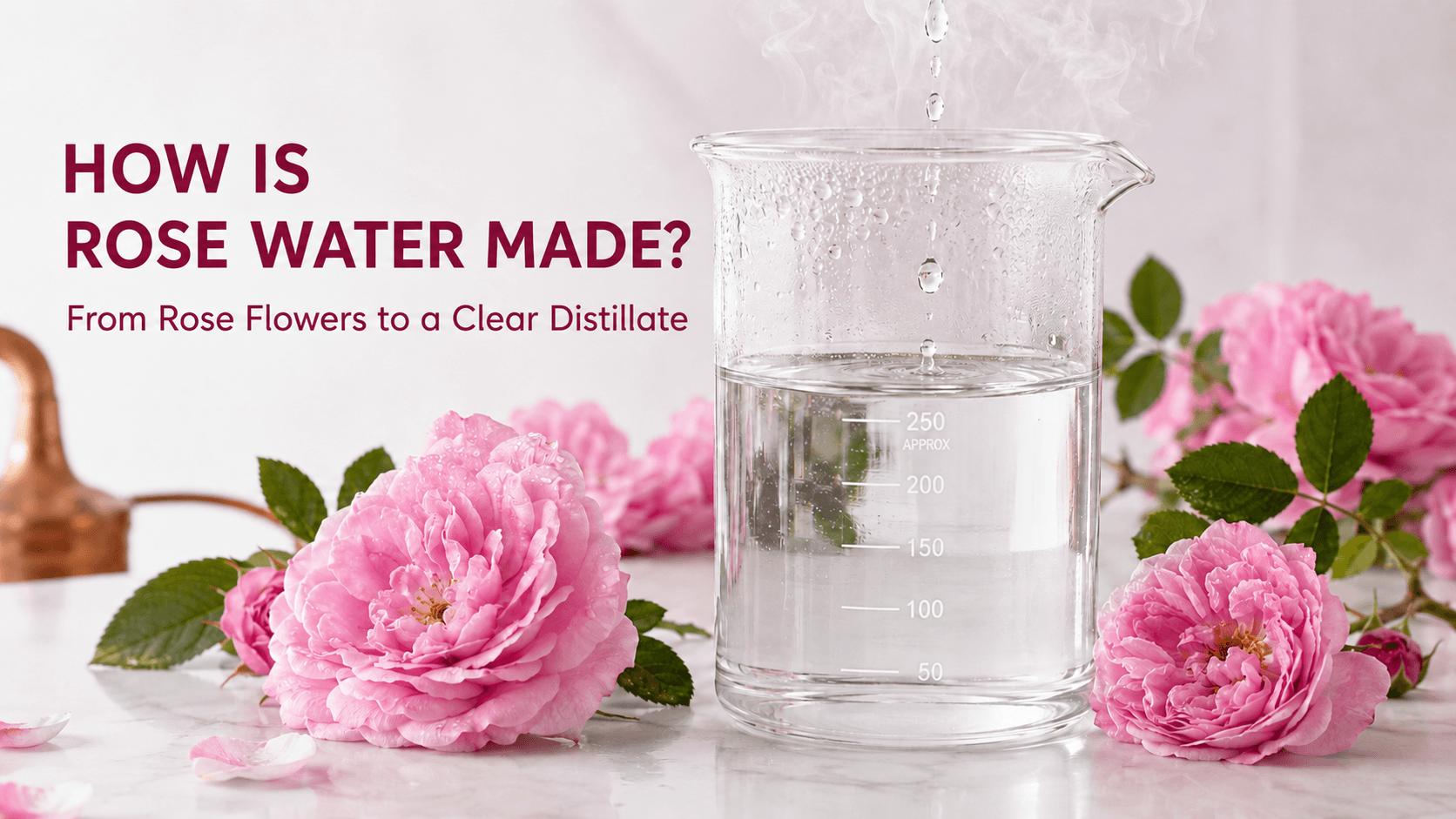
Rose water is an aromatic aqueous product obtained by distilling fragrant rose flowers with water and heat. However, not every product sold as “rose water” is produced in the same way. Some are obtained directly through distillation, while others may be prepared by adding rose oil, fragrance or flavouring to water.
For this reason, the question “How is rose water produced?” cannot be answered simply by saying that roses are boiled. The rose species, harvest time, the period for which the flowers are stored before processing, the distillation method, temperature, pressure, cooling system and whether the oil phase is separated can all influence the characteristics of the final product.
In this article, we will examine the production journey of rose water step by step, using a scientific and objective approach without presenting any particular product or method as inferior.
What Is Rose Water?
Rose water is the aromatic aqueous phase formed when rose flowers are distilled, particularly through water distillation or steam distillation.
During distillation, some of the volatile compounds in the rose flowers are carried by the steam. When the vapour is cooled, it condenses back into a liquid, producing an aromatic fluid known as a distillate.
This liquid may contain:
- Water-soluble aromatic compounds
- Volatile substances that can be carried with steam
- Very small amounts of dissolved or dispersed essential oil components
The terms “hydrosol” and “hydrolat” may also be used for rose water. However, the precise meaning of these terms may vary between regulations and commercial practices. The most reliable way to understand how a product was made is to examine not only its name, but also its production description and ingredient list.
Rose Academy Note
Rose water obtained through distillation and a product made by adding rose oil or fragrance to purified water are not produced by the same method.
Which Rose Is Used to Produce Rose Water?
Rose water can be produced from different fragrant rose species. However, one of the world’s most important species for essential oil and aromatic distillate production is Rosa damascena Mill.
In Türkiye, oil-bearing roses cultivated particularly in and around Isparta, Burdur, Afyonkarahisar and Denizli are used for this purpose. Rosa damascena is also commonly known as the Isparta rose, Damask rose or oil-bearing rose.
Not every pink rose has the same aroma or chemical composition. The characteristics of the final product may vary according to:
- The rose species and cultivar
- The region in which the rose is grown
- Climate and altitude
- Soil characteristics
- The flowering stage
- Harvest time
- The freshness of the flowers
- Distillation conditions
Scientific studies show that the volatile composition of Rosa damascena flowers may vary according to cultivar, stage of development, harvest time and storage conditions. It is therefore not accurate to assess the characteristics of rose water solely by the colour of the flowers or the strength of its fragrance.
1. Harvesting the Rose Flowers
The production journey of rose water begins not at the distillation facility, but in the rose garden.
Oil-bearing rose flowers are usually harvested during the cool early-morning hours. The main purpose is to preserve the freshness of the flowers and limit the loss of volatile compounds that may occur as temperatures rise.
As the sun rises:
- The air temperature increases
- Surface moisture on the flowers decreases
- Some volatile substances may disperse into the atmosphere
- The flowers may warm and wilt more quickly
The harvested roses should not be tightly compressed inside sacks or bags. Compressed flowers may be crushed, become warm and receive insufficient air circulation. These conditions may encourage undesirable biochemical changes and fermentation.
It is therefore important for rose flowers to be:
- Harvested cleanly
- Transported without being crushed
- Protected from excessive heat
- Processed as soon as possible
In industrial practices in the Isparta region, freshly harvested oil-bearing roses are generally intended to be distilled on the same day. A study by Baydar and colleagues explains how oil-bearing roses grown in the region are processed through water distillation to produce rose oil and rose water.
2. Loading the Roses into the Distillation Vessel
After the rose flowers arrive at the production facility and have been inspected, they are placed in vessels known as stills or distillation boilers.
Traditional systems may use copper stills. Large-scale factories generally use stainless-steel vessels that allow temperature and pressure to be managed more precisely.
Depending on the system:
- Rose flowers may be placed in the vessel together with water
- Steam may be introduced into the vessel from an external source
- Flowers immersed in water may be heated directly or indirectly
The ratio of roses to water is important. However, there is no single ideal ratio that applies to every production system. The capacity and design of the vessel, the purpose of production, the condition of the flowers and the desired product characteristics may require different ratios.
Overfilling the vessel may prevent steam from moving evenly through the flowers. Using too few flowers, on the other hand, may affect production efficiency and the aromatic concentration of the distillate.
3. How Does Distillation Work?
Distillation is not simply the process of boiling roses. It consists of four main stages carried out under controlled conditions:
- Heating
- Evaporation
- Transport of aromatic compounds
- Cooling and condensation
As the vessel is heated, the water begins to evaporate. The resulting hot steam comes into contact with the rose flowers and carries some of the volatile compounds from the flower tissue.
The aromatic vapour then travels towards the outlet at the top of the vessel and passes through connecting pipes.
The speed of distillation is important. If the process is too rapid or uncontrolled, if cooling is insufficient, or if time and pressure are not properly managed, both the quantity and composition of the distillate may be affected.
A simple way to understand it
Steam acts like a carrier that collects transportable aromatic compounds from the rose flowers. This transport is not unlimited, however. Not every compound is carried by steam to the same extent, and not every substance is present in rose water at the same concentration.
4. Cooling the Vapour
The hot aromatic vapour coming from the rose flowers must be converted back into a liquid. This takes place inside a condenser.
In traditional distillation systems, long metal pipes extending from the still may pass through a cooling pool. The cold water in the pool absorbs heat from the hot vapour travelling through the pipes.
As the vapour loses heat, it condenses back into a liquid. The mixture that enters the pipe as vapour therefore leaves it as an aromatic distillate.
The basic principle is the same in modern factories. The main difference is that modern cooling systems can operate in a more enclosed, controlled and efficient manner.
If cooling is insufficient, not all of the vapour may condense into liquid. This can lead to product loss and the release of volatile compounds into the atmosphere. The temperature and flow of the cooling water, together with the surface area of the condenser, are therefore important production variables.
5. Collecting the Distillate
The liquid leaving the condenser is called the distillate. It may contain two main groups of components:
- An aromatic aqueous phase
- A condensed essential oil phase
Rose essential oil does not mix completely with water. Some essential oil components dissolve in water to a certain extent, while others tend to form a separate oil phase.
For this reason, the condensed liquid may be collected in a Florentine flask or a similar oil–water separation system.
6. What Is the Purpose of a Florentine Flask?
A Florentine flask is a specialised collection vessel designed to facilitate the separation of the aqueous and essential oil phases produced during distillation.
The system works according to the principles that oil and water:
- Do not mix completely
- Have different densities
- Can form separate phases over time
However, it is not accurate to state that every essential oil always remains on top of the water. The position of the oil phase may vary according to its density and composition, the temperature and the design of the separation system. A Florentine flask must therefore be designed according to the physical properties of the essential oil being produced.
In rose oil production, the oil separated in the Florentine flask during the first distillation may be called “first oil” or “direct oil.”
The aromatic water remaining after this initial separation may be distilled again to obtain an additional oil fraction known as “second oil,” “water oil” or “Veronika oil.” Commercial rose oil may be prepared by combining the first and second oils in suitable proportions. This is an important characteristic of traditional rose oil production systems, as described by Baydar and colleagues.
7. Rose Water Obtained During Rose Oil Production
In traditional commercial systems, the primary objective may be to produce rose essential oil. Once the separable essential oil phase has been removed from the condensed liquid, the aromatic aqueous phase remains.
Depending on the production method and any subsequent processing, this aqueous phase may be used as rose water or hydrosol.
Separating the oil phase does not mean that all aromatic compounds have been removed from the water. Some components interact more readily with water or dissolve in it to a certain extent. The distillate remaining after oil separation therefore retains its own distinctive aroma and composition.
Certain rose aroma compounds, such as phenethyl alcohol, may be present in significant amounts in the aqueous phase. However, the resulting composition may vary according to:
- The rose species
- The rose-to-water ratio
- Distillation time
- Pressure
- The quantity of distillate collected
- The oil-separation method
- Whether a second distillation is performed
Scientific studies comparing the distillation products of oil-bearing roses show that essential oil, rose water and different distillation fractions do not have identical chemical profiles. A study published by Ankara University’s Faculty of Agriculture examined the essential oil and phenolic composition of these distillation products separately.
8. Producing Rose Water as the Primary Product
The principal purpose of every distillation process is not necessarily to produce rose essential oil. Some production systems are designed specifically to obtain rose water or rose distillate as the primary product.
In such a process, the producer may adjust the following variables according to the characteristics desired in the aqueous product:
- The rose-to-water ratio
- Distillation time
- Steam pressure
- The rate at which the distillate is collected
- The total quantity of distillate collected
- Whether the essential oil phase is separated
An aromatic water obtained as a secondary product in a system designed primarily for rose oil production does not therefore represent the same production approach as a rose distillate intentionally produced as the main product.
The purpose here is not to declare one method superior or to diminish the value of another. The important point is to explain accurately how each product is produced. When the production objective and process parameters change, the composition of the resulting distillate may also change.
9. Different Products That May Be Sold as Rose Water
In everyday language, the term “rose water” may be used for a broad range of products. Technically, however, these products are not necessarily the same.
Distilled rose water or hydrosol
This product is obtained by distilling rose flowers with water or steam and condensing the resulting aromatic vapour. It may be the aqueous phase produced during essential oil production or a distillate intentionally produced as the main product.
Rose petals steeped in water
Fresh or dried rose petals may be steeped in cold or warm water. This is a form of infusion rather than distillation.
Water prepared by boiling rose petals
An aromatic liquid may be prepared by boiling rose petals directly in water. Because this method does not include a separate stage in which vapour is collected and condensed, the resulting liquid is not technically considered a distillate.
Water with added rose oil or fragrance
A rose-scented product may be made by adding rose oil, solubilisers, solvents or fragrance materials to purified water. The fact that a product smells like roses does not necessarily mean that it was obtained by distilling rose flowers.
Products prepared from concentrates
A product may be prepared by diluting concentrated rose water or a concentrated aromatic composition with water. The method used to produce the concentrate and the formulation of the final product determine its characteristics.
Important distinction
A distillate, an infusion, water produced by boiling petals and water containing added fragrance are not interchangeable terms. Their production methods and chemical compositions may differ.
10. Filtration and Hygienic Filling
Completing the distillation process does not mean that production is finished. The resulting rose water must be collected under suitable conditions, filtered when necessary and packaged hygienically.
Depending on the method used, filtration may be intended to:
- Remove visible particles
- Reduce foreign material that may have entered during production
- Create a more uniform appearance
Filtration alone does not necessarily eliminate all microorganisms. To ensure the microbiological safety of a product, the production environment, equipment, water quality, packaging and filling conditions must all be evaluated together.
The principal factors that may influence the stability of rose water include:
- The initial microbial load
- Production hygiene
- The product’s pH
- The type of packaging
- Exposure to light and oxygen
- Storage temperature
- Whether a preservation system is used
- Conditions of use after opening
It is scientifically inaccurate both to claim that “a natural product can never spoil” and to assume that “every preservative-free product will spoil immediately.” Shelf life must be established through product-specific microbiological analyses and stability testing.
The Main Factors That Determine Rose Water Quality
The quality of rose water cannot be determined solely by the strength of its fragrance. The following factors should be evaluated together:
- Rose species and cultivar
- Geographical origin
- Flowering stage
- Harvest time
- Freshness of the flowers
- Time between harvesting and distillation
- Method used to transport the roses
- Rose-to-water ratio
- Distillation temperature and duration
- Pressure
- Steam-flow rate
- Efficiency of the cooling system
- Total quantity of distillate collected
- Whether the essential oil phase is separated
- Whether a second distillation is performed
- Filtration and filling hygiene
- Packaging and storage conditions
It is not appropriate to reach a definitive conclusion about an entire product by considering only one of these variables.
Common Misconceptions About Rose Water
“Every pink rose produces the same rose water.”
Incorrect. Different rose species and cultivars have different volatile compound profiles. Even when the flowers look similar, their aromas and distillation products may differ.
“Rose water is produced by boiling rose petals.”
This is an incomplete explanation. Rose-scented water can be prepared by boiling petals in water. During distillation, however, the vapour is collected separately, cooled and converted back into a liquid.
“Every rose-scented water is a distilled product.”
Incorrect. A rose-scented product can also be prepared by adding rose oil, fragrance or aromatic ingredients to water.
“Separating or retaining the rose oil makes no difference.”
This is not accurate. Separating the oil phase may affect both the composition of the aqueous phase and the objective of the production process. However, the extent of this difference should be assessed according to the production conditions and analytical results.
“Natural rose water has an unlimited shelf life.”
Incorrect. Natural products may also be affected by microorganisms, light, temperature, oxygen and packaging conditions. Shelf life must be established through appropriate testing.
Conclusion: How Is Rose Water Produced?
Rose water is produced by distilling suitable rose flowers with water or steam under controlled conditions, cooling the resulting aromatic vapour and converting it back into a liquid.
However, the characteristics of the final product are not determined solely by whether distillation has taken place. The rose species, harvest time, freshness of the flowers, rose-to-water ratio, duration, temperature, pressure, cooling system, management of the oil phase, filtration, filling and storage conditions are also important.
In traditional rose oil production, the separable essential oil is collected, while the remaining aromatic aqueous phase may be used as rose water. In another production approach, rose water is intentionally produced as the main product. In this case, the distillation conditions may be designed specifically for the aqueous product, and the naturally occurring oil phase may be left unseparated.
How does this decision affect the structure of the final product?
Separating the essential oil phase at the end of distillation is one of the key decisions that can influence both the composition of the aqueous product and the overall production approach. What happens if the rose oil is not separated during distillation? You can explore this question in detail in our Akita Rose Academy article, “What Happens When Rose Oil Is Not Separated During Distillation?”
Frequently Asked Questions
1. Are rose water and rose distillate the same thing?
These terms may be used interchangeably in everyday and commercial language. From a technical perspective, however, the purpose of production, the management of the oil phase, the distillation parameters and the declared ingredient identity should all be considered.
2. Can rose water be produced using only roses and water?
A simple distilled rose water can be produced using roses and water. However, some products on the market may contain preservatives, fragrances, solubilisers or other ingredients. The ingredient list should always be checked.
3. Does rose water contain rose oil?
Rose water may contain water-soluble volatile compounds and very small amounts of dissolved or dispersed essential oil components. Whether a separate oil phase remains in the product depends on the production method.
4. Is water made by boiling rose petals at home the same as distilled rose water?
No. If the vapour is not collected and cooled in a separate system, the resulting product is not a distillate. It is rose-scented water prepared through boiling or infusion.
5. Can the quality of rose water be determined by its fragrance alone?
No. Fragrance alone is not sufficient. The production method, ingredient list, rose species, analytical results, packaging, storage conditions and technical information supplied by the producer should be considered together.
References
Baydar, H. (2019). Tıbbi ve aromatik bitkiler bilimi ve teknolojisi [Science and Technology of Medicinal and Aromatic Plants] (7th ed.). Nobel Academic Publishing.
Baydar, H., Erbaş, S., Şanlı, A., & Kara, N. (2019). A study on the elemental composition and potential uses of oil-bearing rose (Rosa damascena Mill.) pomace, a by-product of distillation. Turkish Journal of Science and Engineering, 1(1), 1–4. Article
Baydar, H., & Göktürk Baydar, N. (2017). Essential oil and phenolic contents, and antiradical and antioxidant activities of distillation products of oil-bearing rose (Rosa damascena Mill.). Journal of Agricultural Sciences, 23, 1–9. Article page
Charoimek, N., Sunanta, P., Tangpao, T., et al. (2024). Pharmaceutical potential evaluation of Damask rose by-products from volatile oil extraction. Plants, 13(12), 1605. https://doi.org/10.3390/plants13121605
Kumar, R., Sharma, S., Sood, S., Agnihotri, V. K., & Singh, B. (2013). Effect of diurnal variability and storage conditions on essential oil content and quality of Damask rose (Rosa damascena Mill.) flowers in the north-western Himalayas. Scientia Horticulturae, 154, 102–108. https://doi.org/10.1016/j.scienta.2013.02.002
Shahid, A., Vaseem, M., Arshad, M., et al. (2025). A comprehensive review of the chemical composition and pharmacological properties of Rosa damascena Mill. Current Pharmacology Reports, 11, 33. https://doi.org/10.1007/s40495-025-00412-3