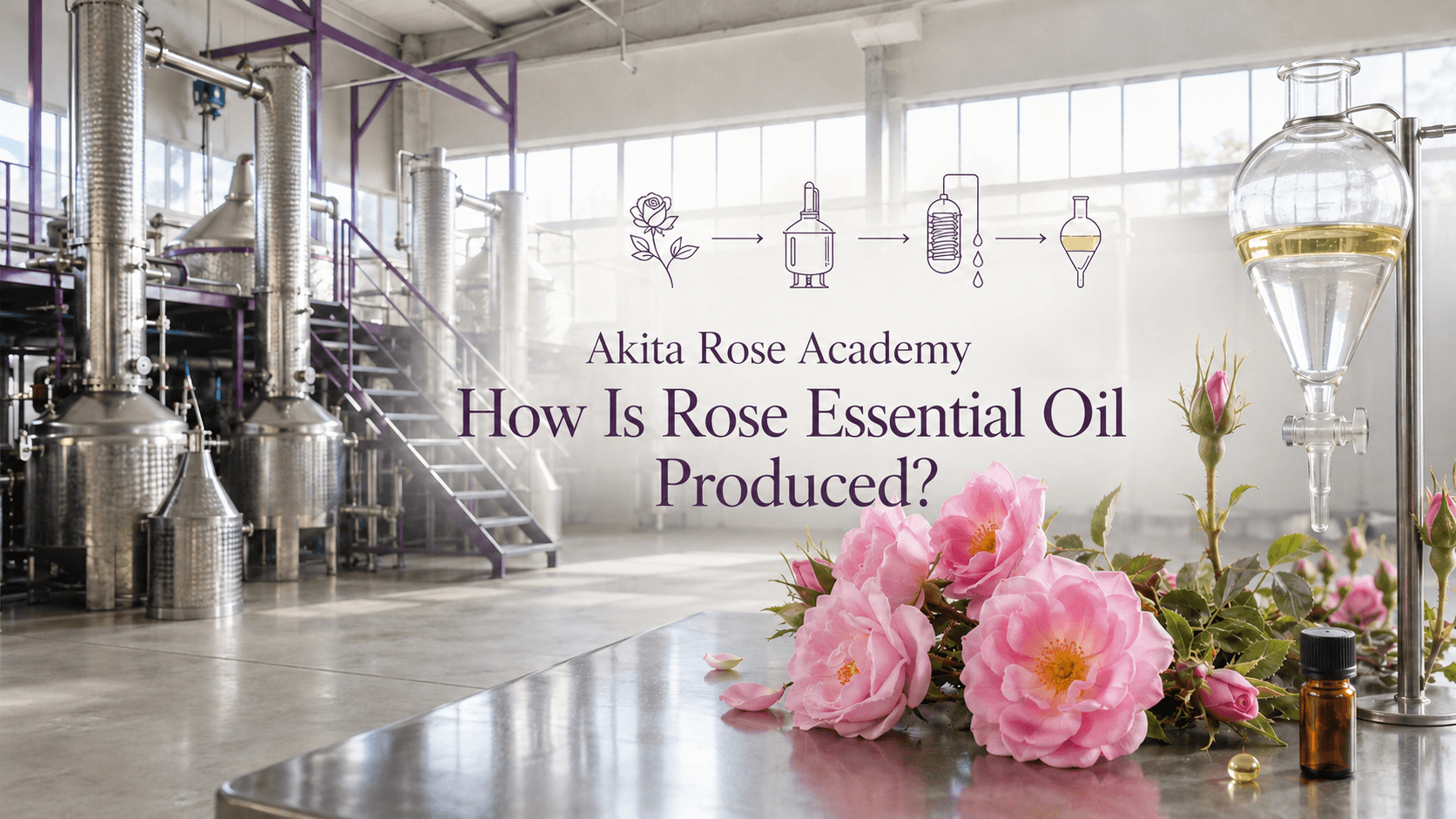
Rose essential oil is a highly valuable aromatic oil obtained through the careful processing of thousands of kilograms of fresh Rosa damascena flowers. Production begins with harvesting the roses in the early morning and continues with water or steam distillation. During distillation, the rose’s volatile compounds are carried by steam, cooled back into liquid form and collected in a Florentine flask.
However, the process does not end there. After the first oil is obtained during the initial distillation, the aromatic water that remains beneath the separated oil is distilled again because it still contains volatile compounds. This second distillation produces the second oil. The two oil fractions may then be blended in specified proportions, filtered, rested and analysed to prepare commercial rose essential oil.
In this article, we will examine each stage of rose oil production, from the traditional still to the modern factory system.
Rose Academy Note
The primary purpose of the method described in this article is to obtain rose essential oil as a separate product. A non-de-oiled rose distillate is produced with a different objective and requires a different distillation approach.
Why Is Rosa damascena Used to Produce Rose Oil?
There are many beautifully scented rose species around the world. However, one of the most important species used in essential oil production is Rosa damascena Mill., commonly known as the Damask rose, oil-bearing rose or Isparta rose.
The main reasons Rosa damascena is preferred include:
Its flowers contain numerous volatile and semi-volatile aromatic compounds.
It contains components associated with the characteristic scent of roses, including citronellol, geraniol and nerol.
It has a distinctive fragrance profile recognised by the perfumery and cosmetics industries.
It is well adapted to the climatic and soil conditions of Isparta and Türkiye’s Lakes Region.
It has been cultivated and processed in this region for more than a century.
The fragrance of rose oil does not come from a single substance. Its complex aroma is created through the combined effect of many compounds present in different proportions.
Why Are Roses Harvested Early in the Morning?
Rose oil production begins not in the factory, but in the rose garden. Harvest time, storage duration and the way the flowers are transported to the factory can influence both the oil yield and its chemical composition.
Rosa damascena flowers are generally harvested early in the morning while the air is still cool. As temperatures rise, the loss of certain volatile compounds from the flowers may increase. The freshly picked roses should be transported without being tightly compressed, with enough ventilation to prevent overheating, and distilled as soon as possible.
When harvested roses are left waiting too long or are piled under unsuitable conditions:
The flowers may begin to heat up.
Fermentation may occur.
Their fragrance may change.
Some volatile compounds may be lost.
The chemical profile of the rose oil may be affected.
For more information about the importance of harvest time, links may be added to the Rose Academy articles “Why Are Rose Flowers Harvested Before Sunrise?” and “How Are Roses Harvested?”
Did You Know?
When rose flowers are stored for too long before distillation, not only the oil yield but also the balance of compounds in the resulting oil may change.
What Is Distillation?
Distillation is the process of vaporising the volatile components of a mixture and then cooling the resulting vapour to return it to liquid form.
The basic process used in rose oil production can be summarised as follows:
Rose flowers are heated with water or brought into contact with steam.
Heat helps release the volatile compounds contained in the flowers.
Water vapour carries the volatile aromatic compounds with it.
The vapour mixture enters the condenser.
Cooling converts the vapour back into liquid.
The resulting distillate is transferred to a Florentine flask.
The separable essential oil phase is collected.
Steam plays an important role in this process. It helps transport volatile compounds without exposing them directly to excessively high temperatures.
How Is Rose Essential Oil Produced Step by Step?
1. Receiving and Inspecting the Flowers
When the roses arrive at the factory, they are weighed and inspected for general quality. Ideally, the flowers should not have been stored for too long, mixed with foreign materials or allowed to overheat.
They should be processed on the same day whenever possible. If immediate production is not possible, the storage conditions must be carefully controlled.
An internal link to the article “How Should Rose Flowers Be Stored?” may be added here.
2. Loading the Distillation Vessel
In traditional water distillation, rose flowers are placed in the distillation vessel with a measured quantity of water. The flower-to-water ratio may vary depending on the vessel’s capacity, the technology used by the facility and the producer’s chosen method.
The vessel should not be overfilled. Water and steam must be able to move evenly through the flowers.
3. Heating the Vessel
In traditional stills, heat may be applied directly beneath the vessel. In factory systems, steam produced in a separate boiler may pass through pipes located inside or beneath the distillation vessel, heating the mixture in a more controlled manner.
As the water heats, steam is produced. The steam comes into contact with the rose petals and helps carry their volatile compounds through the system.
4. Carrying the Volatile Compounds with Steam
The volatile compounds released from the rose flowers rise with the steam toward the upper section of the vessel. They then travel through a connecting pipe to the condenser.
At this stage, several variables can affect oil yield and composition:
Heating rate
Consistency of the steam flow
Distillation time
Pressure inside the vessel
Flower-to-water ratio
5. Cooling the Vapour
The hot vapour carrying the rose’s volatile compounds enters a cooling unit known as a condenser. Cold water circulating through the condenser lowers the temperature of the vapour.
As the vapour cools, it returns to liquid form. This liquid is called the distillate. It consists mainly of water but also contains dissolved aromatic compounds and compounds capable of separating into an oil phase.
6. Transferring the Distillate to the Florentine Flask
The distillate leaving the condenser is transferred to a separation device known as a Florentine flask or Florentine receiver. Its purpose is to assist in separating the water and essential oil phases, which are not completely miscible.
However, the statement that “rose oil always collects directly on the surface of the water” is an oversimplification. Phase behaviour may be influenced by:
The density of the essential oil
The temperature of the distillate
The water solubility of individual oil components
The size of the oil droplets
Emulsion formation
The design of the Florentine flask
The flow rate through the system
Some components of rose oil separate and form a distinct oil phase, while others—particularly those with greater affinity for water—may remain in the distillation water. For this reason, the remaining aromatic water is neither completely odourless nor entirely free of volatile compounds.
What Is a Florentine Flask?
A Florentine flask is a specialised vessel used to separate the recoverable essential oil phase from the water phase of a distillate.
The system generally performs the following functions:
It allows the distillate to remain in a relatively calm environment.
It helps small oil droplets combine into larger droplets.
It facilitates the separation of oil and water according to their density difference.
It enables the separated oil to be collected in a controlled manner.
It allows the remaining aromatic water to be transferred to another tank through a lower or separate outlet.
The design of a Florentine flask is not necessarily the same for every essential oil. Essential oils obtained from different plants may have different densities and may behave differently in water.
In Brief
A Florentine flask does not create rose oil. It simply facilitates the collection of the essential oil phase that has already been carried through the distillation system and can separate from the water.
What Is First Rose Oil?
The essential oil collected in the Florentine flask following the initial distillation of rose flowers with water is generally known in production terminology as:
First oil
First-distillation oil
Flower oil
First oil comes directly from the initial distillation vessel containing the rose flowers. Some studies have shown that this fraction may contain higher proportions of long-chain hydrocarbons than the second oil.
Its colour, appearance and chemical composition may vary according to the flowers used, harvest time, pre-distillation storage conditions and distillation parameters.
What Is Second Rose Oil?
After the first oil has been separated in the Florentine flask, an aromatic water phase remains. In Turkish rose oil production, this water is traditionally known as the water beneath the oil. It may still contain volatile compounds dissolved in the water or dispersed as extremely small droplets.
When this aromatic water is transferred to a separate vessel and distilled again, a second essential oil fraction can be recovered. This fraction is generally known as:
Second oil
Second-distillation oil
Water oil
The redistillation vessel may be referred to as a cohobation still or Veronica still in some production facilities.
The main purpose of cohobation is to recover part of the volatile compounds that remain in the water after the initial separation. Second oil is not simply a repetition of first oil. Certain aromatic compounds with a greater tendency to remain in water may occur in different proportions in the second-distillation fraction.
Rose Academy Note
The term “second oil” does not mean a low-value or inferior oil. First and second oils have different chemical profiles, and both may contribute to the balanced composition of commercial rose oil.
Differences Between First and Second Rose Oil
| Characteristic | First oil | Second oil |
|---|---|---|
| Production stage | Initial distillation of rose flowers | Redistillation of the aromatic water remaining after the first oil is separated |
| Alternative name | Flower oil | Water oil |
| Source | Initial vessel containing roses and water | Aromatic water remaining after the first distillation |
| Production vessel | Flower-distillation vessel | Cohobation or Veronica still |
| General composition tendency | May contain higher proportions of certain long-chain hydrocarbons | May show a different profile of water-associated monoterpene alcohols |
| Use | May be blended with second oil in a specified proportion | May be blended with first oil in a specified proportion |
These differences should not be treated as a fixed formula. Flower quality, equipment and production conditions can all affect the final results.
Why Are First and Second Rose Oils Blended?
First- and second-distillation oils may have different chemical profiles. Producers may therefore combine the two fractions in specified proportions to achieve the desired fragrance and quality characteristics.
This process is known as blending.
In the factory practice examined by Baydar and Göktürk Baydar, first and second oils were reported to be blended at a general ratio of approximately 25% first oil to 75% second oil. However, this should not be regarded as a fixed formula applicable to every producer or every production batch.
The appropriate blending ratio may depend on:
GC–MS results for both oil fractions
Organoleptic or sensory evaluation of the aroma
Long-chain hydrocarbon content
The balance of monoterpene alcohols
The intended quality standard
Customer or industry specifications
How Is Rose Oil Produced in a Traditional Still?
A still is a traditional apparatus used for distillation. It may be made of copper or another material suitable for the distillation process.
A basic traditional still generally consists of:
A vessel containing roses and water
A lid or still head
A connecting pipe that carries the vapour
A cooling section or condenser
A vessel that collects the distillate
A device that helps separate the oil and water phases
During traditional production, the vessel is heated from below. The resulting steam carries the volatile compounds from the roses, travels through the pipe to the cooling section and condenses back into liquid.
Traditional still production is historically important and remains suitable for small-scale processing. However, maintaining balanced heat, cooling and flow throughout the process requires considerable experience.
How Does a Factory Distillation System Work?
Factory production applies the basic principles of traditional distillation through larger and more controllable systems.
A factory system may generally include:
Large-capacity distillation vessels
A steam boiler
Steam pipes and control valves
Pressure and temperature gauges
A condenser
A distillate collection tank
A Florentine flask
A cohobation still
Oil collection and resting vessels
A laboratory and quality-control area
In the Başmakçı Rose Cooperative system examined by Baydar and Göktürk Baydar, 500 kilograms of rose flowers and 1.5 tonnes of water were placed in copper vessels with a capacity of three tonnes. Distillation was reported to take approximately 1.5 hours at a steam pressure of 1.5 bar.
These are example values from a specific facility and study. Not every factory uses the same quantities or production parameters. Read the study.
Traditional Still and Factory System Compared
| Characteristic | Traditional still | Factory system |
|---|---|---|
| Production scale | Generally small | Medium or large |
| Heating method | Usually direct heating from below | A controlled steam system may be used |
| Capacity | Limited | Higher |
| Temperature and pressure control | More dependent on the distiller’s experience | Can be monitored with measuring and control devices |
| Batch standardisation | May be more variable | Can be managed more consistently |
| Cooling system | Simple cooling arrangements may be used | Industrial condensers are generally used |
| Second-oil production | Depends on the equipment | May be performed in a separate cohobation still |
| Basic principle | Water or steam distillation | Water or steam distillation |
A factory system does not change the basic principle of traditional distillation. It increases the capacity of the process and makes production variables easier to monitor and control.
Why Are Distillation Time, Heat and Pressure Important?
The belief that “more heat or a longer distillation always produces more and better oil” is incorrect.
If the Temperature Rises Too Quickly
Movement within the vessel may become excessive.
Foaming or irregular flow may occur.
Plant particles may be carried into other parts of the system.
Distillate clarity and phase separation may be affected.
If Distillation Is Too Short
Some volatile compounds may not be recovered sufficiently.
Oil yield may remain low.
The compositional balance of the resulting fraction may change.
If Distillation Continues for Too Long
Energy and water consumption may increase unnecessarily.
The proportion of heavier, later-distilling compounds may change.
The fragrance and chemical profile of the oil may be affected.
Distillation time, heat, steam flow and pressure must therefore be managed together. Appropriate values depend on vessel capacity, the flower-to-water ratio and the technology used.
How Many Roses Are Needed to Produce Rose Oil?
The essential oil content of Rosa damascena flowers is extremely low. Production figures reported by Baydar and Göktürk Baydar indicate that approximately 3 to 3.5 tonnes of fresh rose flowers may be required to produce one kilogram of rose oil.
However, this ratio is not fixed. Yield may vary according to:
Growing region
Seasonal climatic conditions
Altitude of the rose garden
Harvest date
Time of day when the flowers are picked
Storage time before distillation
Fermentation status of the flowers
Flower-to-water ratio in the vessel
Distillation time
Steam and cooling conditions
Separation efficiency of the Florentine flask
Use of cohobation
Did You Know?
Producing one kilogram of rose oil may require the processing of millions of rose petals. One of the main reasons rose oil is so valuable is the extremely low concentration of essential oil in the flowers.
How Is the Produced Rose Oil Prepared and Controlled?
1. Blending
First and second oils may be combined in proportions determined by analytical results and the intended characteristics of the final product.
2. Filtration
Very small water droplets or unwanted physical particles that may be present in the oil are removed using suitable filtration methods.
3. Resting
Freshly produced oil may be left to rest in suitable containers for a specified period so that its composition and aroma can stabilise. Although historical sources mention resting rose oil in sunlight, modern production must consider the effects of light, oxygen and temperature on oxidation.
4. Storage
Rose oil is generally stored:
Protected from light
At a controlled temperature
In tightly sealed containers
In clean containers made from materials compatible with the oil
Reducing unnecessary headspace inside the container may help limit the oil’s contact with oxygen.
5. Quality Control
Rose oil quality is not evaluated by scent alone. Its chemical and physical characteristics may also be examined.
The principal quality-control procedures include:
Chemical composition analysis using GC–MS
Relative density
Refractive index
Optical rotation
Freezing or crystallisation behaviour
Colour and appearance
Organoleptic fragrance evaluation
Residue and purity testing
Compliance with relevant standards
The characteristic composition of rose oil includes citronellol, geraniol, nerol, linalool, long-chain hydrocarbons and other compounds that may have a significant influence on aroma even when present only in very small quantities.
Concepts Commonly Confused in Rose Oil Production
Distillation and Solvent Extraction Are Not the Same Process
Rose essential oil is obtained through water or steam distillation. Extracting rose flowers with a suitable solvent is a different process used to produce rose concrete, which may then be processed with ethanol to obtain rose absolute.
These products differ in their production methods, chemical compositions and fragrance characteristics.
Rose Oil and Rose Water Are Not the Same Product
Rose oil is the essential oil phase formed during distillation that can be collected separately. Rose water is the water phase of the distillation and may contain aromatic compounds dissolved in the water.
Second Oil Does Not Mean Second-Quality Oil
The term “second oil” refers to the production stage, not to inferior quality. It is obtained through the redistillation of the aromatic water remaining after the initial oil separation.
Rose Oil Cannot Be Explained Only as a Visible Layer on the Surface
Part of the oil may form a separate phase, while some components may remain dissolved in the water or dispersed as extremely small droplets. This is one of the reasons a second distillation may be performed.
Not Every Factory Uses the Same Formula
Vessel capacity, flower-to-water ratio, production time, pressure, cooling conditions and cohobation procedures may vary among facilities. Values used at one factory should not be generalised to the entire rose oil industry.
Which Factors Determine Rose Oil Quality?
High-quality rose oil is not created only inside the distillation vessel. Quality is the result of a chain of decisions extending from the rose garden to final storage.
The principal factors include:
The characteristics of the Rosa damascena flowers
The climate and soil of the growing region
Harvest date and time
The way the flowers are transported
The period between harvest and distillation
Flower-to-water ratio in the vessel
Heat, distillation time and steam pressure
Cooling temperature and rate
Separation efficiency of the Florentine flask
Cohobation procedures
The blending ratio of first and second oils
Filtration, resting and storage conditions
Rose oil is therefore not a simple product obtained merely by “boiling roses.” Its production requires agricultural knowledge, distillation technology, practical expertise and laboratory control.
Chapter Summary
Rosa damascena flowers are among the most widely used roses in traditional rose oil production.
The flowers are harvested early in the morning and processed as soon as possible.
Traditional production is based on water or steam distillation.
Vapour carrying the volatile compounds is cooled in the condenser and converted into distillate.
The Florentine flask helps separate and collect the recoverable oil phase from the water.
The oil obtained from the first distillation is known as first oil or flower oil.
Redistilling the aromatic water remaining after the first separation produces second oil or water oil.
First and second oils may be blended in specified proportions according to analytical results.
Rose oil, rose concrete and rose absolute are distinct products obtained through different production methods.
Production parameters are not identical at every facility.
Frequently Asked Questions
1. Which Rose Is Used to Make Rose Oil?
Although essential oil can be produced from several fragrant rose species, Rosa damascena Mill., or the Isparta rose, is the species most widely used in Türkiye’s traditional rose oil industry.
2. Are Roses Boiled to Produce Rose Oil?
In water distillation, roses are heated together with water. However, the process should not be understood as simple boiling. The transport of vapour, condensation and separation of the oil phase are all essential parts of production.
3. What Does a Florentine Flask Do?
A Florentine flask helps separate and collect the recoverable essential oil phase from the water phase of the distillate leaving the condenser.
4. What Is First Rose Oil?
First rose oil is the oil recovered in the Florentine flask from the distillate produced in the initial vessel containing the rose flowers. It is also known as flower oil.
5. How Is Second Rose Oil Produced?
After the first oil is separated, the remaining aromatic water is redistilled in a cohobation still. The oil recovered during this stage is known as second oil or water oil.
6. Is Second Rose Oil Lower in Quality?
No. The word “second” identifies the stage of production, not a lower quality grade. Its composition may differ from that of first oil, and it can play an important role in the final commercial rose oil blend.
7. Must First and Second Oils Always Be Blended?
In traditional factory production, these two fractions may be blended in specified proportions. However, the blending ratio is not necessarily the same for every producer or production batch.
8. How Many Kilograms of Roses Are Needed to Produce One Kilogram of Rose Oil?
The literature reports that approximately 3 to 3.5 tonnes of fresh rose flowers may be required to produce one kilogram of rose oil. The actual amount can vary according to flower quality and production conditions.
9. Are Rose Oil and Rose Absolute the Same Product?
No. Rose oil is produced by distillation, whereas rose absolute is produced through solvent extraction followed by additional purification stages.
10. Can the Water Remaining After Rose Oil Production Be Used?
Yes. The water phase of the distillation may traditionally be used as rose water. However, its composition can vary depending on whether the first oil has been separated and whether processes such as cohobation have been applied.
The Same Rose, Different Production Objectives
The primary objective of traditional rose oil production is to obtain the volatile rose oil as a separate product. The oil phase is therefore separated at the end of distillation, and some of the volatile compounds remaining in the aromatic water may be recovered through a second distillation.
The production objective of a non-de-oiled rose distillate is different. Distillation time, the use of a single-stage process and other production parameters are planned to retain the distillation-carried rose components together within one integrated product rather than separating them into different fractions.
Neither method is simply a “good” or “bad” version of the other. They represent two distinct distillation approaches applied to the same Rosa damascena flower with different final products in mind.
To understand the difference between traditional production in which rose oil is separated and Akita’s non-de-oiled rose distillate method, read the Rose Academy article “The Differences Between Traditional Rose Water and Non-De-Oiled Rose Distillate.”
The fragrance of rose oil depends not only on the compounds it contains but also on the three-dimensional structures of those molecules. Some compounds with the same molecular formula may be perceived differently by our sense of smell because of their different spatial arrangements. To learn more, read our Akita Rose Academy article “The Invisible Secret of Rose Oil: Chiral Molecular Structure.”
References — APA 7
Baydar, H. (2009). Tıbbi ve aromatik bitkiler bilimi ve teknolojisi [Science and technology of medicinal and aromatic plants] (Expanded 3rd ed., pp. 305–332). Süleyman Demirel University.
Baydar, H., Erbaş, S., Kineci, S., & Kazaz, S. (2007). Yağ gülünde (Rosa damascena Mill.) damıtma suyuna katılan Tween-20’nin taze ve fermente olmuş çiçeklerin gül yağı verimi ve kalitesi üzerine etkisi [The effects of adding Tween 20 to distillation water on rose oil yield and quality in fresh and fermented Rosa damascena flowers]. Süleyman Demirel Üniversitesi Ziraat Fakültesi Dergisi, 2(1), 15–20.
Baydar, H., & Göktürk Baydar, N. (2010). Organik ve konvensiyonel gül (Rosa damascena Mill.) yağlarının koku kalitesinin karşılaştırılması [Comparison of the fragrance quality of organic and conventionally produced Rosa damascena oils]. Süleyman Demirel Üniversitesi Ziraat Fakültesi Dergisi, 5(2), 9–14. Article link
Baydar, H., Schulz, H., Krüger, H., Erbaş, S., & Kineci, S. (2008). Influences of fermentation time, hydrodistillation time and fractions on essential oil composition of Damask rose (Rosa damascena Mill.). Journal of Essential Oil Bearing Plants, 11(3), 224–232.
Bayrak, A., & Akgül, A. (1994). Volatile oil composition of Turkish rose (Rosa damascena). Journal of the Science of Food and Agriculture, 64(4), 441–448.
Göktürk Baydar, N., & Baydar, H. (2005). The effects of harvest date, fermentation duration and Tween 20 treatment on essential oil content and composition of industrial oil rose (Rosa damascena Mill.). Industrial Crops and Products, 21(2), 251–255.
Republic of Türkiye Ministry of Agriculture and Forestry, Fruit Research Institute. (2022). Oil-bearing rose cultivation: Rosa damascena. Document link